
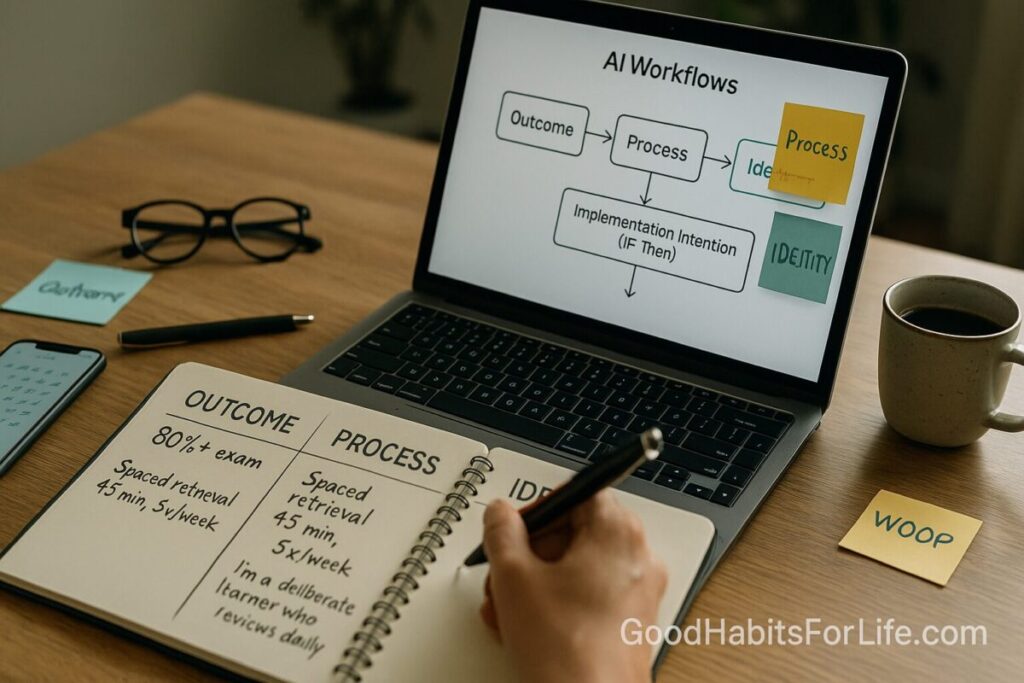
Outcome Process Identity: Goals That Stick: AI workflows (2025)
Outcome Process Identity: Goals That Stick — AI Workflows (2025)
Table of Contents
🧭 What & Why
Definitions (fast):
-
Outcome goal — the result you want (e.g., “score 80%+ on the exam”).
-
Process goal — the repeatable actions that lead there (e.g., “45 minutes of spaced retrieval, 5 days/week”).
-
Identity goal — the story you act into (e.g., “I’m a deliberate learner who reviews daily”).
Why layer them? In classic goal-setting research, specific, challenging goals focus effort and improve performance; aligning them with daily actions and a self-view strengthens persistence. Identity-congruent behaviors feel more “natural,” reducing the willpower tax. Stanford Medicine+1
Two more pillars:
-
Implementation intentions (“If situation Y, then I’ll do X”) increase follow-through across domains. Pairing them with mental contrasting (WOOP) is especially effective. prospectivepsych.org+1
-
Habits form gradually (median ~66 days; range varies) as actions become automatic in a stable context. Wiley Online Library
Finally, monitoring progress—especially when recorded or shared—reliably boosts goal attainment. PubMed
🚀 Quick Start (Do This Today)
-
Pick one learning outcome for 30 days.
Example: “Master 40 Anki cards/day and complete two past papers by Day 30.” -
Convert to process + identity.
-
Process: “45-minute timebox after breakfast, 5x/week: 30 min Anki + 15 min error log.”
-
Identity: “I am the kind of person who studies before I scroll.”
-
-
Write two WOOPs + three If-Then plans.
-
WOOP: Wish, Outcome, Obstacle, Plan.
-
If-Then: “If it’s 07:30 at my desk, then I open Anki and start review.” socmot.uni-konstanz.de+1
-
-
Time-box it in your calendar (recurring event) and set a 5-minute micro-review after each session to log wins/obstacles.
-
Track publicly & in writing.
Share a weekly score or streak with a study buddy or group chat. It works. PubMed -
Automate prompts.
Use your AI assistant to DM you a 07:25 pre-commitment message with your If-Then cue and the first task.
🗺️ 30-60-90 Roadmap
Days 0–30 (Install the system)
-
Target: Nail the process and identity layers; outcome is secondary.
-
Weekly cadence:
-
Mon–Fri: 45-min timebox (Anki + error log)
-
Sat: 30-min past-paper review
-
Sun: 15-min weekly review (What worked? Obstacles → new If-Then)
-
-
Checkpoints:
-
Day 7: ≥4 sessions completed; identity statement posted where you’ll see it.
-
Day 14: Add one WOOP for the top obstacle; adjust timebox if failing.
-
Day 30: 80%+ of planned sessions done; baseline test to gauge outcome progress.
-
Days 31–60 (Strengthen & space)
-
Add spacing to extend retention windows (e.g., 1-3-7-14-30 days).
-
Introduce interleaving (mix topics) and one temptation bundle (favorite podcast only during practice). laplab.ucsd.edu+1
-
Checkpoint Day 45: One past paper under test conditions.
Days 61–90 (Scale outcomes)
-
Raise challenge (harder items; retrieval first, notes second).
-
Public progress post each week.
-
Checkpoint Day 90: Full mock exam; adjust next quarter’s outcome target.
🧠 Techniques & Frameworks that Work
1) SMART → CLEAR + Identity
Keep goals Specific, time-bound, but write a one-line identity anchor you can read before each session (“I’m a consistent, curious learner”). Identity-congruent actions stick. PMC
2) Implementation Intentions & WOOP
Write 3–5 If-Then lines for your single biggest obstacle (fatigue, phone, confusion). Combine with WOOP for a double lift. prospectivepsych.org+1
3) Spacing & Retrieval > Rereading
Use spaced retrieval schedules (Anki/flashcards/past questions). Spacing is one of the most robust effects in learning science. laplab.ucsd.edu+1
4) Progress Monitoring
Score sessions (0–2), graph streaks, and share summaries weekly; recorded or public monitoring has larger effects. PubMed
5) Fogg Behavior Model & Tiny Starts
Make the behavior absurdly easy at the start (e.g., “open Anki & do 1 card”), then expand. Motivation × Ability × Prompt must coincide. ACM Digital Library
6) Temptation Bundling
Pair “want” (music, podcast) with “should” (study drill). Field experiments show improved exercise adherence; apply the same principle to study. PMC
7) Time-boxing
Put study blocks on the calendar, not just a to-do list. Protect the block with a pre-commitment message and a physical phone-box.
8) Planning Fallacy Countermeasures
Under-promising, buffer time, and premortems help when you chronically underestimate task duration. Massachusetts Institute of Technology
👥 Audience Variations
-
Students: Favor shorter, more frequent time-boxes (30–45 min), aggressive spacing, and weekly past-paper drills.
-
Professionals: Use 60–75 min deep-work blocks, calendar holds, and outcome metrics tied to deliverables.
-
Parents: Anchor sessions to fixed household cues (post-drop-off, nap time).
-
Seniors: Smaller starts + consistent cues; prioritize morning cognitive windows.
-
Teens: Gamify streaks; use WOOP on phone distractions and make identity social (“We’re the 20-minute-a-day crew”).
⚠️ Mistakes & Myths to Avoid
-
Only outcome, no system. Results without daily actions are wishes.
-
Too many goals. Run one major learning goal per 30–90 days.
-
No written tracking. “I’ll remember” ≠ progress; log it. PubMed
-
All-or-nothing identity. Missed a day? Resume next time-box; protect the story (“I’m consistent”) by acting now, not perfect.
-
Rereading as primary method. Retrieval + spacing beats rereading for durable memory. laplab.ucsd.edu
💬 Real-Life Examples & Copy-Paste Scripts
A) Outcome → Process → Identity (study example)
-
Outcome (30 days): “Score 80%+ on the next mock.”
-
Process: “Mon–Fri 45-min: 30 min Anki retrieval + 15 min error log.”
-
Identity: “I’m the kind of person who studies before I scroll.”
B) WOOP (phone distraction)
-
Wish: 45-min focused block.
-
Outcome: Finish 2 sets of retrieval.
-
Obstacle: I reach for my phone at minute 10.
-
Plan: If I notice my hand move to the phone, then I stand, breathe twice, and resume card #1.
C) If-Then Pack (copy-paste)
-
If it’s 07:25, then I put the phone in the kitchen and fill my water.
-
If I finish 30 minutes, then I log the score and schedule tomorrow’s block.
-
If I miss a block, then I do a 10-minute “repair session” before 21:00.
D) AI Prompt (clarify & calendarize)
“Convert this outcome into process + identity statements. Write 5 If-Then plans and a WOOP. Create a 5-day time-boxed schedule (45-min blocks), and a 7-day spaced review plan. Return a checklist and a one-line identity affirmation.”
E) AI Prompt (weekly review)
“Summarize my study log. Score adherence (0–2), list top 3 obstacles, propose 3 new If-Then plans, and adjust my spacing intervals for next week.”
F) AI Prompt (premortem)
“Imagine my 30-day goal failed. List 10 likely reasons, the earliest warning signs, and a prevention step for each. Consolidate into a 3-rule ‘anti-fragile’ plan.”
🧰 Tools, Apps & Resources
-
Anki / RemNote: Spaced retrieval; powerful, customizable. Con: setup learning curve. laplab.ucsd.edu
-
Calendar (Google/Outlook): Time-boxing; add alerts + buffer.
-
Notion/Obsidian: Templates for WOOP, weekly reviews, and error logs.
-
Beeminder / CommitClub: Commitment devices; public tracking boosts adherence. PubMed
-
Focusmate / Forest: Externalized focus cues; pair with If-Then plans.
-
Shortcuts/Zapier: Auto-send pre-commitment messages before blocks.
✅ Key Takeaways
-
Stack outcome + process + identity for durability.
-
Use WOOP + If-Then to pre-decide actions at friction points. socmot.uni-konstanz.de+1
-
Time-box + space practice; track in writing and (lightly) in public. laplab.ucsd.edu+1
-
Start tiny (Fogg), bundle temptations, and run a simple 30-60-90. ACM Digital Library+1
❓ FAQs
1) What’s the difference between outcome, process, and identity goals?
Outcome = result, process = repeatable actions, identity = who you’re becoming. Align all three to increase persistence and reduce reliance on willpower. Stanford Medicine+1
2) Do implementation intentions really help?
Yes. “If-Then” plans show robust effects in lab and field settings; a meta-analysis confirmed meaningful gains in goal attainment. ScienceDirect
3) How long to form a habit?
Varies widely; one prospective study found a median of ~66 days with a broad range depending on the behavior and context. Wiley Online Library
4) Is sharing my goals useful or risky?
Sharing progress (not just intentions) and recording it tends to improve outcomes. Keep shares small and accountable. PubMed
5) What’s the best way to study: rereading or retrieval?
Retrieval practice with spaced review outperforms rereading for durable memory. laplab.ucsd.edu
6) I always underestimate how long tasks take. Help?
Use premortems, buffer time, and past-based estimates to counter the planning fallacy. Massachusetts Institute of Technology
7) Why start tiny?
Small, easy behaviors raise ability so the action happens when prompted; build intensity later. ACM Digital Library
8) Does temptation bundling trivialize learning?
No—used well, it reduces avoidance and increases consistency (e.g., pairing a favorite podcast with drills). PMC
📚 References
-
Locke, E. A., & Latham, G. P. (2002). Building a practically useful theory of goal setting and task performance. American Psychologist. (PDF). https://med.stanford.edu/… Stanford Medicine
-
Gollwitzer, P. M. (1999). Implementation intentions: Strong effects of simple plans. American Psychologist. (PDF). https://www.prospectivepsych.org/… prospectivepsych.org
-
Gollwitzer, P. M., & Sheeran, P. (2006). Implementation intentions and goal achievement: A meta-analysis of effects and processes. Advances in Experimental Social Psychology. https://www.sciencedirect.com/… ScienceDirect
-
Lally, P. et al. (2010). How are habits formed? Modelling habit formation in the real world. European Journal of Social Psychology. https://onlinelibrary.wiley.com/… Wiley Online Library
-
Harkin, B. et al. (2016). Does monitoring goal progress promote goal attainment? Psychological Bulletin. https://pubmed.ncbi.nlm.nih.gov/26479070/ PubMed
-
Oettingen, G. et al. (2015). Mental contrasting with implementation intentions. European Journal of Social Psychology. (PDF). https://www.socmot.uni-konstanz.de/… socmot.uni-konstanz.de
-
Ryan, R. M., & Deci, E. L. (2000). Self-Determination Theory and the facilitation of intrinsic motivation, social development, and well-being. (PDF). https://selfdeterminationtheory.org/… selfdeterminationtheory.org
-
Cepeda, N. J. et al. (2008). Spacing effects in learning. Psychological Science. (PDF). https://laplab.ucsd.edu/… laplab.ucsd.edu
-
Fogg, B. J. (2009). A Behavior Model for Persuasive Design. ACM. https://dl.acm.org/doi/10.1145/1541948.1541999 ACM Digital Library
-
Milkman, K. L., Minson, J. A., & Volpp, K. G. M. (2014). Holding the Hunger Games Hostage at the Gym: An Evaluation of Temptation Bundling. Management Science. (PMC). https://pmc.ncbi.nlm.nih.gov/articles/PMC4381662/ PMC
-
Buehler, R., Griffin, D., & Ross, M. (1994). Exploring the “planning fallacy”. Journal of Personality and Social Psychology. (PDF). https://web.mit.edu/… Massachusetts Institute of Technology
-
Oyserman, D. (2010). Identity-based motivation: Implications for intervention. (PMC). https://pmc.ncbi.nlm.nih.gov/articles/PMC3079278/ PMC