
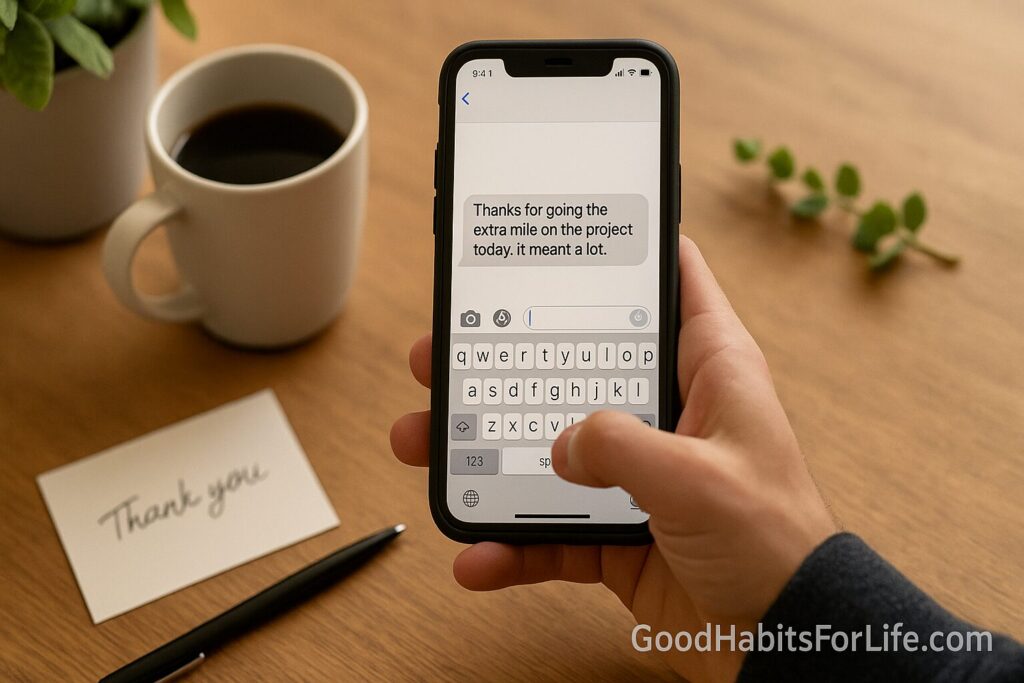
The One ThankYou Rule: Daily Outreach that Sticks
Daily Thank You Rule: Outreach That Sticks
Table of Contents
🧭 What Is the Daily Thank You Rule?
The Daily Thank You Rule is a micro-habit: once a day, thank one real person for one specific thing—a favor, a kindness, their effort, or their influence on you. Format is flexible (text, voice note, email, card, in person). Time cap: 10 minutes.
Why a single outreach? Tiny, consistent actions beat occasional grand gestures. One authentic message compounds into stronger ties and a happier baseline.
✅ Why It Works (Science-backed benefits)
-
Happier mood & life satisfaction. Gratitude practices reliably improve well-being and reduce depressive symptoms compared with controls. cite: Emmons & McCullough 2003; Seligman et al. 2005; Wood et al. 2008.
-
Better relationships. Expressing thanks increases closeness and prosocial behavior; in couples, everyday gratitude acts like a booster shot. cite: Algoe, Haidt & Gable 2008; Algoe, Gable & Maisel 2010; Grant & Gino 2010.
-
Broaden-and-build. Positive emotions expand attention and resourcefulness, helping you build durable social resources over time. cite: Fredrickson 2004.
-
Health via connection. Strong social ties predict longer life and lower mortality risk. Your daily thank-yous strengthen those ties. cite: Holt-Lunstad, Smith & Layton 2010.
🛠️ Quick Start in 10 Minutes
-
Pick today’s person (2 min). Scroll messages or contacts; choose someone who helped you recently, however small.
-
Name the specific thing (2 min). “Because you ___, I was able to ___.” Specificity beats generic praise.
-
Send the message (3–4 min). Text or email is fine; voice notes/cards are great when time allows.
-
Log it (1 min). Note the name, date, and reason.
-
Cue tomorrow (30 sec). Add a 9:00 pm reminder or stack it after an existing routine (e.g., post-dinner tea).
Channel quick guide
| Channel | Time | Best for | Watch-outs |
|---|---|---|---|
| Text/WhatsApp | 1–3 min | Friends, peers | Keep it personal, not spammy |
| 3–5 min | Mentors, colleagues | Clear subject; short body | |
| Voice note | 2–4 min | Close ties | Speak slowly; keep under 60–90 sec |
| Handwritten card | 10–15 min | Big thanks | Occasional; address correctly |
| In-person | varies | Family/roommates | Make eye contact, be specific |
🗓️ 7-Day Starter Plan (with prompts)
Daily rule: 1 person, 1 specific thank-you.
-
Day 1 – Low-hanging fruit: Someone who helped this week (tip, introduction, reminder).
-
Day 2 – Behind-the-scenes worker: Guard, cleaner, barista, driver—thank for consistency.
-
Day 3 – Family member: Appreciate a recent effort (cooking, school run).
-
Day 4 – Colleague/classmate: Acknowledge problem-solving or backup.
-
Day 5 – Old friend/teacher: “I still use the lesson you taught me about ___.”
-
Day 6 – Service provider: Doctor, tutor, vendor—recognize reliability.
-
Day 7 – Self-compassion twist: Write a gratitude note to yourself; record what you did right this week.
Prompt formula: “Because you [specific action], I [benefit/outcome]. I noticed [detail]. Thank you.”
🧱 30-60-90 Roadmap (make it automatic)
Days 1–30 (Installation).
-
Same time daily; stack to a stable cue (after dinner / commute).
-
Build a Thank-You List of 30 names to remove friction.
-
Track streaks and quick reflections (“mood before/after”).
Days 31–60 (Optimization).
-
Vary channels (try a card or voice note weekly).
-
Add a Friday review: who impacted you that week?
-
Start a gratitude bank: save screenshots or replies.
Days 61–90 (Expansion).
-
Increase thoughtfulness, not volume: one high-quality message per day.
-
Add a monthly deep-gratitude letter (300–500 words).
-
Consider a give-forward: ask recipients how you can support them.
🧠 Techniques & Frameworks
-
Habit stacking: “After I make evening tea, I send my thank-you.” (Stable cue → routine → small reward.) cite: Lally et al. 2009.
-
Implementation intentions: If it’s 21:00, then I open Contacts → pick top name → send message. Pre-decide the when/where/how. cite: Gollwitzer 1999.
-
Specificity over flattery: Mention a concrete action and effect; it reads as genuine and memorable. cite: Grant & Gino 2010.
-
Broaden-and-build: Expect spillover—more ideas, opportunities, and supportive exchanges. cite: Fredrickson 2004.
-
2-minute rule: If crafting feels heavy, write just two sentences. Consistency > eloquence.
-
Privacy & consent: Keep sensitive details out; assume your message could be shown to others.
-
Reciprocity without strings: Gratitude is not a transaction. Appreciate; don’t obligate.
👥 Audience Variations
-
Students: Thank tutors, seniors, librarians, teammates; log in a simple sheet for scholarship/portfolio stories.
-
Professionals: Keep it tight (≤100 words). Use clear subjects: “Thanks for the intro to ___” or “Appreciated your review.”
-
Parents: Model gratitude at dinner; invite kids to pick someone daily.
-
Seniors: Combine with a short walk or call time; voice notes are easier than typing.
-
Teens: Use DMs wisely; avoid public tags unless the person is comfortable.
⚠️ Mistakes & Myths to Avoid
-
Myth: “It’ll sound fake.” Specifics make it real; generic praise can sound perfunctory.
-
Mistake: Sending bulk or templated messages. Personalize each note.
-
Mistake: Over-explaining. Two-to-five sentences is perfect.
-
Myth: “Only big favors count.” Small, consistent efforts matter most.
-
Mistake: Keeping score. Your thank-you is complete without a reply.
-
Myth: “Texting isn’t meaningful.” It is, when specific and timely.
✍️ Real-Life Scripts You Can Copy
Use, tweak, and send.
-
Recent help (colleague/friend)
“Hey [Name], thanks for staying late to help me debug the [issue]. Because you caught [specific detail], I shipped on time. I really appreciate your eye for detail.” -
Everyday reliability (service worker)
“Hi [Name], I appreciate how consistently you keep our building clean. I notice the stair rails and lift buttons always shine. It makes a real difference to everyone—thank you.” -
Old mentor/teacher
“Hello [Name], I still use your advice about [principle]. It helped me navigate [situation] last week. I wanted you to know your teaching still travels—thank you.” -
Family member
“[Name], thanks for handling [task] yesterday so I could finish [task]. I felt less rushed and more present at dinner. You’re thoughtful, and I’m grateful.” -
Gratitude letter (monthly deep-dive)
“Dear [Name], I’ve been thinking about how you changed my trajectory. When you [specific story], I learned [lesson]. I carry that every day in how I [behavior]. Thank you for shaping me.”
🧰 Tools, Apps & Resources
-
Reminders & lists: Google Keep, Apple Reminders, Todoist (fast capture; recurring cues).
-
Tracking: Notion or a simple Google Sheet (Name, Reason, Date, Channel, Mood before/after).
-
Contact surfacing: Phone Favorites; “Recents” in WhatsApp; email search (“from:me thank”).
-
Voice notes: WhatsApp/Telegram built-in record; keep it under 90 seconds.
-
Cards: Keep blank cards + stamps; write one on Sundays.
Pros: Low cost, frictionless, searchable. Cons: Easy to over-systematize—don’t turn people into tasks.
📌 Key Takeaways
-
One authentic thank-you daily strengthens ties and lifts mood.
-
Specific, timely appreciation beats generic praise.
-
Stack to a routine, pre-list names, and track briefly for momentum.
-
Vary channels occasionally (voice, card) for depth.
-
Keep it human: no bulk messages, no strings attached.
❓ FAQs
1) What exactly counts as a “thank-you”?
Two-to-five sincere sentences about a specific action and how it helped you. That’s enough.
2) Is texting okay or does it have to be a handwritten note?
Text or email is perfectly fine; handwritten or voice notes add variety but aren’t required.
3) I don’t know who to thank—what then?
Scan the past week: who saved you time, taught you something, or showed steady reliability? Start there.
4) Won’t it feel awkward?
Specific thanks rarely reads as awkward. Keep it short and about the person’s action and impact.
5) What if I miss a day?
Resume the next day. Don’t “double up” unless you genuinely want to—consistency matters more than streaks.
6) How long should a message be?
Aim for 40–120 words (or a 30–90-second voice note).
7) Can I thank the same person more than once?
Yes—thank for distinct actions or ongoing reliability, spaced out over time.
8) When’s the best time?
When the cue is stable for you—after dinner, end of work, or during commute—so the habit sticks.
9) Does this help mental health?
Gratitude interventions show small-to-moderate improvements in well-being; they’re a complement, not a cure.
10) How do I track progress?
Log name, reason, channel, and a quick mood check. Review weekly to notice patterns and keep it fresh.
📚 References
-
Emmons, R. A., & McCullough, M. E. (2003). Counting blessings versus burdens. Journal of Personality and Social Psychology, 84(2), 377–389. https://doi.org/10.1037/0022-3514.84.2.377
-
Seligman, M. E. P., Steen, T. A., Park, N., & Peterson, C. (2005). Positive psychology progress. American Psychologist, 60(5), 410–421. https://doi.org/10.1037/0003-066X.60.5.410
-
Algoe, S. B., Haidt, J., & Gable, S. L. (2008). Beyond reciprocity: Gratitude and relationships. Emotion, 8(3), 425–429. https://doi.org/10.1037/1528-3542.8.3.425
-
Algoe, S. B., Gable, S. L., & Maisel, N. C. (2010). It’s the little things: Everyday gratitude as a booster shot for romantic relationships. Personal Relationships, 17(2), 217–233. https://doi.org/10.1111/j.1475-6811.2010.01273.x
-
Grant, A. M., & Gino, F. (2010). A little thanks goes a long way. Journal of Personality and Social Psychology, 98(6), 946–955. https://doi.org/10.1037/a0017935
-
Fredrickson, B. L. (2004). The broaden-and-build theory of positive emotions. Philosophical Transactions of the Royal Society B, 359, 1367–1378. https://doi.org/10.1098/rstb.2004.1512
-
Holt-Lunstad, J., Smith, T. B., & Layton, J. B. (2010). Social relationships and mortality risk. PLoS Medicine, 7(7), e1000316. https://doi.org/10.1371/journal.pmed.1000316
-
Lally, P., van Jaarsveld, C. H., Potts, H. W., & Wardle, J. (2009). How are habits formed in the real world? European Journal of Social Psychology, 40(6), 998–1009. https://doi.org/10.1002/ejsp.674
-
Gollwitzer, P. M. (1999). Implementation intentions. American Psychologist, 54(7), 493–503. https://doi.org/10.1037/0003-066X.54.7.493
-
Wood, A. M., Maltby, J., Gillett, R., Linley, P. A., & Joseph, S. (2008). Gratitude predicts well-being and social support. Personality and Individual Differences, 45(8), 653–657. https://doi.org/10.1016/j.paid.2008.06.009