
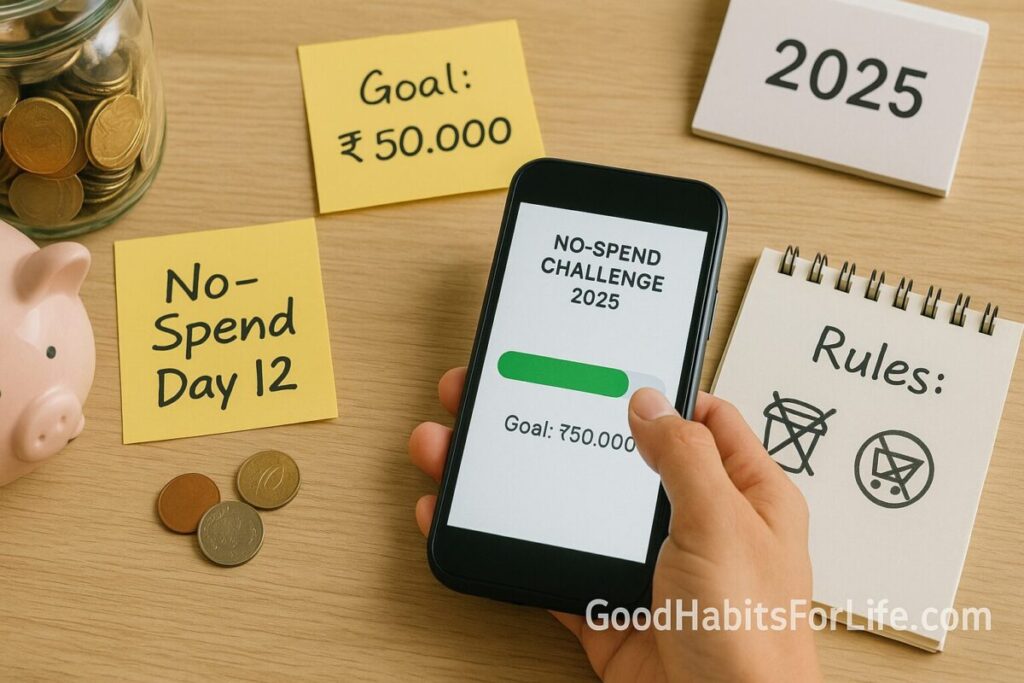
Tiny Wins: Gamify Saving with Progress Bars: No-Spend Challenge (2025)
Gamify Saving with Progress Bars: No-Spend Challenge 2025
Table of Contents
🧭 What This Is & Why It Works
“Gamifying” saving means turning your savings goal into a game you can see and score: a visible progress bar, streaks, and small rewards for milestones. Pair it with a focused no-spend challenge (e.g., no takeaway coffee or no non-essential online shopping for 30 days) and you get a simple system that builds an emergency fund faster—without complicated budgets.
Why it works (evidence-based):
-
Progress monitoring measurably increases goal achievement—especially when you record it and/or make it visible to others. A meta-analysis across 138 studies found bigger effects when progress is tracked and shared. APAPubMed
-
Progress bars and “tiny wins” leverage the goal-gradient effect (motivation rises as you feel closer to the goal) and the “small wins” principle. Design your bar to surface frequent progress. home.uchicago.eduHarvard Business Review
-
Beware the mid-goal slump. Motivation can dip around the middle of a goal; good trackers and milestone design help you avoid getting “stuck in the middle.” PubMedSAGE Journals
-
Implementation intentions (“If X, then I will Y”) and timely reminders further improve follow-through. kops.uni-konstanz.deNBER
✅ Quick Start: Your 30-Day No-Spend + Progress Bar
Choose one spend category to pause for 30 days (e.g., delivery food, impulse fashion, in-app game purchases).
Define the prize: “Save ₹15,000 (or $200) for an emergency fund by Day 30.”
Create your bar (sheet or app): starting at 0%, target 100%.
Daily routine (5 minutes):
-
Log whether you spent in the banned category (Yes/No).
-
Add any saved amount to your “Challenge Pot.”
-
Update the % complete and streak.
-
Share your progress weekly with a buddy or chat group.
Rules that make it stick:
-
Pre-decide exceptions (e.g., genuine emergencies).
-
Set If-Then plans for triggers: “If I feel like ordering, I brew tea and wait 15 minutes.” kops.uni-konstanz.de
-
Schedule SMS/app reminders at spend-temptation windows. Reminders raise saving rates in field experiments. poverty-action.org
🛠️ Build Your Progress System (Spreadsheet & App options)
Option A — Google Sheets / Excel (5-minute setup)
Columns: Date | Spent? (0/1) | Saved Amount | Cumulative Saved | % Complete | Streak
-
Cumulative Saved:
=SUM($C$2:C2) -
% Complete (target in D1):
=MIN(1, CumulativeSaved/$D$1) -
Streak (no-spend):
=IF(B2=0, IF(ROW()=2,1,IF(B1=0,E1+1,1)), 0)
Insert a bar chart (progress % by date) and a conditional-formatting bar for the savings cell to visualize growth. Display 25%, 50%, 75%, and 100% checkpoints to counter the mid-goal dip. PubMed
Option B — Habit/Finance Apps
Pick any app with goal tracking and progress bars (e.g., general habit trackers or bank “pots”). Ensure it supports: clear target, visual % bar, reminders, and export. (See “Tools” below.)
📈 30-60-90 Roadmap (Tiny-Wins Scaling)
Days 1–30 (Foundation):
-
Single category ban; save small, frequent amounts (₹200–₹500 / $5–$10).
-
Celebrate weekly micro-wins (25%, 50%, 75%).
-
Share a Sunday screenshot of your bar with an accountability buddy.
-
Add one implementation intention per trigger. kops.uni-konstanz.de
Days 31–60 (Level-Up):
-
Add a second no-spend category or increase your daily auto-transfer by 10–20%.
-
Introduce a commitment device: lock away funds in a separate pot/account you won’t touch. Commitment products increase savings in randomized trials. Professor Nava Ashraf
-
Make progress public within a small group (WhatsApp/Discord). Public reporting strengthens adherence. PubMed
Days 61–90 (Sustain & Safeguard):
-
Convert the challenge into a recurring habit (weekly no-spend day + automatic transfer). Habit research suggests consistency over weeks to months builds automaticity. Wiley Online Library
-
Consider fun add-ons like prize-linked saving (where available): chance-based rewards for deposits can boost engagement. Pension Research Council
🧠 Techniques & Frameworks That Supercharge Saving
-
Goal-Gradient + Progress Bars: Show frequent progress; add milestones to fight the mid-goal slump. Consider dual bars: (1) % of money goal, (2) streak days. home.uchicago.eduPubMed
-
Implementation Intentions: “If it’s after 8 pm and I’m browsing, I add items to a 48-hour wishlist—no purchase.” These if-then plans automate decisions. kops.uni-konstanz.de
-
Save More Tomorrow (SMarT): Pre-commit now to increase your auto-savings with each raise/bonus. UCLA Anderson School of Management
-
Reminders & Salience: Timed prompts tied to payday or temptation hours lift follow-through. poverty-action.org
-
Mental Accounting (Use it on purpose): Create labeled “pots” (Emergency, Travel, Festive Gifts). Labels reduce leakage and clarify rules. University of Bath
-
Prize-Linked Savings: Where allowed, saving triggers prize entries—motivating for some savers. Verify regulation in your country. Pension Research Council
-
Progress Visibility & Social Proof: Share your bar with a buddy; public or recorded progress improves outcomes. PubMed
👥 Variations by Audience
Students: Focus on food delivery/ride-share bans, small daily transfers (₹50–₹150 / $1–$3).
Parents: Target impulse kids’ buys or convenience foods; batch-cook weekends.
Professionals: Weekday no-spend; swap out coffee runs; auto-increase after appraisals (SMarT). UCLA Anderson School of Management
Seniors: Medication and essentials exempt; prioritize fraud-proofing and low-effort transfers.
Teens: Guardian-approved pocket-money streaks; visual trackers build the habit muscle (shorter horizons, more badges).
⚠️ Mistakes & Myths to Avoid
-
Myth: “If I just resolve to save, I will.” → Plans + prompts beat willpower alone. kops.uni-konstanz.de
-
Mistake: Vague targets (“save more”). → Use a number and date (e.g., ₹30,000 by Nov 30).
-
Mistake: Hidden spending categories. → Limit the challenge scope clearly; log exceptions.
-
Myth: “Progress bars are cosmetic.” → Visual monitoring increases completion and goal attainment. APA
-
Mistake: Middle-goal drift. → Add mid-point bonuses or reframe to “distance-from-start” to keep momentum. PubMed
💬 Real-Life Scripts & Examples
If-Then Plan (copy-paste):
-
If I open a shopping app after 9 pm, then I add items to Wishlist and set a 48-hour reminder; no checkout. kops.uni-konstanz.de
Text Reminder (schedule on payday):
-
“Top-up your Challenge Pot now 💪 (tap and transfer ₹500). You’re {current%}% to goal!”
Accountability Check-in:
-
“Quick update: 14/30 no-spend days, ₹4,200 saved, 28% complete. Next milestone: 50% by Friday.”
Micro-reward Ladder:
-
25%: free home spa night; 50%: movie night at home; 75%: picnic; 100%: add 5% buffer to the fund and treat with a low-cost celebration (not from the fund!).
🧰 Tools, Apps & Resources (Pros/Cons)
-
Google Sheets / Excel — Free, flexible, shareable; manual entry required.
-
Notion / Obsidian templates — Custom dashboards; setup time.
-
Habitica / generic habit trackers — Gamified streaks; indirect money features.
-
Bank “pots”/“vaults” features — Automated goal sub-accounts; features vary by country.
-
Budget apps (e.g., envelope/zero-based styles) — Structured categories; learning curve.
-
IFTTT-style auto-saves (round-ups, payday rules) — Hands-off; watch fees/FX.
(Where available, verify prize-linked rules and protections before joining. Pension Research Council)
🔑 Key Takeaways
-
Track one no-spend category for 30 days with a visible progress bar.
-
Use If-Then plans + reminders; share progress weekly. kops.uni-konstanz.depoverty-action.org
-
Expect a mid-goal dip—add milestones and reframing. PubMed
-
Scale with a 30-60-90 roadmap and pre-commit future increases (SMarT). UCLA Anderson School of Management
-
Habit strength builds with consistent repetition over weeks to months. Wiley Online Library
❓ FAQs
1) How long until this becomes “automatic”?
Habit studies suggest anywhere from ~18 to 254 days (median ≈ 66) depending on behavior and consistency. Keep cues and routines stable. Wiley Online Library
2) What if I break the streak?
Reset the day streak but keep the money you saved. Add a small “restart ritual” and resume—no shame cycles.
3) Should I track daily or weekly?
Daily for the no-spend streak; weekly for the money bar. Recording and sharing progress increases success. PubMed
4) Are prize-linked savings safe?
They’re regulated differently by country; check local rules and product protections first. Motivation can rise with prize mechanics for some savers. Pension Research Council
5) What if I already budget?
Great—layer a visible progress bar and a focused no-spend sprint to accelerate one priority goal (e.g., emergency fund top-up). Monitoring acts as a force multiplier. APA
6) Does public posting matter?
Yes—recorded and shared progress tends to improve follow-through versus private, unrecorded goals. PubMed
7) How big should my first goal be?
Small enough to finish in 30–45 days (e.g., ₹15,000 / $200). Frequent early wins fuel momentum via the goal-gradient effect. home.uchicago.edu
8) Is “Save More Tomorrow” only for retirement plans?
No—it’s a principle. Pre-commit now to boost any automatic transfer when your income increases. UCLA Anderson School of Management
📚 References
-
Kivetz R, Urminsky O, Zheng Y. The Goal-Gradient Hypothesis Resurrected. Journal of Marketing Research (2006). (PDF) home.uchicago.edu
-
Harkin B, Webb TL, et al. Does Monitoring Goal Progress Promote Goal Attainment? Psychological Bulletin (2016). (PDF/PubMed) APAPubMed
-
Bonezzi A, Brendl CM, De Angelis M. Stuck in the Middle: The Psychophysics of Goal Pursuit. Psychological Science (2011). (PubMed/PDF) PubMedweb-docs.stern.nyu.edu
-
Gollwitzer PM. Implementation Intentions: Strong Effects of Simple Plans. American Psychologist (1999). (PDF) kops.uni-konstanz.de
-
Karlan D, McConnell M, Mullainathan S, Zinman J. Getting to the Top of Mind: How Reminders Increase Saving. (Working paper and journal versions). NBERJSTORpoverty-action.org
-
Thaler RH, Benartzi S. Save More Tomorrow™: Using Behavioral Economics to Increase Employee Saving. Journal of Political Economy (2004). (JSTOR/PDF) JSTORUCLA Anderson School of Management
-
Ashraf N, Karlan D, Yin W. Tying Odysseus to the Mast: Evidence from a Commitment Savings Product in the Philippines. QJE (2006). (PDF/JSTOR/J-PAL) Professor Nava AshrafJSTORJ-PAL
-
Thaler RH. Mental Accounting and Consumer Choice. Marketing Science (1985). (PDF/INFORMS) bear.warrington.ufl.eduINFORMS Publications
-
Kearney MS, Tufano P. An Overview of Prize-Linked Saving Products. Pension Research Council (2011). (PDF) Pension Research Council
-
Conrad FG, Couper MP. The Impact of Progress Indicators on Task Completion. (2010). (PMC) PMC
-
Lally P, van Jaarsveld CHM, Potts HWW, Wardle J. How Are Habits Formed? Eur. J. Soc. Psychol. (2010). (Wiley abstract/replicas) Wiley Online Library
-
Amabile TM, Kramer SJ. The Power of Small Wins. Harvard Business Review (2011). (HBR) Harvard Business Review
⚖️ Disclaimer
This article is educational and not financial advice. Always consider your personal circumstances and local regulations before making financial decisions.