
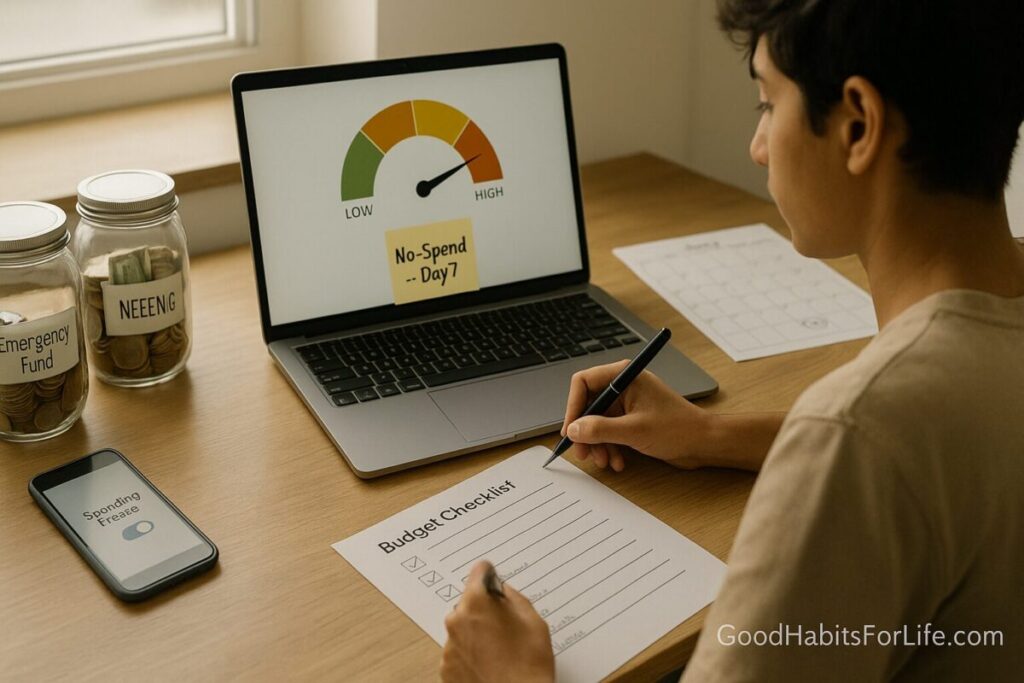
Risk Tolerance: A Simple SelfTest: No-Spend Challenge (2025)
Risk Tolerance Self-Test: No-Spend Challenge (2025)
Table of Contents
🧭 What “Risk Tolerance” Really Means
Risk tolerance is your willingness and ability to accept fluctuations and possible losses in pursuit of higher long-term returns. Regulators define it plainly as your readiness to lose some or all of an investment in exchange for potential gains and emphasize aligning choices with your goals and time horizon. Investor+1
Two related—but distinct—ideas matter:
-
Risk tolerance (willingness): how you feel about risk.
-
Risk capacity (ability): how much risk your circumstances can support (income stability, emergency fund, time horizon). Professional frameworks urge combining “need, ability, and willingness” when profiling investors. CFA InstituteCFA Institute Research and Policy Center
If you ever work with an adviser, your stated tolerance, goals, liquidity needs, and time horizon should shape recommendations under suitability/best-interest rules. That’s another reason to get your self-assessment right. FINRA+1
Why feelings alone can mislead
Questionnaires help, but results can be biased by context, recency of market moves, or who sponsors the quiz. Pair structured reflection with behavior-based tests to see how you act—not just how you intend to act. Investor
✅ Why a No-Spend Challenge Works as a Self-Test
A no-spend challenge is a short, rule-based sprint where you spend on essentials only (e.g., rent, utilities, groceries) and pause all discretionary buys. This simple constraint reveals how you handle present bias (preferring now over later), loss aversion, and mental accounting (treating money in “buckets”). These same forces drive many investing mistakes. OECDUniversity of Bath
-
Present bias: Overvalues immediate rewards, making it hard to delay gratification—similar to panic-selling or chasing hot tips. OECD
-
Mental accounting: Labeling money (e.g., “found money”) leads to inconsistent choices—like treating dividends differently from wages or windfalls. Wiley Online Library
-
Habit loops: Repetition builds automaticity; a time-boxed pause can disrupt “tap-to-buy” routines and create space for better defaults. CentreSpring MD
Important: A spending sprint is not a regulated risk-profiling tool. It’s a behavioral mirror that complements formal questionnaires and helps you articulate tolerance, capacity, and goals more clearly. CFA Institute Research and Policy Center
🛠️ Quick Start: 7-Day No-Spend Reset
Goal: Build awareness of urges and triggers while proving you can wait.
Rules (set before Day 1):
-
Essentials only: rent, utilities, basic groceries, transport, medical.
-
Frozen categories: takeout, snacks, apparel, gadgets, non-work subscriptions, impulse online buys.
-
Pre-commit: uninstall shopping apps; remove saved cards; put 24-hour holds on carts.
-
If-then plan: If I feel like buying, then I’ll open my tracker, breathe 3×, and schedule a review for tomorrow. (See techniques below.)
-
Track every urge and attempt to spend (date/time, what, why, replacement activity).
Daily cadence (10–15 minutes):
-
Morning: Re-read your rules; visualize 1 temptation and your if-then response.
-
Midday: Quick log—any urges? Rate discomfort 1–10.
-
Evening: 3-line reflection: What triggered me? How did I respond? What will I try next time?
One-page tracker: Categories + notes (download a free spending-tracker template—paper or PDF—to keep it simple). Consumer Financial Protection Bureau
End of Day 7—mini debrief:
-
Top 3 triggers?
-
Average discomfort rating?
-
Any rule breaks? Why?
-
Did waiting feel easier by Day 6–7?
📅 30-60-90 Plan: Build Insight & Control
Use this three-phase plan to deepen self-knowledge and translate it into your investor profile.
Days 1–30: Awareness & Friction
-
Keep essentials-only rules for 14 days; next 16 days become low-spend (add one small treat/week).
-
Add friction: 24-hour cooling-off rule, cart caps (e.g., ≤₹1,000 per item without a 48-hour wait).
-
Weekly check-in: Which discomfort feels like market volatility (uncertainty), and which feels like a permanent loss?
Investor reflection prompt: On a scale 1–10, how okay am I with waiting to buy? How does this map to my comfort holding a dropping investment?
Days 31–60: Capacity & Buffers
-
Build/boost emergency fund (at least a starter buffer) and automate a small transfer on payday.
-
Simulate market swings: pick a long-term holding (or a model portfolio) and journal reactions to a hypothetical –10% dip vs. +10% jump.
-
Adjust rules based on triggers: subscriptions, social shopping, or late-night browsing.
Investor reflection prompt: If an expense or job changed tomorrow, what risk could I still take? (That’s risk capacity.)
Days 61–90: Calibration & Portfolio Rules
-
Draft an Investor Operating Manual (IOM):
-
Goals & horizon (e.g., retirement 25 years).
-
Risk tolerance statement (feelings) + capacity (math).
-
Guardrails (max single-asset weight, rebalancing cadence, when to not act).
-
-
Practice if-then investing scripts (e.g., If my equity fund drops 15%, then I will review allocation on the weekend and rebalance if drift >5 p.p.*).
-
Choose a simple asset mix aligned to your tolerance/capacity; document why.
🧠 Techniques & Frameworks That Help
Implementation intentions (if-then plans). Pre-decide responses to triggers (“If I see a flash sale, then I’ll start a 24-hour timer”). This planning method reliably improves goal follow-through. Cancer Control
Mental accounting cleanup. Treat money as fungible: one plan, one budget. Move windfalls straight to priorities (e.g., debt, emergency fund). Wiley Online Library
Tracker + review. Logging spending and urges increases clarity and control. Use a printable or digital tracker; run a weekly 15-minute review. Consumer Financial Protection Bureau
Habit science. Repetition in a stable context builds automaticity; many people need weeks to months for a habit to stick—be patient. CentreSpring MD
Questionnaire cross-check. After 30–60 days, take a reputable risk-tolerance questionnaire (e.g., based on Grable–Lytton research) and compare with your diary insights. Arnaud Sylvain
👥 Variations: Students, Parents, Professionals, Seniors, Teens
-
Students: Focus on cafeteria vs. takeout, ride-shares, micro-purchases (stickers, add-ons). Use library/college perks.
-
Parents: Pre-plan low-cost family fun; batch-cook; set treat budgets (“one dessert night”).
-
Professionals: Tackle convenience spend (delivery, premium subs). Put work-expense items on a separate card for clarity.
-
Seniors: Review recurring charges; optimize prescriptions/health utilities; plan free community activities.
-
Teens: Co-create rules with a parent/guardian; swap in free hobbies; track phone-based impulse triggers.
⚠️ Myths & Mistakes to Avoid
-
Myth: “If I can white-knuckle no-spend, I have high risk tolerance.”
Reality: Tolerance isn’t toughness—it’s a stable preference shaped by goals, horizon, and capacity. Use insights, but still profile formally. CFA Institute -
Mistake: Using a viral challenge with no rules. Write rules before Day 1, and pre-commit with friction (cool-off timers, card removal).
-
Mistake: Confusing capacity with tolerance. A big salary ≠ comfort with volatility. Measure both. CFA Institute Research and Policy Center
-
Mistake: Going from zero to extreme. Start with 7 days; extend gradually.
-
Mistake: Not tracking urges. Your diary is the data.
💬 Real-Life Scripts & Examples
To friends: “I’m on a 7-day no-spend sprint—down to essentials only. If we hang, let’s keep it free (walk, picnic, board games).”
At checkout (online): “I’m using a 24-hour cool-off. If I still want this tomorrow and it fits my priorities, I’ll revisit.”
If tempted by a sale: “If I feel FOMO, then I’ll compare it to my long-term goal and check my tracker first.”
Investor Operating Manual snippet:
-
Goal: Retirement corpus by 2055; children’s education by 2038.
-
Risk tolerance: Moderate; okay with ~20% equity drawdown if horizon ≥10 years.
-
Risk capacity: Emergency fund 6 months; stable income; low debt.
-
Rules: Rebalance annually or when allocation drifts >5 p.p.; avoid new positions during headline-driven spikes.
🧰 Tools, Apps & Resources
-
Printable trackers (free): CFPB “Spending Tracker” (PDF) and worksheets for analyzing weekly spend. Great for a paper-first reset. Consumer Financial Protection Bureau+1
-
Budgeting apps: YNAB, Money Manager, Walnut, Splitwise (groups).
-
Browser friction: Disable 1-click, remove saved cards, use site blockers (set custom rules during the sprint).
-
Investor basics: SEC Investor.gov explainers on risk, diversification, and asset allocation. Investor
-
Questionnaires: Look for tools referencing validated scales (e.g., Grable–Lytton). Use results as inputs, not orders. Arnaud Sylvain
🔑 Key Takeaways
-
Risk tolerance blends willingness and ability; profile both. CFA Institute
-
A focused no-spend sprint is a low-risk way to observe your reactions to waiting, uncertainty, and rules—the same muscles you need for investing discipline.
-
Use if-then plans, friction, and trackers to build control and insight. Cancer Control
-
Convert insights into an Investor Operating Manual and asset-mix rules you can actually follow.
-
Re-check your profile yearly or after big life changes.
FAQs
1) Is a no-spend challenge a legitimate way to measure risk tolerance?
It’s a behavioral self-test—useful for insight, not a replacement for formal profiling. Pair it with a validated questionnaire and a review of your time horizon, liquidity needs, and goals. CFA Institute Research and Policy Center
2) How long should my first challenge be?
Start with 7 days. If it goes well, repeat or shift to a low-spend phase and extend to 30 days.
3) What if I break a rule?
Log it without judgment. Note the trigger and design an if-then response for next time.
4) Do I need an emergency fund first?
Build at least a starter buffer as you go; your risk capacity rises with better cushions.
5) I’m already frugal—will this help?
Yes. You’ll still uncover present-bias moments and refine rules for when to act (or hold) in markets. OECD
6) How does this relate to investing regulation?
Advisers must consider suitability and your risk profile when making recommendations; clearer self-knowledge helps them help you. FINRA
7) Any research behind if-then planning?
Decades of studies show implementation intentions improve goal attainment across domains. Cancer Control
8) How long to form a money habit?
Varies widely—weeks to months. Evidence suggests many people need around two months on average for automaticity with consistent repetition. CentreSpring MD
📚 References
-
U.S. SEC Investor.gov – Risk Tolerance (Glossary) and Gauge Your Risk Tolerance. https://www.investor.gov Investor+1
-
SEC Investor.gov – Beginners’ Guide to Asset Allocation, Diversification, and Rebalancing. https://www.investor.gov Investor
-
FINRA – Suitability (Rule 2111) & FAQs. https://www.finra.org FINRA+1
-
CFA Institute Research Foundation – Risk Tolerance and Circumstances; Investment Risk Profiling. https://www.cfainstitute.org CFA InstituteCFA Institute Research and Policy Center
-
Grable, J.E., & Lytton, R.H. (1999). Financial risk tolerance revisited (validated scale). (PDF access). Arnaud Sylvain
-
Consumer Financial Protection Bureau – Spending Tracker and worksheets. https://www.consumerfinance.gov Consumer Financial Protection Bureau+1
-
Thaler, R.H. (1999). Mental Accounting Matters. Journal of Behavioral Decision Making. (Wiley/PDF). Wiley Online LibraryUniversity of Bath
-
OECD – Behavioural economics & financial consumer protection (present bias overview). https://www.oecd.org OECD
-
Lally, P. et al. (2010). How are habits formed? European Journal of Social Psychology (UCL summary/PDF). University College LondonCentreSpring MD
-
Gollwitzer, P.M. – Implementation Intentions: Strong Effects of Simple Plans (review/overview). Cancer Control
-
SEC Investor.gov – Assessing Your Risk Tolerance (biases in online quizzes). https://www.investor.gov Investor
Disclaimer: This article is educational and not financial advice; investing involves risk, and you should consider your personal situation or consult a qualified adviser.