
PayYourselfFirst: Autopilot Savings that Stick: No-Spend Challenge (2025)
Pay Yourself First: Autopilot Savings That Stick (2025)
🧭 What “Pay Yourself First” Means (and Why It Works)
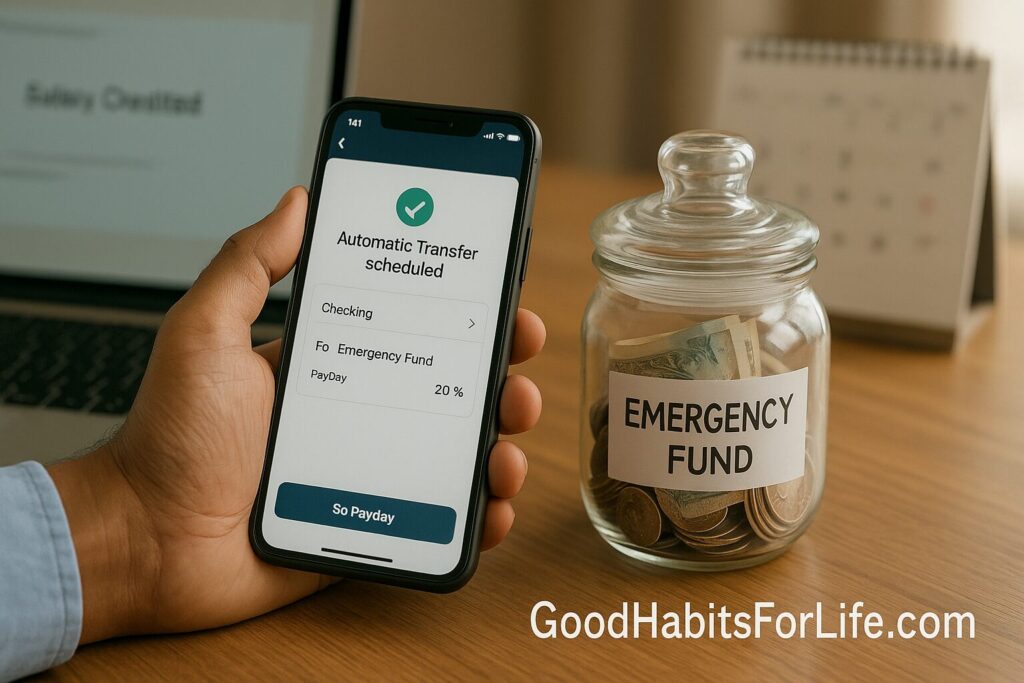
“Pay yourself first” flips budgeting on its head: treat saving like a must-pay bill that happens before rent, food, or fun. The easiest way is to set an automatic transfer (or split direct deposit) on payday so cash moves to savings without willpower. Consumer Financial Protection Bureau+1
Why it works
-
Automation beats motivation. When saving happens by default, participation and balances jump—classic studies on automatic enrollment and default settings show big gains. NBER
-
Save More Tomorrow. Committing today to raise your contribution with each future raise can push save rates from ~3–4% to double digits over time—without feeling poorer. UCLA Anderson School of Management
-
Emergency-fund security. A cash buffer prevents debt when life hits; a common target is 3–6 months of essential expenses (adjust for your risk). FINRA+1
✅ Quick Start: Do This Today (15 Minutes)
-
Pick your percent. Start with 5–10% of take-home (or a flat ₹/$ amount). If that’s too high, begin with 1–2% and step up monthly. Consumer Financial Protection Bureau
-
Automate on payday.
-
Split direct deposit: Ask HR/payroll to send X% to checking, Y% to savings each payday. PNC Bank
-
Or set a bank auto-transfer for the morning you’re paid. Consumer Financial Protection Bureau
-
-
Name the account “Emergency Fund — Hands Off.”
-
Create a mini no-spend window (7–14 days) to kick-start the balance (details below). Fidelity
-
Calendar a raise. Schedule increases each quarter or with every salary hike (SMarT style). UCLA Anderson School of Management
🗺️ 30-60-90 Day Habit Plan
Days 1–30 (Foundation)
-
Auto-transfer ₹/$ every payday to a separate savings account.
-
Run a 14-day no-spend on non-essentials; track wins. Fidelity
-
Build a simple budget (in/out + categories).
Days 31–60 (Acceleration)
-
Increase save rate by +1–2% (or +₹/$500 per month).
-
Park the fund in a high-yield savings (liquid, FDIC/insured equivalent).
-
Add a tax-refund split plan (Form 8888 lets you route refunds to savings). IRS+1
Days 61–90 (Stability)
-
Reach one month of essentials saved; set sights on 3–6 months. FINRA
-
Switch to automatic step-ups aligned to salary increases (Save More Tomorrow). UCLA Anderson School of Management
-
Keep one no-spend weekend monthly to top up.
🧠 Techniques & Frameworks That Make Saving Automatic
-
Default first. Make saving the default via payroll split/auto-transfer. Consumer Financial Protection Bureau
-
Save More Tomorrow (SMarT). Pre-commit to boost the percent you save with each raise. UCLA Anderson School of Management
-
50/30/20 (or 60/20/20). Route the “20” to savings first, then budget the rest.
-
Separate stashes. Create sub-accounts: Emergency, Annual Bills, Goals.
-
Friction for spending. Turn off 1-click buys; delete saved cards during challenges.
-
Paywindfall rule. Split irregular income (bonuses, refunds) 50% to savings, 50% flexible—use IRS Form 8888 to pre-route refunds. IRS
🛠️ Run a No-Spend Challenge (Fast Cash Boost)
What it is: A set period (14–30 days) where you cut non-essentials to spike savings and reset habits. Essentials stay (rent, utilities, basic groceries, transport). Fidelity
Rules & tips
-
Whitelist: essentials only. Blacklist: takeout, shopping, rideshares for convenience, new subscriptions.
-
Prep: Meal-plan, list free activities, unsubscribe from promos.
-
Track: Use a printed calendar or app; check off no-spend days.
-
Finish line: Move every rupee/dollar saved to your Emergency Fund.
🧑🤝🧑 Audience Variations
-
Students: Start with ₹/$100–₹/$300 per month; funnel scholarships/part-time income on autopilot.
-
Parents: Create a “Family Buffer” sub-account for kid surprises; automate from joint payroll.
-
Professionals: Use SMarT step-ups tied to annual raises and bonus splits (e.g., 60% save / 40% enjoy). UCLA Anderson School of Management
-
Seniors/Fixed income: Smaller auto-transfers (₹/$25–₹/$50 weekly) build resilience without strain.
-
Variable income (freelancers): Save a percent of each payment; keep a larger buffer (closer to 6+ months). FINRA
⚠️ Mistakes & Myths to Avoid
-
Myth: “I’ll save what’s left.” Reality: there’s rarely anything left—save first. Consumer Financial Protection Bureau
-
Mistake: Mixing funds. Keep emergency cash separate and liquid. FINRA
-
Myth: You need a huge amount to start. Even small, automatic amounts matter. FINRA
-
Mistake: One-time push. Lasting savings come from defaults + gradual step-ups. UCLA Anderson School of Management
💬 Real-Life Scripts You Can Copy
Ask HR to split your paycheck
“Hi [Name], could payroll split my direct deposit so ₹/$___ (or __%) goes to [Bank, acct ending ____] and the rest to my usual checking each payday? Thanks!” PNC Bank
Set a bank auto-transfer
“Please set an automatic transfer of ₹/$___ from checking to Emergency Fund on [payday + 0 days], recurring every pay period.” Consumer Financial Protection Bureau
No-Spend rules with your household
“For the next 14 days, we’ll buy essentials only (rent, basic groceries, utilities, transport). No takeout or shopping. We’ll track saved ₹/$ and transfer it on day 14.”
Route your tax refund
“I’m using IRS Form 8888 to send ₹/$___ of my refund straight to savings.” IRS
🧩 Tools, Apps & Resources
-
Payroll split deposit (via HR portal) — fastest “set-and-forget” start. PNC Bank
-
Bank auto-transfers (same-day as payday). Consumer Financial Protection Bureau
-
High-yield savings (insured; easy access for emergencies).
-
Financial education: CFPB Your Money, Your Goals and FDIC Money Smart tools and lesson sheets. Consumer Financial Protection BureauFDIC
-
No-spend planning: Fidelity’s guide to setting rules and tracking progress. Fidelity
📌 Key Takeaways
-
Automate savings on payday so it happens before spending. Consumer Financial Protection Bureau
-
Use step-ups tied to raises to increase your save rate painlessly. UCLA Anderson School of Management
-
Build toward 3–6 months of essential expenses; any start is progress. FINRA
-
Run short no-spend sprints to accelerate your cash buffer. Fidelity
-
Leverage refund splits and windfalls to top up automatically. IRS
❓ FAQs
1) How much should I save in my emergency fund?
A common target is 3–6 months of essential expenses; lean toward the high end for variable income or single-earner households. FINRA+1
2) Checking or savings for the emergency fund?
Use a separate, insured savings account for quick access and fewer temptations. FINRA
3) What if I can’t afford 10% yet?
Automate 1–2% now and step up quarterly or with raises—this is the SMarT approach. UCLA Anderson School of Management
4) Does a no-spend challenge really help?
Yes—cutting non-essentials for 14–30 days reveals leaks and boosts savings quickly. Set rules in advance and track days. Fidelity
5) Can I split my paycheck and my tax refund?
Many payroll systems support split direct deposit, and IRS Form 8888 lets you split tax refunds into multiple accounts. PNC BankIRS
6) Isn’t cash drag a risk?
Keep emergency money liquid; invest only beyond that buffer to balance security and growth. AP News
7) How do defaults increase saving?
When saving is the default (auto-enroll, auto-transfer), participation and balances rise significantly due to reduced friction and procrastination. NBER
📚 References
-
Consumer Financial Protection Bureau. Looking for an easy way to save money? Make it automatic. Consumer Financial Protection Bureau
-
CFPB. An essential guide to building an emergency fund. Consumer Financial Protection Bureau+1
-
Madrian, B. C., & Shea, D. F. Inertia in 401(k) Participation and Savings Behavior. NBER Working Paper No. 7682. NBER
-
Thaler, R. H., & Benartzi, S. Save More Tomorrow™: Using Behavioral Economics to Increase Employee Saving. Journal of Political Economy. UCLA Anderson School of ManagementChicago Journals
-
FINRA. Financial Foundations — Build an Emergency Fund. FINRA
-
FINRA. Prepare & Survive Financial Hardship. FINRA
-
Fidelity. No-spend challenge: How to do it. Fidelity
-
IRS. Form 8888 — Allocation of Refund (Including Savings Bond Purchases). IRS
-
IRS. FAQs: Splitting federal income tax refunds. IRS
-
PNC Bank. What Is Split Direct Deposit? (overview of paycheck splits). PNC Bank
-
FDIC. Money Smart (free financial education resources). FDIC
Disclaimer: This article is for general educational purposes only and is not financial advice; speak with a qualified adviser about your situation.