
Shoulder Health: Scapular Upward Rotation Drills: Zone 2 + NEAT (2025)
Scapular Upward Rotation Drills + Zone 2 & NEAT
Table of Contents
🧭 What & Why: Scapular Upward Rotation
Scapular upward rotation is the coordinated turning of your shoulder blade so the socket faces up and slightly outward as you raise your arm. It’s produced mainly by the serratus anterior and the upper + lower trapezius acting as a force couple. When this pattern is underactive or late, the humeral head can pinch soft tissues (impingement-type pain), your rotator cuff overworks, and overhead strength stalls.
Benefits backed by research
-
Better subacromial clearance (more space for tendons) as the scapula upwardly rotates and posteriorly tilts.
-
Healthier scapulohumeral rhythm, distributing load away from irritated structures.
-
Improved overhead mechanics for work, sport, and lifting.
Why Zone 2 + NEAT belong in a shoulder plan
-
Zone 2 (easy, steady cardio) improves circulation, mitochondrial efficiency, and recovery capacity so tissues tolerate more training.
-
NEAT (all movement outside formal exercise) reduces stiffness from sitting and keeps shoulder blades moving through the day—your best “anti-desk” habit.
✅ Quick Start: 10-Minute Daily Flow
Do this once daily (or as a warm-up before upper-body training):
-
Breathing + Rib Position (60 s)
-
4 slow nasal breaths. Exhale fully, ribs down; keep neck relaxed.
-
Goal: set the thorax so the scapula can glide smoothly.
-
-
Wall Slides with Lift-Off (2 x 8–10)
-
Forearms on wall, elbows at ~90°. Slide up; gently reach to let the shoulder blade rotate up and around.
-
Cue: “Glide up; don’t shrug.”
-
-
Prone/Y-Raise (Lower Trap Focus) (2 x 8–10)
-
On bench or floor, thumbs up, lift arms into a “Y.”
-
Cue: “Reach long; shoulder blades rotate up and back.”
-
-
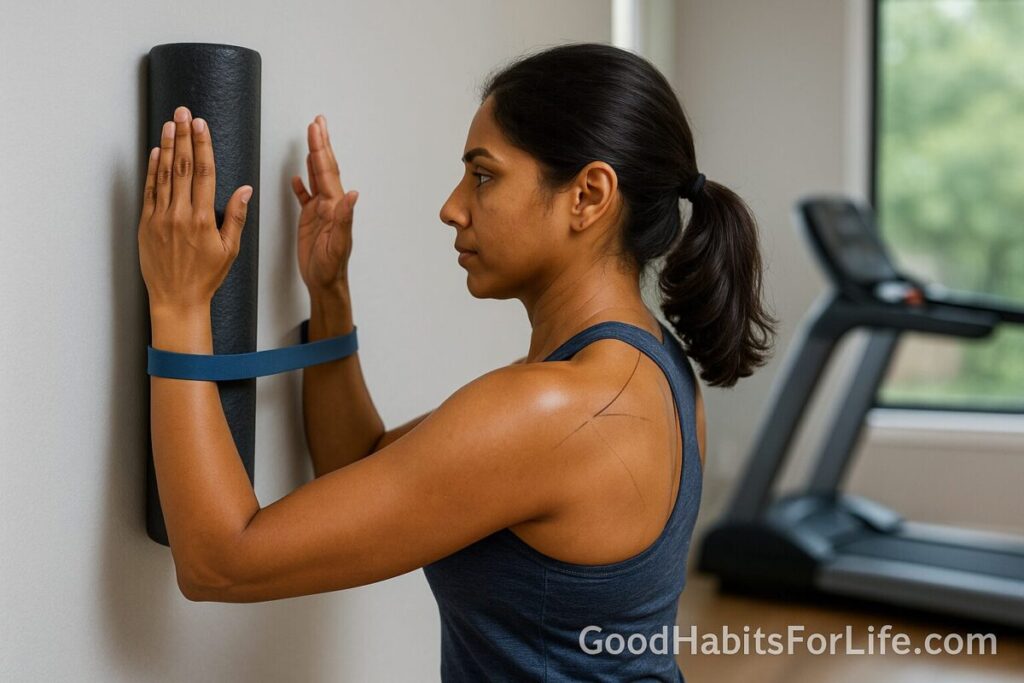
Serratus Punch or Foam-Roll Wall Slide (2 x 10–12)
-
Light dumbbells/band; punch upward with a protraction “reach.”
-
Cue: “Wrap the shoulder blade forward without jutting the head.”
-
-
Banded Upward-Rotation Press (2 x 8–10/side)
-
Anchor band below shoulder. Start at chest; press up/out on a slight diagonal.
-
Cue: “Elbow follows hand; blade turns like a wheel.”
-
Optional finisher (1–2 sets): Landmine Press (or Scaption Raise with a light DB) for a friendly, upward-rotation path.
Pain rule: Mild discomfort (≤3/10) that improves as you move is OK. Sharp, worsening pain—stop and regress.
🛠️ Techniques & Frameworks (with reps/cues)
A. Mobility/Activation
-
Open-Book Thoracic Rotations – 2 x 6/side
Cue: “Ribs rotate; neck stays long.”
Benefit: Free the thorax so the scapula can upwardly rotate. -
Scapular Clocks (Wall) – 1 x 6 each “time”
Cue: Move your blade to 12-2-4-6-8-10 o’clock without hiking the shoulder.
B. Strength & Motor Control (progress from bodyweight → load)
-
Wall Slides → Wall Slides with Lift-Off → Foam-Roll Wall Slides
Sets/Reps: 2–3 x 8–12.
Emphasis: Reach at the top to finish the upward rotation. -
Prone Y / T / W Series
Sets/Reps: 2–3 x 8–12 each.
Emphasis: Lower trap in “Y,” mid trap in “T,” external rotators in “W.” -
Serratus Punch (Supine or Standing) / Push-Up Plus
Sets/Reps: 2–3 x 10–15.
Emphasis: “Reach” at end-range without shrug. -
Banded 45° Press-Out (Serratus + Lower Trap)
Sets/Reps: 2–3 x 8–12/side.
Emphasis: Press slightly out and up, letting the blade turn. -
Landmine Press (Kneeling or Standing)
Sets/Reps: 3 x 6–10.
Emphasis: Arc is friendly to shoulders; finish with rib control. -
Scaption Raise (Thumbs Up) / Overhead Carry (KB/DB)
Sets/Reps: 2–3 x 8–12 or carries 20–40 m.
Emphasis: Light to moderate load; prioritize smooth blade motion.
C. Dose & Tempo
-
Tempo: 2-1-2 (up 2 s, pause 1, down 2).
-
Rest: 45–75 s between sets.
-
Frequency: 4–6 days/week for the short drill stack, 2–3 days/week for loaded work.
🧭 30-60-90 Habit Roadmap
Days 1–30 (Restore & Groove)
-
Daily 10-minute Flow.
-
Add Zone 2 3×/week, 20–30 min each (RPE 3–4/10, conversational).
-
NEAT target: 7,000 steps/day (≈5–6 km).
-
Checkpoint: Pain ≤3/10; smoother overhead reach to 150–170°.
Days 31–60 (Build Capacity)
-
Keep daily Flow; add 2 loaded sessions/week (landmine press, scaption, carries).
-
Zone 2: 120–150 min/week total (e.g., 4 × 30–40 min).
-
NEAT: 8–9k steps/day, hourly micro-break (60–90 s shoulder blade moves).
-
Checkpoint: Can perform 3 sets of each drill with clean form; improved endurance.
Days 61–90 (Perform & Maintain)
-
Maintain Flow 4–5×/week; progress load 5–10% when technique is perfect.
-
Add an overhead day if pain-free (e.g., DB press/scaption supersets).
-
Zone 2 steady or introduce short strides (still sub-threshold).
-
NEAT: Anchor routines—walk calls, stairs, carry groceries, desk mobility timer.
-
Checkpoint: Confident overhead tasks; no post-workout flare-ups.
💓 Zone 2 & NEAT: How They Support Shoulder Health
Zone 2 defined: easy-moderate effort where you can talk in full sentences, roughly 64–76% of max heart rate (or RPE 3–4/10). Activities: brisk walking, cycling, rowing, elliptical.
Why it helps your shoulders
-
Increases capillary density and mitochondrial function, improving recovery between sets and sessions.
-
Low stress on joints while building work capacity, allowing higher quality skill practice.
NEAT upgrades that matter
-
Hourly mobility minute: 3–4 shoulder blade slides + 4 serratus reaches.
-
Walk it in: Park farther, take stairs, 10-minute post-meal walks.
-
Carry stuff: Light farmer carries (10–20 kg total) during errands.
-
Aim for 7–9k steps/day (≈5–7 km). If you’re already active, consider 10–12k.
👥 Audience Variations
-
Desk-bound professionals/students: Prioritize hourly mobility minutes, wall slides, and serratus punches. Keep a mini band at your desk.
-
Overhead athletes/lifters: Add landmine press, overhead carry, and scaption as a pre-lift primer; maintain rib control to avoid over-extension.
-
Seniors: Use supported versions (wall slides, cable/band presses). Keep loads light-moderate; focus on posture and balance during carries.
-
Postpartum or returning after layoff: Start with breathing, wall slides, and NEAT walks; add load only when daily activities are pain-free.
-
Teens/new exercisers: Short sessions (6–8 minutes) most days; master technique first.
⚠️ Mistakes & Myths to Avoid
-
Myth: “Just strengthen rotator cuff and you’re done.”
Reality: Scapular control (serratus + traps) is the platform for cuff function. -
Mistake: Shrugging through reps.
Fix: Keep neck long; think “reach and rotate,” not “hike.” -
Mistake: Chasing heavy overhead pressing too soon.
Fix: Earn range with wall slides/Y raises; then load with landmine/scaption. -
Myth: “Cardio doesn’t matter for shoulders.”
Reality: Zone 2 improves tissue recovery and training quality. -
Mistake: Weekend-warrior dosing.
Fix: Small, daily practice + NEAT beats sporadic big sessions.
💬 Real-Life Examples & Scripts
-
Desk micro-break (60–90 s): “Timer’s up—stand, 6 wall slides, 6 serratus reaches, 4 open-books. Back to work.”
-
Gym warm-up (5 min): “Foam-roll wall slides 2×8 → prone Y 2×8 → banded press-out 2×8. Now press.”
-
Walk call habit: “Every phone call = walk and 2 stops for 6 scapular clocks.”
-
Progression note: “No pain today? Add 1–2 reps per set or +1 kg to landmine.”
🧰 Tools, Apps & Resources
-
Mini bands & light DBs (1–6 kg): cheap, portable, perfect for serratus work.
-
Landmine (or makeshift corner anchor): shoulder-friendly pressing path.
-
Step counter app or wearable: track NEAT (set reminders every 60–90 min).
-
Timer app: habit-stack mobility minutes with Pomodoro cycles.
-
Rower/bike/treadmill: reliable Zone 2 options with easy pacing.
Pros/Cons snapshot
-
Bands/DBs: ✅ accessible; ❌ easy to “cheat” form—film yourself.
-
Landmine: ✅ scalable, joint-friendly; ❌ needs space.
-
Wearables: ✅ feedback; ❌ can distract—schedule “no-screen” walks.
🔑 Key Takeaways
-
Train the force couple (serratus + traps) that drives upward rotation.
-
Keep a daily 10-minute drill stack; add 2–3 loaded sessions/week as you progress.
-
Use Zone 2 for work capacity and NEAT to fight desk stiffness.
-
Progress gradually; pristine technique beats more weight.
-
Small, consistent sessions transform how your shoulders feel overhead.
❓ FAQs
1) How long until I feel relief?
Many feel smoother motion in 2–4 weeks; strength/overhead confidence typically improves over 6–12 weeks with consistent practice.
2) Can I do these drills every day?
Yes—the activation set (wall slides, Y raises, serratus) is low-load and suits daily practice. Keep loaded pressing to 2–3 days/week.
3) What if I hear clicking?
Non-painful clicks are common. If clicks are painful, reduce range, slow tempo, and prioritize control. Seek a clinician if it persists.
4) How hard should Zone 2 feel?
You should be able to talk comfortably. Aim for RPE 3–4/10 or ~64–76% HRmax.
5) Are push-ups bad for impingement?
Not necessarily. Start with wall or incline push-ups and emphasize the plus (reach) to bias serratus.
6) Do I need external rotation band work too?
Yes—add light ER work (e.g., side-lying ER or banded ER) to support cuff endurance, 2–3×/week.
7) Which is better—landmine or overhead DB press?
Landmine is usually more shoulder-friendly early on. Transition to DB press once you have clean upward rotation and rib control.
8) How many steps count for NEAT?
A practical target is 7–9k steps/day for most adults. More is fine if joints tolerate it.
9) Can I combine this with a lifting program?
Absolutely. Use the 10-minute Flow as warm-up and sprinkle serratus/Y work on non-press days.
10) When should I see a professional?
Acute trauma, progressive weakness, night pain, or numbness/tingling warrant a medical/physio check.
📚 References
-
Ekstrom RA, Donatelli RA, Soderberg GL. Surface electromyographic analysis of exercises for the trapezius and serratus anterior muscles. J Orthop Sports Phys Ther. 2003;33(5):247-258. https://doi.org/10.2519/jospt.2003.33.5.247
-
Decker MJ, Hintermeister RA, Faber KJ, Hawkins RJ. Serratus anterior muscle activity during selected rehabilitation exercises. Am J Sports Med. 1999;27(6):784-791. https://doi.org/10.1177/03635465990270061901
-
Kibler WB, Sciascia A. Current concepts: scapular dyskinesis. Br J Sports Med. 2010;44(5):300-305. https://doi.org/10.1136/bjsm.2009.059758
-
Cools AM, Johansson FR, et al. Rehabilitation of scapular muscle balance: which exercises to prescribe? Am J Sports Med. 2014;42(9):2313-2321. https://doi.org/10.1177/0363546514536684
-
WHO. Guidelines on Physical Activity and Sedentary Behaviour. 2020. https://www.who.int/publications/i/item/9789240015128
-
CDC. Measuring Physical Activity Intensity (Talk Test & Heart Rate). https://www.cdc.gov/physicalactivity/basics/measuring
-
American College of Sports Medicine. ACSM Position Stand: Quantity and Quality of Exercise for Developing and Maintaining Fitness. Med Sci Sports Exerc. 2011;43(7):1334-1359 (and updates). https://doi.org/10.1249/MSS.0b013e318213fefb
-
Levine JA. Non-exercise activity thermogenesis (NEAT). Proc Nutr Soc. 2002;61(3):375-391. https://doi.org/10.1079/PNS2002191
-
Ludewig PM, Reynolds JF. The association of scapular kinematics and subacromial-impingement symptoms. J Shoulder Elbow Surg. 2009;18(6):1009-1015. https://doi.org/10.1016/j.jse.2009.02.003
Disclaimer
This article provides general fitness information and is not a substitute for personalized medical advice; consult a qualified clinician if you have pain, injury, or health conditions.