
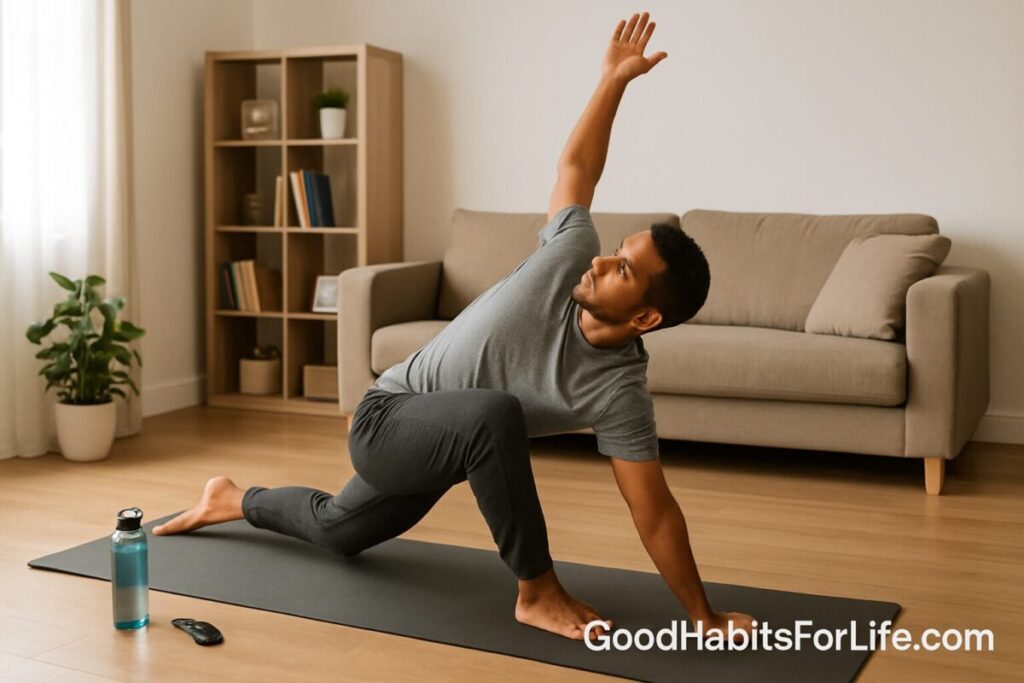
Daily Mobility Menu: 10 Moves in 10 Minutes
Daily Mobility Menu: 10 Moves in 10 Minutes
Table of Contents
🧭 What & Why
What it is: A short, whole-body 10-minute mobility routine using controlled, pain-free motion across major joints. It emphasizes dynamic range of motion (moving in and out of positions) and brief isometrics to prepare your body for daily tasks or training.
Why it works (evidence-aligned):
-
Dynamic movement before activity can improve performance and readiness compared with long static stretching, which is best saved for after workouts.
-
Regular range-of-motion (ROM) exercise supports joint function, posture, and comfort, especially when combined with strength and aerobic activity.
-
Short, consistent bouts (like 10 minutes) are easier to adhere to, building the habit that actually delivers results.
You’ll move head-to-toe, breathe steadily, and stay within comfortable ranges. Over weeks, you should notice easier squats/stands, smoother turning/reaching, and less “morning stiffness.”
✅ Quick Start (Do This Today)
-
Pick your slot: Right after waking, pre-workout, or mid-afternoon slump.
-
Clear 2×2 m space & set a 10-minute timer.
-
Do each move for ~60 seconds (or 30s/side). Use smooth reps, no bouncing.
-
Breathe through the nose when possible; exhale on effort.
-
Note your “stiffness score” (0–10) before and after. Aim for a 1–2 point improvement.
-
Repeat daily for 7 days; adjust any painful move (reduce range or swap).
🛠️ The 10-Move, 10-Minute Menu
Format: ~1 minute per move (left/right = 30s each). Move through without long rests.
| # | Move | Main Areas | How To & Cues | Easier / Harder |
|---|---|---|---|---|
| 1 | Neck CARs (controlled circles) | Cervical spine | Chin tuck, slow circles within pain-free range; shoulders relaxed. | Smaller circles / Slower, larger arcs |
| 2 | Shoulder Rolls + Scap Slides | Shoulders, upper back | Big rolls forward/back; then glide shoulder blades up/down & around ribs. | Hands on hips / Add wall slide |
| 3 | Cat–Cow + T-Spine Reach | Thoracic spine | On all fours: round/extend spine; then thread-the-needle (30s/side). | Only Cat–Cow / Add rotation reach |
| 4 | Wrist Rocks | Wrists, forearms | On all fours, fingers forward/back; gentle rock to edge of comfort. | Tabletop rocks / Kneeling lean further |
| 5 | Hip Flexor Shift (Half-Kneel) | Hip flexors, quads | One knee down, posterior pelvic tilt, shift hips forward; squeeze glute. | Hands on thigh / Add overhead reach |
| 6 | 90/90 Hip Rotations | Hips (IR/ER) | Sit in 90/90; rotate both knees side-to-side with tall spine. | Hands behind for support / Lift front foot |
| 7 | Hamstring Hinge (RDL Reach) | Hamstrings, posterior chain | Soft-knee hinge; reach long spine forward; squeeze glutes to stand. | Higher hips / Add single-leg balance |
| 8 | Ankle Dorsiflex (Knee-to-Wall) | Ankles, calves | Foot a few cm from wall, drive knee to touch wall without heel lift. | Closer to wall / Step back further |
| 9 | Deep Squat Hold + Pry | Hips, knees, ankles | Heels down, chest up; hold bottom squat, gently pry knees with elbows. | Hold onto doorframe / Heels elevated |
| 10 | World’s Greatest Stretch | Full body | Lunge, hand to floor, T-spine rotate up; switch sides. | Shorter lunge / Add hamstring sweep |
Coach notes:
-
Keep all motion pain-free—discomfort ≤3/10.
-
If a move aggravates symptoms, reduce range, slow down, or swap (e.g., replace deep squat with chair sit-to-stand + ankle rocks).
-
Progress by adding tension control (light isometric squeezes) or time (75–90s).
📅 7-Day Starter Plan
Goal: Lock in the habit, then refine.
-
Day 1–2: Do the menu as written. Record stiffness (0–10) pre/post.
-
Day 3: Add two 10-second isometric pauses in moves 5 and 9 (glute squeeze; bottom squat).
-
Day 4: Add a breathing cadence: 4-second inhale, 4-second exhale throughout.
-
Day 5: Measure one metric—e.g., ankle knee-to-wall distance or deep-squat time.
-
Day 6: Choose a focus joint (hips or thoracic): add +30s to moves 3 or 6.
-
Day 7 (Review): Tally completions (out of 7), note any mobility gains, pick your anchor time for next week.
After Week 1: Keep daily 10 minutes, or use “3×10 + 2×5”: ten minutes on three days; five-minute “mini-menu” on two lighter days.
🧠 Techniques & Frameworks
The 3M Framework: Move, Mobilize, Maintain
-
Move: Daily dynamic ROM (this menu).
-
Mobilize: Add joint-specific work if tight (e.g., extra ankle dorsiflex drills).
-
Maintain: Strength and walking keep new range usable.
Dynamic vs Static Stretching (when to use):
-
Before activity or in the morning: Favor dynamic moves to raise temperature and coordination.
-
After training or in the evening: Add static holds (30–60s) to improve tolerance to stretch.
Auto-regulation: Rate stiffness and energy 0–10. If stiff ≥7, shorten ranges and slow tempo; if ≤3, add range or light load (e.g., band).
Habit science tips:
-
Anchor to an existing routine (coffee brewing).
-
Make it obvious (mat left out).
-
Make it satisfying (checklist streak, 5-breath finish).
🗂️ Variations by Audience
Students/Desk-bound: Break the menu into 2×5-minute snacks (morning/afternoon). Prioritize 2, 3, 4, 8, 9.
Professionals (time-crunched): Do Moves 3, 5, 6, 9 (4 minutes) before meetings; full 10 at day’s end.
Parents with little floor time: Do standing alternatives: 2, 5 (standing lunge), 6 (supported), 7 (hinge), 8 (wall), 9 (doorframe).
Seniors: Use stable support (countertop, chair). Shorter holds (20–30s), more breaths. Avoid end-range neck circles—use small arcs.
Teens/Athletes: Add low-intensity pogo hops or band pull-aparts for 60s after Move 10 if pre-practice.
⚠️ Mistakes & Myths to Avoid
-
Myth: “No pain, no gain.” → Truth: Mobility should be pain-free; sharp pain is a stop sign.
-
Myth: “Static stretching before sport prevents injury.” → Truth: A dynamic warm-up is generally more appropriate pre-activity.
-
Mistake: Rushing with jerky, ballistic bounces. → Move slow and controlled.
-
Mistake: Holding your breath. → Use steady nasal breathing.
-
Mistake: Doing mobility once a week. → Frequency beats duration—10 minutes daily outperforms 60 minutes sporadically.
🎬 Real-Life Scripts & Prompts
Two-line timer script (copy-paste into your phone reminder):
-
Title: “Daily Mobility Menu”
-
Note: “10 moves × 60s. Breathe. Pain-free ranges. Finish with 5 calming breaths.”
Self-talk prompts during sticky spots:
-
“Smaller circle, slower tempo.”
-
“Exhale, soften the shoulders.”
-
“Find tall spine; move from the joint, not the low back.”
Desk micro-break (90 seconds):
-
20s shoulder rolls → 20s wrist rocks → 20s neck arcs → 30s ankle rocks.
🧰 Tools, Apps & Resources
-
Timer apps (any phone clock, Interval Timer): simple intervals for 10×60s.
-
Yoga blocks/strap: reduce range, add support.
-
Foam roller (optional): 3–5 gentle passes before moves can ease perception of stiffness for some people.
-
Mobility apps/courses: choose ones with clear progressions and pain-free cues; look for metrics (ankle knee-to-wall, squat depth).
Pros: structure and reminders. Cons: subscription fatigue; choose one and stick with it for 4–6 weeks.
📌 Key Takeaways
-
Short, daily mobility beats occasional marathon sessions.
-
Use dynamic, controlled ranges; reserve long static holds for after workouts.
-
Track a simple metric (stiffness, squat depth, knee-to-wall).
-
Personalize with supports or swaps; never push through pain.
-
Habit stack with an existing routine to make it automatic.
❓FAQs
1) Is this better in the morning or evening?
Either. Morning eases overnight stiffness; evening pairs well with light static holds. Pick one time and be consistent.
2) Should I feel sore after mobility?
Mild muscular awareness is normal; sharp or joint pain is not. Reduce range, slow down, or substitute a move.
3) Can I use this as a warm-up for workouts?
Yes—especially if you emphasize dynamic moves and finish with a few activation reps (e.g., bodyweight squats, band pull-aparts).
4) How long until I see results?
Many feel easier motion immediately; measurable changes often appear in 2–4 weeks with daily practice.
5) Do I need equipment?
No. Optional tools (block, strap, foam roller) can make positions more comfortable or progressive.
6) Will static stretching harm performance?
Long static holds right before power/strength work may temporarily reduce force in some contexts. Save longer holds for after, or use brief end-range pauses.
7) What if I can’t deep squat?
Hold a doorframe or place heels on a small wedge/book. Work within your range and gradually increase time.
8) I have knee/low-back issues—can I do this?
If cleared for general activity, yes—with pain-free ranges, supports, and substitutions. When in doubt, consult a qualified clinician.
9) How do I progress after a month?
Increase time per move to 75–90s, add gentle isometric squeezes, or introduce light load (e.g., banded hinges).
10) Can kids do this?
Yes—make it a game (count breaths, “paint circles with elbows”), keep it playful and short.
📚 References
-
World Health Organization. Guidelines on Physical Activity and Sedentary Behaviour (2020). https://www.who.int/publications/i/item/9789240015128
-
Centers for Disease Control and Prevention. Physical Activity Basics (flexibility & warm-up guidance). https://www.cdc.gov/physicalactivity/basics/index.htm
-
American College of Sports Medicine. ACSM’s Guidelines for Exercise Testing and Prescription (10th ed.). Overview pages: https://www.acsm.org
-
NHS. Stretching exercises—safe technique and when to use stretching. https://www.nhs.uk/live-well/exercise/how-to-stretch/
-
Harvard Health Publishing. The importance of stretching (2023). https://www.health.harvard.edu/staying-healthy/the-importance-of-stretching
-
Cleveland Clinic. Dynamic vs. Static Stretching: What’s the Difference? (2022). https://health.clevelandclinic.org/dynamic-vs-static-stretching
-
APTA (American Physical Therapy Association). Range of Motion Exercises patient resources. https://www.choosept.com
-
Behm DG, Chaouachi A. A review of the acute effects of static and dynamic stretching on performance. Eur J Appl Physiol. 2011;111(11):2633–2651. https://doi.org/10.1007/s00421-011-1879-2
-
Cheatham SW, et al. The effects of self-myofascial release using a foam roll on performance and recovery: A systematic review. Int J Sports Phys Ther. 2015;10(6):827-838. https://www.ncbi.nlm.nih.gov/pmc/articles/PMC4637917/
-
Costa PB, et al. Upper-Body Stretching and Strength Performance: A Systematic Review. J Strength Cond Res. 2024;38(1):e1–e15. (Overview via publisher.)
Disclaimer: This content is educational and not a substitute for personalized medical advice; consult a qualified professional if you have pain, injury, or a medical condition.