
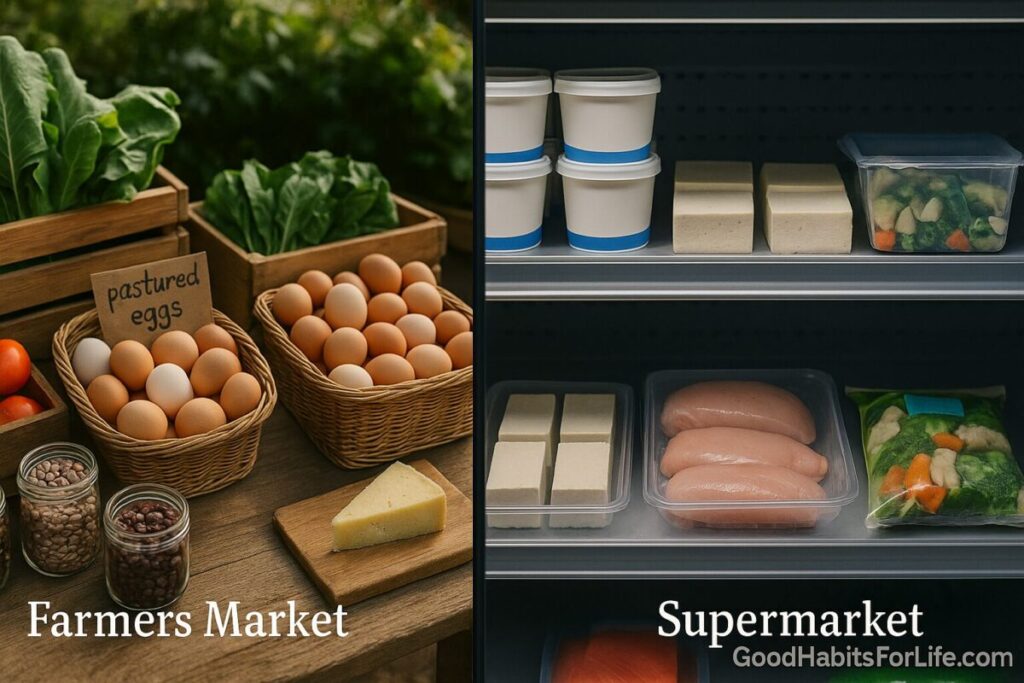
Farmers Market vs Supermarket: What to Buy Where: Protein-Forward Plan (2025)
Farmers Market vs Supermarket: Protein-Forward Guide (2025)
Table of Contents
🧭 What & Why
Goal: Build a weekly eating routine that prioritizes high-quality protein (animal or plant), fresh produce, and smart budgeting by knowing what to buy where.
Why this works
-
Protein anchors meals and supports satiety and muscle maintenance (aim ~0.8–1.2 g/kg/day depending on activity).
-
Freshness & variety: Farmers markets often offer just-harvested produce, pastured eggs, local poultry/dairy, and heirloom beans; supermarkets excel at availability, bulk pricing, and frozen proteins for convenience.
-
Budget control: Choosing the right store per item plus a simple price book typically lowers your weekly spend and food waste.
✅ Quick Start: Today’s 30-Minute Shop Plan
-
Sketch 7 protein anchors for the week (e.g., eggs, yogurt, lentils, chicken thighs, tofu, canned beans, frozen fish).
-
Check seasonality (what’s abundant = cheaper) and your supermarket’s weekly flyer/app.
-
Two-stop strategy (optional): If the market is open, buy freshness-sensitive items there; finish at the supermarket for bulk/freezer staples.
-
Food-safe transport: Bring an insulated bag with ice pack for meat, fish, dairy, and eggs.
-
Batch once: Pre-cook 2 proteins and 1 grain on day 1; assemble fast meals all week.
What to Buy Where (Protein-Forward Focus)
| Item | Farmers Market—Best When | Supermarket—Best When | Notes |
|---|---|---|---|
| Eggs | From small, reputable producers; very fresh | When priced lower in bulk | Store ≤4 °C (≤40 °F); use within 3–5 weeks. |
| Chicken/Turkey | Pasture-raised, pre-chilled, traceable | Bulk packs, frozen thighs/breasts | Freeze portions you won’t cook in 2–3 days. |
| Fish/Seafood | Direct-from-boat vendors, very fresh | Frozen fillets/shrimp for price/availability | Choose sustainable species; thaw in fridge. |
| Beef/Pork | Grass-fed or specialty cuts | Standard cuts, value & family packs | Cook to safe temps; freeze extras. |
| Tofu/Tempeh | Small-batch makers (if available) | Widely available; multi-pack deals | Keep cold; use by date; press tofu for texture. |
| Yogurt/Cheese | Local, artisanal, short ingredient lists | Large tubs, value brands | Plain yogurt = versatile protein + probiotic. |
| Beans/Lentils | Heirloom/dry beans from growers | Canned (no-salt), dry bulk bins | Cook big batch; freeze portions. |
| Nuts/Seeds | Fresh-roasted local stands | Bulk aisle, better prices | Check for rancidity; store airtight, cool. |
| Herbs | Ultra-fresh bunches, unusual varieties | Packaged herbs when market closed | Wash/dry; freeze chopped herbs in oil. |
| Leafy Greens | Just-harvested, more shelf-life | Bagged/boxed for convenience | Store dry; use crispers; eat earliest. |
🗺️ 30-60-90 Protein-Forward Roadmap
30 days — Foundation
-
Set protein target (e.g., 1.0 g/kg/day).
-
Build a 7-meal template: 2 egg meals, 2 legume/tofu meals, 2 poultry/fish, 1 dairy/other.
-
Start a price book (notes app or sheet): item, store, size, ₹/₹100 g (or $/100 g).
60 days — Optimization
-
Add a batch day: cook 1 legume and 1 meat/fish each week.
-
Rotate 3 quick sauces (yogurt-herb, peanut-lime, tomato-spice) to avoid taste fatigue.
-
Shift 20–30% of spend to frozen proteins/veg to reduce waste.
90 days — Mastery
-
Lock a seasonal cycle (spring–summer–autumn–winter favorites).
-
Negotiate regular buys with favorite market vendors (discount boxes, off-cuts).
-
Use inventory caps (e.g., max 3 open sauces, 2 frozen proteins) to keep clutter low.
🧠 Techniques & Frameworks
-
Protein-First Planning: Start each meal with a protein (≈20–40 g), then add veg, complex carbs, and fats.
-
The 3-2-1 Batch: Each week cook 3 proteins (e.g., lentils, chicken, eggs), 2 grains (rice, couscous), 1 tray veg; mix-and-match.
-
Perishability Ladder: Eat highly perishable items first (fish → greens → poultry → eggs/tofu → frozen/canned).
-
Price-Per-Protein: Track cost per 20 g protein serving (beans often win).
-
Freezer Map: Keep a list on the freezer door; label date/portion for fast defrost choices.
-
Food-Safe Temps: Refrigerate ≤4 °C (≤40 °F); cook poultry to 74 °C (165 °F), ground meats 71 °C (160 °F), fish 63 °C (145 °F).
👥 Audience Variations
-
Students: Rely on canned beans, eggs, and frozen fish; buy herbs at the market for flavor pops.
-
Parents: Batch-cook thighs, lentils, and yogurt parfaits; add market fruit/veg for snacks.
-
Professionals: Pre-portion lunch bowls (grain + protein + veg); supermarket rotisserie chicken is a legit shortcut.
-
Seniors: Emphasize easy-chew proteins (yogurt, soft tofu, eggs, poached fish); shop earlier for quieter markets.
-
Teens: Build DIY wraps: eggs, beans, shredded chicken; keep cut veg and yogurt dips ready.
⚠️ Mistakes & Myths to Avoid
-
“Farmers markets are always cheaper.” Sometimes yes, often not—prices vary by season and crop. Compare unit prices.
-
Skipping food safety. Warm rides home spoil proteins—use an ice pack and go straight home.
-
Ignoring frozen fish. Frozen can be fresher than “fresh” that’s been thawed in-store.
-
Buying novelty only. Build your cart around the week’s proteins before treats.
-
Over-buying herbs/greens. They wilt fast; freeze chopped leftovers in olive oil.
💬 Real-Life Examples & Scripts
-
At a poultry stall: “Do you chill immediately after processing? What’s the packed-on date and cut weight?”
-
At an egg vendor: “How old are these eggs? Are they refrigerated at the stall?”
-
At a fish counter: “Is this previously frozen? If yes, when was it thawed? Do you have frozen fillets?”
-
With a bean grower: “Cooking time for this variety? Any soak tips?”
-
Price comparison habit: “I’m tracking cost per 100 g—this bulk pack beats the small one by 18%.”
🧰 Tools, Apps & Resources
-
Market finder/seasonality: National/State farmers-market directories; Seasonal Food Guide.
-
Seafood info: NOAA FishWatch / sustainable-choice guides.
-
Grocery apps: Store flyers, digital coupons, and unit-price calculators.
-
Food safety: CDC/USDA cooking temps & storage charts.
-
Template pack: Price book (columns: Item | Store | Size | Price | ₹/100 g | Notes); Freezer map; Weekly 7-anchor menu.
📌 Key Takeaways
-
Plan protein first, then fill with seasonal produce and wholesome carbs.
-
Buy fresh-critical items from markets when quality/price is right; use supermarkets for bulk and frozen value.
-
Batch once per week and label/freeze to cut waste.
-
Keep a price book and compare unit prices; your weekly bill drops as habits stick.
-
Follow safe storage and cooking temps to keep the gains healthy.
❓ FAQs
1) Are farmers-market eggs safer or more nutritious than supermarket eggs?
Safety depends on handling and temperature control, not the venue. Nutrition varies modestly by hen diet; buy from vendors who refrigerate and rotate stock, and store eggs cold at home.
2) Is “fresh” fish always better than frozen?
Not necessarily. Properly frozen fish can retain quality better than “fresh” that was previously frozen and thawed. Choose what fits your budget, taste, and schedule.
3) What protein staples should beginners prioritize?
Eggs, canned beans/lentils, plain yogurt, frozen chicken thighs, firm tofu/tempeh, and frozen fish. They’re versatile, affordable, and batch-friendly.
4) How much protein do I actually need?
A common benchmark is ~0.8 g/kg/day for healthy adults; active people and older adults may benefit from the higher end (consult a clinician/dietitian for personal targets).
5) Is organic meat at markets always pasture-raised?
No. “Organic” and “pasture-raised” are different claims. Ask vendors how animals are fed/raised and whether products are certified.
6) Best time to get deals at farmers markets?
Near closing (for discounts) or opening (for best selection). Build relationships—regulars often get tips on upcoming bargains.
7) What if I only have time for one stop?
Choose the supermarket and lean on frozen proteins/veg plus one or two fresh items. If the market is logistically easy, flip the strategy.
8) How do I prevent waste with herbs and greens?
Wash, dry thoroughly, and store in breathable bags; or chop and freeze in olive oil portions for quick sauces.
9) Are canned beans okay on a protein-forward plan?
Yes—rinse to reduce sodium. They’re budget-friendly and fast, and pair well with eggs, yogurt sauces, or chicken.
10) Which cooking methods keep protein juicy?
Moist heat (poaching, steaming), pressure cooking for legumes, and quick high-heat searing for tender cuts. Always hit safe internal temps.
📚 References
-
USDA Food Safety & Inspection Service. Safe Minimum Internal Temperatures and refrigeration basics. https://www.fsis.usda.gov/food-safety/safe-food-handling-and-preparation/food-safety-basics
-
Centers for Disease Control and Prevention (CDC). Food Safety: Keep Food Safe! https://www.cdc.gov/foodsafety/keep-food-safe.html
-
Harvard T.H. Chan School of Public Health. Protein—The Nutrition Source (intake ranges, sources). https://www.hsph.harvard.edu/nutritionsource/what-should-you-eat/protein/
-
National Academies of Sciences, Engineering, and Medicine. Dietary Reference Intakes for Protein. https://nap.nationalacademies.org/ (search: “protein DRI”)
-
USDA. Farmers Market & Local Food Directories (find markets; seasonality varies). https://www.ams.usda.gov/local-food-directories/farmersmarkets
-
NOAA FishWatch. Seafood Profiles & Buying Tips. https://www.fishwatch.gov/
-
Seasonal Food Guide (GRACE Communications). What’s in Season Near You. https://www.seasonalfoodguide.org/
-
Michigan State University Extension. Farmers Markets vs. Grocery Stores: Cost and Value (overview & tips). https://www.canr.msu.edu/
Disclaimer: This article provides general nutrition and shopping guidance and is not a substitute for personalized medical or dietary advice.