
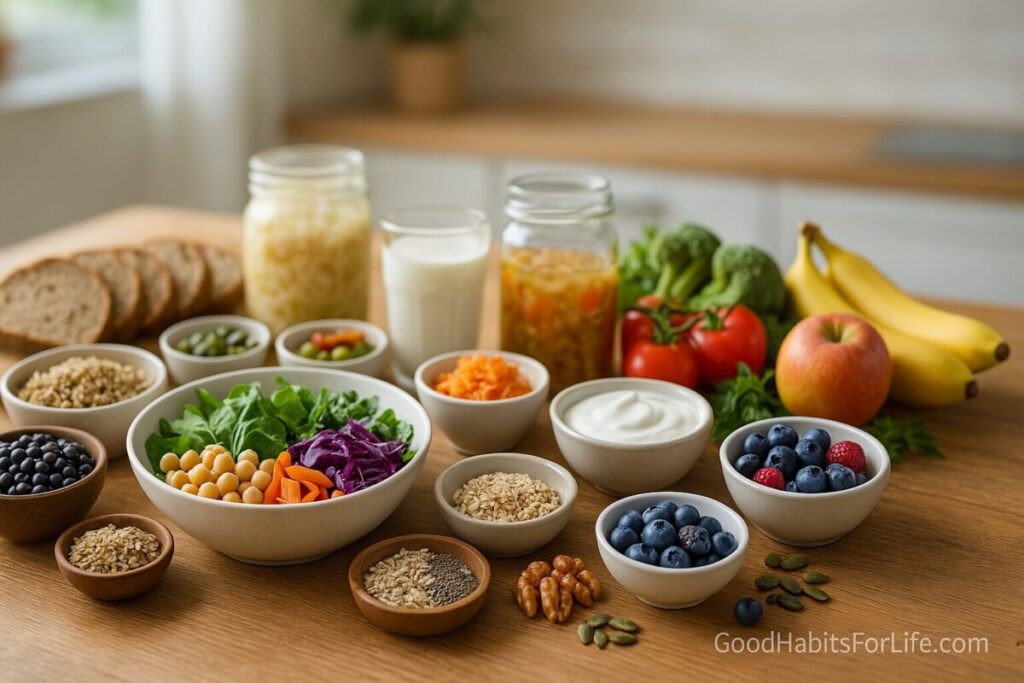
MicrobiomeFriendly Eating (2025): Fiber, Ferments, Variety
Microbiome-Friendly Eating (2025): Fiber, Ferments, Variety
Table of Contents
🧠 What is Microbiome-Friendly Eating?
Definition. Microbiome-friendly eating is a pattern that nourishes your gut microbes—mainly by supplying dietary fiber, fermented foods, and diverse plant foods. These inputs help microbes produce short-chain fatty acids (SCFAs) such as butyrate, acetate, and propionate, linked to gut barrier integrity, metabolic health, and immune regulation (see References).
Why it matters.
-
Fiber (especially prebiotic fibers like inulin, FOS, GOS, and resistant starch) feeds beneficial microbes that generate SCFAs.
-
Fermented foods introduce live and bioactive microbes and compounds that can increase microbial diversity.
-
Variety (many different plants) supplies a broad mix of fibers and polyphenols that different microbes prefer—diversity begets diversity.
Think of your microbes as a bustling city: fiber is the food supply, ferments are friendly visitors and tools, and variety is the city’s job market—more roles, more residents, more resilience.
✅ Quick Start: Do This Today
-
Add one fiber-rich food to each meal.
Examples: oats or millet at breakfast; lentils or chickpeas at lunch; beans or vegetables + whole grains at dinner. -
Include 1 small fermented item daily.
Options: plain yogurt or kefir (125–175 ml), sauerkraut/kimchi (1–2 tbsp), miso in soup, idli/dosa batter, traditionally fermented pickles. -
Count plants, not calories.
Keep a note on your phone—aim for 30 unique plants/week (fruits, veg, grains, legumes, nuts, seeds, herbs, spices, teas). -
Hydrate.
Extra fiber needs fluids. Target ~2–2.5 L/day (8–10 cups), more in hot climates or with activity. -
Go slow.
Increase fiber gradually over 1–2 weeks to reduce gas/bloating. -
Cook simply.
Use a one-pot template: onion + legume + veg + whole grain + spices + lemon/yogurt.
🛠️ 30-60-90 Day Habit Plan
Outcome target: Consistently average ≥30 g fiber/day, 1–2 fermented servings/day, and 30 plants/week.
Days 0–30: Foundation
-
Breakfast habit: 1 high-fiber base (oats/millet/whole-grain toast) + fruit + nuts/seeds.
-
Daily ferment: Choose one default (e.g., plain yogurt at lunch).
-
Plant count: Hit 15 unique plants/week.
-
Track: Log fiber once/day (approximate is fine).
Checkpoint: Less bloating? More regularity? If excess gas, scale back slightly and re-ramp.
Days 31–60: Build
-
Legume ladder: Add legumes 3–5 days/week (dal, chana, rajma, hummus, lentil soups).
-
Ferment variety: Rotate yogurt/kefir/kimchi/miso.
-
Plant count: Reach 25/week with herbs & spices (they count!).
-
Resistant starch: Try cooked-and-cooled potatoes/rice or green bananas 2–3×/week.
Checkpoint: Fiber average ~25–30 g/day; you’ve got a go-to fermented option.
Days 61–90: Lock-In
-
30 plants/week target.
-
Two ferments/day on most days (e.g., yogurt + 1–2 tbsp sauerkraut/kimchi).
-
Whole-grain swap: Make 50–75% of grains whole (brown rice, whole-wheat roti, oats, millet).
-
Refine routine: Batch-cook legumes; prep slaws; keep a “ferments shelf” in the fridge.
Checkpoint: Comfortable digestion, energy steady, habits feel automatic.
🧭 Techniques & Frameworks
1) The 3F Framework: Fiber • Ferments • Food Variety
-
Fiber: Aim ≥30 g/day; use legumes, whole grains, veg, fruit, nuts, seeds.
-
Ferments: 1–2 servings/day of live-culture foods.
-
Food Variety: Count unique plants weekly (goal: 30).
2) 30-Plants Challenge
-
Each unique plant counts once per week.
-
Include herbs/spices (coriander, cumin, turmeric), teas/cocoa, and mixed dishes.
3) Fiber Ladder (gentle ramp)
-
Start 10–15 g/day.
-
Add 5 g every 3–4 days.
-
Pause/hold if bloating; increase fluids.
4) Plate Template (easy visual)
-
½ plate: colorful veg/salad.
-
¼ plate: whole grains or starchy veg.
-
¼ plate: legumes/beans, tofu, or other protein.
-
Plus: 1 fermented condiment; nuts/seeds sprinkle.
5) Polyphenol Boosters
-
Berries, cocoa, tea/coffee, olives, herbs/spices support microbial metabolism—include daily.
👥 Audience Variations
-
Students/Busy Professionals:
Keep shelf-stable helpers: canned beans, frozen veg, plain yogurt cups, whole-grain wraps, microwaveable brown rice. Use 10-minute meals (see scripts). -
Parents & Kids:
Start with fruity kefir smoothies; add beans to tacos/pulao; include crunchy veg sticks; involve kids in counting weekly plants. -
Seniors:
Prioritize chewable fiber (cooked veg, soups, stews) and hydration. If appetite low, use smoothies with oats, flax, and yogurt. -
Vegetarian/Vegan:
Ferments beyond dairy (kimchi, sauerkraut, tempeh, miso). Consider B12 from fortified foods/supplements per clinician guidance. -
Sensitive GI (e.g., IBS):
Some fibers/ferments can trigger symptoms. A dietitian-guided low-FODMAP approach may help short-term; re-expand variety gradually.
⚠️ Mistakes & Myths to Avoid
-
Myth: “Probiotic pills alone fix the microbiome.”
Reality: Diet pattern (fiber + variety) is foundational; supplements are situational. -
Mistake: Jumping to 35–40 g fiber overnight.
Ramp slowly and drink fluids. -
Myth: “All fermented drinks are healthy.”
Check added sugar and alcohol content; choose minimally sweetened options. -
Mistake: Ultra-processed choices crowding out whole foods.
Some ultra-processed foods are okay, but a whole-food base should dominate. -
Myth: “Gluten-free is automatically better for the gut.”
Unless medically indicated, whole-grain wheat/rye/barley provide beneficial fibers.
💬 Real-Life Examples & Scripts
5-Minute Breakfasts
-
Overnight oats: oats + milk/yogurt + chia + banana + cinnamon.
-
Kefir bowl: kefir + berries + walnuts + cocoa nibs.
-
Millet upma with peanuts and peas (make-ahead).
10-Minute Lunches
-
Chickpea wrap: whole-grain wrap + hummus + slaw + pickled veg.
-
Dal + rice (microwaveable packs) + cucumber raita (fermented dairy).
-
Bean salad: beans + tomato + onion + herbs + lemon + olive oil.
15-Minute Dinners
-
Stir-fry: tofu/tempeh + mixed veg + brown rice; finish with kimchi.
-
Rajma or chana (pressure-cooked/batch-cooked) + roti + salad.
-
Veg-loaded pasta with whole-wheat spaghetti + olive oil + garlic + olives + greens.
Implementation Intentions
-
“After I brew my morning tea, I’ll add fruit + nuts to breakfast.”
-
“When I plate dinner, I’ll add one fermented condiment.”
-
“Every Sunday, I’ll plan 30 plants for the week.”
🧰 Tools, Apps & Resources
-
Cronometer / MyFitnessPal — estimate fiber; helpful but don’t obsess.
Pros: awareness; Cons: time-consuming, database variance. -
Habit trackers (TickTick, Loop, Streaks) — log daily ferment + plant count.
-
Label-reading tip: Choose grains with ≥6 g fiber/100 g; yogurts with live cultures and ≤6–8 g added sugar/100 g.
📌 Key Takeaways
-
Fiber first: target ~30 g/day; increase gradually.
-
Ferments daily: small, consistent servings.
-
Diversity wins: count unique plants (aim 30/week).
-
Hydration + patience: your gut adapts in weeks, not hours.
-
Make it automatic: use the 30-60-90 plan and simple plate templates.
❓ FAQs
1) How fast can the microbiome change after diet changes?
Measurable shifts can occur in days to weeks, while stable, beneficial patterns develop over months of consistent habits.
2) What are easy high-fiber wins if I’m new to legumes?
Start with red/yellow lentils (dal), hummus, or canned beans rinsed well; combine with rice/roti and vegetables.
3) Do I need probiotic supplements?
Not necessarily. For most healthy adults, a fiber-rich diet plus fermented foods is a strong baseline. Supplements may be useful in specific cases under clinician guidance.
4) Are coffee and tea okay for the microbiome?
Yes in moderation. They contain polyphenols that microbes metabolize; watch added sugar and excess caffeine.
5) What about kombucha?
Can fit in small amounts. Choose low-sugar versions; it’s not a cure-all.
6) Is low-carb or keto compatible with microbiome goals?
Possible but challenging; ensure non-starchy veg, nuts/seeds, and fermented foods to maintain fiber and variety.
7) Can kids have fermented foods?
Generally yes in small amounts (e.g., yogurt, idli/dosa batter, sauerkraut). Watch salt/spice levels and allergy considerations.
8) I get gas with beans—what helps?
Soak, rinse, cook thoroughly; start with lentils; try smaller, frequent portions; increase fiber gradually.
9) Are artificial sweeteners bad for the microbiome?
Evidence is mixed and evolving. Prioritize whole foods and minimize very sweet beverages—whether sugar or sweeteners—if they displace nutrient-dense options.
10) Do herbs and spices count toward the 30-plants goal?
Yes—they count and are easy wins for variety and polyphenols.
📚 References
-
U.S. National Academies (Dietary Reference Intakes for Fiber): Adequate Intake ≈ 14 g fiber per 1000 kcal; adults often 25–38 g/day. https://nap.nationalacademies.org/catalog/10490/dietary-reference-intakes
-
Harvard T.H. Chan School of Public Health — Fiber and Health. https://www.hsph.harvard.edu/nutritionsource/carbohydrates/fiber/
-
ISAPP (International Scientific Association for Probiotics and Prebiotics): Prebiotics definition and evidence. https://isappscience.org/
-
Wastyk HC et al., Cell (2021): Fermented-food diet increased microbial diversity and decreased inflammatory markers. https://doi.org/10.1016/j.cell.2021.06.019
-
Conlon & Bird, Nutrients (2015): Role of SCFAs from dietary fiber in gut health. https://doi.org/10.3390/nu7085231
-
British Dietetic Association — Food Fact Sheet: Fibre (practical targets and tips). https://www.bda.uk.com/resource/fibre.html
-
The American Gastroenterological Association — Patient info on diet, gut health, and probiotics. https://gastro.org/practice-guidance/gi-patient-center/
-
De Filippis F. et al., Gut (2016): Mediterranean-style, plant-rich eating linked to higher SCFAs and beneficial microbes. https://doi.org/10.1136/gutjnl-2015-309957
-
Selma MV et al., J Agric Food Chem (2009) & reviews on polyphenols–microbiota interactions. https://doi.org/10.1021/jf902107d
-
Sonnenburg & Sonnenburg, Cell (2014) and follow-ups: Diet-microbiota co-evolution and fiber deprivation effects. https://doi.org/10.1016/j.cell.2014.05.050
⚖️ Disclaimer
This article is for general education only and is not a substitute for personalized medical or dietetic advice; consult your clinician for individual guidance.