
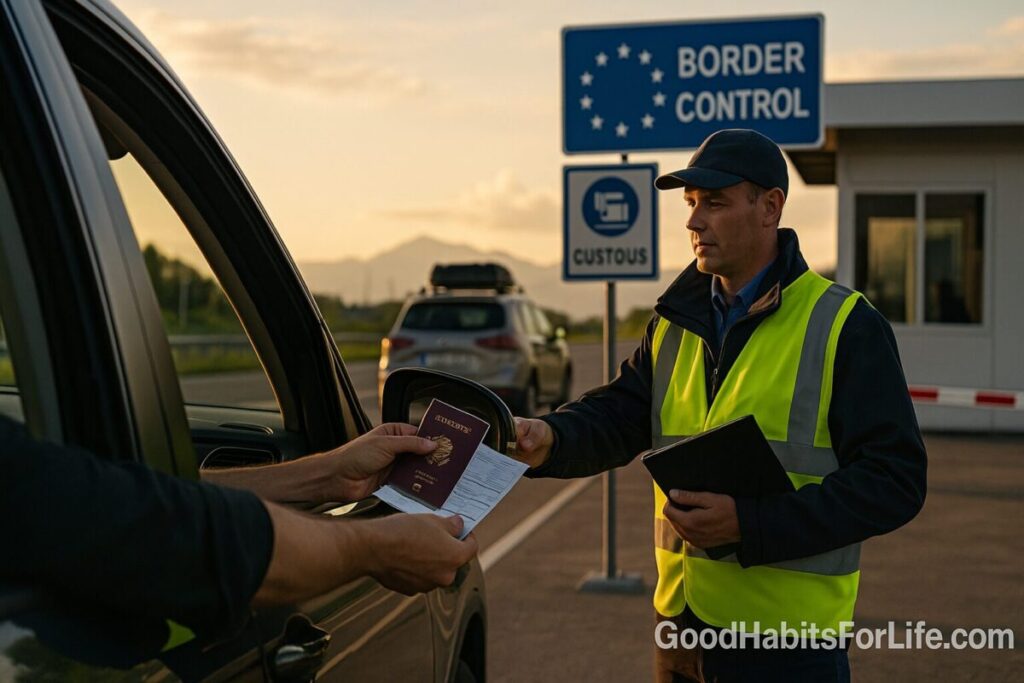
Border Crossings by Road: Documents & Etiquette
Border Crossing by Road: Documents & Etiquette
Table of Contents
🧭 What “Border Crossing by Road” Means & Why It Matters
Crossing an international border by car, motorcycle, RV, bicycle, or on foot means you and your vehicle must meet both immigration rules (for people) and customs rules (for goods/vehicles). Preparation saves time, money, and stress. It also reduces the chance of refusal, fines, or delays at the booth.
Benefits of planning ahead:
-
Faster processing and fewer secondary inspections.
-
Lower risk of fines for undeclared goods or missing papers.
-
Safer trips—legal insurance, appropriate equipment, and a clear route.
✅ Documents You’ll Typically Need (Adults, Minors, Vehicle)
For travelers (adults):
-
Passport (valid for the required period; some borders accept passport cards/EDLs for specific land/sea crossings).
-
Visa or e-Visa (if required for your nationality/destination).
-
Residence permit/BRP (if returning to a host country).
-
International Driving Permit (IDP) if your license isn’t in a language accepted locally.
-
Health documents if applicable (e.g., proof of required vaccinations in a few countries).
For minors:
-
Passport (and visa if required).
-
Consent letter if a child is traveling with one parent/guardian or someone else, including contact details for the non-traveling parent(s).
-
Birth certificate copy may be requested by some authorities to verify relationship.
For the vehicle:
-
Registration/title (or rental contract).
-
Insurance proof valid in the destination (e.g., “Green Card” in parts of Europe, frontier insurance, or country-specific liability cover).
-
Permission letter from the owner if the vehicle is borrowed or company-owned.
-
Temporary Import Permit (TIP) where required (e.g., for some countries when bringing a foreign-plated car).
-
Road-use items mandated in certain countries (e.g., reflective vests, warning triangle, spare bulbs).
Pro tip: Keep paper originals neatly in a folder and digital scans in cloud storage for backup.
🛠️ Quick-Start: Do-This-Today Checklist
-
Check whether you need a visa and the entry rules for your nationality.
-
Verify passport validity and blank pages.
-
Confirm car insurance is valid across the border (upgrade/buy frontier insurance if not).
-
Download official border wait-time and maps apps; identify two alternate crossings.
-
Prepare a consent letter if traveling with kids without both legal guardians.
-
Review customs allowances for food, alcohol, tobacco, and cash thresholds.
-
Print a vehicle permission letter if the car is rented/borrowed.
-
Save emergency numbers, nearest consulate, and roadside assistance.
🗺️ Choosing the Right Crossing & Time
-
Hours of operation: Some crossings aren’t 24/7.
-
Traffic patterns: Weekends, holidays, and commuting hours can spike lines.
-
Commercial vs. passenger lanes: Follow signage; wrong lanes cause delays.
-
Real-time tools: Use official wait-time sites and highway advisories.
-
Plan B: Identify a secondary crossing 30–60 km away in case of closures.
📦 Customs, Declarations & Allowances
-
Declare everything that must be declared (food, alcohol, tobacco, gifts, commercial goods, and cash over the threshold—amounts differ by country).
-
Personal medications: Bring them in original packaging with prescriptions.
-
Agricultural items: Many borders restrict fresh fruits, vegetables, plants, seeds, and soil.
-
High-value electronics: Keep receipts handy; rules differ for temporary export/re-import.
-
Duty-free limits: Know your personal exemption (varies by country and time abroad).
Tip: If unsure, ask before you cross or declare proactively. Honest declarations are usually faster than penalties.
👨👩👧 Kids, Pets & Special Items
-
Children: Consent letter, emergency contacts, and custody documents (if applicable).
-
Pets: Microchip, rabies vaccination certificates, health certificate, and sometimes import permits/quarantine depending on destination.
-
Sports/hobby gear: Firearms, drones, radios, and pro camera gear can have extra rules—research in advance.
🚗 Vehicle Rules: Insurance, Permits & Equipment
-
Insurance: Your home policy may not cover you abroad. Some regions require a Green Card (proof of third-party liability). If not covered, buy frontier insurance at or near the border.
-
Temporary Import Permit (TIP): Required in some countries for foreign-plated vehicles; bring registration, passport, and sometimes a refundable guarantee.
-
International Driving Permit (IDP): A translation of your license, recognized under UN road conventions.
-
Mandatory equipment: Certain countries legally require warning triangles, reflective vests, spare fuses/bulbs, first-aid kit, or headlamp beam deflectors.
-
Tolls & vignettes: Many European/Asian highways use vignettes or electronic tolls; buy before or right after entry.
🧠 Border Etiquette: How to Handle Questions
-
Be ready: Windows down, sunglasses off, engine low/idle, documents in hand.
-
Phones away: No filming at the booth; it slows you down.
-
Answer briefly & truthfully: Stick to the question asked.
-
No jokes about contraband or immigration status.
-
Declare proactively: “I have food to declare—sealed snacks and fruit.”
-
Stay calm: If selected for secondary, follow instructions; it’s routine.
✅ 7-Day Starter Plan + Day-Of Checklist
7-Day Starter Plan
-
Day 1: Confirm visa policy; book e-visa/appointments if needed.
-
Day 2: Check passport validity; print copies and scan to cloud.
-
Day 3: Call insurer; add cross-border coverage or arrange frontier insurance.
-
Day 4: Gather vehicle papers; get owner permission letter (if borrowed/rented).
-
Day 5: Prepare customs list (gifts, food, alcohol) and check allowances.
-
Day 6: Draft child consent letter; print pet papers if applicable; pack required vehicle equipment.
-
Day 7: Save alternate routes/crossings offline; check hours/closures.
Day-Of Checklist
-
Full fuel, tire pressure, coolant; paper folder with passport/visa/insurance/TIP.
-
Snacks and water (check what’s allowed).
-
Border wait-time checked; choose best crossing.
-
Cash/card for tolls; small bills for local fees where applicable.
-
Calm, courteous approach; answer questions clearly.
⚠️ Common Mistakes & Myths
-
“Driver’s license is enough.” Often false; a passport is usually required, and sometimes a visa.
-
Ignoring insurance. Uninsured driving abroad can mean fines or vehicle seizure.
-
Bringing restricted foods/plants. Agricultural controls are strict.
-
Not declaring cash. Exceeding thresholds without declaration can result in seizures.
-
Joking at the booth. Humor can be misread and cause delays.
-
Assuming rentals are fine to cross. Many contracts prohibit border exits without written permission.
💬 Real-Life Scripts (Copy-Paste)
Primary inspection, typical questions
-
Officer: “Citizenship?”
You: “Indian. Here’s my passport and visa.” -
Officer: “Where are you going and for how long?”
You: “Three days in Toronto to visit family. Returning Monday.” -
Officer: “Anything to declare?”
You: “Yes—sealed snacks and a small gift worth about ₹3,000.”
Declaring borrowed car
-
“This is my brother’s vehicle. Here is the permission letter, registration, and insurance valid for [country].”
Traveling with a child without the other parent
-
“I’m the mother. Here is the consent letter from the father with contact details, plus the child’s birth certificate copy.”
🧰 Tools, Apps & Resources (brief pros/cons)
-
Official border wait-time sites (pros: authoritative; cons: may lag a bit).
-
Government travel advisories (pros: visa/docs clarity; cons: general, not tailored).
-
Maps with offline mode (pros: coverage when data drops; cons: storage).
-
Insurance portals/frontier insurance desks (pros: legal compliance; cons: extra cost).
-
Consular phone numbers (pros: emergency help; cons: business hours vary).
📚 Key Takeaways
-
Pack people documents (passport/visa/IDP) and vehicle documents (registration, insurance, permits).
-
Know what to declare and duty limits.
-
Use official wait-time tools and choose smart timing.
-
Follow etiquette: be prepared, honest, and respectful.
-
Run the 7-day plan + day-of checklist for a smoother crossing.
❓ FAQs
1) Do I always need a passport to cross by land?
Usually yes. A few border programs or ID types work only on specific corridors (e.g., passport cards/EDLs in limited regions). When in doubt, bring a passport.
2) Is my driver’s license valid in the next country?
Often yes for short visits, but many places also expect an IDP as a translation. Check local rules.
3) What is frontier insurance?
Border-sold liability insurance for drivers whose home policy isn’t recognized in the destination. It proves legal minimum coverage.
4) Do I need a Temporary Import Permit (TIP)?
Some countries require a TIP for foreign-plated vehicles. You’ll usually show registration, passport, and pay a fee/deposit.
5) What are cash declaration rules?
If you carry cash/monetary instruments above a set threshold, you must declare it when entering/leaving (amount varies by country).
6) Can I bring food?
Packaged, shelf-stable items are often allowed; fresh produce, meat, and plants may be restricted. Check agricultural rules.
7) What if I’m refused entry?
Stay polite, ask for the reason, and what you can do next (e.g., obtain a visa, add insurance). Try another day/crossing once compliant.
8) Are rental cars allowed to cross borders?
Only with written permission in the rental agreement and appropriate insurance. Call the agency before you book.
9) How early should I arrive?
Plan buffer time (60–120 minutes at busy crossings or holidays) and check wait-time tools the morning of travel.
10) Do kids need a consent letter?
If a child is traveling with one parent/guardian or another adult, a consent letter is strongly recommended and sometimes requested.
📚 References
-
U.S. Department of Homeland Security — Western Hemisphere Travel Initiative (WHTI): https://www.dhs.gov/western-hemisphere-travel-initiative
-
U.S. Customs and Border Protection — Travel & Border Wait Times: https://bwt.cbp.gov/
-
Government of Canada — Border Wait Times (CBSA): https://www.cbsa-asfc.gc.ca/bwt-taf/menu-eng.html
-
Government of Canada — Travel with Children (consent letter guidance): https://travel.gc.ca/travelling/children/consent-letter
-
European Union — Schengen Borders Code (Regulation (EU) 2016/399): https://eur-lex.europa.eu/legal-content/EN/TXT/?uri=CELEX:32016R0399
-
UNECE — International Conventions on Road Traffic (IDP context): https://unece.org/transport/road-safety/conventions
-
European Commission — Motor Insurance & Green Card system overview: https://transport.ec.europa.eu/transport-themes/road/motor-insurance_en
-
Mexico National Migration Institute (INM) — Forma Migratoria Múltiple (FMM): https://www.gob.mx/inm/acciones-y-programas/forma-migratoria-multiple
-
Banjército — Temporary Vehicle Import Permit (Mexico): https://www.banjercito.com.mx/registroVehiculos/
-
U.S. Department of State — Traveling with Children: https://travel.state.gov/content/travel/en/international-travel/before-you-go/travelers-with-special-considerations/children.html
-
WHO — International Travel & Health (general health requirements): https://www.who.int/ith/en/
-
European Consumer Centre — Driving Abroad (equipment, documents): https://www.ecc-net.eu/consumers/driving-abroad
Disclaimer: This guide provides general travel information, not legal or immigration advice—always verify current requirements with official sources before you go.