
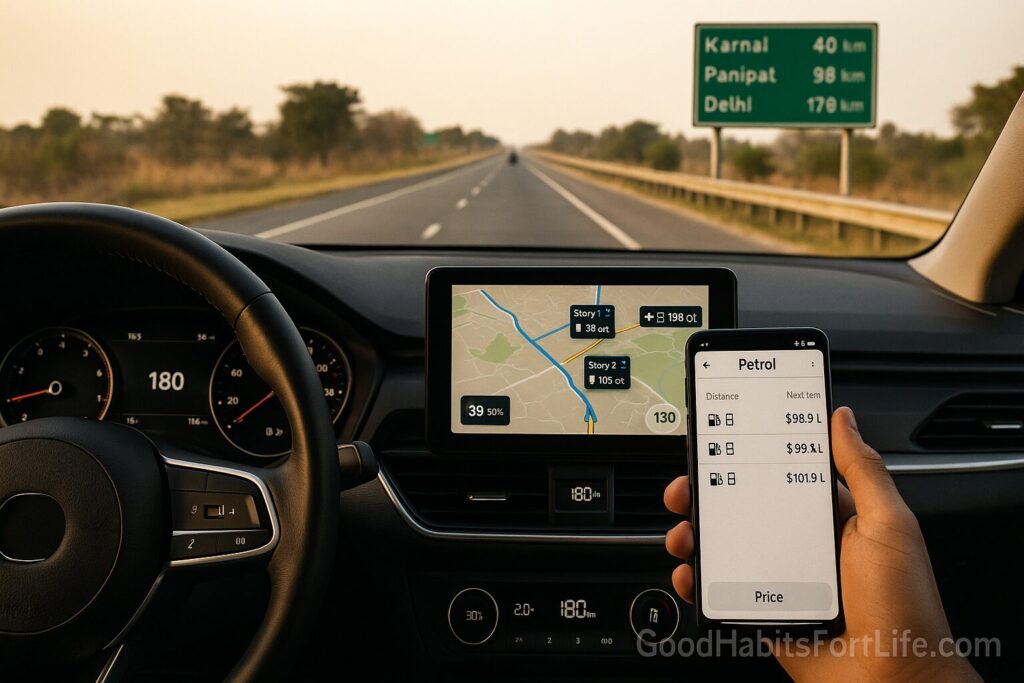
Fuel Strategy: Range, Refills, & Price Apps
Fuel Strategy: Range, Refills & Price Apps
Table of Contents
🧭 What “Fuel Strategy” Means & Why It Matters
A fuel strategy is a simple plan that combines (a) realistic driving range, (b) smart refueling points, and (c) price data—so you spend less, avoid range anxiety, and keep your trip on schedule. It turns “hope we find a station” into “we know exactly where to stop, how much to pay, and how to stretch the tank.”
Benefits
-
Lower cost per kilometre through cheaper stations and efficient driving.
-
Fewer stressful “low-fuel” moments; safer choices in remote stretches.
-
Predictable stop cadence that fits meals, restrooms, and fatigue breaks.
✅ Quick Start: 15-Minute Setup
-
Find your real-world economy: note your last 3–5 tanks (or car display) and take a conservative figure (e.g., 15 km/L if recent average is 16–17).
-
Do range math: tank size × conservative economy. Keep 20–30% buffer for hills, A/C, traffic.
-
Open Google Maps: plot your route; toggle the fuel layer (where available).
-
Check a price app: shortlist 2–3 on-route stations at 250–350 km intervals (adjust to your car).
-
Set refuel rule: on highways, refuel at ~⅓ tank or ~30–40% remaining—so a closure or queue won’t trap you.
-
Add to itinerary: star those stations, add notes (hours, amenities), and save a backup in Notes.
-
Prep the car: tire pressure to door-jamb spec; remove roof box/extra cargo; set Eco/cruise.
🧮 Range Math 101 (with examples)
Formula:
Usable range ≈ (tank size in L × conservative km/L) × 0.8 (keeps 20% buffer)
Example: 45 L tank × 16 km/L = 720 km theoretical.
With 20% buffer → 576 km usable. Plan refuels every 300–350 km so you’re always ahead of the game.
Diesel vs petrol: Diesel cars often deliver steadier highway economy; petrol can vary more with speed/A/C. Turbo-petrols may sip on cruise but surge under load—keep the buffer.
Hilly/remote legs: Increase buffer to 30–35%; pre-confirm long-hour stations.
🛣️ Refuel Plan: When, Where, How
When
-
Highway trips: top up at ~⅓ tank (or ~30–40% remaining).
-
Urban days: aim for early morning or non-peak times when stations are quieter.
Where
-
Prefer on-route stations near interchanges (fast exit/entry).
-
Check amenities (restrooms, food, air, windshield cleaning) and safety (lighting, CCTV).
-
For rural legs, call ahead (where numbers are listed) to confirm fuel type/availability.
How
-
Pay method: keep one card + one UPI/wallet (or local equivalent) + some cash.
-
Fill to click-off; don’t top off (prevents vapor recovery issues and spills).
-
Save your receipt or snap the pump readout (helps cost tracking).
📱 Price Apps & Tools (mini-comparison)
| Tool | Best For | Notes |
|---|---|---|
| Google Maps fuel layer | Quick scan of nearby prices (where supported) | Works with your route; pair with station reviews/amenities. |
| GasBuddy (NA) | Crowdsourced prices, trends, deals | Robust coverage; join-to-save options in some areas. |
| Waze | Live reports + on-the-way prices | Good for traffic + station detours. |
| Fuelio (Android) | Logbook: economy, cost per km | Great for long-term tracking; manual price entry. |
| PetrolPrices (UK) or AA apps | Regional accuracy | Country-specific; verify coverage before trips. |
Tip: Prefer on-route cheap stations over big detours; a 10 km detour may erase any savings.
🛠️ Techniques to Stretch Your Range
Drive at efficient speeds. Fuel economy typically drops rapidly above ~80 km/h (50 mph); the DOE estimates every extra 8 km/h (5 mph) over 50 mph is like paying more per litre (per gallon in US). Sit in the right/centre lane and let cruise control hold steady when traffic allows. The Department of Energy’s Energy.gov
Avoid aggressive inputs. Hard acceleration, speeding, and heavy braking can lower highway economy by ~15–30% and city by ~10–40%. Look far ahead, feather the throttle, and keep gaps. The Department of Energy’s Energy.gov
Keep tires at spec. Proper inflation can improve mileage ~0.6% on average (up to ~3%) and keeps handling predictable. Check “cold,” at least monthly and before trips. afdc.energy.gov
Mind A/C and climate loads. Using A/C—especially on Max—can trim MPG by ~5–25% depending on conditions; prefer flow-through ventilation at low speeds and use A/C wisely at highway speeds for comfort/safety. fueleconomy.gov
Reduce drag and weight. Roof boxes can cut fuel economy 6–17% on highways; remove them when not in use. Clear heavy clutter; every extra 45 kg (100 lb) costs roughly ~1% MPG, more in small cars. fueleconomy.gov
Don’t idle. If you’re stopped more than ~10 seconds (not in traffic), shut down—idling wastes more fuel than a restart on modern cars. oee.nrcan.gc.ca
Know your sweet spot. An ORNL analysis across 74 vehicles found best efficiency near the lowest speed in top gear; the drop from 60→70 mph averaged ~14%. The Department of Energy’s Energy.gov
Maintenance matters. Correct oil grade, alignment, clean filters (as per manual), and no brake drag keep rolling resistance and consumption down. fueleconomy.gov
Safety first: Use cruise only in steady traffic on dry roads. Never “draft” large vehicles—dangerous and illegal in many places.
👥 Audience Variations
-
Families: Add more buffer (30%+), pre-pick stations with clean restrooms/play areas.
-
Professionals (sales/drivers): Track cost per kilometre in Fuelio/Sheets; set weekly tire-pressure checks.
-
Students/first-time road-trippers: Keep one “backup” station every 100–150 km starred in Maps.
-
Seniors: Choose stations with full-service options where available; avoid late-night low-lit stops.
-
Diesel owners: Cold-start idling is rarely necessary; follow glow-plug indicators and manufacturer guidance.
⚠️ Mistakes & Myths to Avoid
-
“Premium fuel gives better mileage.” Unless your owner’s manual requires higher octane, premium typically offers no benefit in mileage or performance. GovInfo
-
Running to empty “uses the whole tank.” Low-fuel driving risks pump damage (fuel cools/lubricates it) and leaves no buffer for closures or traffic.
-
Huge detours for cheap fuel. A 15–20 km detour can wipe out any per-litre savings.
-
Topping off after click-off. Can damage the evaporative system and spill fuel.
-
Ignoring tire pressure lights. Even minor under-inflation compounds drag and tire wear. fueleconomy.gov
🧪 Real-Life Examples & Scripts
Phone note template (copy-paste):
-
Route: NH-xx → City B → City C
-
Car & economy (conservative): 16 km/L; Tank 45 L; Usable 575 km
-
Refuel rule: stop at ~⅓ tank or ~180–200 km when convenient
-
Starred stations (MM:SS from start):
-
Highway Plaza East, km 210 — clean restrooms, air, card/UPI
-
GreenFuel Hub, km 380 — 24×7, windshield wash, snacks
-
Backup: City C bypass, Exit 14
-
Map search script:
“Fuel near me on route” → filter by Open now, pick stations on the same carriageway, check reviews for crowding/cleanliness, then star and Add stop.
At the pump:
“Regular unleaded to first click-off, please. I’ll pay by card.”
🧰 Tools & Resources
-
Google Maps fuel prices & station reviews — quick on-route checks.
-
GasBuddy — crowdsourced pricing + price alerts (NA).
-
Waze — traffic + price overlays and community reports.
-
Fuelio — mileage/cost tracking, export to CSV.
-
PetrolPrices (UK) / local motoring club apps — country-specific coverage.
-
Tire-pressure gauge & portable inflator — tiny cost, huge payoff.
📆 30-60-90 Fuel-Smart Habit Plan
Days 1–7 (Setup)
-
Log two fill-ups; set conservative km/L.
-
Check/adjust tire pressure; remove roof box/clutter.
-
Install a price app; star two dependable stations on common routes.
Days 8–30 (Consistency)
-
Use the ⅓-tank rule; stop at starred stations only.
-
Hold a steady, efficient speed on highways; avoid hard inputs.
-
Track cost per km in a simple sheet (km, litres, price).
Days 31–60 (Optimization)
-
Compare average cost per km across station choices; refine your “preferred” list.
-
Add a quarterly “car efficiency check” (pressure, alignment, oil grade).
-
Test a gentle +2 psi (within door-jamb max) if allowed by your manual for sustained highway trips.
Days 61–90 (Scale)
-
Build route packs for your top 3 long drives with pre-picked stops.
-
Share a family copy in Google Maps “Lists” so everyone can follow the same plan.
📌 Key Takeaways
-
Do the math once; keep a 20–30% buffer and you’ll never sweat low-fuel warnings.
-
On-route, reliable stations beat chasing the absolute lowest price off-route.
-
Smooth driving, correct pressure, smart A/C use, and less drag = meaningful range.
-
A simple ⅓-tank refuel rule + price apps is all most trips need.
❓ FAQs
1) How low should I let the tank go on highways?
Aim to refuel around ⅓ tank; it keeps a safety margin for traffic, weather, or closed stations.
2) Is it worth a long detour to save a few cents per litre?
Usually no. A 10–20 km detour plus time lost often cancels savings. Prefer on-route stations that are consistently fair-priced.
3) Does premium fuel improve mileage in a car that recommends regular?
Generally no; unless your manual requires high octane, premium rarely increases fuel economy. GovInfo
4) Should I idle to warm up?
Not in modern fuel-injected cars. Drive off gently; if you’ll be stopped >10 seconds (not in traffic), shut down. oee.nrcan.gc.ca
5) What speed is most efficient?
It varies by car, but many see peak efficiency at the lowest speed in top gear; fuel economy drops quickly past ~80 km/h (50 mph). The Department of Energy’s Energy.gov+1
6) Do roof boxes hurt highway range a lot?
Yes—tests show 6–17% loss on highways. Remove when not needed. fueleconomy.gov
7) How often should I check tire pressure?
Monthly, and before road trips. Proper inflation can save ~0.6–3% fuel and improve safety. afdc.energy.gov
8) Is A/C or open windows better?
A/C can reduce economy ~5–25%; at higher speeds, moderate A/C is usually better than big open windows for comfort and noise. fueleconomy.gov
📚 References
-
U.S. DOE Energy Saver — Fuel Economy: Driving More Efficiently (aggressive driving impact). The Department of Energy’s Energy.gov
-
U.S. DOE Energy Saver — Fuel Economy (speed over 50 mph and cost equivalent). The Department of Energy’s Energy.gov
-
U.S. DOE Alternative Fuels Data Center — Gas-Saving Tips (tire pressure 0.6–3%). afdc.energy.gov
-
FuelEconomy.gov — Factors Affecting Fuel Economy (A/C, terrain, cargo). fueleconomy.gov
-
FuelEconomy.gov — Driving Habits & Car Tips (roof boxes drag, weight effect). fueleconomy.gov
-
Natural Resources Canada — Idling FAQs (10-second guideline). oee.nrcan.gc.ca
-
U.S. DOE Vehicle Technologies Office — Fact #982: Slow Down to Save Fuel (ORNL speed study). The Department of Energy’s Energy.gov
-
FuelEconomy.gov — Keeping Your Car in Shape (maintenance factors). fueleconomy.gov
-
U.S. Federal Trade Commission — Facts about Octane Ratings (no benefit of premium if not required). GovInfo