
Shrinkflation Spotter: Unit-Price Math Youll Actually Use: No-Spend Challenge (2025)
Shrinkflation Spotter: Unit-Price Math (2025 Guide)
Table of Contents
🧭 What Is Shrinkflation & Why Unit Price Wins
Shrinkflation is when a product quietly shrinks in size but the sticker price stays the same (or rises slightly). You pay more per unit even if the package looks familiar. National statistical offices and economists track these changes because they affect the true cost of living. Office for National Statistics
Most regions require stores to show a unit price (price per kg, L, 100 g, etc.) so shoppers can compare apples to apples. Learn to lean on that line on the shelf tag—it’s your first defense. European CommissionGOV.UK
The only number that matters:
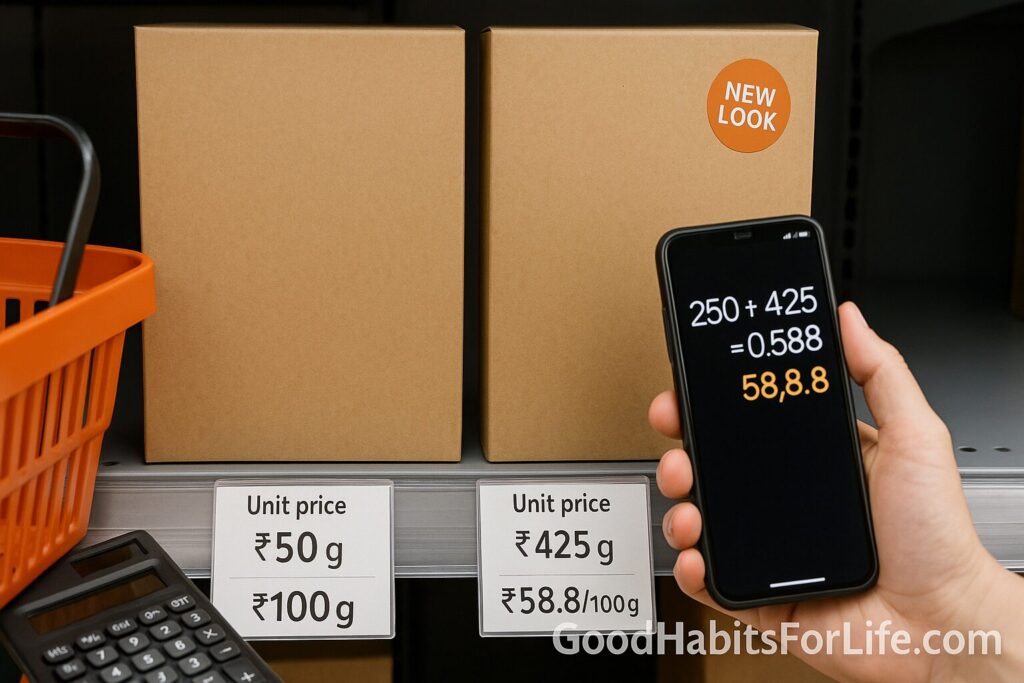
Unit price = Total price ÷ Quantity (convert to a common unit like ₹/100 g or $/oz).
This simple habit neutralizes tricky packaging, “new look—same great taste,” and confusing promos. Public agencies like MyPlate and SNAP-Ed teach this exact formula. MyPlateSnap Ed NY
✅ Quick Start: 3 Steps You Can Do Today
-
Standardize your unit. For dry goods, compare ₹ per 100 g (or $ per oz). For liquids, use ₹ per 100 mL (or $ per fl oz).
-
Check the shelf tag’s unit price (often bottom-left). If it’s missing or uses odd units, convert with your phone calculator. GOV.UK
-
Ignore “family size.” Buy the lowest unit price that fits your budget and storage.
Example table (real-world style):
| Product | Pack Price | Size | Your Unit (₹/100 g) | Winner |
|---|---|---|---|---|
| Oats Brand A | ₹199 | 500 g | ₹39.8 | |
| Oats Brand B | ₹349 | 1 kg | ₹34.9 | ✅ |
| Oats Brand C (promo 2 for ₹250) | ₹125 | 300 g | ₹41.7 |
🛠️ The Habit Plan: 7-Day Starter + 30-60-90 Roadmap
7-Day No-Spend Challenge (Groceries & Small Extras)
Goal: Pause non-essentials, use pantry/freezer, and practice unit-price math without distractions.
-
Rules:
-
Buy only perishables you truly need (milk, eggs, fresh veg) and staples you run out of.
-
No snacks, desserts, sodas, ready-to-eats, or “just in case.”
-
Track unit price on each essential purchase; save receipts in one envelope/folder.
-
-
Daily cues:
-
Day 1: Inventory pantry + fridge; list 7 dinners you can make.
-
Day 2: Read shelf unit prices on 10 items; note 3 surprises.
-
Day 3: Swap one brand/size purely on lower unit price.
-
Day 4: Cook from stores; freeze leftovers in labeled 1-cup (240 mL) portions.
-
Day 5: Compare bulk vs small—buy only if unit price and use-by make sense.
-
Day 6: Review receipts; highlight best unit-price wins.
-
Day 7: Calculate total you didn’t spend; move that to savings or debt.
-
Why this works: clear rules reduce impulse buys; unit-price tags are a nudge embedded in law/retail standards, giving you transparent comparisons. European CommissionGOV.UK
30-60-90 Day Roadmap
-
Day 30: Build a mini price book (top 20 staples, usual best unit price, store).
-
Day 60: Add a “stock-at-threshold” rule (e.g., buy rice ≤ ₹8/100 g; otherwise wait).
-
Day 90: Standardize household sizes (e.g., 500 g pasta; 1 L oil) to simplify comparing flyers and online carts; schedule a quarterly audit of 10 “frequent shrinkers” (chocolate, chips, paper goods). Evidence shows items often downsize in these categories. Office for National Statistics
🧠 Techniques & Frameworks (with mental-math shortcuts)
A. The 100-Unit Rule
Always convert to 100 g / 100 mL:
-
₹199 ÷ 500 g = ₹39.8/100 g
-
₹349 ÷ 1,000 g = ₹34.9/100 g → better.
B. Countables Framework (eggs, tissues, cans)
Use price per count: ₹180 ÷ 12 = ₹15 per egg. If size/weight differs significantly (jumbo vs small), check both per-count and per-weight.
C. Bulk-Smart Test
Bulk only wins when:
-
Unit price is lower and you’ll use it before expiry.
-
Storage is available (to avoid waste).
-
Portion control won’t be a problem.
D. Promo Trap Radar
-
Multi-buys (2 for ₹250): often equal to or worse than regular unit price.
-
End-caps and “family size” labels: design-driven, not value-driven.
-
Drip pricing/hidden fees online: ensure the headline price includes fees where applicable. The Verge
E. Know the Landscape
-
Regulators and stats agencies monitor downsizing; CPI methods try to capture it so official inflation isn’t fooled. That doesn’t help your wallet at checkout—unit price does. Bureau of Labor Statistics
👥 Audience Variations
-
Students: Use the 100-Unit Rule and split bulk purchases with roommates; cook once, portion into 3–4 meals.
-
Parents: Pre-decide staples with target unit prices; teach kids to spot lower unit prices as a game.
-
Professionals: Shop weekly with a short list; buy store brands for staples where unit prices stay consistently low.
-
Seniors: Smaller packs may reduce waste; still compare unit prices (smaller can be cheaper when promotions hit).
-
Teens: Turn snack purchases into a project: track 5 items for a month; choose brands with the best per-100 g price.
⚠️ Mistakes & Myths to Avoid
-
Myth: “Bigger pack is always cheaper.” Often false—verify unit price.
-
Mistake: Comparing ₹/kg to ₹/500 g without converting.
-
Mistake: Chasing coupons on high-unit-price items.
-
Myth: “Shrinkflation makes up most inflation.” Recent analyses suggest downsizing is visible but a small slice of overall inflation; your focus should be on individual unit prices to save real money. gao.gov
💬 Real-Life Examples & Scripts
At the shelf:
-
“This 750 g cereal at ₹299 is ₹39.9/100 g; the 1 kg bag at ₹369 is ₹36.9/100 g. Let’s take the 1 kg.”
-
“The ‘2 for ₹250’ chips are ₹41.7/100 g; store brand is ₹33/100 g. Switching.”
With family/roommates:
-
“Our rice buy-point is ≤ ₹8/100 g. If it’s higher, we wait or switch brands.”
-
“We’ll stock detergent only when ≤ ₹2.2/100 g. Added to our price book.”
Online cart check:
-
“Before checkout, sort by ‘price per 100 g’ where available; if not shown, calculate for top 5 items.”
🔧 Tools, Apps & Resources
-
Phone calculator (fastest).
-
Spreadsheet price book (columns: Item, Size, Total Price, Unit, Unit Price, Store, Date).
-
Grocery apps with unit-price views; where labels are inconsistent, use the 100-Unit Rule manually.
-
Government/consumer guides on unit pricing and comparison shopping (see References). These explain shelf tags, legal standards, and best-buy tactics. MyPlateSnap Ed NYGOV.UK
📌 Key Takeaways
-
Always compare by unit price; convert to a common base (100 g / 100 mL).
-
Run a 7-day no-spend to reset habits and surface true needs.
-
Record buy-points for your top 20 staples and stock only when the unit price meets them.
-
Ignore size labels and flashy promos; let the math decide.
❓ FAQs
1) What if the shelf tag shows unit price in odd units (e.g., per 10 g)?
Convert to your standard (per 100 g or per kg). Consistency beats confusion.
2) Is shrinkflation illegal?
Generally no—as long as labeling accurately shows quantity and price. That’s why unit pricing exists in many jurisdictions. European Commission
3) Do official inflation numbers “miss” shrinkflation?
Statistical agencies adjust for size changes and track downsizing; it’s part of how CPI is measured. Bureau of Labor Statistics
4) Is bulk always best?
No. It wins only when unit price is lower and you’ll use it before it expires (storage + waste matter).
5) What categories shrink most?
Historically, foods like chocolate, snacks, and paper goods often see size changes—check unit price every time. Office for National Statistics
6) How do I set “buy-points”?
Log 3–5 weeks of prices for staples; set a threshold at the best regular or promo unit price you observe.
7) Any quick mental-math hack?
For ₹/100 g: move the decimal after dividing by pack-size in hundreds. Example: ₹249 for 750 g → 249 ÷ 7.5 ≈ ₹33.2/100 g.
8) Does brand loyalty ever beat unit price?
Only if quality, nutrition, or performance differences matter to you. Otherwise, unit price is the clearest value signal.
9) Online shopping feels tricky—any tips?
Sort by unit price where possible, beware drip pricing (fees/tips added late), and redo the math before checkout. The Verge
10) How do I involve kids/teens?
Turn it into a scavenger hunt: “Find which yogurt is under ₹12/100 g and explain the math.”
📚 References
-
UK Office for National Statistics (ONS). Shrinkflation: How many of our products are getting smaller? (2019). https://www.ons.gov.uk/ Office for National Statistics
-
U.S. Bureau of Labor Statistics (BLS). Getting less for the same price? Explore how the CPI measures “shrinkflation”. (2023). https://www.bls.gov/ Bureau of Labor Statistics
-
European Commission. Price Indication Directive — selling price and unit price for consumers. https://commission.europa.eu/ European Commission
-
UK Competition & Markets Authority (CMA). Unit pricing (project + guidance). https://www.gov.uk/cma-cases/unit-pricing GOV.UK
-
MyPlate (USDA). Shop Smart — How is the unit price found? https://www.myplate.gov/eat-healthy/healthy-eating-budget/shop-smart MyPlate
-
SNAP-Ed NY. Comparison Shopping Tips (unit price how-to). https://snapedny.org/tip-sheets/comparison-shopping-tips/ Snap Ed NY
-
FTC Consumer Advice. The case of the shrinking packaging (unit-price tip). https://consumer.ftc.gov/consumer-alerts/ Consumer Advice
-
CMA. Review of unit pricing in the groceries sector (2023 report PDF). https://assets.publishing.service.gov.uk/…/CMA_Review_of_unit_pricing_in_the_groceries_sector.pdf GOV.UK
-
GAO. Consumer Prices: Trends and Policy Options Related to Product Downsizing (2025). https://www.gao.gov/ gao.gov
Disclaimer: This guide offers general budgeting and shopping education, not financial advice; make decisions based on your circumstances.