
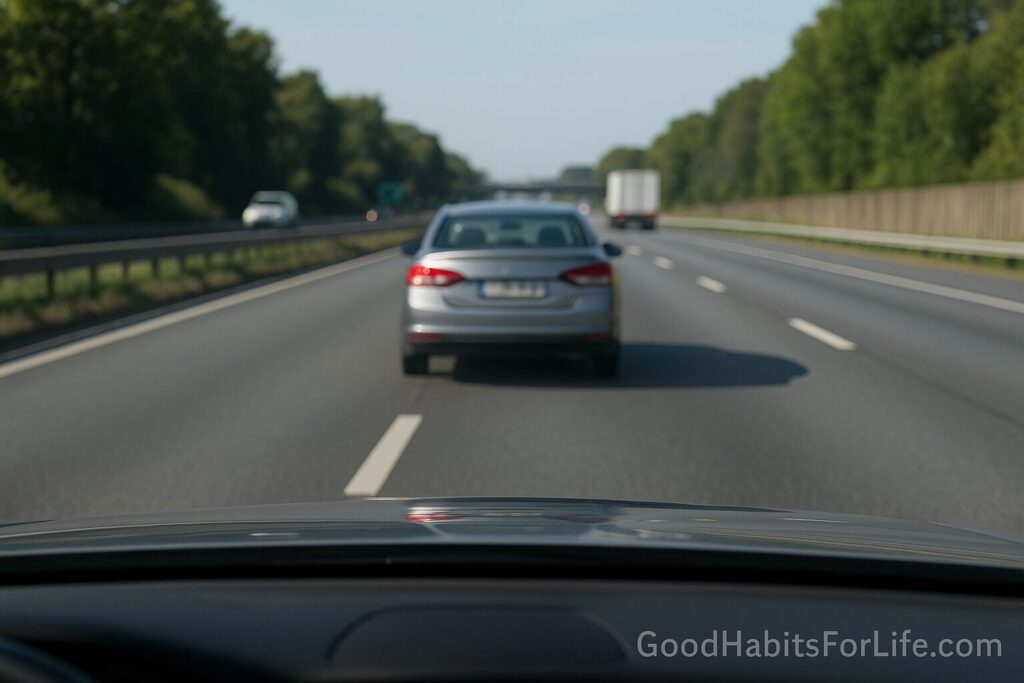
Defensive Driving 101: Space, Pace, Place
Defensive Driving 101: Space, Pace, Place
Table of Contents
🧭 What Is Defensive Driving? Why Space–Pace–Place Works
Defensive driving means actively reducing risk by anticipating hazards, maintaining time/space buffers, and positioning for maximum visibility. The Space–Pace–Place model turns that idea into three memorable levers:
-
Space — the distance and escape room around your vehicle.
-
Pace — your speed and smoothness relative to conditions.
-
Place — where you position yourself on the road to be seen and to avoid conflict points.
Why it works:
-
Most crashes stem from recognition and decision errors. Extra seconds and meters improve your ability to detect, decide, and brake.
-
Speed magnifies risk: a small increase in pace sharply raises crash severity.
-
Strategic place avoids high-risk zones (blind spots, intersections, tailgater traps), cutting exposure even before a mistake happens.
✅ Quick Start: Do This on Your Very Next Drive
-
Set mirrors & posture (60 s). Heels light, shoulders relaxed; adjust mirrors to just overlap your blind spots.
-
Adopt the 3-second rule. Pick a roadside marker—when the car ahead passes it, count “one-one-thousand…” to three before you pass. Use 4+ seconds in rain, at night, or when following trucks/buses.
-
Scan 12–15 s ahead. On city streets that’s roughly one block; on highways, 250–400 m (800–1,300 ft).
-
Choose your lane. Prefer a lane with fewer merges/exits; keep an escape path to one side.
-
Smooth your inputs. Gentle throttle, early lift, progressive braking. Avoid last-second braking.
-
Phone on Do Not Disturb. No notifications, no temptation.
-
After the trip (2 min). Ask: Did I keep 3–4 seconds? Any surprises? How can I widen Space, adjust Pace, or change Place next time?
🛡️ Space: Your Safety Cushion
Core rules
-
Following gap:
-
Dry: ≥3 seconds at ≤80 km/h (50 mph).
-
Wet, night, gravel, heavy traffic: ≥4 seconds.
-
Behind buses/trucks or when towing: 5–6 seconds.
-
-
Side space: When passing cyclists, leave 1.5 m (5 ft) where required; more at higher speeds. Give wide berth to parked cars (door zone ~1 m).
-
Stop distance: At 50 km/h, total stopping distance is ~35 m (reaction + braking). At 100 km/h, it can exceed 100 m. Keep that in mind when cresting hills or in fog.
-
Escape route: Always know where you’d steer right now if the lane ahead blocked—usually a shoulder or a gap between clusters.
Space builders
-
Stagger in traffic so you see brake lights two cars up.
-
Zip-merge early; avoid dive-bombing at the taper.
-
Don’t camp in packs. Either ease off 5–8 km/h (3–5 mph) to create a pocket or change lanes safely.
Space killers (avoid)
-
Tailgating to “teach a lesson.”
-
Fixating on the bumper ahead (tunnel vision).
-
Hovering beside another vehicle (especially trucks)—clear the blind spot.
⏱️ Pace: Speed, Smoothness, and Time Buffers
Speed strategy
-
Drive within limits and for conditions: rain, glare, and night driving all justify lower speed.
-
Match safe flow, not the fastest car. A large speed difference is risky whether too high or too low.
-
Use time buffers: plan to arrive 5–10 minutes earlier; it removes the pressure that breeds risky overtakes.
Smoothness
-
Look far, act early. Lift off throttle as soon as you identify potential stops.
-
Progressive braking beats late, hard spikes—shortens stopping distance and gives followers more warning.
-
Cornering pace: Brake in a straight line, then maintain a steady throttle through the turn.
Pace cues to act on
-
If you’re needing constant braking to maintain distance, you’re too fast for the pack. Ease back 5 km/h and rebuild the 3–4-second gap.
-
If vehicles are stacking behind you while others pass on both sides, increase pace slightly (still legal) or move right to let them by.
📍 Place: Positioning, Lane Choice, and Visibility
Lane choice
-
Multi-lane highways: Right/left depends on the country’s keep-left/keep-right rule. Cruise in the non-passing lane; use the passing lane to pass, then return.
-
Avoid conflict lanes: Stay away from lanes with frequent on-ramps/off-ramps if you’re traveling long distance.
-
Truck awareness: Trucks have large blind zones (“No-Zones”)—don’t linger beside or tail them. If you can’t see the driver’s mirrors, the driver may not see you.
Intersection strategy
-
Cover the brake when entering intersections.
-
Delay launch on green by ~1 second; quick head-left/right/left for red-light runners.
-
Turn-left/right positioning: Angle wheels straight while waiting so a rear-impact doesn’t push you into traffic.
Visibility
-
Headlights on in rain, dusk/dawn, tunnels—be seen sooner.
-
Keep a clean windscreen inside and out; haze at night multiplies glare.
-
At night on rural roads, look slightly to the right/left edge to reduce glare from oncoming high beams; flick your eyes back to the lane markers.
🧠 Techniques & Micro-Frameworks
-
SEE System (Search–Evaluate–Execute): Constantly scan, judge options, then act early and smoothly.
-
12-Second Eye-Lead: Aim your gaze where you’ll be in ~12 seconds; your hands follow your eyes.
-
3-Before-Go: Before moving off: mirrors, blind-spot check, signal.
-
1-2-3 Merge: Signal 3 blinks in advance, set gap (Space), match Pace, then move to the Place—single clean lateral move, no drift.
-
BRAG for tailgaters: Build gap ahead, Roll off gently, Adapt lane/Place, Give way when safe—don’t brake-check.
-
Weather triangle: Reduce Pace, increase Space, choose safer Place (middle lanes away from pooling water).
🗺️ 30-60-90 Day Habit Plan
Metrics you can track
-
% of trip with ≥3 s following gap (estimate or use telematics).
-
Number of hard brakes per 100 km (apps/dashcams log this).
-
Weekly near-miss count and triggers (journal).
-
Average arrival buffer (minutes early vs. late).
Days 1–30: Foundations
-
Put phone on Do Not Disturb While Driving every trip.
-
Practice 3-second gap; 4+ in rain/night.
-
End every trip with a 2-minute review: one thing you did well, one thing to improve (Space–Pace–Place).
-
One parking-lot drill weekly: smooth braking from 40 km/h to zero; feel the weight transfer.
Days 31–60: Positioning & Smoothness
-
Add 12–15 s scanning and early lifts for every signal/roundabout.
-
Choose lanes to minimize merges; rehearse escape routes verbally (“Shoulder right is clear”).
-
Target zero hard brakes for three consecutive commutes.
-
Night module: check headlight aim; clean glass; practice glare management.
Days 61–90: Mastery & Coaching
-
Use a dashcam/telematics summary; identify top two risk habits and design counters.
-
Do a highway session focusing on pacer car avoidance (don’t sit beside someone for >10 s).
-
Teach a family member the Space–Pace–Place model—coaching deepens your own habits.
-
Celebrate: log 3 tangible wins (e.g., fewer near misses, less stress, improved fuel economy).
👥 Variations by Audience
Students / New drivers
-
Stick a “Count 3” Post-it on the dash for the first month.
-
Practice mirror–signal–shoulder checks in an empty lot until automatic.
Parents with kids
-
Load the car before buckling kids to minimize mid-drive distractions.
-
If a child needs attention, exit traffic to a safe spot; don’t twist around at speed.
Professionals / Daily commuters
-
Build a 10-minute buffer into departures to remove “late pressure.”
-
Use podcasts/audiobooks only if they don’t steal visual attention; otherwise switch to music.
Seniors
-
Prefer daylight trips and familiar routes.
-
Increase gaps (4–5 s) to account for slower reaction times; get regular vision checks.
Teens
-
One new habit per week; no passengers the first month if local rules allow—it reduces risk.
-
Phone stays in the glovebox until parked.
⚠️ Mistakes & Myths to Avoid
-
Myth: “Keeping up with the fastest flow is safer.”
Reality: Large speed differences increase crash risk. Stay legal and smooth; let speeders go. -
Myth: “ABS shortens every stop.”
Reality: ABS preserves steering control; stopping distances vary—still keep big gaps. -
Mistake: Brake-checking tailgaters—escalates danger.
-
Mistake: Cruising in others’ blind spots—either pass or drop back.
-
Mistake: Multitasking (texts, food, grooming). Eyes off road for 2 s at 90 km/h covers ~50 m blind.
📋 Real-Life Examples & Ready-to-Use Scripts
-
Merging: “Signal on, mirror, shoulder check. Match speed 90 → 100 km/h, find the gap, smooth steer across once.”
-
Tailgater behind: “I’ll add 1 extra second ahead, ease off 5 km/h, and exit or change lanes when safe.”
-
Blocked view at junction: “Nudge forward in small steps, scan left-right-left, go only with a clear escape route.”
-
Truck pass: “See driver’s mirror, accelerate slightly to pass, signal early, return only when I see both headlights in my mirror.”
-
Wet curve: “Brake straight before the curve, steady throttle through, widen gap to the car ahead.”
🛠️ Tools, Apps & Resources
-
Driving Focus / Do Not Disturb While Driving (iOS/Android): Silences notifications; auto-replies. Pro: zero-setup. Con: may block needed calls—set exceptions.
-
Navigation with speed & hazard info (Google Maps, Waze): Shows limits, congestion ahead. Pro: early warning. Con: can distract—use voice only.
-
Dashcams: Objective feedback on spacing and smoothness. Pro: incident evidence. Con: storage management.
-
Telematics apps (insurer or standalone): Track hard brakes, speeding, phone use. Pro: quantifies habits. Con: privacy trade-off.
-
Tire pressure monitors & maintenance apps: Proper tire pressure improves grip and braking.
📌 Key Takeaways
-
Space buys time; Pace reduces severity; Place avoids exposure.
-
Keep 3–4 seconds (more in bad weather); don’t linger beside trucks; scan far.
-
Smooth inputs and early decisions remove most surprises.
-
Make it a habit with trip reviews and a 30-60-90 plan.
-
Calm, courteous driving is a superpower; you arrive safer and less stressed.
❓ FAQs
1) What is the 3-second rule and when is it not enough?
Count three seconds between the vehicle ahead and your front bumper. Use 4–6 seconds in rain, fog, night, gravel, when towing, or behind large vehicles.
2) Is it safer to match the fastest flow even if it’s over the limit?
No. High speed and large speed variance both raise risk and crash severity. Stay legal; let faster drivers pass.
3) Which highway lane is safest?
Generally the lane with fewer merges and steady flow (often a middle lane). Avoid camping in passing lanes; return right/left per local rules after overtaking.
4) How do I handle a tailgater without escalating?
Increase your gap ahead, slow gradually, signal early, and change lanes or let them pass when safe. Never brake-check.
5) What’s the best following distance at 100 km/h?
At least 3 seconds in dry daylight; that equates to roughly 85–100 m at 100 km/h. Increase to 4–6 seconds with risk factors.
6) Do modern safety features let me follow closer?
No. ABS, ESC, and AEB help when you make a mistake; they don’t change physics. Keep the same or larger buffers.
7) How do I improve at intersections?
Scan early, cover the brake, delay your launch ~1 s on green, and keep wheels straight while waiting to turn.
8) What about motorcycles and cyclists?
Give motorcycles full lane respect; leave cyclists ≥1.5 m when passing and slow your pace to avoid wind wash.
9) Any quick way to check blind spots?
Set mirrors wide (horizon centered, bodywork just at the edge). Do a shoulder check before every lateral move.
10) How do I stay alert on long trips?
Breaks every 90 minutes, hydrate lightly, avoid heavy meals, and consider a 15–20 min power nap if drowsy—never push on tired.
📚 References
-
National Highway Traffic Safety Administration (NHTSA). Safe Driving Tips. https://www.nhtsa.gov/road-safety
-
World Health Organization. Global Status Report on Road Safety. https://www.who.int/publications
-
Insurance Institute for Highway Safety (IIHS). Speed and Fatality Risk. https://www.iihs.org/
-
AAA Foundation for Traffic Safety. Aggressive Driving and Speeding Research. https://aaafoundation.org/
-
Federal Highway Administration (FHWA). Intersection Safety & Design. https://highways.dot.gov/
-
Royal Society for the Prevention of Accidents (RoSPA). Defensive Driving. https://www.rospa.com/
-
Transport for NSW (Australia). Keeping a Safe Following Distance. https://www.nsw.gov.au/transport
-
Government of Canada. Driving in Adverse Weather. https://tc.canada.ca/en/road-transportation
⚖️ Disclaimer
This guide is educational and general in nature. Always follow your local traffic laws, licensing requirements, and official road-safety guidance.