
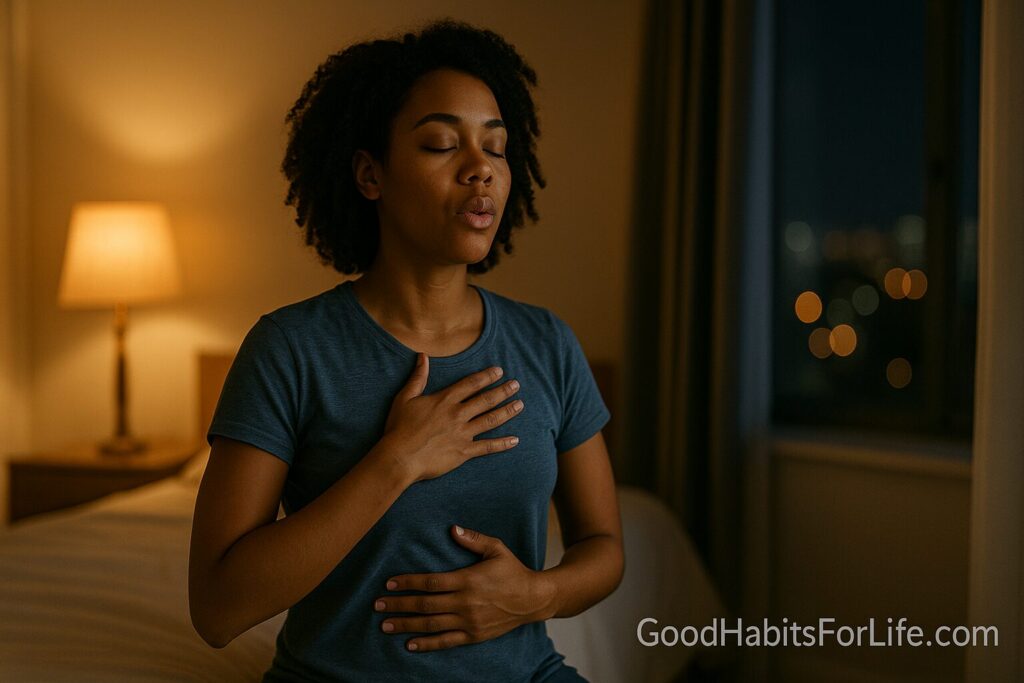
478 Anywhere: Train a Relaxation Reflex
478 Anywhere: Train a Relaxation Reflex
Table of Contents
🧭 What 4-7-8 Breathing Is—and Why It Works
4-7-8 breathing is a simple paced-breathing pattern: inhale for 4 counts, hold for 7, exhale for 8. It’s a variant of slow, controlled breathing shown to increase parasympathetic (vagal) activity, stabilize heart rate, and reduce subjective stress and anxiety. In practice, a longer, complete exhale signals “safety” to the body, helping shift out of the fight-or-flight response.
Core benefits (supported by research on slow/paced breathing):
-
Faster calm-down during stress spikes by nudging the autonomic nervous system toward parasympathetic dominance.
-
Better sleep onset when used as a pre-bed ritual.
-
Steadier heart-rate variability (HRV) and perceived emotional control.
-
Craving control (the pause + long exhale creates a “speed bump” before reacting).
Importantly, you’re not trying to force oxygen into the body. You’re using rhythm + longer exhale to teach your nervous system a predictable calm pattern. With consistent repetition, this becomes a relaxation reflex you can trigger anywhere—before you reply, click, or crave.
✅ Quick Start: Do It Right Now (60–120 seconds)
-
Posture: Sit or stand tall, shoulders soft, jaw unclenched.
-
Tongue: Tip of tongue lightly behind upper front teeth (optional but traditional).
-
Nose Inhale (4): Quietly inhale through the nose for 4 counts.
-
Hold (7): Hold gently for 7 counts (no straining; soften belly, neck).
-
Mouth Exhale (8): Exhale fully through pursed lips for 8 counts—steady, whisper-slow.
-
Repeat: Do 4 cycles to start (about 1–2 minutes).
Feeling light-headed? Shorten to 3-5-6 or 4-4-6 for a week, then return to 4-7-8.
Where to use it: Between emails, before presentations, when stuck in traffic, at bedtime, during cravings, or after an argument text—any moment you want to respond instead of react.
🛠️ Technique Tips, Variations & Safety
Form cues
-
Quiet nose inhale, long mouth exhale. The long exhale is the “calm signal.”
-
Soft belly expansion on inhale; avoid lifting the chest.
-
Count at a pace that’s comfortable. If 7-count holds feel tense, scale it down.
Progressions & variations
-
4-4-6 (easier): Great for beginners.
-
Box breathing 4-4-4-4: Useful for focus; exhale not as long.
-
6 breaths per minute (research-backed slow breathing): Inhale 4–5 sec, exhale 5–6 sec, no hold.
-
Silent or with a timer: Use a metronome/breath app or your watch’s breathe feature.
Safety
-
Stop if you feel dizzy or distressed; resume gentler pacing.
-
If you’re pregnant, have cardiovascular/respiratory issues, panic disorder, or are recovering from surgery, use a shorter hold (or skip holds) and consult a clinician if unsure.
-
Breathwork complements—not replaces—medical or psychological care.
📅 Habit Plan: 7-Day Starter → 30-60-90 Reflex Roadmap
Goal: Turn 4-7-8 into an automatic relaxation reflex you can trigger in <30 seconds.
7-Day Starter
-
Morning (anchor to kettle/coffee): 4 cycles of 4-7-8.
-
Midday (calendar cue): 4 cycles before lunch.
-
Evening (pre-bed): 4–8 cycles after lights-out.
-
Micro-moments: Any stress spike → 1–2 cycles before you decide or reply.
-
Track: Put “🫁” in your calendar each time you practice.
30-Day Builder
-
Increase reps: 6–8 cycles morning/evening; 4 cycles midday.
-
Add a trigger: Doorway, seatbelt click, or phone unlock → do 1 cycle.
-
Pair with a phrase: On exhale, silently say “Downshift” or “Let go.”
60-Day Integrator
-
Combine with posture: On inhale, grow tall; on exhale, soften shoulders.
-
Add a decision-gap: Before any “high-stakes click” (send, buy, reply), do 1–2 cycles.
-
Sleep protocol: 8 cycles in bed; if awake at night, repeat calmly without striving.
90-Day Reflex
-
Stress rehearsals: Visualize a tough moment (craving, conflict), do 2 cycles, then imagine your ideal response.
-
Periodic refresh: 1 minute on the hour, 4–5 hours/day you’re at a desk.
-
Measure: Subjective stress 0–10 before/after; watch it drop over weeks.
👥 Audience Variations
-
Students/Examinees: Use 1–2 cycles before reading each question; longer set (6–8 cycles) the night before exams to sleep.
-
Professionals/Leaders: 2 cycles before meetings and when switching tasks; a 60-second “team reset” at the start of tense calls.
-
Parents/Caregivers: Teach a kid-safe version (3-3-4, “Smell the flower, blow the candle”); use after tantrums—for both of you.
-
Seniors: Prefer gentle 4-4-6; focus on posture and nasal breathing for airway comfort.
-
Teens: Pair with music beats (~60 BPM) to keep the exhale slow without counting out loud.
⚠️ Mistakes & Myths to Avoid
-
Myth: “If one round doesn’t fix it, it doesn’t work.”
Reality: It’s a skill—consistency wires the reflex. -
Mistake: Forcing the breath or clenching on the 7-count hold.
Fix: Downshift to 4-4-6; holds should feel easy. -
Myth: “You must use 4-7-8 specifically.”
Reality: The long, complete exhale is the key; several slow-breathing patterns help. -
Mistake: Skipping the exhale.
Fix: Exhale fully to the end; think “whisper-slow deflate.” -
Mistake: Only using it when stressed.
Fix: Daily reps build the reflex you’ll trust under pressure.
💬 Real-Life Scripts & Use-Cases
-
Before a tough conversation:
“Give me 30 seconds to collect my thoughts.” → 2 cycles → “Thanks, here’s what I’m thinking…” -
Craving or impulse buy:
“Pause—two breaths first.” → 2–4 cycles → Decide with a cooler head. -
Bedtime wind-down:
Lights off → 8 cycles, eyes closed, exhale with the word “down.” -
During pain or discomfort (e.g., blood draw):
Stare at a fixed point; 4 cycles; exhale longer and soften shoulders each time. -
On the commute:
Red light or train stop → 2 cycles → Arrive calmer.
🧰 Tools, Apps & Resources
-
Timers & Wearables: Phone metronome, Apple Watch “Breathe,” Garmin/Polar/Whoop HRV displays (watch the down-trend in HR as you exhale).
-
Apps: Insight Timer (free guided breaths), Headspace/Calm (sleep wind-downs), Breathwrk (visual pacers).
-
Low-tech: Sticky note “4-7-8” on your screen, a bracelet you touch to trigger one cycle, or a desktop widget displaying a simple in/out animation.
Pros/Cons snapshot
-
Apps: easy pacing & reminders; risk of dependency.
-
Wearables: biofeedback; cost and battery.
-
Analog: always available; less precise pacing.
🔑 Key Takeaways
-
4-7-8 = inhale 4, hold 7, exhale 8—the long exhale is the calm trigger.
-
Practice briefly and often (2–3×/day) to create a relaxation reflex.
-
Scale the pattern to comfort; 4-4-6 works great while you build capacity.
-
Use it before you act: send, speak, buy, scroll, or snack.
-
Track tiny wins; in weeks, you’ll de-stress faster and sleep easier.
❓FAQs
1) How many cycles should I do?
Start with 4 cycles. In stressful moments, add sets of 2–4 cycles until you feel a downshift.
2) Is mouth exhale mandatory?
Not mandatory, but many people find a pursed-lip mouth exhale helps lengthen and smooth the out-breath.
3) Can I use it if I get anxious during breath holds?
Yes—remove or shorten the hold (e.g., 4-0-6 or 4-4-6) and build up slowly.
4) Does it increase oxygen?
The main effect isn’t “more oxygen;” it’s nervous-system regulation through slower rhythm and longer exhale.
5) Will this help me sleep?
Many people fall asleep faster using 4-7-8 before bed; it reduces arousal and racing thoughts.
6) How soon will I notice results?
Often in the first session (less tension, slower heart rate). The reflex strengthens over 2–8 weeks of daily practice.
7) Is 4-7-8 safe for kids?
Use gentler patterns like 3-3-4 without long holds; make it playful: “Smell the flower, blow the candle.”
8) Can I combine it with meditation or prayer?
Absolutely. Use 1–2 cycles to settle, then transition into your usual practice.
📚 References
-
Cleveland Clinic. What Is the 4-7-8 Breathing Technique? (education page).
-
Harvard Health Publishing. Relaxation techniques: Breath focus & paced breathing.
-
National Center for Complementary and Integrative Health (NCCIH). Relaxation techniques for health.
-
Zaccaro A, et al. How Breath-Control Can Change Your Life: A Systematic Review on Psycho-Physiological Correlates of Slow Breathing. Frontiers in Human Neuroscience (2018).
-
Russo MA, et al. The physiological effects of slow breathing in the healthy human. Breathe (2017).
-
American Psychological Association. Deep breathing and the relaxation response (overview).
-
University of Michigan Health. Breathing for relaxation (patient guide).
-
National Sleep Foundation. Breathing exercises to fall asleep.
Disclaimer
This article is educational and not a substitute for professional medical or mental-health advice; consult your clinician for personalized guidance.