
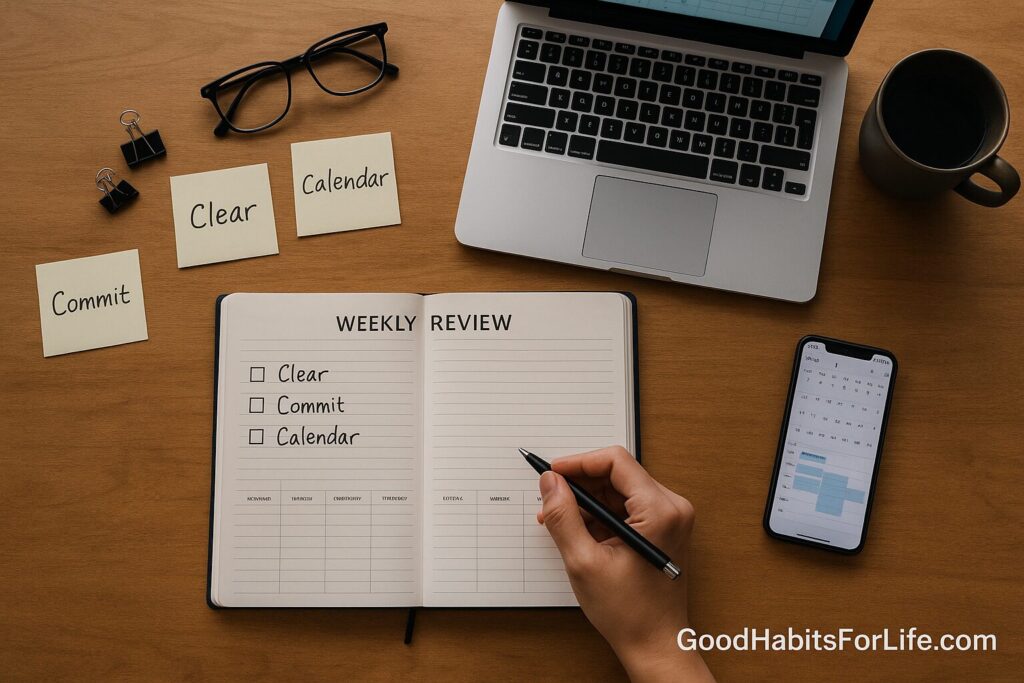
Weekly Review 2.0: Clear, Commit, Calendar
Weekly Review 2.0: Clear, Commit, Calendar
Table of Contents
🧭 What & Why
A Weekly Review is a short, scheduled ritual—typically 30–60 minutes—where you:
-
Clear open loops, 2) Commit to a small set of outcomes, and 3) Calendar the real time to do them.
Why it works
-
Planning → better performance: Meta-analysis shows time management practices have moderate positive effects on job performance, academics, and wellbeing. PMC
-
Plans reduce mental clutter: Making specific plans reduces intrusive thoughts about unfinished goals (the classic “Zeigarnik effect” problem). PubMed
-
If–Then commitments (“implementation intentions”) produce medium–large improvements in goal attainment across many domains. ScienceDirect
-
Cognitive offloading: Writing lists and using external systems preserves working memory for deep work. discovery.ucl.ac.uk
-
Pre-commitment & deadlines (e.g., booking blocks on your calendar) help curb procrastination. Massachusetts Institute of Technology
✅ The Weekly Review 2.0 Checklist (12 steps)
Time target: 40–45 minutes. Use a single page; check items as you go.
Phase A — Clear (15–20 min)
-
Close the week: What did I finish? What moved? What’s stuck? (2 min)
-
Capture sweep: Brain dump; scan notes, messages, screenshots, desk; add tasks to your system. (5 min)
-
Inbox Zero lite:
-
Email: archive/label, schedule replies; convert todos to tasks.
-
Messages/DMs: capture actionables.
-
Downloads/desktop: file or delete. (6–8 min)
-
-
Project lists refresh: For each active project, ensure a clear Next Action. (3–5 min)
Phase B — Commit (10–15 min)
5. Top outcomes (max 5): Write outcome-oriented statements: “Deliver Q3 draft,” “Fix page speed to <2s,” “Run 3 study blocks.” (3 min)
6. If–Then plans: For each outcome, add one concrete trigger plan:
-
If it’s 09:30 Mon, then open brief and outline for 25 min. (3–5 min) ScienceDirect
-
Constraints check: What meetings/obligations are fixed? Any deadlines to pre-commit (self-imposed is fine). (2–3 min) Massachusetts Institute of Technology
-
Capacity reality check: Estimate time for each outcome (add 30% buffer).
Phase C — Calendar (10–15 min)
9. Time-block big rocks: Schedule focus blocks for outcomes first; then admin/meetings. (5–7 min)
10. Defend focus:
– Hold “Focus AM” or “Maker blocks.”
– Add buffer (15–30 min) after long meetings. (3–4 min)
11. Recovery & life: Book sleep, meals, workouts, family, commute. (2–3 min)
12. Preview & commit: Scan the week view; sanity-check transitions; finalize.
Tip: Keep the checklist laminated or as a pinned doc—no more than one screen.
🛠️ Quick Start (Do this today)
-
Pick a recurring slot: Fri 16:00–16:45 or Sun 17:00–17:45.
-
Duplicate this checklist into your notes/app.
-
Run a fast review:
-
Clear: 10 minutes inbox sweep
-
Commit: Choose 3 outcomes + If–Then plan each
-
Calendar: Place three 60-min focus blocks
-
-
Share your top 3 with a partner/manager for gentle accountability.
-
Set a calendar repeat with alerts (email + push).
📆 7-Day Starter Plan
Goal: Install Weekly Review 2.0 as an automatic habit.
-
Day 1 (10 min): Create a “Weekly Review 2.0” checklist note. Add a Friday/Sunday recurring event.
-
Day 2 (10 min): Clear one inbox (email only). Turn action emails into tasks.
-
Day 3 (10 min): Refresh project lists; mark a “Next Action” for 3 projects.
-
Day 4 (10 min): Draft 3 weekly outcomes, write an If–Then for each. ScienceDirect
-
Day 5 (10 min): Block 2 × 60-min focus sessions next week.
-
Day 6 (10 min): Add life maintenance: sleep/walks/meals.
-
Day 7 (30–40 min): Full Weekly Review 2.0.
🧠 Techniques & Frameworks to Supercharge Your Review
-
Implementation Intentions (If–Then): Convert “finish draft” to “If 09:30 Mon, then open doc and outline for 25 min.” Strong evidence they boost follow-through. ScienceDirect
-
Daily Planning Link-up: A short daily plan amplifies the benefits of a weekly plan; evidence shows daily planning can improve same-day performance. Do a 3-minute morning preview of the week’s blocks. PubMed
-
Cognitive Offloading: Use lists/boards to offload memory and cut switching costs; this protects working memory during deep work. discovery.ucl.ac.uk
-
Pre-mortem (5 min): Imagine it’s Friday and the week failed. Why? Note 3 risks and 3 preventions (move meetings, prep docs, pre-read). Harvard Business Review
-
Goal-Setting Theory: Make weekly outcomes specific, challenging, time-bounded (not vague). Stanford Medicine
-
Pre-commitment: Announce your focus blocks, book a room, or co-work—external commitments reduce procrastination. Massachusetts Institute of Technology
👥 Audience Variations
Students: Tie blocks to class times; make If–Then cues location-based (“If I reach the library, then set a 50-min study timer”).
Professionals: Protect 2–3 “maker” blocks before noon; cluster meetings in the afternoon.
Managers: Add a people-review: feedback to send, 1:1 prep, hiring pipeline.
Parents: Plan school runs/meals first; use 30-min micro-blocks while kids are at activities.
Seniors/Retirees: Emphasize health, social, and hobby blocks; shorter sessions (25–40 min) with more buffer.
Remote/Hybrid teams: Publish your weekly priorities and focus hours in Slack/Teams every Monday morning.
⚠️ Mistakes & Myths to Avoid
-
Too many goals: Cap weekly outcomes at 3–5; more dilutes attention.
-
Vague tasks: Replace “work on project” with a verb + artifact: “Draft outline (1 page).”
-
Calendar fiction: Over-optimistic blocks with no buffer. Add 30% slack by default.
-
Skipping the review after “busy” weeks: Busy weeks need review the most.
-
Confusing tools with systems: Apps help, but the ritual is what changes behavior.
-
Doing only daily planning: Without a weekly map, daily plans become reactive. Evidence supports connecting planning with performance—especially when plans are specific. PMCPubMed
💬 Real-Life Examples & Scripts
End-of-week reflection (2 min):
-
“What mattered this week? What moved the needle? What do I want off my plate?”
Outcome script:
-
“By Friday 17:00, publish the ‘Sleep Signals Guide’ draft (editorial checklist complete).”
If–Then scripts:
-
“If it’s 09:30 Mon, then open Notion ‘Sleep Signals’ and outline for 25 min.”
-
“If I finish stand-up, then start ‘image sourcing’ checklist for 15 min.” ScienceDirect
Pre-mortem prompts (5 min):
-
“It’s Friday and the draft isn’t done. What stopped me?”
-
“Prevention: move Tue meeting; prep images on Mon; ask for data today.” Harvard Business Review
Team post (Monday 09:00):
-
“This week I’m focused on (1) publish Sleep Signals draft, (2) fix page speed to <2s, (3) record 2 habit videos. Focus blocks: Mon/Tue/Thu 09:30–11:30.”
🧰 Tools, Apps & Resources (pros/cons)
-
Google Calendar / Outlook: Great for time-blocking; weak for tasks.
-
Todoist / TickTick: Fast capture + recurring tasks; keep labels simple.
-
Notion / Obsidian: Flexible databases for projects; require upfront design.
-
Trello / Asana: Visual boards and team workflow; can become complex.
-
Pomofocus / Toggl: Lightweight focus timer + time tracking; nice for data-driven reviews.
-
Email triage helpers: rules/filters + one “Waiting For” label.
📌 Key Takeaways
-
A weekly ritual that clears, commits, and calendars turns chaos into clarity.
-
Keep it short (≤45 min) and repeatable (same slot each week).
-
Limit outcomes to 3–5 and pair each with an If–Then plan. ScienceDirect
-
Block priority time first; protect it with buffers and holds.
-
Offload memory to lists; your brain is for thinking, not storage. discovery.ucl.ac.uk
❓ FAQs
1) How long should a Weekly Review take?
30–60 minutes. Aim for 45; you’ll get faster with a fixed checklist.
2) What day is best—Friday or Sunday?
Either. Friday helps you close loops and protects Monday. Sunday helps you enter Monday clear-headed. Choose one and stick with it.
3) How many outcomes should I set?
Three to five. Specific, challenging targets outperform vague intentions. Stanford Medicine
4) Do I need daily planning if I do a Weekly Review?
Yes—do a 3-minute morning preview to align with your weekly blocks; daily planning complements weekly planning. PubMed
5) What if my days are unpredictable?
Use anchor blocks (non-negotiable) and micro-blocks (15–25 min). Keep a short “next-actions” list for opportunistic wins.
6) How do I stop procrastinating on big rocks?
Use If–Then cues + tiny starts (“open doc and draft intro for 10 minutes”) and pre-commit calendar blocks. ScienceDirectMassachusetts Institute of Technology
7) Can a weekly review help with stress?
Yes; better planning is linked to higher perceived control and lower distress overall. PMC
8) What if my inbox never hits zero?
Aim for actionable zero: all decisions made; the rest is archived or snoozed.
9) How do I make it stick?
Same time each week, visible checklist, and share outcomes with a partner/manager for light accountability.
10) Team version?
Run the same ritual with a shared board, 20-minute stand-alone meeting, and a brief pre-mortem on risks. Harvard Business Review
📚 References
-
Aeon, B., Faber, A., & Panaccio, A. (2021). Does time management work? A meta-analysis. PLOS ONE. https://pmc.ncbi.nlm.nih.gov/articles/PMC7799745/ PMC
-
Gollwitzer, P. M., & Sheeran, P. (2006). Implementation intentions and goal achievement: A meta-analysis. Advances in Experimental Social Psychology. https://www.sciencedirect.com/science/article/abs/pii/S0065260106380021 ScienceDirect
-
Masicampo, E. J., & Baumeister, R. F. (2011). Plan making can eliminate the cognitive effects of unfulfilled goals. Journal of Personality and Social Psychology. https://pubmed.ncbi.nlm.nih.gov/21688924/ PubMed
-
Risko, E. F., & Gilbert, S. J. (2016). Cognitive Offloading. Trends in Cognitive Sciences. UCL open access PDF: https://discovery.ucl.ac.uk/id/eprint/1508770/1/gilbert_TiCS_OFFLOADING_RPS.pdf discovery.ucl.ac.uk
-
Ariely, D., & Wertenbroch, K. (2002). Procrastination, Deadlines, and Performance: Self-Control by Pre-commitment. Psychological Science. MIT PDF: https://web.mit.edu/ariely/www/MIT/Papers/deadlines.pdf Massachusetts Institute of Technology
-
Parke, M. R., Weinhardt, J. M., Brodsky, A., Tangirala, S., & DeVoe, S. E. (2018). When daily planning improves employee performance. Journal of Applied Psychology. https://pubmed.ncbi.nlm.nih.gov/29154579/ PubMed
-
Klein, G. (2007). Performing a Project Premortem. Harvard Business Review. https://hbr.org/2007/09/performing-a-project-premortem Harvard Business Review
-
Locke, E. A., & Latham, G. P. (2002). Building a practically useful theory of goal setting and task motivation. American Psychologist. https://med.stanford.edu/content/dam/sm/s-spire/documents/PD.locke-and-latham-retrospective_Paper.pdf Stanford Medicine