
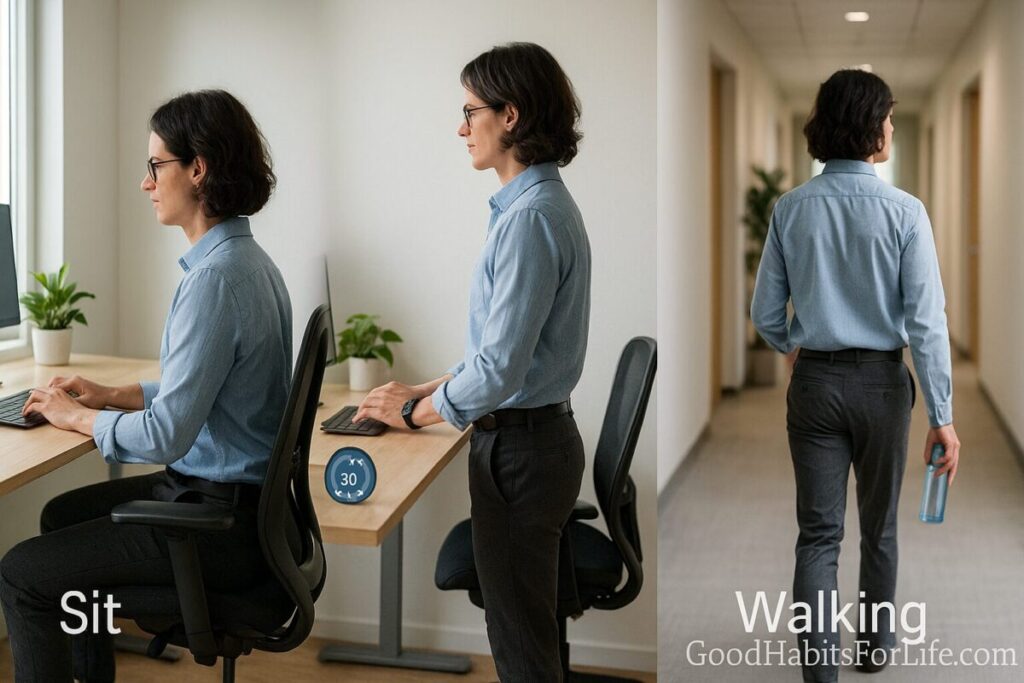
Workday Health: StandSitMove Rhythms: Dopamine Detox (2025)
Workday Health: StandSitMove Rhythms: Dopamine Detox
Table of Contents
🧭 What & Why
What it is: A practical rhythm for office hours—Stand–Sit–Move—that cycles postures and inserts short “movement snacks” to prevent long sitting streaks and tame digital over-stimulation.
Why it matters:
-
Health: Breaking up sitting every ~30 minutes with light walking (~5 minutes) reduces post-meal glucose and lowers systolic blood pressure—beneficial even in otherwise healthy adults. PubMed
-
Performance: Frequent micro-breaks and posture changes reduce musculoskeletal strain and sustain attention. Regulators endorse short, frequent breaks over infrequent long ones. OSHA+1
-
Reality check: Simply standing all day isn’t the answer—prolonged static standing carries its own risks. Alternation is the win. CDC Blogs
-
Dopamine clarity: A “dopamine detox” does not purge dopamine. It’s a behavioral reset: step away from high-stimulation triggers (infinite scroll, rapid-reward apps) and re-anchor to low-friction habits. Harvard Health+1
-
Policy backdrop: Global guidance urges moving more and sitting less across all ages—there’s no magic threshold, but any reduction in sedentary time helps. World Health Organization
✅ Quick Start (Do This Today)
-
Set a 30-min cue. Use your watch/phone/computer to ping you every 30 minutes. When it fires, walk 3–5 minutes indoors/outdoors. (~200–400 m; 220–440 yd). PubMed
-
Rotate postures on purpose:
-
30 min sitting (neutral spine) →
-
15–20 min standing (soft knees, one foot on a footrest) →
-
Move 3–5 min (corridor loop, water run, stairs). OSHA+1
-
-
Batch screens: Silence all non-urgent alerts; open tabs you actually need; park the rest in a “Later” list.
-
Add a friction break: Phone to a shelf during deep work; enable app limiters for social feeds until lunch. Cleveland Clinic
-
Desk fit check (2 min): Chair height so elbows ≈90°, monitor at eye level, feet supported. Micro-stretch wrists/neck at each cue. OSHA
🛠️ 30-60-90 Habit Plan
Goal: Make Stand–Sit–Move automatic and reduce total continuous sitting blocks.
Days 1–30 (Install the rhythm)
-
Every work hour: 30 min sit → 15–20 min stand → 5 min walk.
-
Two “screen fasts”/day: 25–45 min deep-work blocks with all alerts off, then 5 min walk.
-
Track: Put a sticky tally of movement snacks. Target 8–10 snacks/day.
Days 31–60 (Optimize)
-
Tune your dose: If glucose/energy is your limiter, prioritize 5-min walks every 30 min; if neck/shoulder strain dominates, add more micro-breaks (30–60 sec each 10–15 min). PubMed+1
-
Upgrade station: If possible, add a height-adjustable desk; trials show bigger sitting-time reductions when desks are included in multi-component programs. BMJ+1
Days 61–90 (Automate & expand)
-
Meeting moves: For every 30-min meeting, schedule 2–3 min stand/walk midway.
-
Active defaults: Stairs for sub-3-floor trips; printer farther away; water bottle small (more refill walks).
-
Digital hygiene: Lock “dopamine peaks” to two 15-min windows/day (post-lunch & late afternoon). Cleveland Clinic
🧠 Techniques & Frameworks
1) The 30:20:5 Loop
-
30 min sit → 20 min stand → 5 min walk, repeat. It respects both anti-sitting and anti-standing risks and ensures real movement. CDC Blogs
2) Five-by-Five Snack Pack
-
Every 30 min, choose one for 5 min: corridor walk, stair laps, desk-side calf raises, gentle hip openers, water refill. Keep heart rate low-to-moderate; this is light activity. PubMed
3) Micro-Break Grid (every 10–15 min, 30–60 sec)
-
Look 20 m (65 ft) away, roll shoulders, wrist flexor stretch, slow neck turns. OSHA endorses frequent short breaks. OSHA
4) StandSmart
-
If standing, shift weight, use an anti-fatigue mat, put one foot on a low rail, switch legs each minute. Avoid >30–40 min static standing. CDC Blogs
5) Digital “Detox” (the accurate version)
-
You’re not flushing dopamine; you’re reducing high-stimulation inputs to let baseline motivation normalize. Try: 24-hr social app freeze, greyscale display, remove auto-play, batch notifications. Harvard Health+1
🧑🎓 Audience Variations
-
Students/Teens: Pomodoro-style 25+5 is fine, but add a 2–3 min walk between blocks; phone in another room during study sprints. OSHA
-
Professionals: Put “walk-and-talk” on calendar; default to standing for short calls; convert 1 meeting/day into a walking 1:1. BMJ
-
Parents/Caregivers at home: Anchor snacks to tasks (laundry change, school pickup, meal prep).
-
Seniors: Prefer gentle, frequent breaks; light-intensity walking yields benefits without joint strain. PubMed
⚠️ Mistakes & Myths to Avoid
-
Myth: “Standing all day is healthy.”
-
Fact: Prolonged static standing stresses back, legs, and cardiovascular system; alternate positions. CDC Blogs
-
-
Myth: “I work out; sitting doesn’t matter.”
-
Fact: Reducing sedentary time benefits health independently of workouts; still break up sitting. World Health Organization
-
-
Myth: “Dopamine detox resets your brain chemistry.”
-
Fact: No biochemical “detox.” It’s a behavior change strategy—use structured abstinence and app limits. Harvard Health
-
-
Mistake: Ignoring workstation basics.
-
Fix: Check height/monitor/keyboard and schedule micro-breaks. OSHA
-
📚 Real-Life Examples & Scripts
-
Slack/Teams status: “On a 5-min movement break—back at 11:35.”
-
Meeting nudge: “Quick stretch and water break? Back in 2.”
-
Manager note: “I’m trialing a Stand–Sit–Move cadence to reduce aches and boost focus; I’ll walk during non-screen portions of calls.”
-
Self-talk (dopamine reset): “Not a ‘detox’—I’m just limiting high-stimulation apps to 15-min windows.” Cleveland Clinic
🛠️ Tools, Apps & Resources (quick picks)
-
Height-adjustable desk or riser: In trials, adding desks amplified sitting-time reductions when combined with coaching/prompts. BMJ
-
Timers & prompts: Native phone/OS timers; smartwatch stand alerts; keyboard stretch pop-ups. OSHA and HSE endorse frequent short breaks. OSHA+1
-
App limiters: Screen Time/Focus (iOS), Digital Wellbeing (Android), website blockers during deep work.
-
Anti-fatigue mat & foot rail: Reduce static-standing load. CDC Blogs
✅ Key Takeaways
-
Break up sitting every ~30 minutes; 5-min light walks are a high-impact dose for glucose and BP. PubMed
-
Rotate sit ↔ stand ↔ move; avoid long streaks of any single posture. CDC Blogs
-
Treat “dopamine detox” as behavioral decluttering, not brain chemistry cleansing. Harvard Health
-
Prompts, environment tweaks, and calendar defaults make the rhythm automatic. BMJ
❓ FAQs
1) What’s the best break interval if I can’t leave my desk?
Aim for 30-minute intervals, but even 1-minute light activity helps; add micro-breaks (30–60 sec) for eyes, wrists, and neck. PubMed+1
2) Does standing instead of sitting fix the problem?
Standing helps with variety but not if done for long, static bouts. The win is alternation plus short walks. CDC Blogs
3) I already hit the gym—do I still need breaks?
Yes. Sitting less gives extra benefits independent of exercise; keep breaking up desk time. World Health Organization
4) What’s a science-based “dopamine detox”?
A temporary reduction of high-stimulation activities (e.g., infinite scroll) with scheduled windows—not a biochemical reset. Use app limiters and routine swaps. Harvard Health+1
5) Is there an official rule for desk breaks?
No fixed law on minutes, but regulators recommend short, frequent breaks (e.g., 5–10 minutes each hour) and task variation. HSE
6) Do tiny movements like fidgeting matter?
Small movements increase local blood flow and energy use—use them between walks. PMC
7) Are computer prompts useful?
Yes—simple pop-ups and reminders can reduce sitting at work and are scalable in offices. BioMed Central
📚 References
-
World Health Organization. Guidelines on physical activity and sedentary behaviour (2020). World Health Organization
-
Duran AT, et al. Breaking Up Prolonged Sitting to Improve Cardiometabolic Risk: Dose-Response Randomized Crossover Trial (2023). PubMed
-
Columbia University Irving Medical Center. Rx for Prolonged Sitting: A Five-Minute Stroll Every Half Hour (2023). CUIMC
-
Edwardson CL, et al. SMArT Work trials—multicomponent interventions and sit-stand desks reduce sitting at work (2018–2022). BMJ+1
-
OSHA. Computer Workstations eTool: Work Process (Micro-Breaks) (accessed 2025). OSHA
-
UK HSE. Working safely with display screen equipment: Work routine & breaks (updated 2025). HSE
-
NIOSH/CDC. Prolonged Standing at Work (2014). CDC Blogs
-
Dempsey PC, et al. Interrupting prolonged sitting with walking or resistance activity improves 22-h glucose in type 2 diabetes (Diabetologia, 2017). SpringerLink
-
Harvard Health Publishing. Dopamine fasting: misunderstanding science (2020). Harvard Health
-
Cleveland Clinic. Dopamine Detoxes Don’t Work (2024). Cleveland Clinic
Disclaimer: This guide is for general education and is not a substitute for personalized medical advice; consult your clinician for individual recommendations.