
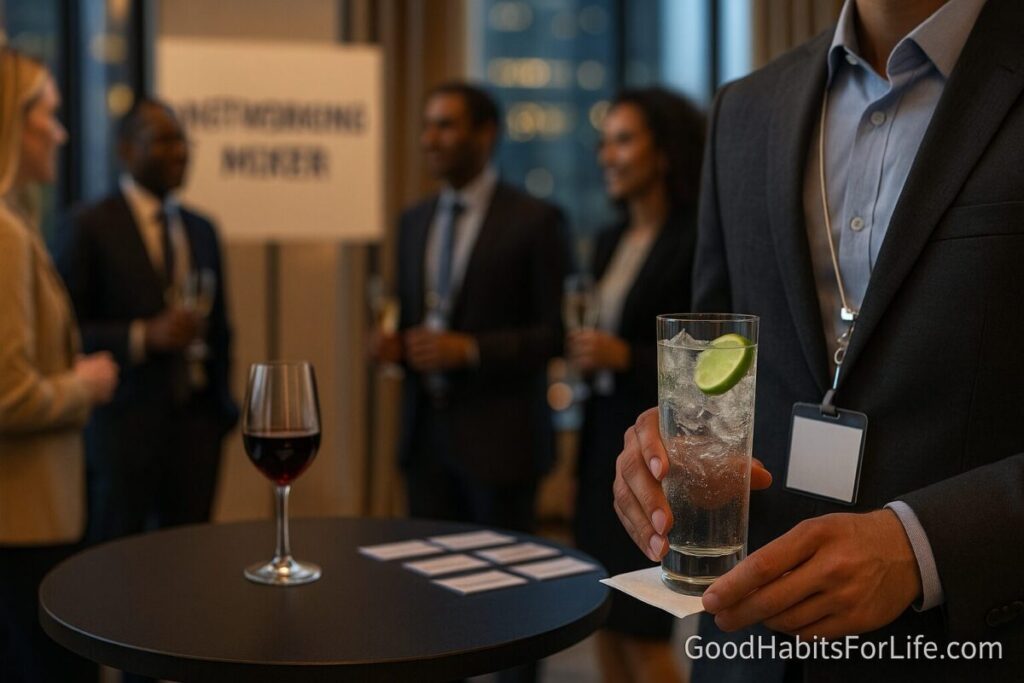
Work Events: Sip Smart or Skip Kindly: Dopamine Detox (2025)
Work Event Drinking: Sip Smart or Skip (Dopamine Detox)
Table of Contents
🧭 What This Guide Covers & Why It Matters
Work events blend socializing with professional image. Alcohol often shows up, but your choices signal judgment, boundaries, and reliability. Health guidance has shifted: there’s no risk-free level of alcohol, so less is better—especially before high-stakes workdays. World Health Organization+1
Performance angle: Even when you feel “fine,” hangovers and short sleep can impair attention, reaction time, and decision-making the next day—a bad look before a big meeting or client call. PubMed
Dopamine-detox lens: “Dopamine detox” isn’t a literal medical process; it’s a behavioral reset to reduce overstimulation (social media, sugar, alcohol) and re-sensitize reward pathways. Use it as a habit frame, not neuro-jargon. Harvard HealthPMC
✅ Quick Start: Tonight’s Work Event Plan
Pick one strategy before you arrive.
A) Sip Smart (light, controlled)
-
Set a cap: Max 1–2 “standard drinks” total (≈14 g ethanol per drink; e.g., 150 ml wine at 12% ABV; 355 ml beer at 5% ABV; 45 ml spirits at 40% ABV). Alternate each drink with water. CDCniaaa.nih.gov
-
Front-load food: Eat a protein- and fiber-rich meal 60–90 minutes beforehand.
-
Choose lower-ABV: Session beer, spritzer, or half-pours.
-
Time-box: Pre-commit to leaving by a set time; book your ride.
-
Protect tomorrow: 7–8 hours sleep, electrolyte water, morning walk.
B) Skip Kindly (no alcohol)
-
Order early: Ask for sparkling water with lime or a 0.0% option at arrival.
-
Use a no-pressure line: “On a reset week,” “Long run tomorrow,” or “Driving.”
-
Focus on people: Greet hosts, circulate, ask questions, take a photo for the team channel.
-
Exit cleanly: Thank organizers + 1 memorable follow-up message tomorrow.
Red flags to avoid tonight
-
Shots, drinking games, pressuring colleagues, discussing sensitive topics, posting impaired content.
🧠 30-60-90 Habit Plan (Dopamine-Detox Friendly)
Goal: Normalize low- or no-alcohol work events while strengthening reputation and well-being.
Days 1–30: Foundation
-
Personal rule: “Work events = 0–2 drinks max (or zero).”
-
Default order: NA beer/wine or sparkling water first; add citrus or bitters for a “grown-up” feel.
-
Boundary script: “I keep it light at work events—I like clear mornings.”
-
Sleep protectors: Set a hard stop time + calendar block labeled “prep + sleep.”
Checkpoint: 2+ events attended with cap respected; next-day energy ≥7/10.
Days 31–60: Social Systems
-
Accountability buddy: Share your limit with a trusted colleague.
-
Team norming: Suggest adding NA options to invites (0.0% beer, mocktails).
-
Calendar rhythm: Cluster deep-work mornings after event nights.
Checkpoint: You’ve influenced at least one event to feature standout NA options.
Days 61–90: Mastery & Maintenance
-
Menu mastery: Identify 3 go-to NA choices at your usual venues.
-
Event cadence: Prefer shorter attendance windows; arrive early, leave on time.
-
Dopamine detox weeks: 7–14 day windows with no alcohol + reduced scrolling/sugar—focus on sleep, exercise, nature. (It’s a behavioral reset, not a neuro “flush.”) Harvard Health
Checkpoint: Your manager or peers comment positively on your energy and reliability.
🛠️ Techniques & Frameworks (Evidence-Aligned)
1) “Set-Switch-Shield”
-
Set a pre-event rule (cap or skip).
-
Switch to NA after your cap (or start NA).
-
Shield tomorrow (sleep, water, exit time).
2) Standard-Drink Literacy
-
Learn what counts as one standard drink (≈14 g alcohol). Many pours exceed that. Use a drink-size calculator to estimate. CDCrethinkingdrinking.niaaa.nih.gov
3) Hangover Risk Management
-
The best prevention is less alcohol. Next-day cognitive and motor tasks can still be impaired—relevant if you’re driving to a client site or presenting. PubMed
4) Workplace Policy Awareness
-
Know your company’s alcohol policy and local norms; managers must model safety. (Public-sector HR manuals explicitly link alcohol issues to performance and attendance expectations.) U.S. Office of Personnel Management
5) Social Fluency
-
Hold a glass (NA OK), toast with eye contact, rotate conversations every ~7–10 minutes.
👥 Audience Variations
Students/Interns: Reputations form fast. Choose NA first; be the person who introduces teammates and snaps a few photos.
Early-Career Professionals: Cap at 0–1 drink; prioritize face time with mentors, not bar time.
Parents/Caregivers: Use “early out” scripts (“Childcare pickup”) without oversharing.
Seniors (60+): Alcohol tolerance often declines; medications may interact—skipping is a strong default. (When in doubt, ask your clinician.)
Teens (work experience/part-time): If invited to adult events, stick to NA—full stop. (Follow local laws and employer policy.)
⚠️ Mistakes & Myths to Avoid
-
Myth: “Moderate drinking is good for health.”
Update: Newer analyses and health bodies caution against health “benefits”; lower is safer. World Health Organization -
Myth: “If I sleep, I’m 100% next-day fine.”
Reality: Hangovers can impair attention/reaction time even after sleep. PubMed -
Myth: “Dopamine detox is a medical cleanse.”
Reality: It’s a behavioral practice to reduce overstimulation—not an actual dopamine “flush.” Harvard Health -
Mistake: Matching a boss drink-for-drink. Lead yourself; don’t mirror someone else’s biology or brand.
-
Mistake: Treating NA choices as “less professional.” Clear thinking is always on-brand.
💬 Real-Life Examples & Scripts
Polite Declines
-
“I’m keeping it zero-proof tonight—big morning tomorrow.”
-
“Driving, so I’m on the sparkling water.”
-
“On a reset week—keen for a 0.0% lager.”
Boundary + Redirect
-
“I cap at one at work events. How’s your team’s rollout going?”
-
“I’m all set—tell me about your new client.”
Host/Manager Scripts
-
Invite copy: “Beer, wine, and great zero-proof options.”
-
On the night: “We’ve got 0.0% IPA and a basil-lime cooler at the bar.”
If Someone Pushes
-
“I appreciate it—I’m good with this.” (Smile, hold eye contact, switch topic.)
📚 Tools, Apps & Resources
-
NIAAA Drink Size Calculator (understand pours). rethinkingdrinking.niaaa.nih.gov
-
Standard Drink Guides (CDC; learn 14 g/“0.6 fl oz” per standard drink). CDC
-
Canada’s Guidance on Alcohol & Health (clear, consumer-friendly tips + risk continuum). CCSA
-
Event Checklist: NA options, hearty snacks, water stations, clear end time, rideshare code.
-
Habit Apps: “I Am Sober,” generic habit trackers; focus on streaks and next-day energy logs.
🔑 Key Takeaways
-
Decide sip or skip before you arrive; act accordingly.
-
Health and performance both favor less alcohol. World Health Organization
-
Know standard drink sizes; many “single pours” aren’t single. CDC
-
Scripts, NA options, and hard exit times keep you on track.
-
Make low-/no-alcohol work events a new normal over 30-60-90 days.
❓ FAQs
1) Should I drink at work events at all?
Optional. If you do, cap at 1–2 small drinks, alternate with water, and leave early. From a health standpoint, less is safer. World Health Organization
2) Is one drink really “safe”?
There’s no risk-free threshold; risks rise with dose. Make your choice based on context, health goals, and tomorrow’s workload. World Health Organization
3) What’s a “standard drink”?
≈14 g ethanol: ~355 ml 5% beer, 150 ml 12% wine, or 45 ml 40% spirits. Labels and pours vary—estimate conservatively. CDC
4) Do hangovers affect next-day work?
Yes. Studies show impairments to attention and reaction time even when BAC is zero. PubMed
5) Is a “dopamine detox” real?
It’s a behavioral reset to reduce overstimulation; not a clinical detox. Use it to shape habits, not as brain chemistry magic. Harvard Health
6) Are 0.0% drinks acceptable professionally?
Absolutely. Many teams now feature quality zero-proof options; it reads as mindful and on-trend.
7) How many drinks per week is “low risk”?
Guidance varies. The UK suggests ≤14 units/week; Canada frames risk on a continuum and encourages fewer is better. GOV.UKNHS informCCSA
8) I’m a manager—what should I provide?
Clear policy reminders, robust NA options, food, water, end time, rideshare codes—and model moderation. U.S. Office of Personnel Management
9) I don’t want to explain why I’m not drinking.
You don’t owe a reason. Hold a NA drink, smile, and pivot: “I’m good—tell me about your trip.”
10) Can I mix alcohol with my meds?
Ask your clinician; many medications interact with alcohol.
References
-
World Health Organization. Alcohol – fact sheet (updated 28 Jun 2024). https://www.who.int/news-room/fact-sheets/detail/alcohol World Health Organization
-
WHO Europe. No level of alcohol consumption is safe for our health (4 Jan 2023). https://www.who.int/europe/news/item/04-01-2023-no-level-of-alcohol-consumption-is-safe-for-our-health World Health Organization
-
CDC. Standard alcohol drink sizes (12 Dec 2024). https://www.cdc.gov/alcohol/standard-drink-sizes/ CDC
-
NIAAA. What Is a Standard Drink? https://www.niaaa.nih.gov/alcohols-effects-health/what-standard-drink niaaa.nih.gov
-
Gunn C, et al. Next-day effects of heavy alcohol consumption (systematic review). Addiction (2018). https://pubmed.ncbi.nlm.nih.gov/30144191/ PubMed
-
Thørrisen MM, et al. Alcohol consumption and impaired work performance: systematic review (2019). https://pmc.ncbi.nlm.nih.gov/articles/PMC6661906/ PMC
-
Harvard Health. Dopamine fasting: misunderstanding science… (26 Feb 2020). https://www.health.harvard.edu/blog/dopamine-fasting-misunderstanding-science-spawns-a-maladaptive-fad-2020022618917 Harvard Health
-
Berridge KC, Kringelbach ML. Pleasure systems in the brain (review). https://pmc.ncbi.nlm.nih.gov/articles/PMC4425246/ PMC
-
UK Chief Medical Officers. Low Risk Drinking Guidelines (2016). https://assets.publishing.service.gov.uk/…/UK_CMOs__report.pdf GOV.UK
-
Canada’s Guidance on Alcohol & Health (consumer brochure, 2023). https://www.ccsa.ca/sites/default/files/2023-05/Canadas-Guidance-on-Alcohol-and-Health-brochure-2023-en.pdf CCSA
-
U.S. OPM. Alcoholism in the Workplace: A Handbook for Supervisors. https://www.opm.gov/policy-data-oversight/worklife/reference-materials/alcoholism-in-the-workplace-a-handbook-for-supervisors/ U.S. Office of Personnel Management
Disclaimer: This guide is for general information only and is not medical or legal advice; consult a qualified professional for personal guidance.