
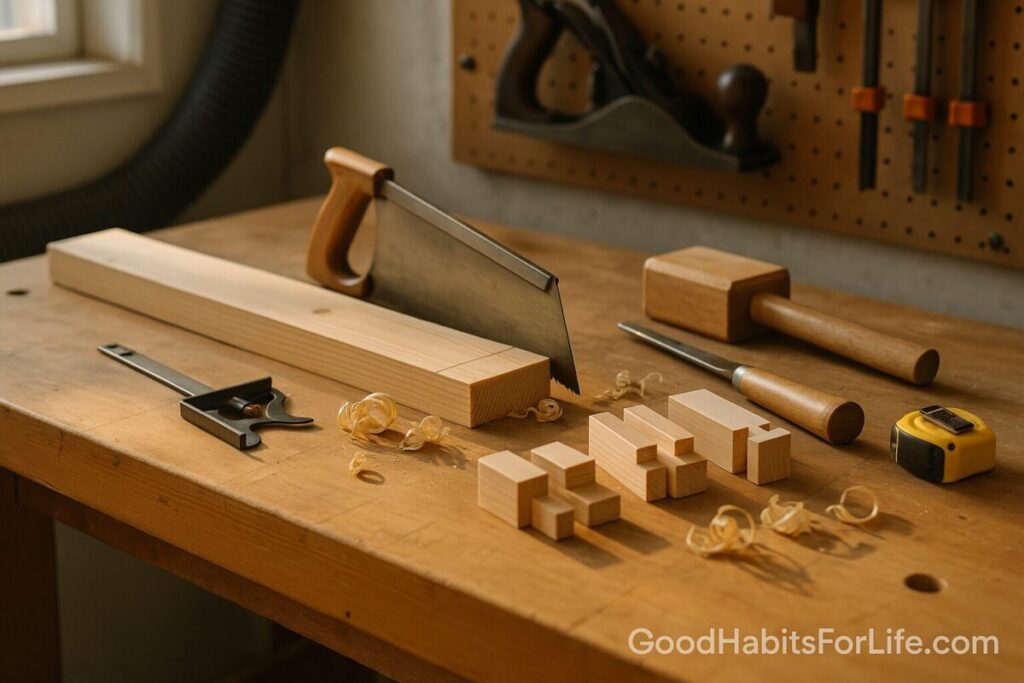
Woodworking Learning Path: Cuts, Joints, Projects
Woodworking Learning Path: Cuts, Joints, Projects
🧭 What & Why
Woodworking is the craft of turning raw boards into useful, long-lasting items through accurate measuring, cutting, joining, and finishing. A structured learning path reduces waste, prevents injury, and builds skills in the right order. You’ll start with layout accuracy, then cuts, then joints, and finally projects that compound everything you’ve learned.
Benefits
-
Better accuracy → tighter joints → stronger, longer-lasting projects.
-
Less tool clutter and cost by buying in stages.
-
Safer habits and dust control from day one.
-
Faster progress via deliberate practice and feedback loops.
✅ Quick Start: Do This Today
-
Set up a safe workspace. Clear a 1.5 × 2 m (5 × 7 ft) area, good lighting, and a stable work surface.
-
Accuracy kit: combo square (300 mm/12 in), sharp pencil/knife, tape (5 m/16 ft), and a marking gauge.
-
Practice three marks: centerline with gauge, square a line across a board’s face, and transfer that line around the edge.
-
Make two cuts: one crosscut and one rip on scrap. Check with your square and note the error direction.
-
Glue and clamp a simple butt joint in scrap to feel open time and squeeze-out control.
-
Create a one-page cutlist for a small tray: base, two long sides, two short sides.
🗓️ 7-Day Starter Plan
-
Day 1: Workspace & safety; mark three reference faces on scrap; tune your pencil/knife and square.
-
Day 2: Crosscut practice (10 cuts). Aim for <0.5 mm (1/64 in) out-of-square.
-
Day 3: Rip practice (3 rips). Plane/sand to a line.
-
Day 4: Rabbets with hand saw + chisel or router (four 10 mm × 6 mm / 3/8 × 1/4 in).
-
Day 5: Glue-up a small tray (butt joints). Check for square corner-to-corner.
-
Day 6: Sanding workflow (80→120→180 grit). Break edges (0.5 mm/1/64 in).
-
Day 7: Finish with an easy oil/varnish blend; observe drying and dust control.
🗺️ 30-60-90 Learning Roadmap
Days 1–30: Foundations (Accuracy & Cuts)
-
Layout: knife lines, story sticks, and squaring.
-
Cuts: crosscut, rip, miter; basic dados/rabbets using a gauge block or router.
-
Project 1: Desk tray (butt joints + rabbets).
-
Project 2: Bookshelf box (dados for shelves, rabbeted back).
Days 31–60: Joints & Repeatability
-
Joints: lap, box/finger, miter reinforcement (splines), dowels.
-
Jigs: crosscut sled, fence stop blocks, drilling jig.
-
Project 3: Small stool or step-up (lap joints or dowels).
-
Project 4: Keepsake box (box joints + lid rabbet).
Days 61–90: Strength & Furniture Scale
-
Joints: mortise-and-tenon, dovetail (through/half-blind).
-
Milling: square stock (face-joint, plane, edge-joint), panel glue-ups.
-
Project 5: Side table (M&T joinery).
-
Project 6: Wall shelf with dovetailed brackets (optional).
Checkpoint targets:
-
Square to ≤0.25 mm over 150 mm (≤0.010 in over 6 in).
-
Consistent glue lines (no gaps visible at 60 cm/2 ft).
-
Sanding uniform with scratch pattern removed before finishing.
🧠 Core Techniques & Frameworks
The A.C.E. Loop (Align → Cut → Evaluate)
-
Align: mark with knife; verify with square; clamp/support the work.
-
Cut: leave the line; use a fence/stop for repeat parts.
-
Evaluate: measure error, record it, and choose a correction (tune fence, change blade, swap to shooting board).
The 3-Line Rule
-
Knife line for precision.
-
Pencil line for visibility.
-
Stop line (tape/jig) for repeatability.
The 4-S Rule for stock prep
-
Select straight grain; Season (acclimate 48–72 h); Square one face/edge; Stabilize with finish or environment control.
🧰 Essential Tools & Materials
Stage 1 (under control budget):
-
Layout: 300 mm combo square, marking knife/gauge, tape, carpenter’s pencil.
-
Cutting: handsaw (fine crosscut), pull saw, block plane, chisels (6/12/18 mm).
-
Clamping: 4 bar/F-style clamps (300–600 mm / 12–24 in).
-
Safety: glasses, hearing protection, dust mask/respirator (P2/N95), shop vac.
Stage 2 (add for speed/scale):
-
Circular saw with guide rail, drill/driver, random-orbit sander (125 mm/5 in), trim router with straight and round-over bits.
Stage 3 (when projects demand):
-
Table saw or track saw upgrade, router table, thickness planer, jointer (or planer sled).
Materials
-
Practice: pine or poplar (soft, forgiving).
-
Projects: stable plywood (birch), then hardwoods (maple/oak/walnut) as accuracy improves.
-
Adhesives: PVA for most joints; epoxy for gaps or exterior; CA for temporary holding.
⚠️ Safety & Shop Habits
-
Eye & ear protection on all power tools; hearing loss is cumulative.
-
Dust control: use extraction or a respirator when sanding/cutting; wood dust is a respiratory irritant.
-
Blade/bit condition: a dull edge burns wood and kicks back.
-
Push sticks, guards, fences—always.
-
No loose clothing/jewelry; tie back hair.
-
Housekeeping: sweep chips, manage cords, empty dust bags safely.
🛠️ Cuts: Skills You’ll Use Every Week
| Cut | What it Does | Typical Tools | Accuracy Tip |
|---|---|---|---|
| Crosscut | Shortens to length | Handsaw, miter saw, table saw | Use a stop block; cut to a knife line. |
| Rip | Splits along grain | Handsaw, table saw, track saw | Featherboard; plane to final width. |
| Miter (45°) | Frames & trim | Miter saw, miter gauge | Sneak up and shoot with a shooting board. |
| Dado | Groove across grain | Router, dado stack | Use test pieces; fit to mating part. |
| Rabbet | L-shaped edge step | Router, table saw | Back up the cut to avoid tear-out. |
Practice Set: Make two identical rails and stiles; your final lengths should match within 0.5 mm (1/64 in).
🧱 Joints: From Simple to Strong
| Joint | Difficulty | Strength | Typical Uses | Notes |
|---|---|---|---|---|
| Butt | ★☆☆ | Low | Boxes, quick builds | Reinforce with screws/dowels. |
| Lap (half/full) | ★★☆ | Medium | Frames, stools | Large glue area; easy to align. |
| Dado/Rabbet | ★★☆ | Medium | Shelving, case backs | Great for plywood. |
| Miter (w/ spline) | ★★☆ | Medium-High | Frames, boxes | Splines add strength & style. |
| Box/Finger | ★★☆ | High | Boxes, drawers | Jig-friendly; very strong end-grain bond. |
| Dovetail (through/half-blind) | ★★★ | Very High | Drawers, cases | Mechanical strength; practice tails/pins. |
| Mortise-and-Tenon | ★★★ | Very High | Chairs, tables | Gold standard for frames. |
| Dowels/Loose Tenons | ★★☆ | High | Rails & panels | Use a jig for alignment. |
Weekly cadence: one joint each week → test piece → small project that uses it.
🧴 Milling, Assembly & Finishing Basics
Milling sequence (rough to ready):
-
Flatten a face → square an edge → plane thickness → rip to width → crosscut to length.
-
For plywood: skip flattening; square and cut with a guide.
Glue-ups
-
Dry fit first. Use cauls to keep panels flat.
-
Apply even glue film; aim for light squeeze-out, not rivers.
-
Clamp pressure: snug + quarter turn; check for square; re-check after 3–5 minutes.
Sanding workflow
-
Start at the lowest grit that removes mill marks (e.g., 80).
-
Progress: 80 → 120 → 180 → 220 (optional). Do not skip grits.
-
Vacuum dust between grits for a clean finish.
Finishes (beginner-friendly)
-
Oil/varnish blend (wiping): warm tone, easy repairs.
-
Water-based poly: clear, fast, low odor; raises grain—sand lightly after first coat.
-
Shellac: fast drying, great sealer; less heat/water resistant.
👥 Audience Variations
-
Students/teens: focus on hand tools, supervision, and small storage builds (desk riser, shelf).
-
Parents: kid-safe projects (toy crate, book ledge); pre-sand edges; use water-based finishes.
-
Professionals (time-poor): track saw + drill/driver + router trio; batch simple gifts (board, box, trays).
-
Seniors: prioritize ergonomics—bench height to wrist level; use lighter species (poplar/pine); anti-fatigue mats.
🚫 Mistakes & Myths to Avoid
-
Myth: “I need every tool first.” → Start with accuracy tools and add per project.
-
Mistake: Cutting to the line instead of leaving it; leaves joints loose.
-
Mistake: Skipping dust control; it affects finish and lungs.
-
Myth: “Hardwoods are always better.” → Plywood is dimensionally stable for cases.
-
Mistake: Rushing glue-ups; dry fit saves disasters.
💬 Real-Life Examples & Scripts
Hardware Store Script
“I’m building a 400 × 300 × 60 mm desk tray from birch plywood. Please rip one 600 × 300 mm panel and two 60 mm strips. I need 18 mm thickness, B/BB grade if available.”
Cutlist Note Template
Project: Keepsake Box. Parts: Lid (200 × 140 × 12), Front/Back (200 × 60 × 12), Sides (140 × 60 × 12), Bottom (180 × 120 × 6). Allow +2 mm for trimming.
Glue-Up Checklist
Dry fit → cauls ready → clamps staged → glue spreader → square check → diagonal measure → wipe squeeze-out after 10 min.
🧩 Tools, Apps & Resources
-
CutList Optimizer (web/app): turns dimensions into efficient layouts (pros: reduces waste; cons: needs accurate kerf).
-
SketchUp Free: visualize parts and joinery (pros: easy; cons: learning curve).
-
Board-Foot & Unit Converters: plan lumber purchases (pros: quick math; cons: imperial ↔ metric confusion—label clearly).
-
Angle & Level Apps (phone): quick miter checks (pros: handy; cons: calibrate before use).
-
Shop-made Jigs: crosscut sled, shooting board, dovetail guide—cheap accuracy boosts.
📌 Key Takeaways
-
Master layout before machines: knife lines and squares are your superpower.
-
Learn cuts → learn joints → build projects; let projects drive tool purchases.
-
Practice on scrap, measure errors, and record fixes.
-
Dust control and sharp tools improve safety and surface quality.
-
Follow the 7-Day start and 30-60-90 roadmap to move confidently into furniture builds.
❓ FAQs
1) What’s the best first saw for beginners?
A quality pull saw or fine crosscut handsaw—cheap, precise, and safe. Add a circular saw with a guide when you need speed.
2) Do I need a table saw right away?
No. A track/circular saw + guide, a router, and a good square will handle most beginner projects.
3) Which wood species are easiest?
Pine and poplar are forgiving and affordable; birch plywood is stable for boxes and shelves.
4) How do I keep miters tight?
Cut slightly proud, sneak up on the line, and use a shooting board. Splines or keys add strength.
5) What glue should I use?
PVA (wood glue) for most interior joints. Epoxy for gaps/exterior; CA for quick tacking.
6) Why are my cuts burning or wandering?
Likely a dull blade/bit or poor support. Replace/clean the blade and use fences, featherboards, and proper feed rate.
7) How much sanding is enough?
Stop when the scratch pattern from the previous grit is gone. Most projects finish at 180–220 grit.
8) Is dust really a big deal?
Yes—use extraction and/or a respirator. Dust affects health and finish quality.
9) Hand tools or power tools first?
Learn fundamentals with hand tools; add power tools to scale up speed and size.
10) How do I know I’m ready for mortise-and-tenon?
When your crosscuts, rips, and laps are square and repeatable; then practice M&T on scrap before furniture.
📚 References
-
OSHA Woodworking Safety (guards, kickback, dust): https://www.osha.gov/woodworking
-
NIOSH Wood Dust Topic Page: https://www.cdc.gov/niosh/topics/wood-dust/
-
HSE (UK) Woodworking Health & Safety: https://www.hse.gov.uk/woodworking/
-
USDA Forest Service – Forest Products Laboratory (Wood Handbook landing): https://www.fs.usda.gov/fpl/
-
The Wood Database (species properties, movement, toxicity): https://www.wood-database.com/
-
Penn State Extension — What Is a Board Foot?: https://extension.psu.edu/what-is-a-board-foot
-
NIOSH Noise & Hearing Loss Prevention (shop hearing basics): https://www.cdc.gov/niosh/topics/noise/
-
UC ANR — Selecting & Buying Lumber (general guidance): https://ucanr.edu/sites/Wood/Lumber/
ℹ️ Disclaimer
This guide is educational and not a substitute for professional training or local safety regulations; always follow tool manuals and safety standards.