
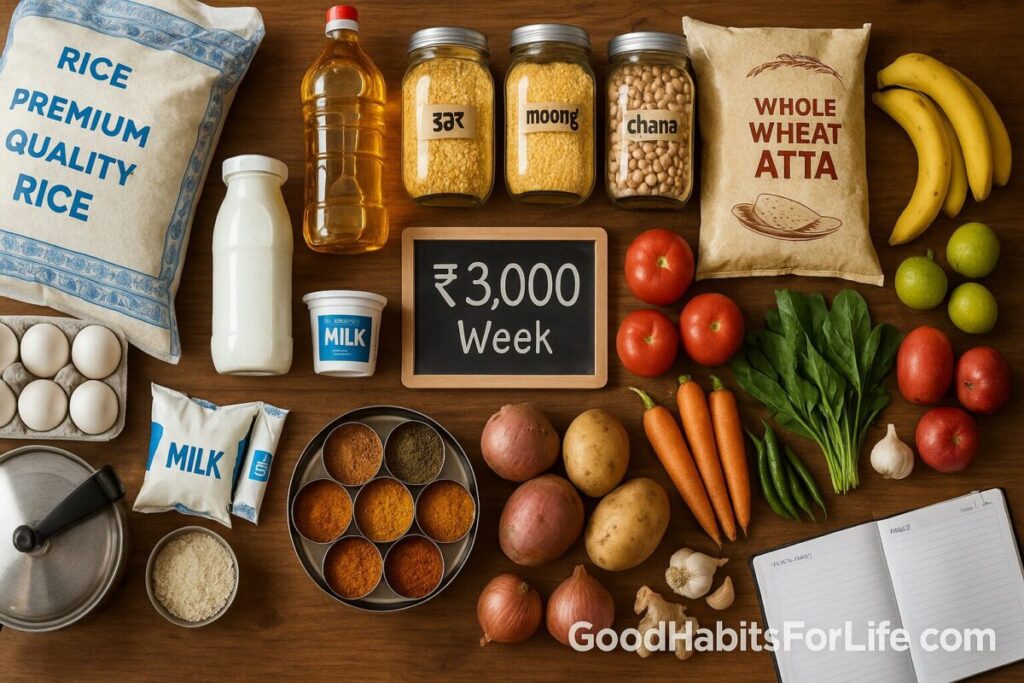
Weekly Food Budget 2025: Sample 3,000 Plan
Weekly Food Budget (2025): Sample ₹3,000 Plan
Table of Contents
🧭 What this ₹3,000 plan covers & why it works
This is a practical, one-week Indian grocery and meal blueprint designed to keep total food spend around ₹3,000 for a household of 2 adults (moderately active) or 1 adult + 1 teen. It balances cost, nutrition, and kitchen time using India-specific guidance:
-
Plate balance: Use ICMR-NIN’s “My Plate for the Day” as your visual rule: half the plate vegetables & fruit; the rest cereals/millets, pulses/animal proteins, dairy, nuts and oils. nin.res.in+1
-
Protein target: Aim around 0.8–1.0 g/kg/day (ICMR-NIN’s 2020 RDA ≈ 0.83 g/kg/day; consider the 1 g/kg/day note if cereal-heavy diets lower protein quality). nin.res.in
-
Sugar & oil sanity: Keep free sugars <10% of energy (ideally <5%) and moderate oils—both save money and improve health. World Health Organization
-
Price realism: Commodity prices vary by city and season; treat the basket below as illustrative and check the Department of Consumer Affairs’ daily price dashboards to adjust. Consumer Affairs+1
✅ Quick start (today)
-
Set the cap: Withdraw or earmark ₹3,000 in an envelope/app category.
-
Pick your week: Choose either Veg or Mixed meal plan below; circle 2–3 optional swaps.
-
Shop twice: Buy staples & long-keepers on Day 1; buy leafy greens/fruit again on Day 4–5.
-
Batch-cook: Pressure-cook 2 dals + 1 curry base + boiled chana/rajma; refrigerate in boxes.
-
Prep grains: Cook a big pot of rice; knead atta for 2 days; keep the rest dry.
-
Track: Write down each bill in a tiny price book (notebook/Notes app)—item, qty, ₹/kg, store.
-
Review: Mid-week, adjust remaining budget; skip treats if you’re overshooting.
🛒 The sample ₹3,000 shopping basket (with costs)
(Illustrative retail ranges; adjust to your city. Use PMD dashboards to cross-check current prices.) Consumer Affairs
Staples & cereals
-
Rice 5 kg … ₹300
-
Whole-wheat atta 5 kg … ₹200
-
Poha or millet (optional) 1 kg … ₹70
Pulses & legumes
-
Toor/Arhar dal 1 kg … ₹150
-
Moong dal 1 kg … ₹130
-
Kabuli chana or rajma 1 kg … ₹120
Proteins (choose per preference)
-
Eggs 30 pcs … ₹210
-
Paneer 500 g … ₹175
-
Chicken (dressed) 1.5 kg (optional; swap for more paneer/legumes if veg) … ₹330
Dairy
-
Milk 7 L … ₹420
-
Curd (set at home with milk above) … —
Vegetables & fruit
-
Potatoes 2 kg … ₹60
-
Onions 2 kg … ₹70
-
Tomatoes 2 kg … ₹100
-
Assorted seasonal veg (bhindi/cabbage/gourd/cauliflower/carrot/beans) ~4 kg … ₹260
-
Leafy greens (spinach/methi/coriander) … ₹120
-
Bananas 24 … ₹120
-
Apples/seasonal fruit 2 kg … ₹260
Fats & basics
-
Cooking oil 1 L … ₹150
-
Ginger-garlic, green chillies, lemons … ₹80
-
Spices/top-ups (haldi, jeera, dhania, garam masala) … ₹120
-
Tea/coffee & sugar (small top-up) … ₹160
Estimated total: ₹2,975–₹3,150 (trim optional meat/fruit if you need to hit ₹3,000 exactly).
🍽️ 7-day meal plan (veg & mixed options)
Daily breakfast (rotate):
-
Veg upma/poha with peanuts + fruit
-
2 eggs (boiled/omelette) + 2 rotis + salad (veg: besan chilla instead)
-
Curd + fruit + chana sundal
-
Oats/porridge with milk + banana
Lunch (mix & match):
-
Rice + dal of the day + sabzi + salad/lemon
-
Roti + chole/rajma + kachumber
-
Curd or buttermilk on hot days
Dinner (light, reuse bases):
-
Roti + stir-fried seasonal veg + paneer/chicken
-
Rice + veg pulao (use leftover sabzi) + raita
-
Khichdi + sautéed greens
Snacks: roasted chana/peanuts, fruit, chai; 2–3 “treat slots” for the week.
Dal schedule (batch-cook Sun):
-
Sun/Mon: Toor dal tadka
-
Tue/Wed: Moong dal with lauki/spinach
-
Thu/Fri: Chana/rajma masala
-
Sat: Khichdi night + clean-out sabzi
Veg plan swaps: replace chicken dishes with paneer bhurji, extra dal portions, or soy granules (if already in pantry).
🛠️ Techniques & frameworks for staying under budget
-
Plate rule first, price second: Anchor meals on vegetables + pulses per ICMR-NIN plate; carbs and oils are cheap but shouldn’t dominate nutrition. nin.res.in
-
The ₹/100 g check: When comparing packs, convert the shelf tag to ₹ per 100 g (or ₹ per egg).
-
Batch bases: One dal, one curry base (onion-tomato-ginger-garlic) = 6+ fast dinners.
-
Pantry-first menu: Plan around what you already have; build the list from gaps only.
-
Zero-based grocery budget: Start each week at ₹0 allocated; every item must “earn” its place.
-
The 10+10 stock rule: Keep 10 essential items (rice, atta, dal, oil, onion, potato, tomato, salt, haldi, jeera) + 10 flex items that rotate with season/deals.
-
Sugar & oil budget: Cap free sugars and cooking oil to curb both cost and empty calories. World Health Organization
-
Two-trip strategy: Prevent wilt/waste by splitting fresh buys across the week.
🧭 30-60-90 habit plan
Days 1–30 (Setup & stability)
-
Build your price book (top 20 items; note store and best price).
-
Stick to the ₹3,000 cap; no bulk buys yet.
-
Batch-cook weekly; track food waste (what spoiled? why?).
Days 31–60 (Optimization)
-
Add millets or whole grains 2–3x/week; try one new veg weekly.
-
Negotiate or compare ₹/kg across kirana, mandi, and apps; log wins.
-
Aim <10% energy from free sugars; replace 3 snack purchases with roasted chana/fruit. World Health Organization
Days 61–90 (Resilience & savings)
-
Build a two-week rotating menu; stock a basic emergency pantry (extra dal, rice, oil, salt).
-
Shift to monthly staples buy when cash-flow allows; keep weekly fresh runs.
-
Target 5–10% under budget to create a “rainy-day food fund”.
👥 Audience variations
Students/hostel:
-
Electric kettle + small pan cooking: poha, suji upma, egg bhurji, oats, chana.
-
Share bulk buys (5 kg atta/rice) across roommates to drop ₹/kg.
Families with young kids:
-
Keep snack boxes: roasted makhana/peanuts/fruit; curb packaged buys.
-
Add milk/curd for calcium; small, frequent veg portions.
Busy professionals:
-
Weekend batch: 8 rotis par-cooked + 2 dals + 1 curry base; freeze portioned.
-
Default khichdi + salad dinner on late days.
Seniors:
-
Softer textures: dal khichdi, curd rice, steamed veg; watch salt and oil.
-
Ensure adequate protein (~0.8 g/kg/day) across the day. nin.res.in
Vegetarian households:
-
Double legumes; include paneer/curd/milk; consider soy/peanuts for affordable protein.
⚠️ Mistakes & myths to avoid
-
Myth: “Healthy = expensive.” Truth: seasonal veg, pulses, curd, eggs are high value per rupee.
-
Mistake: One big shop; leafies wilt, fruit spoils. Split the shop.
-
Mistake: Buying snacks “on offer.” Offer ≠ need; treats get a fixed line in the budget.
-
Myth: “Cut all carbs.” Use whole grains/millets + veg + pulses for balance (see “My Plate”). nin.res.in
💬 Real-life examples & scripts
-
At the mandi: “Bhaiya, agar 3 kilo le lu, ₹X per kilo kar doge? Cash le lo; bag mere paas hai.”
-
Family huddle (Sunday night): “This week our cap is ₹3,000. We’ll buy staples today, greens Thursday. If we cross ₹2,200 by Wednesday, we skip treats.”
-
Roommates split: “I’ll take rice/oil, you take dal/atta—settle on UPI now so we stick to the cap.”
🧰 Tools, apps & resources
-
Price references: Dept. of Consumer Affairs—Price Monitoring Division dashboards for daily retail/wholesale prices. Great for reality-checking your list. Consumer Affairs
-
Nutrition & plate balance: ICMR-NIN Dietary Guidelines (2024) and My Plate for the Day—simple, reliable, India-specific. nin.res.in+1
-
Eat Right India (FSSAI): Bite-size tips on eating safe, healthy, and sustainable; helpful posters and toolkits. eatrightindia.gov.in+1
-
Apps: Notes/Sheets for a price book; any grocery app for quick price checks; stopwatch for “30-minute cook block.”
📌 Key takeaways
-
Anchor meals on the ICMR-NIN plate and protein target, not just price. nin.res.in+1
-
Batch bases + two trips + price book = under budget without daily stress.
-
Use government price dashboards to steer choices when costs swing. Consumer Affairs
-
Keep sugars/oils in check for health and savings. World Health Organization
❓ FAQs
1) Is ₹3,000 enough for a week?
For 2 moderately active adults (or 1 adult + 1 teen), it’s workable with legumes, eggs, seasonal produce, and batch cooking. Trim optional meat/fruit if prices spike; use PMD price dashboards to adjust. Consumer Affairs
2) What if I’m fully vegetarian?
Swap chicken for paneer/soy/extra legumes; keep curd/milk. Hit ~0.8 g/kg/day protein by distributing dal, dairy, nuts/peanuts across meals. nin.res.in
3) How do I handle sudden price surges?
Switch to in-season veg, choose cheaper pulses (chana/masoor), and lean on stored staples. Cross-check daily retail prices before shopping. Consumer Affairs
4) Is sugar really that big a deal for the budget?
Yes—packaged sweets/drinks carry high ₹/calorie and crowd out essentials. WHO advises <10% energy from free sugars (ideally <5%). World Health Organization
5) Can I meal-prep without a freezer?
Yes. Pressure-cook dal/legumes, refrigerate 3–4 days; par-cook rotis; make curry base; plan a khichdi night to finish leftovers.
6) What about kids’ needs?
Keep fruit/dairy daily, use less-spicy versions of family meals, and add eggs/legumes for protein. Follow the plate balance. nin.res.in
7) How do I reduce oil without losing taste?
Use non-stick or well-seasoned iron pans, temper spices in less oil, add acidity (lemon/tomato) and herbs for flavor. FSSAI encourages cutting excess oil for health. eatrightindia.gov.in
8) Should I buy organic to be healthy?
Not required for a balanced diet. Focus first on variety, plate balance, hygiene, and cooking methods (Eat Right India). eatrightindia.gov.in
📚 References
-
ICMR-NIN. Dietary Guidelines for Indians (2024). https://www.nin.res.in/dietaryguidelines/pdfjs/locale/DGI07052024P.pdf nin.res.in
-
ICMR-NIN. My Plate for the Day (Poster). https://www.nin.res.in/downloads/My_Plate_08-2020.pdf nin.res.in
-
ICMR-NIN. A Brief Note on Nutrient Requirements for Indians (RDA 2020). https://www.nin.res.in/rdabook/brief_note.pdf nin.res.in
-
WHO. Guideline: Sugars intake for adults and children. https://www.who.int/publications/i/item/9789241549028 World Health Organization
-
FSSAI. Eat Right Toolkit / Eat Right India. https://eatrightindia.gov.in/eatright-toolkit.jsp and https://eatrightindia.gov.in/ eatrightindia.gov.in+1
-
Government of India, Dept. of Consumer Affairs. Price Monitoring Division (PMD)—daily retail/wholesale prices. https://consumeraffairs.gov.in/pages/price-monitoring-division Consumer Affairs
Disclaimer: This guide is educational information on budgeting and everyday nutrition and is not personal financial or medical advice; adjust for your health needs and consult a professional if required.