
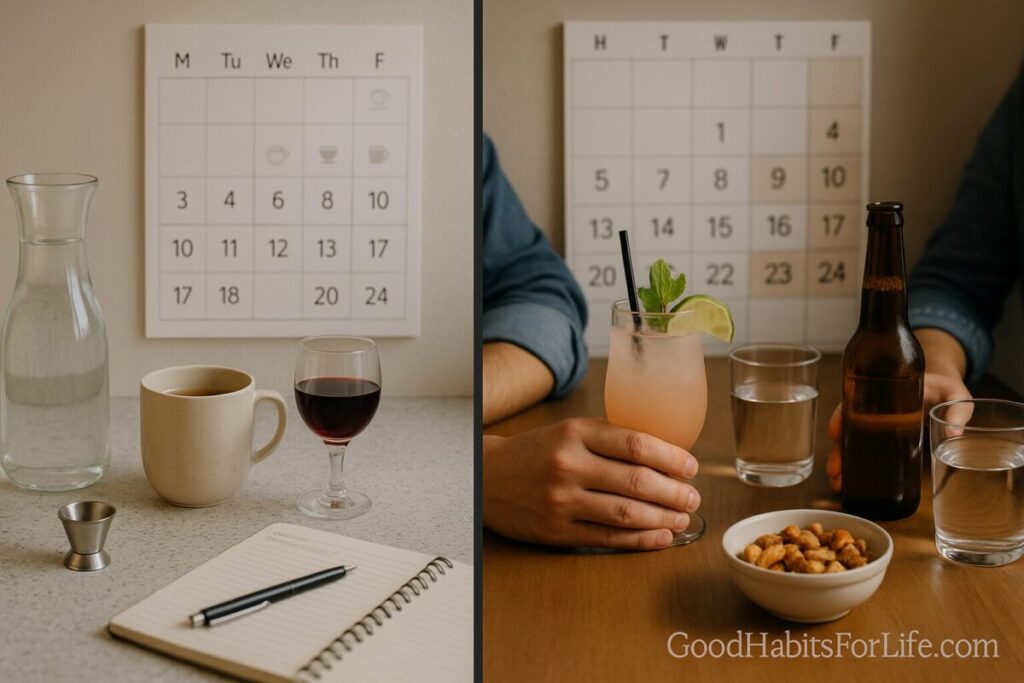
Weekend vs Weeknight: Make a Sensible Plan
Weekend vs Weeknight Drinking: Sensible Plan
Table of Contents
🧭 What “Weekend vs Weeknight” Really Means
Many people feel fine going alcohol-free Monday–Thursday and relaxing on Friday or Saturday. Others prefer a small, routine weeknight drink at home and little to none on weekends. Either pattern can be more or less risky depending on how much you drink on those days and how often you have drink-free days.
Evidence-based guardrails (international snapshot)
-
U.K.: Keep it ≤14 units/week (spread over 3+ days) with several alcohol-free days. (In the U.K., 1 unit ≈ 8 g pure alcohol.) nhs.ukGOV.UK
-
Australia: ≤10 standard drinks/week and ≤4 on any day (1 Aus standard drink = 10 g alcohol). NHMRC+1Alcohol and Drug Foundation
-
Canada (2023 Guidance): Risk is low at ≤2 drinks/week; 3–6/week = moderate risk; 7+ = increasingly high; >2 per occasion raises injury risk. (1 Canadian standard drink ≈ 13.45 g.) CCSA+1Canada
-
Global health view: “No safe level” for health—less is better. World Health Organization+1
Why it matters: Concentrating most of your drinks into a single weekend night pushes you toward binge territory—4+ drinks for women, 5+ for men in ~2 hours—which spikes accidents, injuries, and health risks even if weekly totals look modest. CDCniaaa.nih.gov
✅ Quick Start: Your Sensible Plan Today
Goal: Keep weeknights clear-headed and make weekends intentional—not excessive.
-
Pick your pattern (choose one):
-
Set hard limits:
-
Build “AF anchors”: At least 2–4 alcohol-free days/week—put them on your calendar.
-
Pace & protect:
-
1 drink/hour max, alternate with water, eat first, stop 2–3 hours before bed.
-
If you hit binge thresholds or feel a loss of control, end the session, switch to AF drinks, and plan a longer reset window. CDC
-
-
Measure your drinks correctly:
-
U.S. std drink: 14 g (e.g., 350 ml beer ~5%, 150 ml wine ~12%, 45 ml spirits ~40%).
-
Australia: 10 g; U.K. uses units; Canada 13.45 g. Check labels and sizes. niaaa.nih.govAlcohol and Drug Foundationnhs.ukCanada
-
🛠️ 30-60-90 Habit Roadmap
Days 0–30: Stabilize & Audit
-
Rules: No drinking Mon–Thu; ≤2 per occasion Fri/Sat; Sun AF.
-
Track: Log exact volumes (ml, %ABV), occasions, and mood/sleep.
-
Replace rituals: Pre-dinner sparkling water with lime; AF beer/wine options.
-
Checkpoint (Day 30):
Days 31–60: Optimize & Social Proof
-
Tighten pacing: 1 drink/hour; add water-for-every-drink rule.
-
Social scripting: Agree rides home; declare “I’m capping at two.”
-
Swap high-ABV: Choose session beers (≤4% ABV) or 125–150 ml wine pours.
-
Checkpoint (Day 60):
-
Cravings/impulse lower?
-
At least 3 AF days/week consistently?
-
Days 61–90: Future-proof
-
Micro-goals: Two AF weekends this month; try one month AF challenge later.
-
Trigger plan: Have If-Then rules (e.g., If pre-game starts → bring AF options).
-
Reassess risks: If work stress or life events push you toward binges, consider a 90-day AF reset and/or talk to a clinician.
🧠 Techniques & Frameworks That Work
-
Pre-commit limits: Decide when/what/how much before you drink; text a friend your cap.
-
HALT Scan: Avoid drinking when Hungry, Angry, Lonely, Tired—pick a soothing alternative first.
-
Pacing Ladder: Start with AF drink → low-ABV → (maybe) one standard. Stop.
-
Environment design: Stock AF options; use smaller glasses; keep spirits out of sight.
-
“Units/Standard drinks” math: Learn your country’s measure so a “glass” doesn’t creep up. nhs.ukAlcohol and Drug FoundationCanada
-
Binge tripwires: Music festivals, bottomless brunches, free-pour parties—pre-choose AF or leave early if caps are breached. Binge = 4+ (women) / 5+ (men) in ~2 h. CDCniaaa.nih.gov
-
Health lens: Remember the global stance—less is better; any reduction lowers long-term risk. World Health Organization
👥 Audience Variations
Students/Teens of legal age in your region: Party contexts = high binge risk; keep ≤2/occasion, always eat first, go AF every other event. CDC
Parents/Caregivers: Fatigue increases impulsivity—pre-set AF weeknights; keep weekend plans child-safe (no driving; coverage arranged).
Busy Professionals: Work dinners? Start AF, nurse one standard with food, close tab early.
Seniors: Alcohol interacts with medicines and sleep—consider tighter caps or AF; discuss with your clinician.
⚠️ Mistakes & Myths to Avoid
-
Myth: “Saving my drinks for Saturday is fine.” Large single-night doses raise accidents/injury risk even if weekly totals look okay. CDC
-
Myth: “Red wine is good for my heart.” Benefits are uncertain; harm risk grows with each drink. World Health Organization
-
Mistake: Not counting ABV/volume. A “glass” can be 1.5–2+ standard drinks depending on pour strength. niaaa.nih.govnhs.uk
-
Mistake: Ignoring country-specific standards. Units and “standard drinks” differ by region; learn yours. nhs.ukAlcohol and Drug FoundationCanada
💬 Real-Life Examples & Scripts
At a Friday dinner
-
You: “I’m doing two tonight—one with starters, one with mains—then I’m on AF.”
-
If pushed: “I feel better tomorrow when I stop at two. Grab a mocktail with me?”
At a house party
-
Plan: Arrive with AF seltzers; pour into a glass; alternate every drink.
-
Exit line: “Early workout tomorrow—leaving after this one.”
At home on a weeknight
-
Rule: Kitchen closed to alcohol Sun–Thu; sparkling water + lime ritual instead.
-
If craving: 10-minute walk → herbal tea → revisit urge.
📚 Tools, Apps & Resources
-
Drink calculators / unit guides: NHS unit calculator; national health sites clarify units vs standard drinks. nhs.uk
-
Tracking apps: Many health apps let you log drinks and set caps; pick one that shows ABV × volume and weekly summaries.
-
AF options: Stock alcohol-free beer/wine/spirits to keep rituals without ethanol.
-
Support: If limits aren’t sticking or binges recur, consult your clinician or a local helpline.
🔑 Key Takeaways
-
Make weeknights mostly AF; weekends planned and paced.
-
Know your local guideline and measure actual standard drinks/units. nhs.ukNHMRC
-
Cap per occasion at ≤2 if minimizing short-term harms; never binge. CCSACDC
-
Use AF anchors, pacing rules, and pre-commitment to stay in control.
-
For long-term health, less is better; there’s no risk-free level. World Health Organization
❓ FAQs
1) Is it healthier to avoid alcohol on weekdays and drink on weekends?
Health risk depends on total volume and per-occasion dose. Large single sessions increase injury and acute risk—even if your week is otherwise AF. CDC
2) What counts as a “standard drink” or “unit”?
It varies by country (e.g., U.S. 14 g; Aus 10 g; Canada 13.45 g; U.K. units of 8 g). Always check your labels and local guidance. niaaa.nih.govAlcohol and Drug FoundationCanadanhs.uk
3) How many drinks are “low risk”?
Guidance differs: U.K. ≤14 units/week; Australia ≤10 standard drinks/week (≤4/day); Canada says risk is low at ≤2 drinks/week and rises with each additional drink. nhs.ukNHMRCCCSA
4) What is binge drinking and why is it worse?
Binge = 4+ drinks (women), 5+ (men) in ~2 h; it rapidly raises BAC, impairment, and harm risk. CDCniaaa.nih.gov
5) Are there any proven health benefits to moderate drinking?
Current public-health consensus emphasizes risk with every drink; safer to assume “less is better” and focus on non-alcohol strategies for heart health. World Health Organization
6) Can I swap to low-ABV options and count half?
Lower-ABV drinks help pacing, but count grams of alcohol or units—not glasses. Use calculators from national health sites. nhs.uk
7) I’m on medication—does the plan still apply?
Many medicines interact with alcohol; ask your clinician and consider an AF plan.
8) How do I handle social pressure?
Pre-commit your cap; order AF first; use firm, friendly scripts (“I’m good at two.”). Practice exit cues and bring AF options.
References
-
World Health Organization. Alcohol – Fact sheet (updated 28 Jun 2024). https://www.who.int/news-room/fact-sheets/detail/alcohol World Health Organization
-
WHO/Europe. No level of alcohol consumption is safe for our health (Jan 4, 2023). https://www.who.int/europe/news/item/04-01-2023-no-level-of-alcohol-consumption-is-safe-for-our-health World Health Organization
-
CDC. Alcohol Use and Your Health (Jan 14, 2025). https://www.cdc.gov/alcohol/about-alcohol-use/index.html CDC
-
NIAAA (NIH). Understanding Binge Drinking. https://www.niaaa.nih.gov/publications/brochures-and-fact-sheets/binge-drinking niaaa.nih.gov
-
NIAAA (NIH). Alcohol Drinking Patterns. https://www.niaaa.nih.gov/alcohols-effects-health/alcohol-drinking-patterns niaaa.nih.gov
-
NHS. Calculating alcohol units. https://www.nhs.uk/live-well/alcohol-advice/calculating-alcohol-units/ nhs.uk
-
UK Chief Medical Officers. Low Risk Drinking Guidelines (2016). https://assets.publishing.service.gov.uk/media/5a80b7ed40f0b623026951db/UK_CMOs__report.pdf GOV.UK
-
Australian NHMRC. Alcohol guidelines (site overview + PDF). https://www.nhmrc.gov.au/health-advice/alcohol ; https://www.nhmrc.gov.au/sites/default/files/2022-07/Australian-guidelines-to-reduce-health-risks-from-drinking-alcohol.pdf NHMRC+1
-
CCSA. Canada’s Guidance on Alcohol and Health – Final Report (2023). https://www.ccsa.ca/sites/default/files/2023-01/CCSA_Canadas_Guidance_on_Alcohol_and_Health_Final_Report_en.pdf CCSA
-
Public Health Agency of Canada. Risk classification using Canada’s Guidance… (2025). https://www.canada.ca/en/public-health/services/reports-publications/health-promotion-chronic-disease-prevention-canada-research-policy-practice/vol-45-no-2-2025/increase-risk-classification-guidance-alcohol-health-examination-sample-community-adults-ontario.html Canada
-
Alcohol & Drug Foundation (AU). Alcohol guidelines and standard drinks (2025). https://adf.org.au/reducing-risk/alcohol/alcohol-guidelines/ Alcohol and Drug Foundation
Disclaimer: This article is for general information only and is not a substitute for personalized medical advice. If you’re concerned about your drinking, speak with a qualified health professional.