
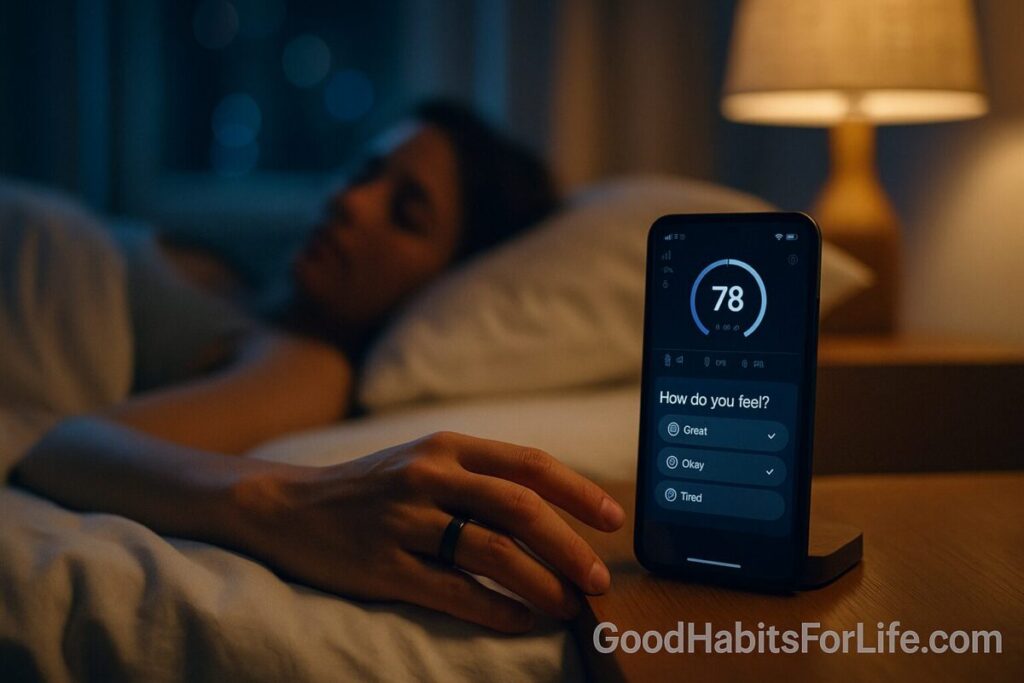
Wearables at Night: Scores vs Feeling (2025)
Wearables at Night 2025: Sleep Score vs Feeling
Table of Contents
🧭 What & Why
What this is: A practical guide to using consumer wearables (rings, watches, bands) at night—without letting the score rule your day. You’ll learn what your device measures, what it doesn’t, and how to combine metrics with your own morning check-in.
Why it matters:
-
Accuracy is mixed. Most modern wearables are solid at detecting sleep vs wake and total sleep time, but sleep stage classification (light/deep/REM) is still imperfect compared to polysomnography (the lab gold standard). That’s fine for habit-building, less fine for diagnosis.
-
Regularity and duration drive health. Research increasingly shows sleep regularity and enough total sleep (adults: ≥7 h/night) are key levers for long-term health.
-
Feeling still counts. Subjective sleep quality often diverges from device output. People can feel great after a “meh” score—or lousy after a “good” one. Pair both to steer your habits.
Core terms (plain-English):
-
TST: Total Sleep Time.
-
SRI / Regularity: How consistent your sleep/wake timing is across days.
-
RHR: Resting Heart Rate (lower is generally better at night).
-
HRV (RMSSD): Beat-to-beat variability; a proxy for recovery and stress. Look for your baseline and trends, not someone else’s number.
-
SpO₂: Oxygen saturation; consumer readings can be skewed—use trends, not single values.
✅ Quick Start (Do This Tonight)
-
Set a target window: Aim for 7–9 h in bed; pick a consistent wake time first.
-
Limit late caffeine: Stop caffeine ≥6–8 h before bed.
-
Evening wind-down (30–60 min): Low light, low screens, same routine nightly.
-
Wear your device + morning check-in: On waking, rate How do I feel? (1–5) and jot one line about why.
-
Track 3 metrics for 14 nights: TST, regularity, RHR/HRV. Ignore nightly stage micromanagement.
-
Act on patterns: If short, advance bedtime by 15–20 min; if irregular, lock wake time.
-
Red flags? Loud snoring, choking/gasping, witnessed apneas, high daytime sleepiness—see a clinician.
🧠 The “Score vs Feeling” Framework
Use this simple triangulation each morning:
-
1) Feeling (1–5): Energy, mood, focus.
-
2) Sleep score: Treat as a trend, not a judgment.
-
3) Behaviours: Bed/wake time, late caffeine/alcohol, stress, late meals, exercise timing.
How to interpret:
-
Score ↑ & Feel ↑: Keep going; protect the behaviours that made it happen.
-
Score ↓ & Feel ↑: Don’t overcorrect. Give it 2–3 nights; the device may be noise-y or misclassifying stages.
-
Score ↑ & Feel ↓: Look for non-sleep confounders (coming illness, heavy training, late meal/alcohol).
-
Score ↓ & Feel ↓: Tackle regularity first, then duration, then wind-down/light/caffeine.
🛠️ Techniques & Frameworks That Work
✅ 1) The 3×3 Metric Set
Track three device metrics + three behaviours:
-
Metrics: TST, sleep regularity (or consistent wake time), RHR/HRV trend.
-
Behaviours: Caffeine cut-off, wind-down routine, light exposure (bright mornings, dim evenings).
Review weekly, not nightly.
🧭 2) Regularity > Everything
Set your wake time and keep it—even after a late night. Weekend drift wrecks regularity and Monday energy. Target ±30 min day-to-day variance.
🧠 3) HRV: Keep it Simple
Use the value your device reports most reliably (RMSSD on many wearables). Compare today vs your 7–30-day average, not vs others. A one-day dip is normal; watch 3-day trends.
🌇 4) Light & Caffeine Windows
-
Morning: Get 5–15 min of outdoor daylight within an hour of waking.
-
Evening: Dim lights in the last 60–90 min.
-
Caffeine: Cut ≥6–8 h pre-bed (earlier if sensitive).
🧪 5) Treat SpO₂ as “directional”
Consumer SpO₂ sensors can be thrown off by skin tone, circulation, temperature, or movement. Look at trends and symptoms—not a single low reading.
📋 Mini-reference: What common metrics mean
| Metric | Use it for | Don’t use it for |
|---|---|---|
| TST | Ensuring ≥7 h most nights | Overreacting to one short night |
| Regularity / SRI | Locking bed/wake windows | Chasing perfect zero-variance |
| RHR (night) | Recovery trend (lower is better) | Diagnosing illness alone |
| HRV (RMSSD) | Recovery/stress trends vs your baseline | Comparing with friends |
| Sleep stages | Broad trends over weeks | Night-to-night decisions |
👥 Audience Variations
-
Students/Teens: Prioritise consistent wake time despite shifting schedules; school nights drift easily—use morning light + earlier caffeine cut-off.
-
Professionals: Travel? Anchor to destination wake time + morning light; use earplugs/eye mask to protect TST.
-
Parents of young kids: Aim for regularity of wind-down, not perfect hours. Nap if needed (<30 min, before mid-afternoon).
-
Seniors: Protect daytime light and movement; review meds with your clinician if insomnia or excessive sleepiness appears.
-
Athletes/Heavy trainers: Expect HRV dips after intense sessions; respond with earlier bedtime, higher-carb dinner, and light evening stretch—not alarm.
⚠️ Mistakes & Myths to Avoid
-
“My stage data is exact.” It isn’t—treat it as approximate.
-
“A low score means a bad day.” Not necessarily; use the score as a conversation starter, not a verdict.
-
“SpO₂ on my wearable = diagnosis.” No—consumer readings have limitations; see a clinician for symptoms.
-
“More sleep is always better.” Aim for adequate and regular, not endless.
-
“I’ll fix everything at once.” Change one lever per week (caffeine, light, bedtime).
🗣️ Real-Life Examples & Scripts
-
If your score says 68 but you feel 4/5: “I’ll keep my plan. Same wake time, morning light, early caffeine cut-off. Re-check in 3 nights.”
-
Jet lag week: “Wake at 07:00 local, daylight walk, no caffeine after 14:00, 20-min late-afternoon nap if needed.”
-
Training block: “Heavy lift day? Expect HRV dip tomorrow. I’ll add 30 min in bed and an earlier wind-down.”
-
Bad stage data spiral: “I’ll hide stages for a week and focus on TST + regularity + feeling.”
🧰 Tools, Apps & Resources (Pros/Cons)
Oura Ring / smart rings
-
Pros: Comfortable, multi-day battery, strong sleep-wake detection; rich recovery trends (HRV/RHR/temperature).
-
Cons: Subscription; stages are estimates; ring fit matters.
Apple Watch (watchOS 10/11+)
-
Pros: Broad app ecosystem; validated sleep-wake; new health features continue to expand.
-
Cons: Daily charging; stage accuracy variable; many metrics need context.
Fitbit / Garmin
-
Pros: Reliable sleep-wake, helpful duration/efficiency trends, long battery (Garmin).
-
Cons: Stage accuracy varies by model/firmware; subscriptions for advanced insights.
WHOOP
-
Pros: Recovery focus, strain-sleep planning, useful HRV/RHR trend visuals.
-
Cons: Subscription only; watch placement/fit can affect data.
General tips: Keep firmware updated, wear consistently, and review weekly, not minute-by-minute.
🔎 Key Takeaways
-
Focus on regularity and enough sleep first.
-
Combine score + feeling + behaviours for smarter decisions.
-
Use trends (14–30 nights), not single nights.
-
Treat stages as approximate and SpO₂ as directional.
-
See a clinician for persistent symptoms or suspected disorders.
❓ FAQs
1) Are sleep stages from wearables accurate?
They’re improving, but still estimates. Devices are best at telling sleep vs wake and giving useful trends. Use stages for long-term patterns, not nightly judgments.
2) What’s the single best metric to watch?
For most people: sleep regularity (consistent bed/wake) and total sleep time. Recovery-focused users can also track RHR/HRV trends vs their own baseline.
3) My score was low but I feel fine—what do I do?
Don’t overcorrect. Note confounders (late meal, stress, alcohol), keep your routine, and look at 3-day trends.
4) Can a wearable diagnose sleep apnea or insomnia?
No. Some features may screen for risk, but diagnosis needs validated testing and a clinician’s evaluation.
5) How do I use HRV correctly?
Check the same time daily (ideally overnight or upon waking), compare against your 7–30-day average, and look for trends.
6) Is wrist vs ring better?
Rings often get steadier night signals; watches add daytime features. Choose the form factor you’ll wear consistently.
7) What’s a healthy HRV or sleep score?
There’s no universal “good” number; baselines vary. Track how your behaviours shift your trends over weeks.
8) How long should I test habits before judging?
Give each change 2 weeks before you decide—sleep adapts slowly.
9) Should teens and older adults follow the same rules?
Principles are similar, but teens need 8–10 h, older adults may sleep slightly less yet still benefit from regularity.
10) When should I worry about SpO₂ dips?
If you see consistent low trends with symptoms (snoring, gasping, morning headaches, daytime sleepiness), seek medical care.
📚 References
-
American Academy of Sleep Medicine (AASM). Consumer Sleep Technology: Position Statement (2018/update & resource hub). aasm.org
-
Watson NF et al. Recommended Amount of Sleep for a Healthy Adult. SLEEP (2015). PMC
-
Windred DP et al. Sleep regularity predicts mortality risk. SLEEP (2024). PubMed
-
Robbins R et al. Accuracy of Oura Gen3, Fitbit Sense 2, Apple Watch Series 8 vs PSG. Sensors (2024). PMC
-
Schyvens AM et al. Validation of six wrist-worn sleep trackers. Sleep Advances (2025). Open Access
-
Apple Health. Estimating Sleep Stages from Apple Watch (Whitepaper, 2023). PDF
-
Lee T et al. Accuracy of 11 wearable/nearable consumer sleep trackers. JMIR mHealth (2023). JMIR
-
Damoun N et al. HRV measurement and influencing factors (review). Frontiers in Physiology (2024). Frontiers
-
Nuuttila OP et al. Morning vs nocturnal HR/HRV for monitoring. Sports Medicine-Open (2024). SpringerOpen
-
U.S. FDA. Pulse Oximeters—Accuracy Limitations & Guidance (2024–2025). FDA overview | Draft guidance PDF
-
Schutte-Rodin S et al. Evaluating consumer and clinical sleep technologies: AASM update. J Clin Sleep Med (2021). PMC
Disclaimer: This guide is educational and not medical advice. If you suspect a sleep disorder or have persistent symptoms, consult a qualified health professional.