
Vitamin D, Omega3 & Zinc: When Food First: Zone 2 + NEAT (2025)
Vitamin D, Omega-3 & Zinc: Food-First + Zone 2 & NEAT
Table of Contents
🧭 What & Why
The trio:
-
Vitamin D helps calcium balance, muscle function, and modulates innate/adaptive immunity. Many adults need 600 IU (15 µg) daily; 800 IU (20 µg) after age 70. Upper limit 4000 IU (100 µg). Office of Dietary Supplements
-
Omega-3s (EPA/DHA/ALA) support cell membranes and generate specialized pro-resolving mediators (SPMs) that help turn off excessive inflammation. Aim for 2 fish meals/week (≈ 250–500 mg/day EPA+DHA on average). www.heart.org+1
-
Zinc is crucial for immune cell signaling and wound healing. Adults typically need 8–11 mg/day; upper limit 40 mg/day. Office of Dietary Supplements
Why food first? Whole foods deliver cofactors (protein, selenium, iodine, B-vitamins, polyphenols) and reduce overdose risk. When diet and lifestyle cover the base, supplements become small “gap fillers,” not the main course. (See safety section.)
Movement synergy: Pair nutrients with Zone 2 (steady, conversational-pace cardio) plus NEAT (all daily non-exercise movement). Together they lower chronic inflammation risk and improve metabolic resilience. Guidelines: 150–300 min/week moderate activity + 2 strength days; move more, sit less. CDC+1
✅ Quick Start (Do This Today)
-
Build your plate
-
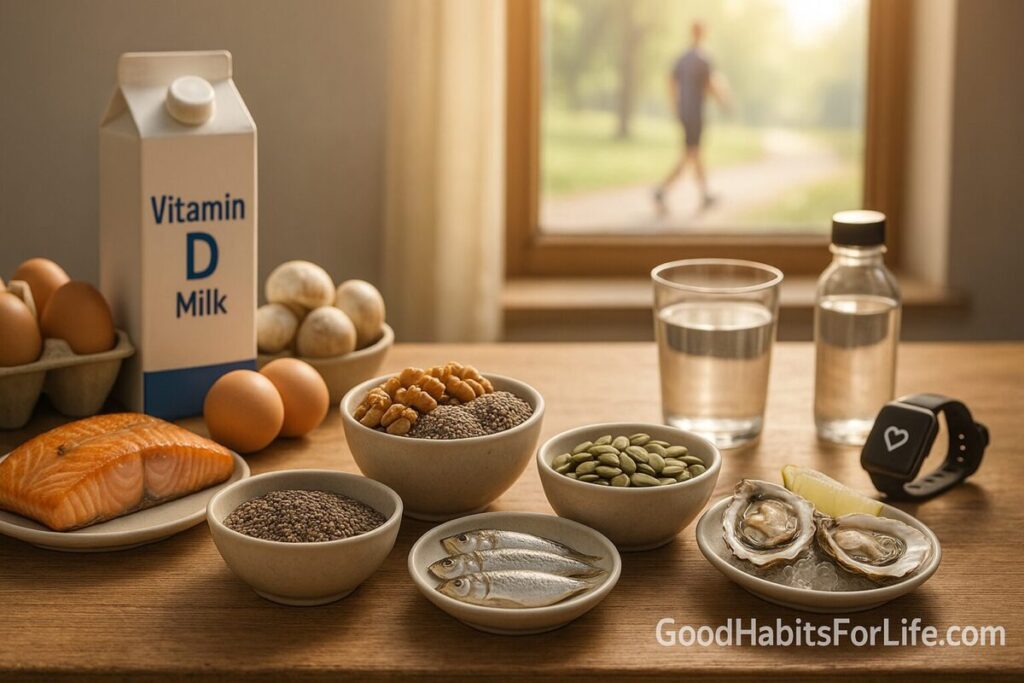
Omega-3s: 2×/week fatty fish (e.g., salmon, sardine, mackerel, ~100–120 g/serve). Plant ALA daily (1–2 Tbsp ground flax/chia, walnuts), understanding conversion to EPA/DHA is limited. Office of Dietary Supplements
-
Vitamin D: Eggs, UV-exposed mushrooms, fortified milk/alt-milk/yogurt; oily fish helps here too. If you rarely get sun/fortified foods, discuss a low-dose supplement. Office of Dietary Supplements
-
Zinc: Oysters, beef/lamb, chicken, lentils/chickpeas/beans, pumpkin seeds, cashews. Vegetarians can boost absorption with soaking/sprouting/fermentation. Office of Dietary Supplements
-
-
Zone 2 today: 30–45 minutes brisk walk or easy cycle at a pace where you can speak in short sentences (talk test = “moderate”). Add 1–2 “movement snacks” (10-minute walks) around meals. CDC
-
NEAT target: set a baseline step count (e.g., 6000–8000) and add +1000 steps/day for two weeks via stairs, walking calls, chores, and light mobility between desk blocks. NEAT meaningfully raises daily energy expenditure. PubMed
-
Smart supplement check (if needed):
-
Vitamin D: typical 600–800 IU/day; avoid long high-dose courses unless prescribed; UL 4000 IU. Office of Dietary Supplements
-
Omega-3 EPA+DHA: if you don’t eat fish, consider ~250–500 mg/day; FDA limits labels to ≤2 g EPA+DHA/day. Office of Dietary Supplements
-
Zinc: use diet first; avoid chronic high-dose (UL 40 mg/day). Office of Dietary Supplements
-
-
Sun + skin safety: You can maintain vitamin D while practicing sun protection; dermatology bodies advise not relying on unprotected UV for vitamin D—use diet/supplements instead when needed. AAD
🛠️ 30-60-90 Habit Roadmap
30 Days (Foundation)
-
Nutrition: Lock 2 fish nights/week; rotate sardine toast, salmon bowls, or mackerel curry. Add daily ALA (flax/chia). Swap in fortified dairy/alt-dairy at breakfast. Legumes or eggs at lunch for zinc. Office of Dietary Supplements+1
-
Movement: 3×/week Zone 2 (30–45 min). Daily NEAT micro-bursts: 10-minute walks, stairs, stretch timers. CDC
-
Safety: If you have risk factors for deficiency (indoor life, darker skin at high latitudes, limited fortified foods), ask your clinician about testing before supplementing above multivitamin levels. Office of Dietary Supplements
60 Days (Consistency)
-
Nutrition: Add a third fish or algae-oil day if you’re fish-free; include UV-exposed mushrooms weekly; batch legumes (pressure-cook/soak to improve zinc bioavailability). Office of Dietary Supplements
-
Movement: Progress Zone 2 volume by +10–15%/week toward 200–300 min/week; add 2 strength sessions (push/pull/legs). CDC
90 Days (Optimization)
-
Nutrition: Review logs; if EPA/DHA intake <250–500 mg/day or Vitamin D/Zinc consistently low, consider clinician-guided supplements. Office of Dietary Supplements+1
-
Movement: Keep Zone 2; raise NEAT set-point (e.g., average steps +1500 vs. baseline). NEAT is a durable lever for weight and cardiometabolic health. ScienceDirect
🧠 Techniques & Frameworks
-
Food-First Matrix:
-
Vitamin D: fatty fish, eggs, fortified milk/alt-milk, UV-mushrooms → 1–2 items/day. Office of Dietary Supplements
-
Omega-3: fatty fish 2×/week; daily ALA seeds/nuts; algae oil if fish-free. Office of Dietary Supplements
-
Zinc: shellfish; meat/poultry; legumes + soaking/sprouting; seeds/nuts. Office of Dietary Supplements
-
-
Talk Test for Zone 2: Maintain a pace where you can talk but not sing; keeps you in the moderate zone with high adherence. CDC
-
NEAT Ladder: Each hour: stand → stroll 2–3 min → light task (dishes/organize) → brief mobility (hips/ankles). Over a day, NEAT can rival a workout in calorie burn. PubMed
-
Evidence nuance:
-
Zinc & colds: prevention effect is small to none; early lozenges may slightly shorten duration, with more minor side effects. Cochrane+1
-
Vitamin D & respiratory infections: 2017 analyses suggested benefit in those with low baseline; recent updates show no significant protective effect overall—use targeted, not mega-doses. PMC+1
-
Omega-3 & inflammation: EPA/DHA produce SPMs (resolvins, protectins, maresins) that help resolve—not just suppress—inflammation. Nature
-
🧩 Audience Variations
-
Students/Young Professionals: Canteen swaps: tuna/salmon sandwich, yogurt (fortified), chia pudding. 30-min Zone 2 between classes; walk-and-talk meetings. CDC
-
Parents: One-pot fish curry or salmon tray bake 2×/week; family step challenges after dinner; weekend market walk for NEAT. www.heart.org
-
Professionals (Desk-heavy): Calendar block 2–3 walking calls/day; under-desk pedal for NEAT; fortified latte + egg snack. PubMed
-
Seniors: Prioritize fortified dairy, eggs, and canned oily fish (soft bones = calcium + D). Keep strength twice weekly for fall prevention; discuss supplements/meds with clinician. CDC
-
Vegetarian/Vegan: ALA seeds/nuts daily; algae-oil EPA/DHA; zinc from legumes/seeds with soaking/sprouting to improve absorption. Office of Dietary Supplements+1
⚠️ Mistakes & Myths to Avoid
-
Myth: “Sunscreen = vitamin D deficiency.” Reality: You can protect skin and meet vitamin D via diet/supps if needed; unprotected UV isn’t recommended for D. AAD
-
Mistake: High-dose vitamin D “loading” without testing—risk of hypercalcemia; stick to guideline doses unless supervised. Office of Dietary Supplements
-
Mistake: Chasing omega-3 capsules while skipping fish/overall diet quality. Food synergy matters. www.heart.org
-
Mistake: Chronic high-dose zinc (>40 mg/day) → copper deficiency and GI upset. Office of Dietary Supplements
-
Myth: “Only workouts count.” NEAT meaningfully boosts daily expenditure—use both. PubMed
💬 Real-Life Examples & Scripts
-
Restaurant script: “I’m aiming for two fish meals weekly—could I swap the chicken for grilled salmon?”
-
Office script: “I’ll take my 2 pm call as a walk-and-talk—ping me if you need screen-share.”
-
Family habit: “Tues/Thu are fish nights; Sunday we batch-cook chickpeas + soak a jar of oats and seeds.”
-
Supplement script with clinician: “My diet averages ~150 mg EPA/DHA/day and limited fortified foods. Is a 250–500 mg algae/fish oil and 600–800 IU vitamin D reasonable for me?”
🧰 Tools, Apps & Resources
-
DRI Calculator (NIH ODS): personalize nutrient targets; good for planning. Office of Dietary Supplements
-
CDC “Physical Activity Basics”: clear examples of moderate activity and strength days. CDC
-
WHO Guidelines PDF (2020): global recommendations for adults/seniors/teens. IRIS
-
Food logs (any simple tracker): focus on fish frequency, fortified foods, legumes/seeds.
📌 Key Takeaways
-
Prioritize whole foods for Vitamin D, Omega-3 & Zinc; use small supplements to fill genuine gaps. Office of Dietary Supplements+2Office of Dietary Supplements+2
-
Combine Zone 2 cardio + NEAT to lower inflammation risk and boost adherence. CDC+1
-
Respect upper limits (D: 4000 IU/day; Zinc: 40 mg/day) and label guidance for omega-3s. Office of Dietary Supplements+2Office of Dietary Supplements+2
-
Evidence evolves: zinc may modestly shorten colds; vitamin D isn’t a blanket ARI shield; omega-3s aid resolution of inflammation. Cochrane+2The Lancet+2
❓ FAQs
1) Do I need a Vitamin D test before supplementing?
Not for multivitamin-level doses, but test if you have risk factors (limited sun/fortified foods, malabsorption, obesity, older age) or plan higher doses. Office of Dietary Supplements
2) Can I rely on flax/chia instead of fish?
ALA is healthy but conversion to EPA/DHA is limited; fish/algae oil provide EPA/DHA directly. Office of Dietary Supplements
3) Will zinc stop me from catching a cold?
Probably not; at best, early lozenges may reduce duration a little, with more minor side effects. Cochrane
4) How much omega-3 is safe?
Most labels limit to ≤2 g/day EPA+DHA; work with your clinician if considering higher doses (e.g., for triglycerides). Office of Dietary Supplements
5) Is sunscreen blocking my Vitamin D?
Regular sun protection is still recommended; get D from foods/supplements if needed. AAD
6) What’s the simplest Zone 2 plan?
Brisk walk or easy cycle 30–45 min, 3–5×/week, where you can talk but not sing; add two strength days and lots of NEAT. CDC
7) I’m vegetarian—can I meet all three?
Yes: fortified foods and eggs (if ovo-), UV mushrooms for D; legumes/seeds/nuts for zinc; algae-oil for EPA/DHA. Office of Dietary Supplements+1
8) Any risks with long-term high-dose zinc?
Yes—copper deficiency, nausea, and other GI issues; avoid exceeding 40 mg/day without medical supervision. Office of Dietary Supplements
📚 References
-
NIH ODS. Vitamin D — Health Professional Fact Sheet. 2025. https://ods.od.nih.gov/factsheets/VitaminD-HealthProfessional/ Office of Dietary Supplements
-
NIH ODS. Omega-3 Fatty Acids — Health Professional Fact Sheet. https://ods.od.nih.gov/factsheets/Omega3FattyAcids-HealthProfessional/ Office of Dietary Supplements
-
NIH ODS. Zinc — Health Professional Fact Sheet. https://ods.od.nih.gov/factsheets/Zinc-HealthProfessional/ Office of Dietary Supplements
-
CDC. Physical Activity Basics: Adults. 2023. https://www.cdc.gov/physical-activity-basics/guidelines/adults.html CDC
-
WHO. Guidelines on Physical Activity and Sedentary Behaviour. 2020. https://iris.who.int/bitstream/handle/10665/336656/9789240015128-eng.pdf IRIS
-
AHA. Recommendations for Physical Activity in Adults. 2024. https://www.heart.org/en/healthy-living/fitness/fitness-basics/aha-recs-for-physical-activity-in-adults www.heart.org
-
Cochrane. Zinc for Prevention and Treatment of the Common Cold. 2024. https://www.cochrane.org/evidence/CD014914_zinc-prevention-and-treatment-common-cold Cochrane
-
Jolliffe DA, et al. Vitamin D supplementation to prevent ARIs. Lancet Diabetes Endocrinol. 2024. https://www.thelancet.com/journals/landia/article/PIIS2213-8587%2824%2900348-6/fulltext The Lancet
-
Jolliffe DA, et al. Vitamin D and ARIs (aggregate data meta-analysis). BMJ 2020. https://pmc.ncbi.nlm.nih.gov/articles/PMC7709175/ PMC
-
Brennan E, et al. Pro-resolving lipid mediators. Nat Rev Nephrol 2021. https://www.nature.com/articles/s41581-021-00454-y Nature
-
Levine JA. NEAT overview. Proc Nutr Soc 2002. https://pubmed.ncbi.nlm.nih.gov/12468415/ PubMed
-
American Academy of Dermatology. Vitamin D & Sun Exposure. https://www.aad.org/media/stats-vitamin-d AAD
⚖️ Disclaimer
This guide is educational and not a substitute for personalized medical advice; consult your healthcare professional for testing, dosing, and interactions.