
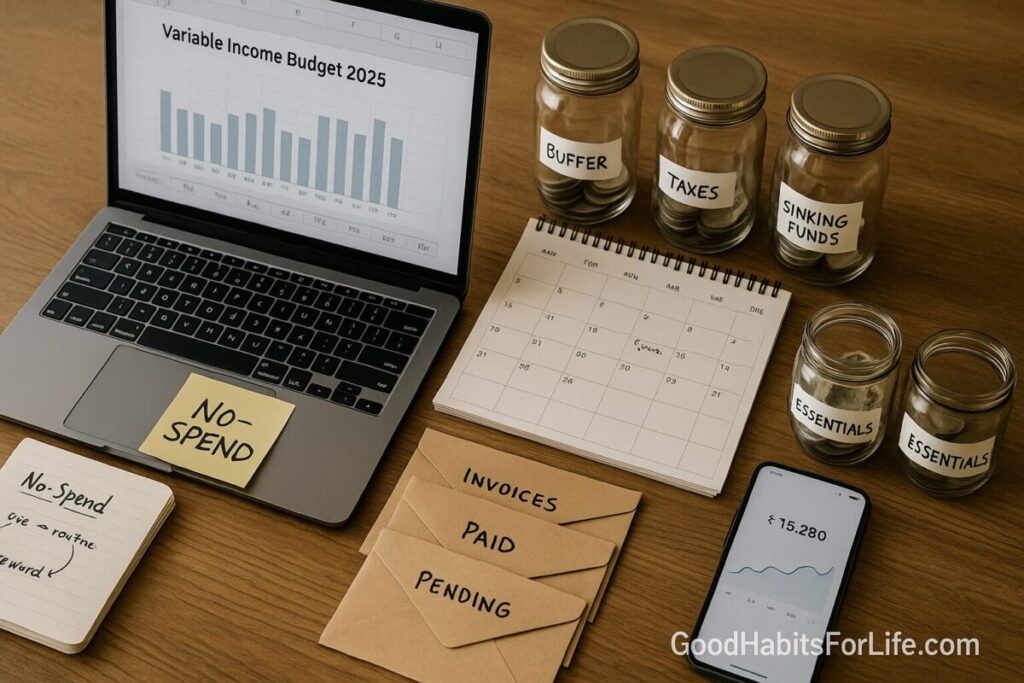
Variable Income Budget: Freelancers & Creators: No-Spend Challenge (2025)
Variable Income Budget 2025: No-Spend for Freelancers
Table of Contents
🧭 What & Why: Variable Income Budget (2025)
Variable income means your pay fluctuates—common for freelancers, creators, seasonal workers, and contractors. The challenge isn’t just how much you earn, but when it arrives. That’s why your plan must smooth timing, not just totals.
Evidence snapshot
-
National money guidance bodies advise planning to the lowest monthly income and building emergency savings to cushion lean periods. MaPS
-
Tracking regular vs irregular vs seasonal income helps you design a budget that actually works when cash lands unpredictably. Consumer Financial Protection Bureau+1
-
Improving financial resilience—via buffers, savings, and habits—reduces fragility during shocks. OECD
Outcome you’re aiming for: calm cash flow, predictable “paydays,” and a growing buffer—so creative focus replaces money stress.
✅ Quick Start: 15-Minute Setup
-
Know your “Survival Number.”
List bare-minimum monthly essentials (housing, utilities, groceries, transport, minimum debt payments, basic healthcare/tools). That total is your floor. -
Pick a “Lowest-Month” Income.
Use your worst month from the last 12 months or a conservative estimate. Budget to this number, not your average. Any extra is buffer or debt prepayment. MaPS -
Create 3 Buckets (accounts or sub-accounts).
-
Base-Pay (personal paycheck): a fixed amount you pay yourself on a schedule.
-
Buffer (income smoothing): where all income lands first.
-
Bills & Goals (savings + annual/quarterly expenses).
-
Set a Payday Rhythm.
Choose two fixed paydays per month (e.g., 1st & 15th). On payday, transfer Base-Pay from Buffer → Personal account. Everything else sits in Buffer for smoothing. -
Turn on Automations.
Auto-transfer tax set-aside, minimum savings (even ₹1,000/$20), and all fixed bills. Build a rule: all income → Buffer; Buffer → Base-Pay + tax + bills. Consumer Financial Protection Bureau -
Start a 30-Day No-Spend.
For one month, spend on essentials only to seed your buffer fast (details below).
🛠️ Core System: Base-Pay + Buffer + Buckets
Think like a studio: guarantee yourself a steady “salary” from a lumpy revenue stream.
How it works
-
Income lands in Buffer.
Do not spend straight from inflows. Let the Buffer absorb spikes and droughts. -
Base-Pay is fixed.
Choose a sustainable, smaller “paycheck” (e.g., ₹60,000/$800 twice a month). You’ll raise it only after your buffer passes key checkpoints. -
Buckets allocate the rest.
After Base-Pay, allocate percentages:
-
Taxes (local rules; automate to a separate safe account).
-
Bills & Annuals (sinking funds: insurance, software, tuition, equipment).
-
Goals (emergency fund, debt, investments).
-
Discretionary (fun, wants).
-
Buffer targets
-
Level 1: 4–6 weeks of essentials (starter)
-
Level 2: 2–3 months of essentials (stability)
-
Level 3: 4–6 months (resilience) MaPSConsumer Financial Protection Bureau
Guardrails
-
Bills from Bills-Account only.
-
Personal spends from Personal-Account only.
-
Never from Buffer (except to fund Base-Pay/bills). This enforces healthy “mental accounts” on purpose. University of Bath
🧠 The 30-Day No-Spend Challenge (Creator Edition)
A No-Spend Challenge temporarily removes optional spending to accelerate savings, build discipline, and surface triggers.
Rules (adapt)
-
Allowed: essentials (rent, utilities, groceries, transport), client costs, medications, basic phone/data, minimum debt, necessary tools.
-
Paused: dining out, impulse buys, apparel, gadgets, skincare/makeup, decor, subscriptions you don’t need for client delivery.
-
Creator carve-outs: pay-per-use assets that directly earn revenue this month are allowed (e.g., stock audio for a paid project).
-
Cooling-off: 72-hour wait on any unplanned purchase ≥₹2,500/$30. Cooling-off windows reduce impulsivity by countering present bias. ifo InstitutPMC
Make it stick
-
Wishlist + Delay: add to a list; review weekly.
-
Friction hacks: remove saved cards, uninstall 2 shopping apps, disable 1-click.
-
Commitment device: tell a friend/followers; pre-commit to donate 10% of any rule break (loss aversion works). JSTOR
What to track
-
Buffer growth (₹/$)
-
Days “no-spend”
-
Triggers (time, mood, apps)
-
Pipeline: leads, WIP, delivered, invoiced, collected
📅 30-60-90 Roadmap (with Checkpoints)
Days 1–30 (No-Spend Sprint)
-
Launch No-Spend; redirect all discretionary budget to Buffer and bills-due-soon.
-
Pay yourself a small Base-Pay only.
-
Build a mini emergency fund of at least 1 month essentials. MaPS
Days 31–60 (Stabilize & Systemize)
-
Keep Base-Pay flat.
-
Add sinking funds for annual costs (software, insurance, devices).
-
Automate tax set-aside per your jurisdiction (see IRS/HMRC resources for mechanics). Internal Revenue ServiceGOV.UK
-
Weekly review: invoice cadence, collection lags, late-fee policy.
Days 61–90 (Grow & Calibrate)
-
Raise Base-Pay slightly only if Buffer ≥ 6 weeks.
-
Resume modest discretionary (e.g., 10–15% of income).
-
Add professional reinvestment cap (e.g., 10% revenue for gear/courses).
-
Document a late-invoice protocol (see scripts below).
📚 Techniques & Frameworks (Evidence-Aligned)
Zero-Based Budgeting (ZBB)
Give every rupee/dollar a job each month; great for irregular cash flow.
50/30/20 Rule (as a diagnostic)
Aim 50% needs / 30% wants / 20% savings-debt on your Base-Pay, not gross inflows. Use it to spot bloat; adjust to your reality. Consumer Financial Protection Bureau
Cash-Flow Calendars
Map due dates, expected invoices, and paydays to prevent overdrafts—especially vital with irregular income. Consumer Financial Protection Bureau
Mental Accounting (use it, don’t let it use you)
We design separate buckets to promote self-control, not to justify extra splurges. Treat all income as fungible until it passes through your rules. University of Bath
Present-Bias Tactics
Use cooling-off windows, pre-commitments, and public accountability to curb impulse spends. ifo InstitutJSTOR
Emergency Fund Targets
Start with 1 month of essentials; stretch to 3 months (or more) as your buffer grows. MaPSConsumer Financial Protection Bureau
👥 Audience Variations
Students
-
Smaller Base-Pay; heavier focus on textbook/transport sinking funds.
-
Use campus resources (library, labs) during no-spend month.
Parents
-
Build kid/education sinking funds; batch cook to reduce food variance.
-
Pre-buy essentials before known lean months (holidays, off-season client gaps).
Professionals/Consultants
-
Add pipeline dashboard (leads → proposals → deposits → milestones).
-
Set deposit + milestone payment terms to reduce collection risk.
Seniors/Part-time Creators
-
Prioritize healthcare sinking fund and steady Base-Pay.
-
Keep higher buffer (3–6 months).
Teens/Early-Career Creators
-
Use a parent-cosigned savings account if needed; practice no-spend with pocket money; track triggers.
⚠️ Mistakes & Myths to Avoid
-
Myth: “Average monthly income is fine.”
Reality: Averages hide timing risk; budget to your lowest month. MaPS -
Mistake: Spending from the account where money arrives.
Fix: All inflows land in Buffer, not your card-spend account. -
Mistake: Ignoring taxes/annuals.
Fix: Automate tax set-aside and create sinking funds for annual bills. Internal Revenue ServiceGOV.UK -
Myth: “No-Spend means deprivation.”
Reality: It’s a temporary reset to accelerate buffer and rewire habits. -
Mistake: Letting mental accounting justify splurges.
Fix: Keep strict rules for when and how funds move. University of Bath
💬 Real-Life Examples & Scripts
1) Late-Invoice Nudges (polite → firm)
-
Day 1 (due date): “Hi [Client], friendly reminder that invoice #[123] for [Project] is due today. Payment link: [link]. Thanks!”
-
Day 7: “Hi [Client], our records show invoice #[123] is outstanding. Could you confirm payment date? This helps us keep your project timeline on track.”
-
Day 14: “Hi [Client], invoice #[123] remains unpaid. As per our terms, a late fee of [x%] applies from [date]. Please settle by [new date] to avoid project pauses.”
2) Deposit Terms (proposal)
“Project total ₹1,20,000/$1,500. 40% deposit to book, 40% at first draft, 20% at delivery. Files transfer on final payment.”
3) Wishlist + Delay Rule
“Adding [Item] to wishlist today; will revisit next Friday. If still needed, I’ll buy within my discretionary cap.”
4) Sinking Fund Math
“Annual software ₹24,000/$300 → save ₹2,000/$25 each month; auto-transfer on payday.”
🧰 Tools, Apps & Resources (brief pros/cons)
-
MoneyHelper Budget Planner (UK) — Free planner; good for fixed/variable clarity; UK-centric. MaPS
-
Moneysmart Budget Planner (AU) — Clear categories + export; AU phrasing. Moneysmart
-
CFPB Worksheets (US/global-friendly) — Income trackers, cash-flow calendars, emergency fund guides; simple PDFs. Consumer Financial Protection Bureau+1Consumer Financial Protection Bureau
-
Spreadsheet systems (Google Sheets/Excel/Tiller) — Full control; manual upkeep.
-
YNAB / Goodbudget / Monarch / Notion templates — Envelope/ZBB-style clarity; subscriptions/learning curve.
-
Website blockers & app limits — Reduce impulse spending during no-spend.
📌 Key Takeaways
-
Budget to lowest month, not average; treat upside as buffer.
-
Route all income → Buffer, then pay yourself fixed Base-Pay on a schedule.
-
Build sinking funds for annual/quarterly lumpy costs.
-
Run a 30-day No-Spend with cooling-off rules to fast-track your buffer.
-
Use behavioral levers (commitment, friction) to keep spending aligned.
-
Grow your Buffer → 1–3 months of essentials; then increase Base-Pay.
❓ FAQs
1) How big should my income buffer be?
Start with 1 month of essentials; aim for 2–3 months as stability improves. MaPSConsumer Financial Protection Bureau
2) Do I budget from gross revenue or net income?
Budget from net personal Base-Pay after routing income into Buffer and setting aside taxes/business costs.
3) Can I do a no-spend if I’m already frugal?
Yes—treat it as a discipline sprint to seed your buffer and audit triggers.
4) What counts as “essential” during no-spend?
Housing, utilities, groceries, transport, medical, minimum debt, tools required to deliver paid work this month.
5) How do I handle annual expenses with variable income?
Create sinking funds; divide the annual total by 12 and auto-transfer monthly.
6) What if I have debt?
Keep minimums current; route extra cash (after Buffer Level 1) to highest-interest debt first.
7) How do I pick my Base-Pay?
Set Base-Pay ≤ lowest-month income minus tax set-aside. Raise only after Buffer ≥ 6 weeks.
8) Should I separate business and personal accounts?
Yes—use Buffer/Bills/Personal segregation; it reduces errors and mental-accounting slippage. University of Bath
9) What about taxes on variable income?
Automate a tax set-aside and follow your local estimated-tax rules (see IRS/HMRC examples). Internal Revenue ServiceGOV.UK
10) How often should I review?
Weekly: invoices & Buffer; monthly: raise/lower Base-Pay; quarterly: recalibrate percentages.
📚 References
-
MoneyHelper (UK). How to budget for an irregular income. Government-backed guidance. MaPS
-
CFPB (US). Income & benefits tracker; Cash-flow calendars; Emergency fund guide. Consumer Financial Protection Bureau tools. Consumer Financial Protection Bureau+1Consumer Financial Protection Bureau
-
OECD/INFE (2023). International Survey of Adult Financial Literacy—resilience and well-being emphasis. OECD
-
Moneysmart (AU). Managing on a casual income—saving, bill smoothing, and planning. Moneysmart
-
Thaler, R. (1999). Mental Accounting Matters. Journal of Behavioral Decision Making. (Foundational behavioral economics on mental accounting.) Wiley Online Library
-
Thaler, R.H., & Benartzi, S. (2004). Save More Tomorrow™—commitment devices to raise saving. Journal of Political Economy. JSTOR
-
Imas, A. (2015). Cooling-off period and present bias—field evidence on patience and timing. CESifo Working Paper. ifo Institut
-
CFPB (US). Analyzing budgets & the 50-30-20 rule. Activity guide. Consumer Financial Protection Bureau
-
IRS (US). Estimated taxes—how to figure/pay (example jurisdiction). Internal Revenue Service
-
HMRC (UK). Self Assessment: payments on account—timing guidance (example jurisdiction). GOV.UK
Disclaimer: This article provides general information for education only and is not financial or tax advice. Consult a qualified professional for your situation.