
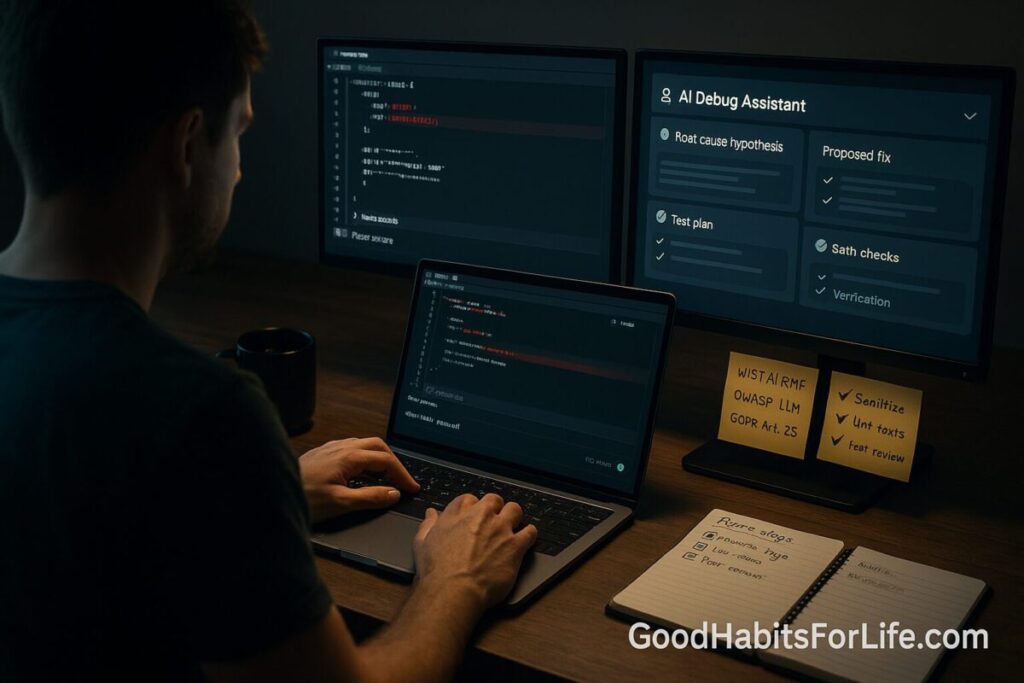
Use AI to Debug Your Code (Safely)
Use AI to Debug Code Safely & Transparently
Table of Contents
🧭 What & Why
AI-assisted debugging is using a large language model (LLM) to help locate faults, reason about causes, and propose fixes—while you stay in control of verification. Done well, it reduces time to diagnosis, surfaces edge cases, and improves documentation quality. The safety piece matters: unredacted code, stack traces, or logs may contain secrets or personal data, and generated fixes can introduce new risks if you don’t validate them.
Good governance frameworks back this up:
-
NIST AI RMF encourages risk-based, transparent use of AI and emphasizes measurement and governance—perfect fit for debugging workflows that must be explainable and testable. NIST Publications+1
-
OWASP Top 10 for LLM Applications warns about prompt injection and insecure output handling—common failure modes when you let an assistant suggest code. OWASP Foundation
-
GDPR Art. 25 “Data Protection by Design & Default” sets a privacy-by-design duty: share the minimum necessary and protect identities. edpb.europa.eu
Bottom line: AI can speed you up, but you must provide clean inputs and verify outputs.
⚙️ Quick Start (Do This Today)
-
Define the bug precisely. One sentence + expected vs. actual behavior.
-
Create a Minimal Reproducible Example (MRE). Isolate the smallest file/test that fails. (Details below.)
-
Sanitize. Remove secrets, API keys, tokens, emails, user data, repo names, hostnames, and proprietary identifiers.
-
Pick a role & task for the AI. Example: “You are a senior debugger. Produce hypotheses, test ideas, and safe patches for this MRE.”
-
Use the Hypothesis → Experiment loop. Ask the AI for 2–3 hypotheses, a test per hypothesis, and the smallest change to verify.
-
Run tests locally. Accept nothing until unit/integration tests pass and you’ve reviewed diffs.
-
Document. Save the root cause, fix, and a regression test. (Future you will thank you.)
Governance guardrail: Keep a written checklist (below) and link it in your PR template so safety stays visible. Transparent process is a trust booster for teams and stakeholders. NIST Publications
🔐 Privacy & Compliance Checklist
Use this pre-flight before every AI debugging session:
-
Minimize data: Share only the MRE—no full repos, no prod logs. (GDPR DPbD principle.) edpb.europa.eu
-
Strip secrets: Keys, tokens, passwords, connection strings, internal URLs—store in a secrets manager and replace with placeholders. (OWASP Secrets Management.) OWASP Cheat Sheet Series
-
Avoid PII/PHI: Names, emails, IDs, addresses; replace with fake values or hashes.
-
Secure-by-design mindset: Prefer designs that fail closed, add input validation, and log safely. (CISA Secure-by-Design.) CISA
-
Test before deploy: All AI-suggested code must pass unit/integration tests and static checks. (NIST SSDF.) NIST Publications
-
Record traceability: Keep the prompt, AI suggestions, and final rationale in the PR for auditability (AI RMF transparency). NIST Publications
Tip: If your organization mandates on-prem or privacy-preserving options, run assistants locally or via enterprise deployments, and keep prompts/artifacts within approved boundaries (data minimization + logging controls). (OECD AI Principles; NIST AI RMF). OECD AI+1
🛠️ Techniques & Frameworks (That Actually Work)
1) Hypothesis → Experiment → Measure
Ask the AI to produce 3 hypotheses about root cause, each with: (a) observable signal, (b) minimal experiment, (c) expected metric, (d) rollback note. This mirrors risk-based thinking and measurability in NIST AI RMF. NIST Publications
2) Defensive handling of AI output
Treat generated code as untrusted input: run linters, type checks, static analysis, and tests before execution. OWASP highlights insecure output handling as a top LLM risk. OWASP Foundation
3) Differential & binary-search debugging
Use git bisect to find the commit that introduced the bug, then let the AI focus on that diff to propose minimal patches.
4) Assertion-driven debugging
Add assertions for invariants you assume are true. AI can help phrase strong pre/post-conditions; your tests enforce them (SSDF “verify integrity”). NIST Publications
5) Property-based tests
Have the AI propose properties (e.g., “idempotent,” “sortedness preserved”). Use tools to generate randomized inputs and catch edge cases.
6) Guardrails against prompt injection
When you paste logs or user inputs into prompts, neutralize directives and code blocks; do not execute anything the model emits without sandboxing. (OWASP LLM01/LLM02). OWASP Foundation
7) Reproducibility as a habit
Lock dependencies, pin toolchains, and capture build metadata; reproducible builds make post-fix verification credible. reproducible-builds.org
🧪 Build a Minimal Reproducible Example (with Redaction)
Step-by-step MRE recipe
-
Copy only the code that fails into a fresh directory.
-
Replace external services with fakes or stubs.
-
Remove unrelated modules and assets.
-
Add one test that fails and one that passes near the boundary.
-
Redact identifiers (project, company, endpoints), secrets, and user data.
One-liner redaction helpers (adapt to your stack)
-
Bash (mask common secrets)
-
Python (strip env secrets & known patterns)
Pair this with a secrets manager and runtime injection instead of hard-coding credentials. (OWASP Secrets Management). OWASP Cheat Sheet Series
🗺️ 30-60-90 Day Habit Plan
Days 1–30 (Foundations)
-
Add a Debugging with AI checklist to your repo wiki and PR template.
-
Standardize MRE + redaction before any AI share.
-
Require tests for all AI-suggested fixes (unit + at least one integration). (NIST SSDF.) NIST Publications
-
Start keeping a lightweight Debug Log in issues/PRs: prompt, hypotheses, chosen fix, verification.
Days 31–60 (Controls & Safety Nets)
-
Add static analysis and secret scanners to CI.
-
Introduce sandboxing for running AI-generated snippets.
-
Run a prompt safety review for any workflow that ingests untrusted text (OWASP LLM Top 10). OWASP Foundation
-
Pilot reproducible build settings and dependency pinning. reproducible-builds.org
Days 61–90 (Scale & Governance)
-
Adopt a team AI usage policy: data minimization, allowed tools, logging, retention. (OECD/NIST AI RMF.) OECD AI+1
-
Add post-incident reviews where the AI session transcript helps explain “why the fix works.”
-
Track MTTD/MTTR for bugs touched by AI to confirm value without compromising safety.
👥 Audience Variations
-
Students / New Devs: Start with explain-my-bug prompts; ask for diagrams and step-through plans. Use an IDE debugger in tandem (university guides are great primers). Stanford University
-
Professionals: Bias toward minimal patches + strong tests and reproducible runs. Keep prompts in PRs for auditability (AI RMF transparency). NIST Publications
-
Seniors/Leads: Establish policy (what data may be shared), review guardrails, and coach teams on unsafe patterns (prompt injection, untrusted outputs). (OWASP LLM Top 10). OWASP Foundation
⚠️ Mistakes & Myths to Avoid
-
Myth: “If the AI compiles, it’s correct.”
Reality: Many bugs are logical; require tests and instrumentation to verify. (SSDF.) NIST Publications -
Mistake: Pasting full prod logs into prompts.
Fix: Sanitize + sample only the lines showing failure; keep identifiers fake (GDPR DPbD). edpb.europa.eu -
Mistake: Executing AI-suggested shell/code blindly.
Fix: Treat output as untrusted; review, sandbox, test. (OWASP LLM02). OWASP Foundation -
Myth: “AI replaces debuggers.”
Reality: AI accelerates reasoning; traditional tools (breakpoints, stack traces, profilers) remain core. (University debugging guides). Stanford University
🧾 Real-Life Prompts & Scripts
1) Bug Investigator (structured)
You are a senior software debugger. Given the MRE and failing test below, list three plausible root-cause hypotheses. For each, provide: (a) how to verify in one small experiment, (b) the minimal code change to test the hypothesis, (c) risks and rollback. Keep responses concise and executable. Do not invent new dependencies.
2) Patch Proposals (safe output handling)
Propose the smallest patch that could satisfy the failing test without affecting unrelated modules. Show diff-style output and explain why it’s safe. Include a regression test. Do not include commands that fetch or execute from the network.
3) Guardrail Reminder (privacy + safety)
Before answering, confirm you will not request secrets, tokens, or personal data. If the MRE is insufficient, ask targeted questions to refine it without requesting sensitive info.
4) Perf vs. Correctness
The fix must maintain correctness and improve runtime by ≥15% on the given benchmark. Suggest micro-benchmarks and explain tradeoffs.
5) Post-Fix Explanation
Explain root cause, why the patch works, and how the new test prevents regressions. Provide two watchpoints I should add during manual testing.
🧰 Tools, Apps & Resources
-
IDE debugging: Breakpoints, watch expressions, time-travel/trace debugging (e.g., VS Code, JetBrains).
-
Testing: pytest/JUnit/Vitest; property-based testing (Hypothesis/FastCheck).
-
Static/linters: ESLint, Ruff/Flake8, mypy, Bandit, Semgrep.
-
Secrets & config: Use a secrets manager; inject at runtime; rotate regularly. (OWASP Secrets Mgmt.) OWASP Cheat Sheet Series
-
Reproducibility: Lockfiles, pinned toolchains/containers; aim for reproducible builds. reproducible-builds.org
-
Governance: Maintain an AI usage policy referencing NIST AI RMF + OECD AI Principles. NIST Publications+1
✅ Key Takeaways
-
Share only a sanitized MRE; never secrets or PII. (GDPR DPbD; OWASP Secrets.) edpb.europa.eu+1
-
Treat AI output as untrusted: validate with tests and reviews. (OWASP LLM Top 10; NIST SSDF.) OWASP Foundation+1
-
Use a transparent, test-first flow aligned to trusted frameworks (NIST AI RMF/OECD). NIST Publications+1
-
Turn this into a habit with a 30-60-90 plan so safety becomes automatic.
❓ FAQs
1) Is it safe to paste code into an AI assistant?
It’s safe only if you share a scrubbed MRE and avoid secrets/PII. Use a secrets manager and placeholders; keep logs minimal. OWASP Cheat Sheet Series
2) How do I verify AI-suggested fixes?
Require unit/integration tests, static analysis, and a clear diff; treat outputs as untrusted until verified. (SSDF + OWASP LLM02). NIST Publications+1
3) Can AI introduce security bugs?
Yes—particularly via insecure output handling or prompt injection. Sandboxing and validation are mandatory. OWASP Foundation
4) What about compliance (GDPR/PII)?
Default to data minimization and privacy by design: share only what’s necessary and pseudonymize. edpb.europa.eu
5) How do I handle confidential repos?
Use local/on-prem assistants or enterprise deployments with approved retention policies, and keep prompts/artifacts in your PR for traceability (AI RMF). NIST Publications
6) Does this replace debuggers or profilers?
No. AI accelerates reasoning, but you still need breakpoints, stack traces, and profiling. Stanford University
7) What if the assistant hallucinates?
Constrain it with an MRE, ask for explicit hypotheses, and verify with tests. If outputs contradict measurements, discard and iterate (risk-based approach per AI RMF). NIST Publications
📚 References
-
NIST. AI Risk Management Framework (AI RMF 1.0). NIST Publications
-
NIST. Profile for AI RMF: Generative AI (NIST.AI.600-1). NIST Publications
-
NIST. SP 800-218: Secure Software Development Framework (SSDF) v1.1. NIST Publications
-
NIST. SP 800-218A: Secure Software Development Practices for AI (IPD). NIST Computer Security Resource Center
-
OWASP. Top 10 for Large Language Model Applications (v1.1). OWASP Foundation
-
OWASP. Secrets Management Cheat Sheet. OWASP Cheat Sheet Series
-
EDPB. Guidelines 4/2019 on Data Protection by Design & by Default (Art. 25 GDPR). edpb.europa.eu
-
OECD. AI Principles — Trustworthy AI. OECD AI
-
CISA. Principles & Approaches for Secure-by-Design and Default. CISA
-
Stanford CS. Debugging Handout / Lecture Notes. Stanford University
-
Reproducible Builds Project. Definition & Rationale. reproducible-builds.org
Disclaimer: This guide is for educational purposes and does not constitute legal advice.