
Ultra-Processed Foods (UPF): How to Cut Back
Ultra-Processed Foods: Smart Swaps that Stick
Table of Contents
🧭 What & Why
What counts as “ultra-processed”?
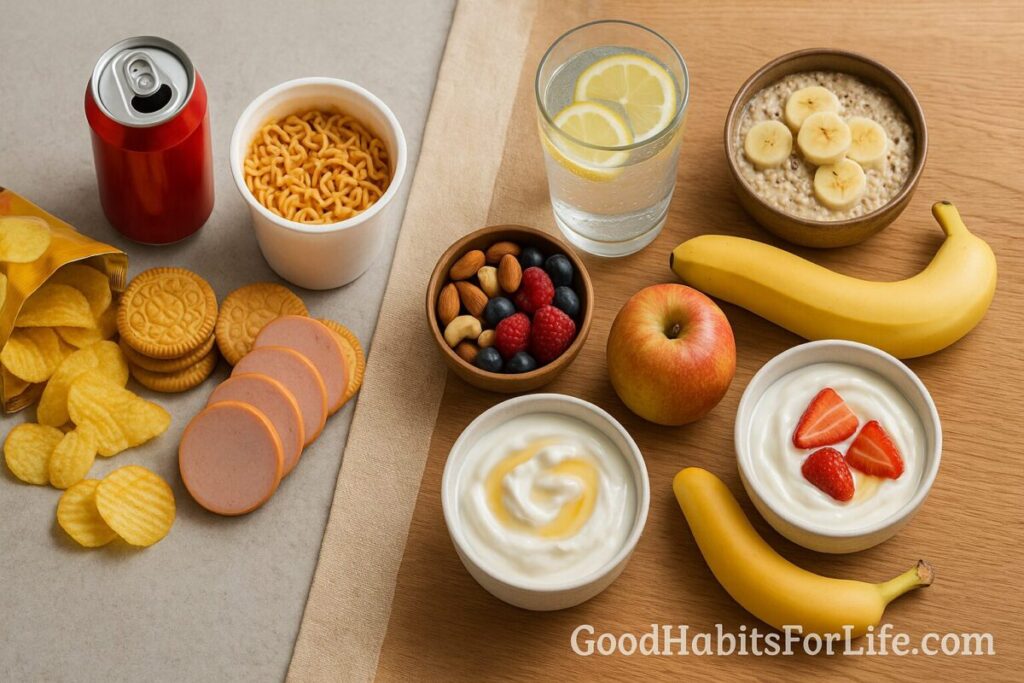
Ultra-processed foods (UPFs) are industrial formulations made mostly from extracted substances (starches, oils, protein isolates) with cosmetic additives (emulsifiers, colors, flavors, sweeteners) and little to no whole food. This is the NOVA system’s Group 4. Examples: sugary drinks, packaged sweets, instant noodles, most processed meats, many ready-to-heat meals. PMC
Why cut back?
Large reviews link higher UPF intake with increased risk of multiple outcomes—especially cardiometabolic disease, mental health outcomes, and all-cause mortality—though mechanisms and causality remain under study. BMJ
A controlled inpatient randomized trial found participants eating UPF ad libitum consumed ~500 kcal/day more and gained weight compared with a minimally processed diet matched for calories offered, macros, fiber, sugar, sodium, and energy density—suggesting UPFs can drive overeating. Cell
Balanced view: UK scientific advisers (SACN) call the associations “concerning,” yet note uncertainty on whether processing itself is the cause versus typical UPF nutrient profiles (high in free sugars, salt, saturated fat). Translation: prioritize nutrient quality and degree of processing—don’t panic about every barcode. GOV.UK
✅ Quick Start (Do This Today)
-
Audit one day: circle UPFs you eat most (e.g., soda, cookies, sausage, instant noodles).
-
Pick one category to swap—usually sugary drinks or processed meats gives the biggest win.
-
Set a default: stock a ready replacement (sparkling water + lemon; yoghurt + fruit; wholegrain bread + peanut butter).
-
Upgrade your desk/pack: nuts, fruit, boiled eggs, hummus + veggies, oats.
-
Use the 3-Signal Label Check:
-
Free sugars high?
-
Sodium > ~0.6 g/100 g (>600 mg/100 g)?
-
Long ingredient list (many additives)?
If ≥2 signals light up, look for a swap.
-
-
Track one metric this week (e.g., sugary drinks per day).
🗺️ 30-60-90 Habit Plan
Days 1–30 (Foundation):
-
Replace all weekday sugary drinks with water, soda water, coffee/tea unsweetened, or milk.
-
Swap workday snacks to minimally processed: fruit, nuts (30 g), plain yoghurt, roasted chickpeas.
-
Cook one big-batch base (beans, lentils, whole-grain rice) each weekend.
Days 31–60 (Momentum):
-
Cut processed meats at home to zero; use eggs, legumes, fish, or unprocessed poultry.
-
Move breakfast to minimally processed: oats, eggs, or plain yoghurt + fruit + nuts.
-
Use an app to scan and choose lower-sodium/lower-sugar packaged items.
Days 61–90 (Stickiness):
-
Tackle ready meals: 2 home-prepped freezer meals/week (soups, dal, chana masala, veg stews).
-
Social plan: agree on “treat windows” (e.g., 2 UPF desserts/week) and savor them.
-
Re-audit: aim for >70% of weekly items to be minimally processed.
🛒 Smart Swap Playbook (By Aisle)
Drinks
-
Soda / energy drink → water, soda water + citrus, 100% fruit spritz (1:3 with water), unsweetened tea/coffee.
-
Flavored yoghurt drink → plain milk or plain yoghurt + fruit.
Breakfast
-
Sugary cereal → oats, muesli without added sugar, poha/upma at home with veg.
-
Sweet spreads → peanut/almond butter (no added sugar), tahini + honey drizzle.
Bread & Staples
-
White bread with long ingredient list → whole-grain (first ingredient “whole wheat”), sourdough with short list.
-
Instant noodles → whole-wheat pasta + quick tomato/olive oil/garlic, or rice + dal.
Proteins
-
Sausages, nuggets, deli meats → eggs, fish, paneer/tofu, beans/lentils; rotisserie chicken (check sodium).
-
Breaded frozen items → plain cuts; bread at home with spices if you want crunch.
Snacks & Sweets
-
Candy/chocolate bars → dark chocolate (70%+), dates + nuts, fruit.
-
Chips → roasted nuts/chickpeas, air-popped popcorn (oil + salt to taste).
Ready Meals
-
Creamy/saucy trays → frozen veg + quick protein + jarred tomato (short list).
-
Jarred sauces with sugar first → passata/tomato puree + your own spices.
Tip: If a packaged choice is unavoidable, choose shorter ingredient lists, less added sugar, and <0.4 g sodium/100 g when possible.
🧠 Techniques & Frameworks
-
Big Rock First: Replace what you consume most often (usually drinks/snacks).
-
Environment Design: Keep visible: fruit bowl, nuts, yoghurt; keep UPFs out of reach.
-
Swap, Don’t Stop: Always pair a “no” with a “instead.”
-
Rule of Availability: Prep or purchase ready-to-eat minimally processed options for your busy times.
-
Treat Windows: Plan UPFs you truly love (e.g., weekend dessert).
-
Label Literacy (NOVA-aware): NOVA Group 1–2 = minimally/culinary ingredients; Group 3 = processed; Group 4 = UPF. Use it as one lens alongside nutrients. PMC
👥 Audience Variations
-
Students/Teens: Stock instant oats, eggs, bananas, peanut butter; batch-cook rice + beans; swap energy drinks for coffee/tea + milk.
-
Professionals: Desk set: nuts, fruit, shelf-stable milk, tins of chickpeas/tuna; default soda water at meetings.
-
Parents: Build “snack boxes” (fruit, cheese sticks, roasted chana, yoghurt); limit “fun foods” to 2–3 times/week.
-
Seniors: Focus on protein at each meal (eggs, yoghurt, dal), easy-chew fruits, lower-sodium picks; keep hydration visible.
⚠️ Mistakes & Myths to Avoid
-
Myth: “All processing is bad.” Reality: Freezing, pasteurizing, milling, and fortifying can improve safety and access. Target ultra-processed patterns, not all processing. GOV.UK
-
Mistake: Swapping soda for juice all day. Portion juice (150–200 ml) or better yet fruit + water.
-
Myth: “Plant-based = never UPF.” Many plant-based packaged foods are UPF; still choose options with better nutrient profiles and shorter lists.
-
Mistake: Going all-or-nothing; consistency beats short-term extremes.
💬 Real-Life Scripts (Copy-Paste)
-
Office: “I’m doing a no-soda weekday—can we stock sparkling water?”
-
Host/WhatsApp: “Bringing a fruit + yoghurt bowl so we have a fresh option too.”
-
Family: “Desserts on Fri/Sat; weekdays we’ll do fruit + dark chocolate.”
-
Eating Out: “Can we swap fries for a side salad or roasted veggies?”
🧰 Tools, Apps & Resources
-
Open Food Facts (free/open): Scan barcodes to see NOVA group, Nutri-Score, and ingredients. Great for quick checks. Open Food Facts
-
FoodSwitch (George Institute): Scan packaged foods and get healthier alternatives; traffic-light view for sugar/salt/fat; available in India and globally. FoodSwitch+1
-
Cronometer: Track nutrients (incl. micronutrients) with verified databases (USDA, CoFID, etc.). Use it to confirm you’re meeting protein, fiber, iron, calcium while cutting UPF. Cronometer
📌 Key Takeaways
-
You don’t need perfection—prioritize high-impact swaps (drinks, processed meats, sweets/snacks).
-
Use environment design + a 30-60-90 plan to make changes automatic.
-
Let labels and NOVA guide you, but judge products by overall nutrients too. GOV.UK
-
Apps can help you scan, compare, and track—but your default grocery list does the heavy lifting.
❓ FAQs
1) Are whole-grain breads or plain yoghurts “UPF”?
Often no if the ingredient list is short and additives minimal; some packaged staples are processed but not ultra-processed. Check labels and NOVA as a guide. PMC
2) What health risks are most strongly linked to UPFs?
Umbrella reviews show higher UPF intake is linked to cardiometabolic disease and mental health outcomes; emerging research also explores brain health (cognitive decline, stroke). BMJ+1
3) Is it the “processing” or the nutrients?
We don’t fully know; many UPFs are high in free sugars, salt, and saturated fat, which independently raise risk. Policy groups advise reducing UPFs and improving overall nutrient quality. GOV.UK
4) If I only change one thing, what should it be?
Sugary drinks—replace with water/soda water/unsweetened tea. It’s the biggest, easiest calorie and sugar win.
5) Are plant-based meats okay?
Some are UPF; compare sodium and additives, and rotate with beans, lentils, tofu, eggs, fish, or poultry.
6) How do I handle cravings?
Use swap, don’t stop; plan treat windows; keep minimally processed snacks visible and ready.
7) Do scanner apps settle the debate?
They’re helpful lenses (NOVA groups, traffic lights), not final arbiters. Use them alongside your nutrition goals and taste.
8) Can I lose weight just by cutting UPF?
Not guaranteed, but it often reduces energy intake and improves diet quality—especially if you replace with fiber- and protein-rich minimally processed foods. Cell
📚 References
-
Monteiro CA et al. Ultra-processed foods: what they are and how to identify them (NOVA). Public Health Nutrition. 2019. https://pmc.ncbi.nlm.nih.gov/articles/PMC10260459/ PMC
-
Lane MM et al. Ultra-processed food exposure and adverse health outcomes: umbrella review of 45 meta-analyses. BMJ. 2024. https://www.bmj.com/content/384/bmj-2023-077310 BMJ
-
Hall KD et al. Ultra-processed diets cause excess calorie intake and weight gain: randomized inpatient trial. Cell Metabolism. 2019. https://www.cell.com/cell-metabolism/fulltext/S1550-4131%2819%2930260-8 Cell
-
SACN (UK). Processed foods and health: rapid evidence update summary. Gov.uk, 2025. https://www.gov.uk/government/publications/processed-foods-and-health-sacns-rapid-evidence-update/processed-foods-and-health-sacns-rapid-evidence-update-summary GOV.UK
-
FAO/WHO. Ultra-processed foods, diet quality and human health (using NOVA). 2019. https://openknowledge.fao.org/…/content Open Knowledge FAO
-
Bhave VM et al. Associations between ultra-processed food consumption and cognitive decline and stroke. Neurology. 2024. https://pubmed.ncbi.nlm.nih.gov/38776524/ PubMed
-
American Heart Association. Ultraprocessed Foods and Their Association With Cardiometabolic Health (Science Advisory). 2025. https://professional.heart.org/en/science-news/ultraprocessed-foods-and-their-association-with-cardiometabolic-health professional.heart.org
-
Harvard T.H. Chan School of Public Health. Processed Foods and Health – The Nutrition Source. https://nutritionsource.hsph.harvard.edu/processed-foods/ The Nutrition Source
-
Open Food Facts. NOVA groups for food processing; app & database. https://world.openfoodfacts.org/nova Open Food Facts
-
FoodSwitch (The George Institute). FoodSwitch—scan and switch to healthier options. https://www.foodswitch.com/ FoodSwitch
-
Cronometer. Accurate Databases & Data Sources. https://cronometer.com/features/accurate-databases.html Cronometer
Disclaimer: This guide is educational and not a substitute for personalized medical or nutrition advice.