
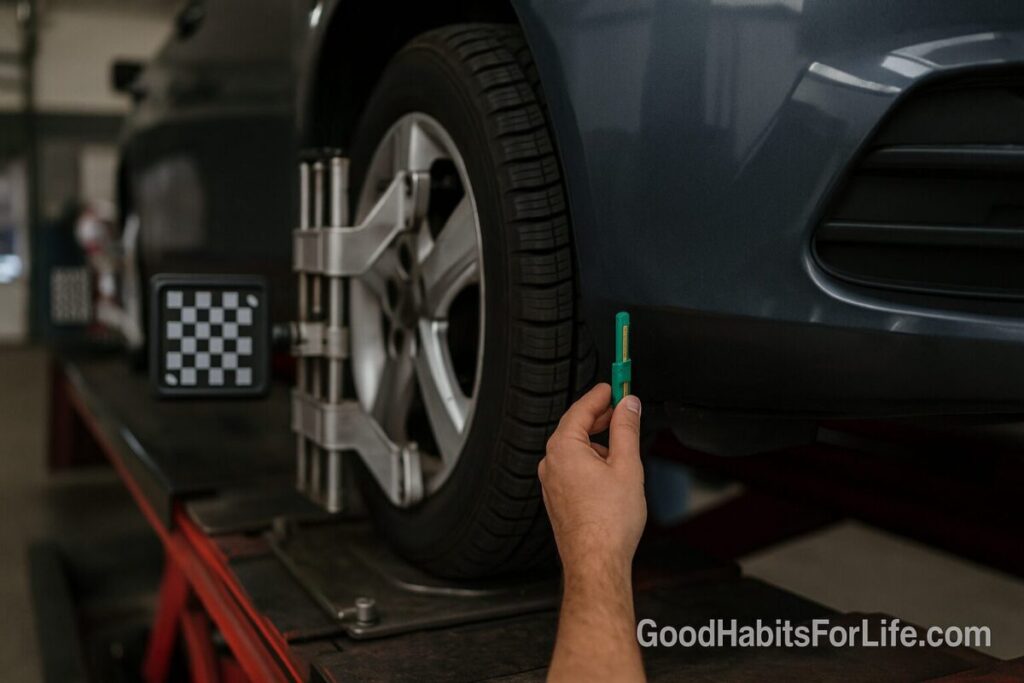
Tyres 101: Rotation, Alignment, Tread Tests
Tyres 101: Rotation, Alignment, Tread Tests
Table of Contents
🧭 What This Guide Covers & Why It Matters
Tyres are your car’s only contact with the road. Keeping them rotated on time, aligned correctly, and above minimum tread depth protects safety, steering feel, braking performance, fuel economy, and total cost of ownership. Many road authorities and safety agencies consider tyres unsafe at or below 1.6 mm (2/32 in) tread depth; several also recommend replacing sooner (around 3 mm) for better wet grip. NHTSAGOV.UKRSA
Under-inflation alone can reduce fuel economy by a few percent; regular pressure checks and timely rotations help avoid that waste and extend tyre life. The Department of Energy’s Energy.govNHTSA
✅ Quick Start: Do This Today
-
Check pressures (cold). Use the door-jamb sticker (not the sidewall) for target PSI/kPa; include the spare. The Department of Energy’s Energy.gov
-
Measure tread. Use a tread-depth gauge across three points on each tyre; if any main groove is near 1.6 mm (2/32 in), plan replacement. NHTSA
-
Look for wear patterns. Feathering, cupping, inner/outer shoulder wear, or a steering wheel off-centre suggests alignment needed. acg.aaa.com
-
Check your service log. If it’s been ~8,000–12,000 km since last rotation—or you see uneven wear—schedule rotation (unless your manual disallows it). NHTSA
-
Note vibration. If you feel vibration as speed rises, ask for balance during rotation; balancing reduces shake and uneven wear. AAA Exchange
🧠 Understanding Wheel Alignment (Camber/Caster/Toe)
-
Camber: Tilt of the wheel inward/outward when viewed from front. Too much negative camber wears inner edges; too much positive wears outer edges.
-
Caster: Fore-aft tilt of the steering axis; affects straight-line stability and steering return.
-
Toe: Whether tyres point slightly inward or outward when viewed from above; incorrect toe quickly scrubs tread.
Symptoms you need alignment: vehicle pulls to one side, uneven tyre wear, steering wheel not centred, or post-impact (pothole/curb). Annual checks (or after tyre replacement or impacts) are a sensible baseline. acg.aaa.com
🔄 Tyre Rotation: Intervals, Patterns & Exceptions
How often? Follow your owner’s manual first. If recommended for your vehicle, rotate about every 8,000–12,000 km (5,000–8,000 mi); rotate sooner if you see uneven wear. NHTSA+1
Why rotate? Front and rear tyres often wear at different rates; rotation evens wear, preserving grip and reducing costs. AAA Exchange
Common patterns (overview):
-
Non-directional, same-size tyres: cross-patterns are typical (e.g., rearward cross for FWD, X-pattern for AWD).
-
Directional tyres: usually front-to-rear on the same side unless remounted.
-
Staggered fitment (different sizes front/rear) or mixed types: may not be rotatable; check manual.
Industry guides illustrate multiple patterns and stress exceptions for directional, asymmetrical, or staggered setups. ustires.orgtireindustry.org
Don’t forget: Adjust pressures after rotation to match front/rear specs and re-balance if you noticed vibration. ustires.orgAAA Exchange
📏 Tread-Depth Checks: Gauge & Coin Tests
Minimums: Many authorities deem tyres unsafe at ≤ 1.6 mm (2/32 in). Replace at or before this depth; wet-weather drivers often aim for ~3 mm for extra margin. NHTSAGOV.UKRSA
Built-in wear bars: All tyres have treadwear indicators molded at 2/32 in to signal end of service. NHTSA
How to measure:
-
Tread-depth gauge (best): Check inner/middle/outer grooves on each tyre.
-
Coin tests (regional):
-
US “penny test”: if you see the top of Lincoln’s head, tread ≤ 2/32 in—replace. NHTSA
-
UK “20p test”: if the coin’s outer band is visible, you’re near/below legal limit—inspect/replace. (The legal minimum remains 1.6 mm.) GOV.UK
-
Ireland: minimum legal 1.6 mm; RSA recommends 3 mm for safety. RSA
-
Canada: replace at ~1.5–1.6 mm (2/32 in) or when you hit wear bars. Transport Canada
-
🛠️ 30-60-90 Day Habit Plan
Day 0 (Set-up):
-
Buy a digital pressure gauge and tread-depth gauge.
-
Create a repeating calendar reminder: “Tyres: pressure & tread check—monthly.”
Days 1–30 (Baseline & Fixes):
-
Check & correct pressures weekly this month (then monthly).
-
Measure tread; photograph each tyre for a wear log.
-
If it’s been ≥ 8,000 km since rotation—or wear is uneven—book rotation & balance. NHTSA
-
If you feel pulling/see uneven edges, add an alignment check to the booking. acg.aaa.com
Days 31–60 (Optimize):
-
After rotation, update pressures by axle, re-measure tread, and note wear rates.
-
Review driving habits (hard cornering/braking accelerates wear).
-
Verify TPMS warnings work (don’t rely solely on them—still check monthly). NHTSA
Days 61–90 (Lock-in):
-
Set a service cadence: rotate every 8–12k km if applicable for your vehicle; align annually or after impacts. NHTSAacg.aaa.com
-
Keep a glovebox card with tread depths and last rotation date.
🧰 Techniques & Frameworks (Keep-It-Rolling System)
-
K-I-S (Know-Inspect-Schedule):
-
Know your specs (pressures, rotation eligibility).
-
Inspect monthly (pressure + tread).
-
Schedule rotation/alignment before problems compound. NHTSAacg.aaa.com
-
-
3-Point Tread Map: Log inner/middle/outer depths per tyre; inner/outer bias often points to camber/toe issues—book alignment. acg.aaa.com
-
Fuel-Save Tie-in: Track fuel economy before/after correcting pressures—expect small but measurable gains. The Department of Energy’s Energy.gov
👥 Audience Variations
-
Students / New drivers: Learn the penny/20p test and monthly pressure routine; ask shops to show you wear bars. NHTSAGOV.UK
-
Parents (family cars): Bigger loads and curb hits—inspect sidewalls for bulges/cuts and align after significant pothole strikes. Transport Canada
-
Professionals (high-mileage): Shorten rotation interval to the low end of the range; keep a simple spreadsheet of tread depth to forecast replacements. NHTSA
-
Seniors: Prioritize ride comfort and safety—ask for alignment checks when replacing tyres to maintain straight tracking and reduced fatigue. acg.aaa.com
-
Teens: Practice smooth acceleration/braking to avoid premature wear; learn to spot off-centre steering as an alignment flag. acg.aaa.com
⚠️ Mistakes & Myths to Avoid
-
“TPMS means I never need a gauge.” False—TPMS often warns only after significant under-inflation; manual checks still matter. NHTSA
-
“All cars should cross-rotate.” Not always—directional/asymmetrical/staggered setups have restrictions; check your manual. ustires.org
-
“Legal = safe.” 1.6 mm may be legal, but wet-weather stopping improves above ~3 mm. RSA
-
“Alignment is only for when the car pulls.” Minor toe errors silently scrub tread; periodic checks protect tyres. acg.aaa.com
💬 Real-Life Examples & Scripts
Service desk call (rotation + balance):
“Hi, it’s been ~10,000 km since my last rotation. Please rotate (if applicable for my tyres), balance the wheels, set pressures to the door-sticker spec, and note any uneven wear.”
Alignment request after pothole hit:
“I struck a deep pothole. The steering wheel is slightly off-centre. Please perform a four-wheel alignment and provide the before/after printout.”
Pre-trip check (DIY):
“Pressure: ___ kPa front / ___ kPa rear (cold). Tread: LF ___ mm, RF ___ mm, LR ___ mm, RR ___ mm. Visual: no bulges/cuts; spare checked.”
🔧 Tools, Apps & Resources
-
Digital pressure gauge (accurate, compact).
-
Tread-depth gauge (0–10 mm).
-
Torque wrench (for correct wheel-nut torque after tyre work).
-
Tyre shop services: rotation, balance, alignment (ask for the printout). AAA Exchange
-
Official guidance: NHTSA TireWise (US), GOV.UK MOT manual (UK), Transport Canada & RSA (Ireland) for local rules and tips. NHTSAGOV.UKTransport CanadaRSA
✅ Key Takeaways
-
Rotate on schedule if your vehicle manufacturer recommends it—~8–12k km works for most, with exceptions. NHTSA
-
Get alignment checks annually or after impacts/tyre replacement to protect tread and handling. acg.aaa.com
-
Replace tyres at or before 1.6 mm (2/32 in); consider ~3 mm for better wet grip. NHTSARSA
-
Keep pressures at the door-sticker spec; low pressure wastes fuel and wears tyres. The Department of Energy’s Energy.gov
❓ FAQs
1) How do I know if my car needs an alignment?
If the car pulls to one side, the steering wheel is off-centre, or you see uneven shoulder wear, book an alignment. Annual checks are a smart baseline. acg.aaa.com
2) What rotation pattern should I use?
It depends on tyre type and vehicle (directional/asymmetrical/staggered/AWD). Follow your owner’s manual; industry guides show common cross and front-to-rear patterns with exceptions. ustires.orgtireindustry.org
3) Is rotating tyres still necessary with AWD?
Yes—AWD still benefits from regular rotation (if permitted), typically every 8–12k km, to equalize wear across all four tyres. NHTSA
4) What’s the legal tread depth?
Often 1.6 mm across the central three-quarters around the full circumference (e.g., UK/Europe), with US guidance to replace at 2/32 in. Check your local rules. GOV.UKNHTSA
5) Do I need to balance wheels at every rotation?
Not always, but it’s efficient to balance when you rotate—especially if you feel vibration or see uneven wear. AAA Exchange
6) How does tyre pressure affect fuel economy?
Under-inflation increases rolling resistance; a study shows a 2–3% drop in fuel economy at 75% of recommended pressure. Check monthly. The Department of Energy’s Energy.gov
7) Can I rely on coin tests alone?
Coin tests are handy quick checks, but a tread-depth gauge is more precise. Replace at or before 1.6 mm (2/32 in). NHTSA
8) My tyres are different sizes front/rear—can I rotate?
Possibly not. Staggered set-ups and some performance tyres can’t be cross-rotated; consult the manual or a tyre professional. ustires.org
📚 References
-
NHTSA — Tire Safety (TireWise): tread minimums, penny test, rotation guidance. NHTSA
-
GOV.UK — MOT manual: tyres must have ≥ 1.6 mm in central 3/4 around full circumference. GOV.UK
-
Transport Canada — “Riding on Air” tyre safety & rotation (~10,000 km common practice). Transport Canada
-
Road Safety Authority (Ireland) — Minimum legal 1.6 mm, 3 mm recommended. RSA
-
U.S. DOE / Energy.gov — Under-inflation and fuel economy: ~2–3% penalty at 75% pressure. The Department of Energy’s Energy.gov
-
USTMA — Tire Care & Safety Guide: rotation patterns & exceptions. ustires.org
-
AAA — Wheel alignment basics and symptoms; alignment/rotation timing. acg.aaa.comAAA Exchange
-
NHTSA Interpretation — Treadwear indicators molded at 2/32 in. NHTSA