
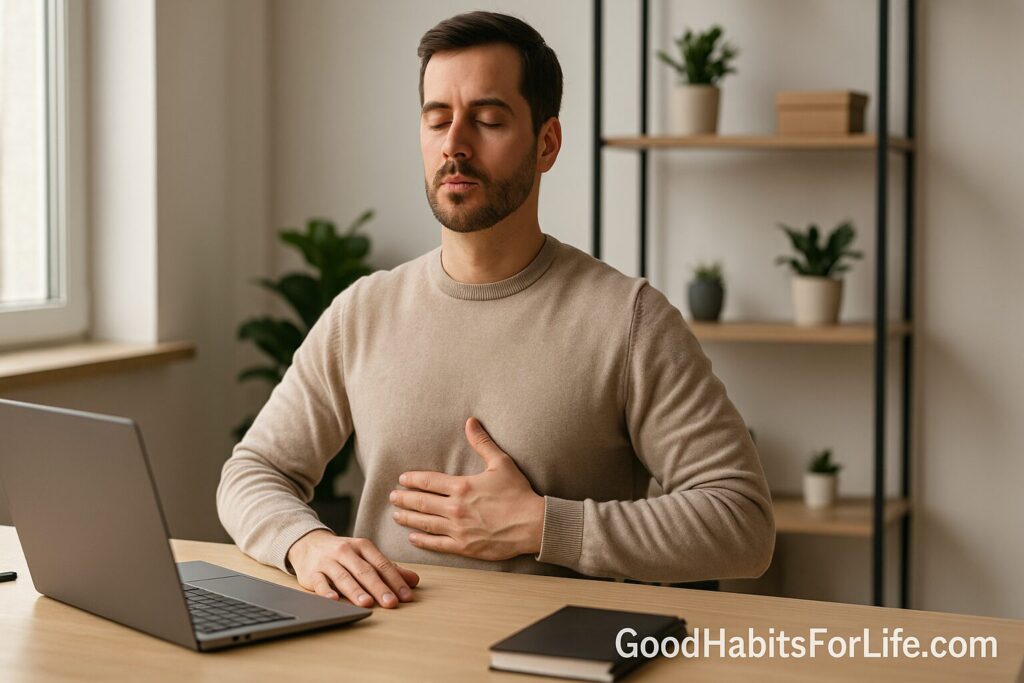
TwoMinute Calm: A Pocket Routine for Busy Days
Two-Minute Calm Routine: Reset in 120 Seconds
Table of Contents
🧭 What & Why
What it is: A compact, repeatable two-minute routine that downshifts your stress response and restores focus using paced breathing, brief muscle release, and attention grounding. No equipment. Works at a desk, in a hallway, or on a commute.
Why it works (in short):
-
Slow, diaphragmatic breathing nudges the vagus nerve, improving heart-rate variability (HRV) and shifting the body toward parasympathetic (“rest-and-digest”) activity.
-
Progressive muscle release reduces somatic tension that fuels mental stress.
-
Grounding and reappraisal pull attention out of rumination and back to the present task.
Use it when you switch tasks, before a meeting, or any time you feel rushed.
✅ Quick Start: The 120-Second Sequence
Do this once, anywhere. Stand or sit upright; feet grounded; phone on silent.
0–10 seconds — Posture & Intent
-
Place both feet flat, lengthen spine, relax jaw and shoulders.
-
Quiet intent: “Two minutes to reset; then I’ll start the next task.”
10–70 seconds — Paced Breathing (6 breaths/min)
-
Inhale through the nose for 4–5 s, belly expands.
-
Exhale gently for 5–6 s (a longer exhale calms).
-
Do 6 cycles. Keep shoulders soft.
70–100 seconds — Micro Release
-
Shoulders: Inhale, shrug 2 s → exhale, drop and soften.
-
Hands/Jaw: Clench 2 s → exhale, release.
-
Neck: Slow ear-to-shoulder tilt, right then left (no forcing).
100–120 seconds — Ground & Re-aim
-
5-4-3-2-1 check: Notice 1 thing you see, 1 you feel, 1 you hear.
-
Whisper your next action: “Open doc, outline three bullets.”
That’s it—120 seconds.
🛠️ 7-Day Starter Plan
Goal: Make “Two-Minute Calm” an automatic micro-break habit.
-
Day 1–2: Do it after you send an email (1× morning, 1× afternoon).
-
Day 3–4: Add a before-meeting trigger.
-
Day 5: Add a post-lunch reset.
-
Day 6: Stack with a phone unlock cue (first unlock after 3 p.m.).
-
Day 7: Review: Which cue was most reliable? Keep 2–3 anchor cues.
Tracking tip: Put three small boxes on your to-do list daily; tick each reset ✅.
🧠 Techniques & Frameworks That Work
-
Paced Breathing (4-6 / 6-6): In 4–5 s, out 5–6 s. If anxious, lengthen exhale.
-
Physiological Sigh (for rapid relief): Two short inhales through the nose, then a long exhale through the mouth. Repeat 3–5 times.
-
Box Breathing (4-4-4-4): Inhale 4, hold 4, exhale 4, hold 4—steady focus.
-
Mini PMR: Briefly tense a region 2–3 s, then release; scan head-to-toe.
-
5-4-3-2-1 Grounding: Name sensory inputs to break worry loops.
-
Implementation Intentions: “If I close a tab, then I do Two-Minute Calm.”
-
Reappraisal Script: “This is pressure, not danger. I can take it step by step.”
👥 Variations for Different People & Situations
-
Students: Use between study blocks; pair with Pomodoro breaks.
-
Professionals: Before calls or presentations; add a one-line agenda mantra.
-
Parents/Caregivers: Do while a kettle boils; include one shoulder roll + sigh.
-
Seniors: Favor gentle nose breathing; keep neck moves slow; sit supported.
-
Teens: Try a silent count (in-4 / out-6) with earbuds off; reward streaks.
-
In transit: Breathe while waiting for a lift or at a red light (hands on wheel, eyes up).
-
On the spot (crowded rooms): Physiological sigh + jaw release; no visible movement needed.
⚠️ Mistakes & Myths to Avoid
-
Myth: “Two minutes can’t matter.” → Small state shifts add up across the day.
-
Mistake: Forcing huge breaths → can cause light-headedness. Keep it gentle.
-
Mistake: Holding breath too long when anxious → lengthen exhale instead.
-
Myth: You must close your eyes → open or closed is fine; choose what’s safe.
-
Mistake: Only using it when overwhelmed → best results come from regular micro-breaks.
💬 Real-Life Examples & Scripts
-
Before a high-stakes call (30 s version):
Two physiological sighs → relax shoulders → “My goal: listen first, speak clearly.” -
Desk reset (120 s):
In-5 / out-6 ×6 → micro release jaw/shoulders → 5-4-3-2-1 → “Open slide deck and write the first headline.” -
Parent pause:
In-4 / out-6 ×4 → shake hands lightly → “Respond, don’t react.” -
Commuter mode:
In-5 / out-6 ×6 while standing on the platform → eyes soft, shoulders down.
🧰 Tools, Apps & Resources
-
Phone timer (2:00) or watch complication—fast, no setup.
-
Breath pacing apps: Breathwrk, Oak, Insight Timer, Headspace, Calm (visual pacers and reminders).
-
Wearables: HRV or breathing prompts on smartwatches can nudge consistency.
-
Low-tech: Sticky note on monitor: “Breathe 2:00 before next task.”
Pros/Cons: Apps help pacing & streaks (pro); some add friction or notifications (con). Start simple—then layer tools.
📌 Key Takeaways
-
Two minutes of paced breathing + micro release + grounding can flip your body from stress to focus.
-
Tie the routine to reliable cues (after email, before meetings, post-lunch).
-
Repeat 3–6 times daily to compound benefits.
-
Keep it gentle, portable, and consistent.
❓ FAQs
1) Does two minutes really reduce stress?
Yes. Even brief bouts of slow, diaphragmatic breathing improve HRV and reduce perceived stress, and a single session can shift state rapidly.
2) How often should I do it?
Aim for 3–6 micro-breaks per day—especially at task transitions.
3) Is nose or mouth breathing better?
Prefer nose in, gentle nose or mouth out. If you feel dizzy, make the breaths smaller and prioritize a longer exhale.
4) Can I do this while walking?
Yes. Try inhale 3 steps, exhale 4–5 steps, shoulders relaxed, eyes on your path.
5) What if breathing exercises make me anxious?
Shorten the inhale, lengthen the exhale, or switch to grounding (5-4-3-2-1) and micro release first.
6) What’s the ideal breathing rate?
Around 6 breaths per minute helps many people; adjust to comfort (some prefer 5–7).
7) Can I use it before sleep?
Absolutely. Use in-4 / out-6 while lying down; skip neck moves.
8) Will caffeine block the effect?
Caffeine can raise arousal; the routine still helps, but aim for slower, softer exhales.
9) Is holding the breath necessary?
No. Gentle continuous breathing with longer exhales is effective and easier.
10) How do I remember to do it?
Use if-then cues and place a 2-minute timer tile on your phone/watch.
📚 References
-
National Center for Complementary and Integrative Health (NCCIH). Relaxation Techniques for Health. https://www.nccih.nih.gov/health/relaxation-techniques-for-health
-
Harvard Health Publishing. The Benefits of Controlled Breathing. https://www.health.harvard.edu/mind-and-mood/relaxation-technique-breath-control-helps-quell-errant-stress-response
-
Zaccaro A, et al. How Breath-Control Can Change Your Life: A Systematic Review on Psychophysiological Correlates of Slow Breathing. Frontiers in Human Neuroscience, 2018. https://www.frontiersin.org/articles/10.3389/fnhum.2018.00353/full
-
American Psychological Association. Mind/Body Health: Stress. https://www.apa.org/topics/stress
-
Laborde S, Mosley E, Thayer JF. Heart Rate Variability and Performance: A Systematic Review and Meta-Analysis. International Journal of Psychophysiology, 2017. https://www.sciencedirect.com/science/article/pii/S0167876016303170
-
NIMH. Coping With Stress. https://www.nimh.nih.gov/health/topics/coping-with-stress
-
University of Michigan Health. Progressive Muscle Relaxation. https://www.uofmhealth.org/health-library/uz2225
-
Ma X, et al. The Effect of Diaphragmatic Breathing on Attention, Negative Affect and Stress in Healthy Adults. Frontiers in Psychology, 2017. https://www.frontiersin.org/articles/10.3389/fpsyg.2017.00874/full
-
Pal GK, et al. Slow Breathing Training and HRV. International Journal of Clinical and Experimental Physiology, 2014. https://journals.lww.com/ijcep/Fulltext/2014/01010/Effect_of_slow_breathing_training_on_heart_rate.2.aspx
⚖️ Disclaimer
This article offers general stress-management education and is not a substitute for personalized medical or mental-health care; seek professional advice for persistent or severe symptoms.