
Track What You Drink: Simple Logs that Change Behavior
Track What You Drink: Simple Logs that Change Behavior
Table of Contents
🧭 What & Why
What is drink tracking?
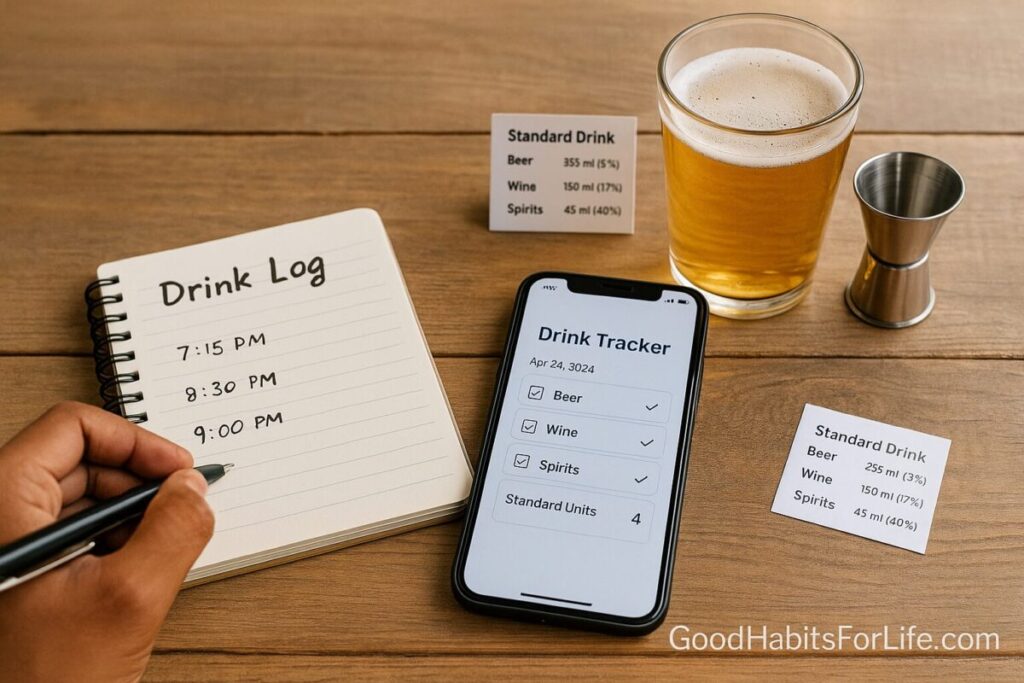
A simple record—paper, notes app, or dedicated app—of every alcoholic drink you consume, plus context (where, when, with whom, how you felt, and approximate units/standard drinks).
Why it works:
-
Self-monitoring is one of the most reliable behavior-change techniques; noticing the behavior often reduces it.
-
Tracking increases situational awareness (triggers, places, people) so you can design better “if-then” plans.
-
It supports motivational interviewing and brief interventions; even light-touch digital tools show small-to-moderate reductions in consumption across populations.
Know your “standard drink” (approximate):
-
Beer: 355 ml (12 fl oz) at ~5% ABV
-
Wine: 150 ml (5 fl oz) at ~12% ABV
-
Spirits: 45 ml (1.5 fl oz) at ~40% ABV
Labels vary—check ABV and adjust.
Low-risk guidance differs by country. In general, many public-health bodies advise limiting daily intake and avoiding heavy episodic drinking. See References for details.
✅ Quick Start (Do This Today)
-
Pick one tracking method
-
Paper card, pocket notebook, Notes/Sheets, or a dedicated app.
-
Create columns: Date / Drink & Size / Location / People / Mood / Cost / Notes.
-
Set your units
-
Add a tiny key: 1 beer = 1 SD; 150 ml wine = 1 SD; 45 ml spirits = 1 SD.
-
If your drink is stronger/larger, record 1.5–2 SD accordingly.
-
Log in real time
-
After each drink, record it. Takes 10–15 seconds.
-
Add a quick emoji for mood 😊😐😔 and a trigger tag (e.g., work-stress, celebration).
-
End-of-day recap (2 min)
-
Count the day’s standard drinks, note any patterns, and rate cravings 1–5.
-
One-week baseline
-
Don’t change anything yet. Just measure. This establishes your starting point.
-
Set one rule for next week
-
Example: “Weeknights: max 1 drink” or “No shots” or “Alternate alcoholic with water.”
🗺️ 30-60-90 Habit Plan
Days 1–30: Awareness & Easy Wins
-
Baseline log for 7 days.
-
Environment reset: stock quality alcohol-free options (sparkling water, zero-alcohol beer/wine), move spirits out of sight, smaller glasses.
-
Two if-then rules:
-
If out with colleagues, then start with a non-alcoholic drink.
-
If I hit 2 SD in an evening, then I switch to water and order food.
-
-
Weekly review: Total SD, heaviest day, triggers. Pick one friction fix.
Days 31–60: Structured Reduction
-
Targeted reduction: Cut weekly total by 10–20% from baseline.
-
Create a personal “unit budget.” Allocate units to social events; leave a buffer.
-
Delay & swap: 20-minute delay before each additional drink; swap one round for AF (alcohol-free).
-
Coping skills: breath-paced walking (5 minutes), text an accountability buddy, order a snack.
Days 61–90: Maintain & Automate
-
Streaks: Track consecutive days meeting your rules.
-
Refine rules: e.g., “2 drink cap on Fridays; AF on Sun–Thu.”
-
Social scripts (below) + identity shift: “I’m someone who tracks and chooses.”
-
Quarterly check-in: Labs/health chat if needed; consider abstinence if moderation isn’t working.
🧠 Techniques & Frameworks that Work
-
Self-Monitoring (core): Logging in the moment beats memory.
-
Implementation Intentions: “If X, then I will Y.” Write 2–3 situation-specific rules.
-
Habit Stacking: “After I sit down, I’ll order water first.”
-
Pre-Commitment: Bring exact cash for two drinks, or pre-order AF options.
-
Environmental Design: Smaller glasses; keep AF options visible; avoid “rounds.”
-
Social Support: Share goals with a trusted friend; use shared calendars for AF days.
-
Coping Rehearsal: Visualize saying “no thanks” before events; rehearse 2 scripts.
-
Data Reflection: Weekly line chart; highlight events tied to higher intake.
-
Temptation Bundling (AF): Pair a favorite TV show or dessert with AF nights.
👥 Audience Variations
-
Students: Watch “pre-drinking” and rounds; set an early cut-off (e.g., midnight). Free AF mixers help.
-
Professionals: Post-work drinks? Switch venue (coffee/walk), set a two-round cap, book early commute.
-
Parents/Caregivers: Stress trigger—build a 20-minute wind-down (shower, tea, short walk) before dinner.
-
Seniors (65+): Alcohol interacts with many meds; track timing relative to doses and hydration.
-
Teens: Best choice is not drinking. If you’re logging exposure (parties/peer pressure), involve a trusted adult.
⚠️ Mistakes & Myths to Avoid
-
Myth: “Logging ruins the fun.” → Reality: most people forget the log within minutes; clarity increases enjoyment.
-
Mistake: Vague measures (“a glass”) → Use ml/oz or standard drinks.
-
Mistake: Only logging alcohol → Log context (who/where/mood); that’s where insights live.
-
Myth: “Weekends don’t count.” → Binge patterns drive many harms; weekends matter most.
-
Mistake: All-or-nothing goals → Prefer small, specific rules and review weekly.
-
Myth: “I can ‘work off’ drinks.” → Exercise doesn’t offset alcohol’s health risks.
🗣️ Real-Life Examples & Scripts
Micro-rules you can copy:
-
“AF on Sun–Thu; max 2 SD on Fri/Sat.”
-
“No shots; wine only with meals; water between rounds.”
-
“Home pours use a jigger (45 ml).”
Polite scripts:
-
“I’m tracking this month—starting with sparkling water.”
-
“I’m good for now; saving one for dinner.”
-
“I’m driving—going AF tonight.”
-
“I’m on a health kick—cheer me on!”
Event checklist (before you go):
-
Eat first • Set a unit budget • Choose AF first drink • Decide a “leave by” time • Plan a ride home.
🛠️ Tools, Apps & Resources
(No affiliation; try what fits your privacy and platform needs.)
-
Simple options: Notes app, paper wallet card, Google Sheets (auto-sum weekly SD).
-
Drink-aware apps: Look for features like real-time logging, unit calculators, week charts, reminders, AF goals, and export.
-
Smart prompts: Set calendar nudges at typical drinking times (“Log first drink?”).
-
Measuring tools: 45 ml jigger; marked wine glass (150 ml line).
-
Supports: Local health services, brief counseling, text-based quit/cut-down programs.
-
Alcohol-free alternatives: Sparkling water with citrus, AF beer/wine—log these too to see what helps.
Pros/Cons snapshot
| Option | Pros | Cons |
|---|---|---|
| Paper card | Fast, private, battery-free | No charts, easy to forget |
| Notes/Sheets | Free, customizable, export | Manual setup |
| Dedicated apps | Unit calc, charts, reminders | Data/privacy varies, notifications can annoy |
📌 Key Takeaways
-
Logging every drink + context is the keystone habit for mindful drinking.
-
Use standard drink sizes to make data comparable.
-
Start with a one-week baseline, then add two if-then rules.
-
Follow the 30-60-90 plan; review charts weekly and adjust.
-
If tracking reveals loss of control, seek professional help—moderation isn’t right for everyone.
❓ FAQs
1) What’s the easiest way to start tracking?
Use your phone’s Notes with a simple line like: 2025-09-06 | 1 beer (355 ml) | friends | 😊 | ₹300 | patio. Do it immediately after each drink.
2) What is a “standard drink”?
Roughly: 355 ml beer (~5%), 150 ml wine (~12%), or 45 ml spirits (~40%). Stronger ABV or larger servings count as more than 1 SD.
3) Does tracking actually reduce drinking?
Yes—self-monitoring and brief digital interventions are consistently linked with small-to-moderate reductions across populations (see References).
4) How many drinks is “low risk”?
Guidelines vary by country and health status. Many agencies advise limiting daily intake and avoiding heavy episodic drinking; check national guidance and personal medical advice.
5) What if I only drink on weekends?
Binge patterns carry higher risk. Use a unit budget, alternate AF drinks, eat first, and set a leave time.
6) Can I moderate if alcohol has caused serious problems?
If you struggle to stick to limits or have dependence signs (tolerance, withdrawal, inability to cut down), moderation may not be safe—seek professional assessment.
7) Should I track alcohol-free days?
Yes—AF streaks build momentum and show which routines help most.
8) How do I handle social pressure?
Use a prepared script (“I’m tracking this month”), order AF first, and change venues where possible.
9) Is wine better than spirits?
Risk depends more on total alcohol (units) and pattern than beverage type.
10) I’m on medication or pregnant. What should I do?
Many medications interact with alcohol, and pregnancy guidance is to avoid alcohol; consult a clinician and choose AF.
📚 References
-
National Institute on Alcohol Abuse and Alcoholism (NIAAA). Rethinking Drinking (standard drinks, risks, change strategies). https://www.rethinkingdrinking.niaaa.nih.gov/
-
NIAAA. What Is A Standard Drink? https://www.niaaa.nih.gov/alcohols-effects-health/overview-alcohol-consumption/what-standard-drink
-
World Health Organization. Alcohol—fact sheet (health risks, global burden). https://www.who.int/news-room/fact-sheets/detail/alcohol
-
U.S. CDC. Alcohol and Public Health—drinking levels & risks. https://www.cdc.gov/alcohol/
-
NHS (UK). Low-risk drinking guidelines & alcohol units. https://www.nhs.uk/live-well/alcohol-advice/low-risk-drinking-guidelines/
-
Kaner EF et al. Digital interventions for hazardous and harmful alcohol consumption in community-dwelling populations. PLoS Med. 2017;14(12):e1002227. https://journals.plos.org/plosmedicine/article?id=10.1371/journal.pmed.1002227
-
Cochrane Review. Brief interventions for heavy alcohol users in general practice. 2018 update. https://www.cochranelibrary.com/cdsr/doi/10.1002/14651858.CD004148.pub4/full
-
Garnett C et al. Behavior change techniques in popular alcohol reduction apps: content analysis. JMIR. 2015. https://www.jmir.org/2015/5/e124/
-
Riper H et al. Effectiveness of e-health interventions for reducing alcohol consumption: meta-analysis. J Med Internet Res. 2011 & updates. https://www.jmir.org/2011/2/e42/
-
Boniface S, Shelton N. How is alcohol consumption affected by drinking context? Alcohol Alcohol. 2013. https://academic.oup.com/alcalc/article/48/2/187/144851
⚖️ Disclaimer
This article offers general education on alcohol and health and is not a substitute for personalized medical advice. If you’re concerned about your drinking, consult a qualified health professional.