
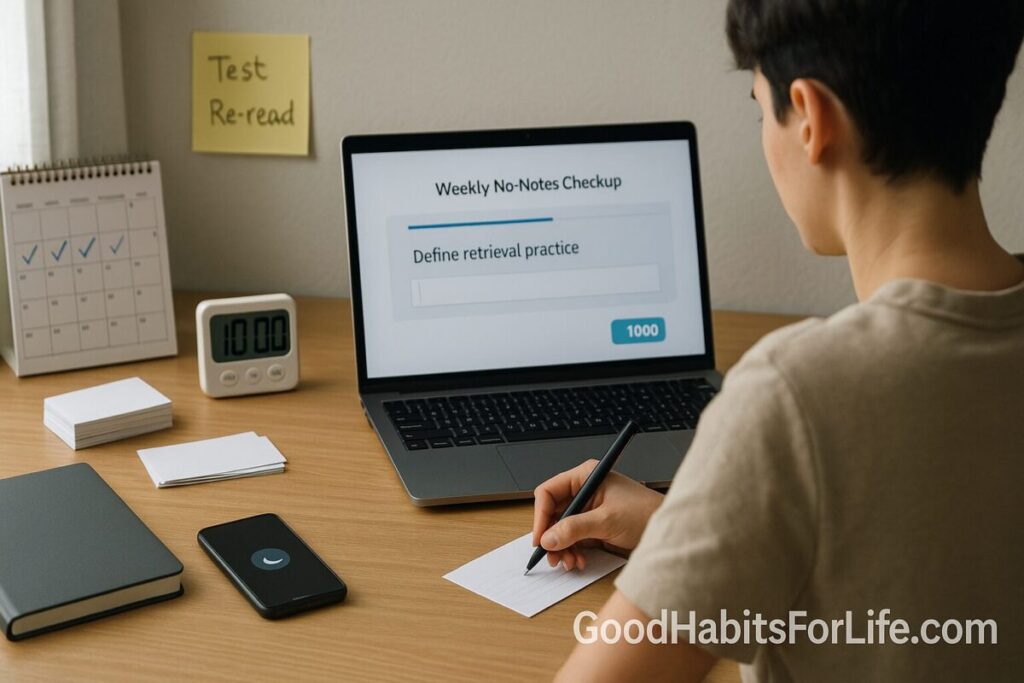
The Testing Effect: Weekly No-Notes Checkups: AI workflows (2025)
Testing Effect: Weekly No-Notes Checkups (AI 2025)
Table of Contents
🧭 What & Why
Definition. The testing effect (a.k.a. retrieval practice) is the robust finding that actively recalling information—without looking at notes—produces greater long-term retention than re-studying the same material. Across lab and classroom studies, retrieval practice reliably outperforms restudy and many “passive” methods. Psychnet+1
Why weekly no-notes checkups?
-
Durable memory: Retrieval strengthens memory traces and retrieval routes; benefits persist for a week or more and generalize to inference questions. Bates College
-
Classroom-proven: Meta-analyses show quizzing yields medium, reliable gains on real course exams and applications—not just fact recall. PubMed
-
Low cost, high impact: Reviews rank practice testing and spacing among the most effective, easy-to-adopt techniques for students. SAGE Journals
-
Compounding with spacing & interleaving: Combining weekly checkups with spacing and mixed-topic practice multiplies learning. PubMed+1
-
Feedback matters: Brief answer-reveals correct errors and prevents false knowledge from multiple-choice lures. SpringerLink
✅ Quick Start: Your First Week
Goal: Run one 20–30-minute no-notes checkup per subject; set up daily 5-minute micro-quizzes.
-
Pick scope (10–20 items). Select key concepts, definitions, and problem types from last week.
-
No-notes round (Timer 12–15 min).
-
Cover notes; answer prompts from memory (short answers, sketches, or worked steps).
-
Mark each item: 0 = blank, 1 = partial, 2 = correct w/ hesitation, 3 = fluent.
-
-
Feedback round (5–8 min). Reveal answers; correct in a different colored pen. SpringerLink
-
Mini-retention test (2–3 min). Re-attempt just the 0–1s immediately (a “second try” boosts consolidation). pdf.retrievalpractice.org
-
Schedule next exposures.
-
0–1s: review in 1 day, 3 days, then next week.
-
2s: next week only.
-
3s: two weeks later. (This equal-interval spacing is effective and simple.) PubMed
-
-
Daily micro-quizzes (5 min). Do 5–8 cards/problems each morning; mix topics (interleaving) by default. ERIC
-
AI assist (5–10 min). Paste last week’s notes into your AI and ask for:
-
“Make 15 cloze deletions and 5 short-answer questions from these notes; include 1 worked problem.”
-
“Generate plausible but incorrect distractors for each multiple-choice item.”
-
“Tag each item by topic and difficulty (1–3).”
-
“Create an interleaved practice set: 5 definitions, 5 concepts, 5 applications.”
-
🛠️ 30-60-90 Habit Plan
30 days (Starter):
-
Weekly: 1 checkup/subject (20–30 min).
-
Daily: 5 min micro-quizzes (phone flashcards).
-
Metrics: Item fluency (avg 0–3), quiz hit-rate %, time on task.
60 days (Builder):
-
Add a cumulative round (old + new).
-
Start application prompts (explain, compare, transfer to a novel context). Bates College
-
Switch to equal-interval spacing (e.g., 2–3 exposures over 2 weeks) and mix topics aggressively. PubMed+1
90 days (Performer):
-
Integrate exam-like formats (short answers > MC for tougher retrieval). PubMed
-
Run mock exam every other week with feedback and a targeted re-quiz 24 h later. SpringerLink
-
Maintain with a 10–15 min weekly mastery check + 3×/week micro-quizzes.
🧠 Techniques & Frameworks
Retrieval modes (stack from easy → effortful):
-
Recognition: 1-best-of-4 (use carefully; always add feedback). SpringerLink
-
Cued recall: prompts with keywords/diagrams.
-
Free recall / Explain like a TA: produce steps or teach back. Higher retrieval difficulty tends to yield larger gains—if you can still succeed. ScienceDirect
Spacing rules of thumb:
-
For exams ≥ 14 days away: begin now; hit each concept 2–3 times with ≥ 2-day gaps. laplab.ucsd.edu
-
Short horizon (≤7 days): shrink gaps but keep them (don’t cram only). PubMed
Interleaving:
-
Mix similar problem types (e.g., algebra forms) so you practice choosing the right strategy—not just executing one recipe. Expect sizable delayed-test gains. ERIC
Elaborative retrieval:
-
After answering, add a brief “because…” explanation or example; this mechanism helps connect cues → targets. learninglab.psych.purdue.edu
Feedback cadence:
-
Immediate answer-reveal for MC (prevents lure learning); delayed or summary feedback can also work—use at least one. SpringerLink
🤖 AI Workflows (2025): Fast, Ethical, Effective
A. From notes to quiz pack
Prompt: “From these notes, produce 20 cloze deletions, 10 short-answer, and 5 application problems. Label topic, difficulty (1–3), and suggested spacing (1d/3d/7d). Include concise answer keys.”
B. Generate high-quality distractors
Prompt: “For each MC item, add 3 distractors based on common misconceptions; ensure only one correct answer; flag near-misses.” (Prevents weak, guessable options.)
C. Explain-then-test loop
Prompt: “Explain [concept] in 70 words, then give me 3 increasingly difficult recall prompts. Withhold answers until I attempt.”
D. Interleaved set builder
Prompt: “Mix 15 items from these three topics into one set; alternate types; ensure at least 5 application tasks.”
E. Error log & re-quiz
Prompt: “From my incorrect items, create a 10-item re-quiz for tomorrow and a 6-item booster for next week.” (Implements spaced re-exposures.) PubMed
Privacy tip: Paste only what you’re comfortable sharing and use local/offline tools when needed.
👥 Audience Variations
-
Students (middle/high/uni): keep it light but frequent: 10–15 items/week/subject + daily 5-min cards; lean on diagrams and short explanations. PubMed
-
Professionals: prioritize application prompts (cases, scenarios); monthly 45-min cumulative checkups.
-
Parents helping teens: use cued recall + diagrams first; graduate to short answers; give immediate feedback. SpringerLink
-
Seniors / returning learners: shorter sets (8–12 items), more frequent spacing (1–2 day gaps), generous feedback. PubMed
⚠️ Mistakes & Myths to Avoid
-
Myth: “Re-reading is studying.” → Retrieval cements memory far better than re-reading. Psychnet
-
Mistake: Over-using multiple choice without feedback. → Risk of learning lures. SpringerLink
-
Mistake: Zero spacing. → Even small gaps beat massed practice. PubMed
-
Myth: “Testing only helps rote facts.” → Gains extend to concept understanding and transfer when prompts demand application. Bates College+1
-
Mistake: Practicing one type in blocks. → Interleave similar types to improve discrimination. ERIC
🗣️ Real-Life Examples & Scripts
-
Teach-back prompt: “In 90 seconds, explain why equal-interval spacing helps retrieval. Give a real example.” PubMed
-
Application cue: “A patient’s lab trends show X; which formula applies and why?”
-
Math interleaving: “Solve 6 problems where you first identify the method (quadratic vs. factoring vs. completing the square) before solving.” ERIC
-
MC with feedback: “Select the best definition. After you choose, see the answer + one-line rationale.” SpringerLink
-
Reflection tag: After each checkup, tag one sticky story/example you’ll reuse when recalling.
🧰 Tools, Apps & Resources (quick notes)
-
Spaced-repetition flashcards (Anki, Mochi, RemNote, Quizlet): fast daily micro-quizzes; supports images, cloze, LaTeX.
-
Outliners/notes (Obsidian/Notion): store item banks; pair with spaced-repetition plugins.
-
Timer apps: enforce short, no-notes sprints.
-
LMS quizzes / Google Forms: auto-grade short-answer/MC with feedback; schedule weekly releases.
-
Whiteboard tablet/camera: record explain-out-loud answers to check for fluency.
📚 Key Takeaways
-
Retrieval practice is a core habit: schedule weekly no-notes checkups and tiny daily quizzes. PubMed
-
Multiply gains by adding spacing, interleaving, and feedback. PubMed+2ERIC+2
-
Use AI to generate, tag, and remix high-quality items—then study without notes.
-
Track a simple 0–3 fluency and promote items with equal-interval spacing. PubMed
-
Expect better understanding and transfer—not just memorization—when prompts demand application. Bates College
❓ FAQs
1) How long should a weekly checkup be?
20–30 minutes per subject with 10–20 items is plenty for steady gains.
2) Are multiple-choice quizzes bad?
No—but add feedback and mix with short answers/cued recall to avoid learning lures. SpringerLink
3) What spacing should I use?
Start simple: equal intervals (1–3–7 days). It’s effective and easy to follow. PubMed
4) Does retrieval help beyond facts?
Yes. Studies show advantages for meaningful learning and inference when prompts push application. Bates College
5) Should I interleave topics or finish one then switch?
Interleave similar types to practice choosing the right method; it improves delayed performance. ERIC
6) When do I see results?
Typically within 2–4 weeks of consistent retrieval + spacing; expect the biggest gains on delayed tests. PubMed
7) Is cramming ever useful?
It can raise short-term scores, but retention drops quickly; retrieval + spacing wins for exams beyond a few days. PubMed
8) How do I grade myself fairly?
Use a 0–3 fluency scale and write brief justifications; re-quiz errors within 24 h with feedback. SpringerLink
9) Can AI replace flashcards?
Use AI to generate and remix items; still rehearse with true no-notes retrieval (eyes off notes, answers hidden).
10) What about anxiety around tests?
Reframe as short, low-stakes “checkups”; frequent success with feedback lowers test anxiety over time. PubMed
References
-
Roediger, H. L., & Karpicke, J. D. (2006). The Power of Testing Memory. Psychological Science in the Public Interest. (overview of testing effect). Psychnet
-
Karpicke, J. D., & Blunt, J. R. (2011). Retrieval practice produces more learning than elaborative studying with concept mapping. Science. (meaningful learning & transfer). Bates College
-
Yang, C., Luo, L., Vadillo, M. A., Yu, R., & Shanks, D. R. (2021). Testing (quizzing) boosts classroom learning: A systematic and meta-analytic review. Psychological Bulletin. PubMed
-
Rowland, C. A. (2014). The effect of testing versus restudy on retention: A meta-analytic review of the testing effect. Psychological Bulletin. PubMed
-
Dunlosky, J., et al. (2013). Improving students’ learning with effective learning techniques. Psychological Science in the Public Interest. (practice testing & spacing rated high utility). SAGE Journals
-
Cepeda, N. J., et al. (2006). Distributed practice in verbal recall tasks: A review and quantitative synthesis. Psychological Bulletin. (spacing effect). PubMed
-
Cepeda, N. J., et al. (2008). Spacing effects in learning. Psychological Science. (practical spacing timelines). laplab.ucsd.edu
-
Rohrer, D., Dedrick, R. F., & Stershic, S. (2015). Interleaved practice improves mathematics learning. (field experiment summary). ERIC
-
Butler, A. C., & Roediger, H. L. (2008). Feedback enhances the positive effects and reduces the negative effects of multiple-choice testing. Memory & Cognition. SpringerLink
-
Lehman, M., & Karpicke, J. D. (2016). The elaborative retrieval account of retrieval-based learning. Journal of Experimental Psychology: Learning, Memory, and Cognition. learninglab.psych.purdue.edu