
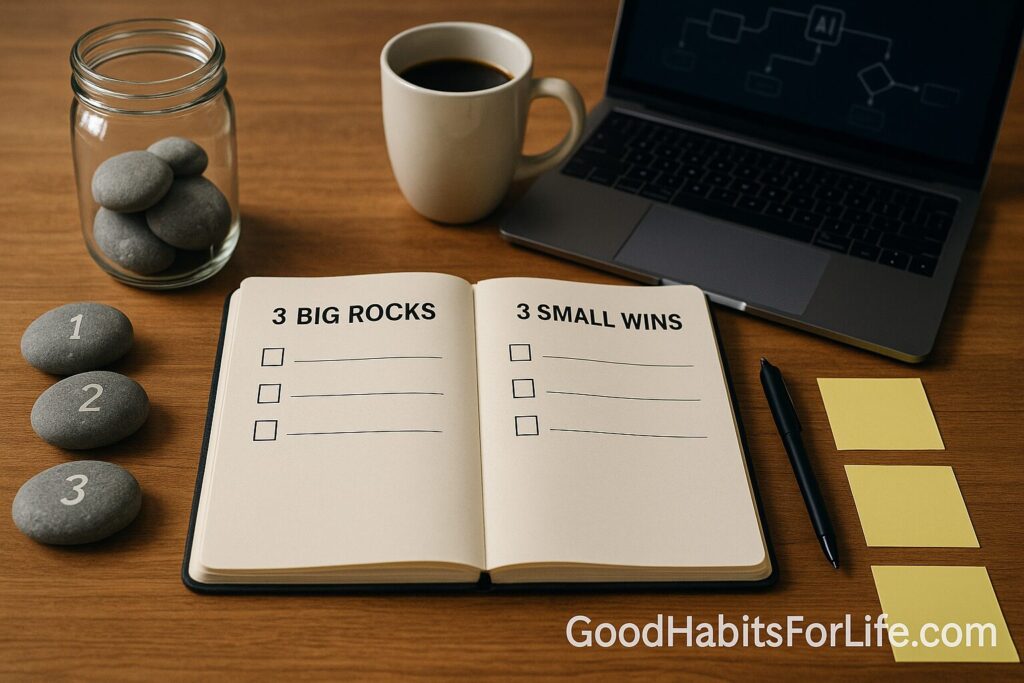
The 33 Rule: Three Big Rocks, Three Small Wins: AI workflows (2025)
33 Rule: 3 Big Rocks, 3 Small Wins (AI Workflows)
Table of Contents
🧭 What Is the 33 Rule? Why It Works
The 33 Rule is a daily planning pattern:
-
3 Big Rocks = three high-leverage outcomes that move your week’s goals forward. Each rock is defined by an observable “Done = …” statement and usually needs 60–120 minutes of focused time.
-
3 Small Wins = three quick tasks (5–15 minutes) that keep life and work flowing—follow-ups, micro-deliverables, tidy-ups.
Why it works
-
Big Rocks first: Popularized by Stephen Covey’s prioritization metaphor, “rocks” force you to schedule the important before the merely urgent.
-
Small wins drive momentum: Research on the Progress Principle shows that visible progress, even tiny, fuels motivation and creativity.
-
Fewer commitments → better follow-through: Goal-setting literature consistently finds that specific, challenging, but limited goals outperform vague to-do piles.
-
Implementation intentions (“If X, then I will Y”) create automaticity, helping you start without wrestling with willpower.
-
Switching costs are real: Minimizing task switching preserves cognitive resources for your rocks.
✅ Quick Start: Do This Today
-
Name your 1–3 weekly outcomes. Example: “Publish the ‘Hydration 2025’ article,” “Close Q3 reporting,” “Ship onboarding email v1.”
-
Pick today’s 3 Big Rocks that directly advance those outcomes. Write Done = … for each:
-
Rock #1 Done = “Outline H2/H3 + sources gathered.”
-
Rock #2 Done = “Dashboard chart fixed & exported.”
-
Rock #3 Done = “Onboarding email draft reviewed by PM.”
-
-
Define 3 Small Wins (5–15 min each):
-
“Email data team for missing metric.”
-
“Book 2 stakeholder interviews.”
-
“Archive last month’s assets.”
-
-
Time-block rocks (90–120 min each) when your energy is highest. Put them on your actual calendar.
-
Guardrails: Phone on Do Not Disturb; single-tab mode; quick desk reset before each block.
-
Use implementation intentions:
-
“If it’s 09:30, then start Rock #1 timer.”
-
“If Slack pings during a rock, then snooze 60 minutes.”
-
-
End-of-day review (5 minutes): Score yourself 0–6. If <4, ask: Was the rock definition unclear? Was the block too short? Do I need a smaller next action?
🛠️ AI Workflows: Prompts & Automations
Use an AI assistant to reduce planning friction and speed routine work.
1) Clarify outcomes from a vague goal
Prompt:
“Here’s my weekly goal: Improve the onboarding experience. Suggest 5 specific outcomes I could finish this week. For each, add a crisp Done = … line, required assets, and likely blockers.”
2) Break a Big Rock into sub-steps
Prompt:
“I want to accomplish: Draft the ‘33 Rule’ article. Break it into 6–8 steps. Mark which steps require deep work vs. quick tasks. Estimate minutes. Output a checklist.”
3) Generate 3 Small Wins from context
Prompt:
“From these project notes, propose 10 micro-tasks I can finish in <15 minutes. Sort by impact. Flag any that can be automated.”
4) Write reusable SOPs
Prompt:
“Create a concise SOP for ‘Publishing a blog post in WordPress using ColorMag.’ Include pre-publish checks, internal links list, and a 10-item QA checklist.”
5) Draft communication
Prompt:
“Draft a friendly status email that summarizes today’s progress on Rock #2, lists blockers, and requests a 15-minute review tomorrow morning.”
6) Calendar + task automations
-
Auto-block time: Use a calendar assistant or automation (e.g., task app → calendar) to place 90-minute holds for Rocks #1–3 every morning.
-
Triage inbox to Small Wins: Route starred emails into a “Small Wins” list.
-
Recurring reviews: Schedule “33 Review” every weekday at 17:30 with a pre-filled template.
🧠 30-60-90 Habit Plan
Goal: Make the 33 Rule automatic in 90 days.
Days 1–30 (Install the ritual)
-
Trigger: After your morning beverage, open today’s 33 card.
-
Action: Write 3 Rocks (with Done = …) + 3 Small Wins.
-
Block: Place two 90-minute rock blocks on your calendar (third after lunch).
-
Track: Daily 0–6 score; weekly average.
-
Constraint: Rocks must tie to weekly outcomes; Small Wins <15 minutes.
Days 31–60 (Refine definition & scope)
-
Tighten “Done = …” to observable outputs.
-
Right-size rocks (aim 60–120 minutes, not 5-hour monsters).
-
Batch Small Wins (one 30-minute sweep).
-
Introduce MCII (WOOP): Wish, Outcome, Obstacle, Plan—write one obstacle + if-then plan per rock.
Days 61–90 (Optimize with data)
-
Review energy mapping: Schedule hardest rock in your highest-energy slot.
-
Cut WIP: Never exceed 3 concurrent rocks per day; push overflow to tomorrow.
-
Automate repetitive wins with templates/SOPs.
-
Share scoreboard with a buddy or manager weekly to increase accountability.
📚 Techniques & Frameworks That Fit the 33 Rule
-
Time Blocking: Put rocks on the calendar first; let meetings fill around them.
-
Eisenhower Matrix: Use “Important & Not Urgent” to pick rocks; “Less Important & Urgent” becomes Small Wins or gets delegated.
-
Implementation Intentions (If-Then): Write a trigger for each rock start.
-
Pomodoro / Focus Sprints: 50/10 or 25/5 cycles; protect the start, then trust the timer.
-
Task Batching: Sweep emails, approvals, and messages as one Small-Wins block to reduce switching.
-
WOOP/MCII: Write a likely obstacle and a pre-decided response.
-
Shut-down Ritual: Close loops, capture tomorrow’s rocks, and leave a “starter step” visible.
👥 Variations for Different Audiences
Students
-
Rocks: readings, problem sets, project milestones.
-
Wins: flashcards, office-hours booking, citation clean-up.
-
Tip: Convert syllabi into weekly outcomes on Sunday night.
Professionals/Managers
-
Rocks: one strategic deliverable, one team-enabler, one stakeholder task.
-
Wins: approvals, 1-on-1 follow-ups, brief status notes.
-
Tip: Start with the rock that unblocks the most people.
Parents/Caregivers
-
Rocks: meal prep plan, key appointment, budget check.
-
Wins: refill supplies, file form, 10-minute tidy.
-
Tip: Use nap-time or school-hours for rock blocks; keep wins on phone.
Creators/Freelancers
-
Rocks: shipping cycles (write/record/edit).
-
Wins: pitch email, invoice sent, asset rename.
-
Tip: Protect mornings; batch client comms later.
Seniors/Low-Energy Days
-
Rocks: health routines, one admin task, one connection.
-
Wins: schedule check-in, refill meds, 5-minute stretch.
-
Tip: Shrink rocks to 30–45 minutes; keep wins very easy.
⚠️ Mistakes & Myths to Avoid
-
Myth: “More tasks = more progress.” The 33 cap prevents dilution.
-
Mistake: Vague rocks. “Work on report” ≠ rock. “Done = draft intro + methods” ✅
-
Mistake: Scheduling around meetings. Put rocks first; negotiate meetings around them.
-
Myth: Small wins are trivial. They maintain momentum and prevent backlog creep.
-
Mistake: No buffer. Leave 10–15% white space for overruns and emergencies.
-
Myth: You must hit 6/6 daily. Aim for 4–6; use misses as debug data.
💬 Examples & Copy-Paste Scripts
Daily 33 Card (template)
-
Rock #1 (Done = …):
-
Rock #2 (Done = …):
-
Rock #3 (Done = …):
-
Small Win A:
-
Small Win B:
-
Small Win C:
-
If-Then: If it’s 14:00, then start Rock #2 sprint.
Status update to manager/client
Subject: 33 Update — [Project/Date]
-
Rock #1: ✅ Done = …
-
Rock #2: ⏳ In progress; blocker: …
-
Rock #3: ▶️ Starts tomorrow 09:30
-
Small Wins: A, B, C completed
-
Ask: 15-minute review of X at 16:30?
Meeting agenda (rocks-first)
-
5 min: What moved a rock since last check-in?
-
10 min: Decide next rock’s “Done = …”
-
5 min: Remove blockers; assign owners
-
2 min: Confirm times for next rock blocks
End-of-day close-down
-
Log score (0–6).
-
Capture “Tomorrow’s 3” with Done lines.
-
Leave the first file/tab open at the starter step.
🧰 Tools, Apps & Resources
| Need | Good Options | Why it helps | Watch-outs |
|---|---|---|---|
| Time blocking | Google Calendar, Outlook, Calendars | Visual protection for rock time | Hold firm; don’t let others overwrite |
| Task hub | Todoist, TickTick, Things, Notion, ClickUp | Easy 33 card, labels for Rocks/Wins | Avoid over-nesting |
| Focus timer | Forest, Focus To-Do, Be Focused | Start friction-free sprints | Don’t chase streaks over outcomes |
| Notes/Sources | Obsidian, Notion, OneNote | Keep “Done = …”, checklists, references | Link notes to outcomes |
| Automation | Zapier, Make, IFTTT | Route emails → Small Wins list; auto-create checklists | Start simple; log automations |
| AI helper | Any modern LLM assistant | Clarify outcomes, break tasks, draft SOPs | Verify facts; keep prompts short |
🔑 Key Takeaways
-
Constrain the day to 3 outcome-focused rocks + 3 frictionless wins.
-
Write “Done = …” for every rock to make success observable.
-
Time-block rocks first, then batch wins.
-
Use AI to remove planning friction and to draft SOPs, checklists, and messages.
-
Score daily, review weekly, and iterate your definitions and time blocks.
❓ FAQs
1) What if emergencies blow up my calendar?
Keep one floating rock (or a spare block) most days. If you miss, reschedule, don’t cram. Track causes and create safeguards.
2) Can I have fewer than 3 rocks?
Yes—2 rocks on heavy meeting days, even 1 on travel days. Keep the total ≤3 to protect depth.
3) How long should a rock take?
Aim 60–120 minutes. If it needs >2 hours, split it. If <45 minutes, it might be a Small Win.
4) Where do recurring chores fit?
Batch them as Small Wins (one 30-minute sweep). If a chore is strategic (e.g., monthly budget), elevate it to a rock with a “Done = report sent.”
5) How do I pick rocks when everything feels urgent?
Ask: “If only three things moved forward today, which would make the week a win?” Use the Eisenhower Matrix and pick from Important & Not Urgent.
6) Is the 33 Rule compatible with Agile/Scrum?
Yes—treat rocks as daily sprint goals that advance your sprint backlog; wins are micro-tasks and hygiene.
7) How do I involve my team?
Run a 10-minute morning stand-up: each person names one rock + one win. End with blockers and time-blocks on the calendar.
8) What metrics should I track?
Weekly average score, % of days with 3/3 rocks completed, and cycle time for repeatable tasks after SOP/automation.
9) How do I keep motivation high?
Ensure at least one rock per day is intrinsically rewarding, and celebrate Small Win streaks with a visible progress bar.
📚 References
-
FranklinCovey. The Big Rocks of Time Management (overview of the metaphor and prioritization). https://www.franklincovey.com
-
Amabile, T. & Kramer, S. (2011). The Power of Small Wins. Harvard Business Review. https://hbr.org/2011/05/the-power-of-small-wins
-
Locke, E. A., & Latham, G. P. (2002). Building a practically useful theory of goal setting and task motivation. American Psychologist, 57(9), 705–717. https://doi.org/10.1037/0003-066X.57.9.705
-
Gollwitzer, P. M. (1999). Implementation intentions: Strong effects of simple plans. American Psychologist, 54(7), 493–503. https://doi.org/10.1037/0003-066X.54.7.493
-
National Institutes of Health (NIH). Breaking Bad Habits. NIH News in Health. https://newsinhealth.nih.gov/2012/10/breaking-bad-habits
-
Mark, G., Gudith, D., & Klocke, U. (2008). The cost of interrupted work: More speed and stress. CHI ’08 Proceedings. https://doi.org/10.1145/1357054.1357072
-
U.S. Bureau of Labor Statistics. American Time Use Survey (ATUS). https://www.bls.gov/tus/
-
Oettingen, G., & Gollwitzer, P. M. (2010). Strategies of setting and implementing goals: Mental contrasting and implementation intentions. In Social Psychological Foundations of Clinical Psychology. (Accessible overviews available via university pages.)