
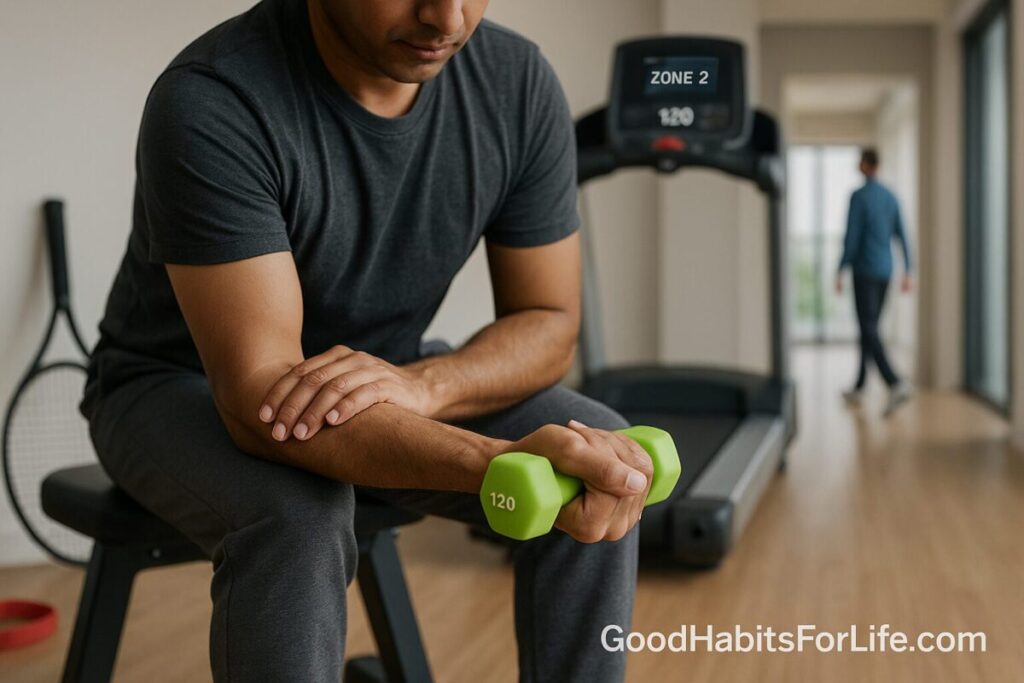
Tennis Elbow Prevention Routine: Zone 2 + NEAT (2025)
Tennis Elbow Prevention Routine: Zone 2 + NEAT (2025)
Table of Contents
🧭 What Is Tennis Elbow & Why Prevention Works
Tennis elbow (lateral elbow tendinopathy) is pain on the outer elbow from overload of the wrist/forearm extensor tendons, often due to repetitive gripping, wrist extension, and sudden spikes in use (tennis, DIY, mouse work). Prevention focuses on gradual loading, tendon-specific strengthening, and reducing long sedentary bouts that impair tissue health. OrthoInfoPubMed
Why Zone-2 + NEAT?
-
Zone-2 cardio (moderate intensity) improves circulation and aerobic base, supporting tendon recovery between hitting/strength sessions; you should be able to talk but not sing at this intensity. CDC
-
NEAT (Non-Exercise Activity Thermogenesis)—all movement outside “workouts”—adds low-stress load and offsets long sitting; frequent short bouts lower post-meal blood sugar and insulin. PubMedPMC
-
Meeting weekly activity targets (e.g., 150–300 min moderate) is associated with broad health benefits and better capacity for sport. PMC
✅ Quick Start: Your 20-Minute Today Plan
Do this once today (20–25 minutes total):
-
Warm-up (4 min): 2 min brisk walk + 2 min arm circles, wrist flexor/extensor swings.
-
Forearm strength (8 min):
-
Zone-2 cardio (8–12 min): fast walk or easy cycle at “talk-test” pace. CDC
-
NEAT breaks: Set timer to stand/move 1–5 min every 30–60 min for the rest of the day. cuimc.columbia.edu
🛠️ 30-60-90 Prevention Roadmap
Days 1–30: Build the base
-
Zone-2: 3×/week, 20–30 min each (talk test; or ~64–76% HRmax). Example (age 40): HRmax ≈ 180; Zone-2 ≈ 115–137 bpm. ACSM
-
Forearm strength: 3×/week (non-consecutive days).
-
Eccentric wrist extensor 3–4×8–10
-
Reverse curl (light) 2–3×12
-
Pron/supination with hammer 2–3×10 each
-
-
NEAT goal: 7,000–10,000 steps/day plus 1–5-min breaks each 30–60 min sitting (after meals preferred). PMCcuimc.columbia.edu
-
On-court: Limit new hitting volume increases to small, steady increments; stop if sharp pain appears. PubMed
Days 31–60: Progress & protect
-
Zone-2: 3–4×/week, 25–35 min.
-
Strength: Progress load 5–10% if pain-free; add isometric wrist extension holds 3×30–45 s at mid-range. PubMed
-
NEAT: Keep breaks; add a 10-min post-meal walk most days. PMC
-
Technique/gear check: Verify grip size and backhand mechanics (reduce excessive wrist extension; use legs/torso). International Tennis FederationPubMed
Days 61–90: Sustain & season-proof
-
Zone-2: 4×/week, 30–40 min (or 3× Zone-2 + 1× easy intervals).
-
Strength: Maintain 2×/week; add compound pulls (e.g., rows) 2–3×8–12.
-
NEAT: Bake in standing work blocks and stairs when possible.
-
On-court: Pre-play primer (see scripts) and weekly rest day to avoid spikes in tendon load. PubMed
🧠 Techniques & Frameworks That Matter
1) Intensity: the Talk Test & Zone-2
-
If you can talk but not sing, you’re in moderate territory—ideal for Zone-2. CDC
-
Weekly target: 150–300 min moderate (or mix with vigorous). PMC
2) NEAT for tendon-friendly days
-
NEAT = all movement outside workouts. Use micro-bouts: 1–5 min walking, mobility, stairs, carry groceries. PubMed
-
Breaking up sitting every 30 min improves glycemic control and lowers blood pressure. cuimc.columbia.edu
3) Tendon-smart loading
-
Use eccentric-dominant wrist extensor work; progress slowly and avoid pain spikes. PMCPubMed
-
Isometrics can settle pain and provide strength stimulus with low movement. PubMed
4) Technique & equipment
-
Grip size affects forearm muscle demand; check you’re within recommended fit to reduce overload risk. PubMed
-
ITF guidance emphasizes overuse nature and the importance of progressive play + technique. International Tennis Federation
5) Desk & device ergonomics
-
Reduce heavy mouse use; keep neutral wrist, bring devices close, and vary input methods. OSHA+1
🧩 Audience Variations
-
Beginners/returning players: Keep Zone-2 to walking or cycling; start forearm work with no pain >3/10 the next day. PubMed
-
Competitive players: Add 1 weekly light interval session (e.g., 6×1 min brisk/1 min easy) while maintaining Zone-2 volume.
-
Desk-heavy professionals: Prioritize post-meal walks + hourly 1–3-min movement snacks; consider vertical mouse/keyboard shortcuts. PMCOSHA
-
Seniors: Same plan with lighter loads; include balance drills on NEAT breaks. WHO guidelines apply across ages with adaptations. PMC
⚠️ Mistakes & Myths to Avoid
-
Myth: “Only tennis causes tennis elbow.” Many repetitive tasks (gripping, DIY, mouse work) contribute. OrthoInfo
-
Mistake: Jumping from zero to long hitting sessions—spike load is the usual culprit. PubMed
-
Mistake: Skipping daily movement—long sitting stalls recovery and capacity. PMC
-
Myth: “Stretching alone prevents it.” Stretching can feel good but strength + load management do the heavy lifting. PubMed
-
Mistake: Using a too-small/too-large grip—raises forearm muscle demand. PubMed
🗓️ Real-Life Routines & Scripts
Pre-play (6 minutes)
-
2 min brisk walk or skipping.
-
2×10 forearm pronation/supination (light hammer).
-
2×10 eccentric wrist extensions (light dumbbell), 3-sec lowers.
-
10 easy groundstrokes focusing on body rotation before wrist. PubMed
Post-play (8 minutes)
-
5–8 min Zone-2 cooldown walk or easy cycle.
-
2×30-45 s isometric wrist extension holds (pain-free). PubMed
At-desk micro-break (60-second script)
Stand → relax shoulders → 10 wrist flex/extend waves → 10 finger spreads → 20-step office walk → sit tall, neutral wrist → resume.
Repeat each 30–60 minutes. cuimc.columbia.edu
Weekly progression example
-
Week 1: 3× Zone-2 20 min; 3× forearm; 7k steps/day.
-
Week 4: 4× Zone-2 30 min; 3× forearm (heavier); 9k steps/day.
🧰 Tools, Apps & Resources
-
Heart-rate/fitness apps: Apple Health, Google Fit, Garmin, Polar—easy HR tracking; remember talk test works without gadgets. Pros: feedback and trends. Cons: can tempt over-precision. CDC
-
Timers: Any interval timer to cue NEAT breaks (30–60 min). Evidence supports frequent short walks. cuimc.columbia.edu
-
Ergonomics: Vertical mouse/trackball; keyboard shortcuts; adjustable chair/desk following OSHA workstation guidance. OSHA+1
-
Reference handouts: AAOS therapeutic exercise, ITF injury briefs for technique reminders. OrthoInfoInternational Tennis Federation
📌 Key Takeaways
-
Zone-2 cardio and NEAT don’t just “get you fit”—they create recovery capacity that protects tendons from overload. CDCPMC
-
The core prevention trio is (1) steady Zone-2, (2) frequent NEAT breaks, (3) progressive forearm strength—plus technique/gear checks. PMCPubMed
-
Keep changes gradual and avoid pain spikes; use the talk test for cardio and slow eccentrics for strength. CDCPubMed
❓ FAQs
1) What exactly is Zone-2?
Moderate-intensity cardio where you can talk but not sing—usually ~64–76% of HRmax. The talk test is enough for most people. CDCACSM
2) How often should I take NEAT breaks?
Aim for 1–5 minutes every 30–60 minutes of sitting; post-meal walks provide extra benefit. cuimc.columbia.eduPMC
3) Which exercises best protect against tennis elbow?
Eccentric-focused wrist extensor strengthening with gradual load increases has the best evidence base. PMCPubMed
4) Can I keep playing if I feel a niggle?
Reduce volume and intensity; keep pain ≤3/10 during and after and avoid next-day flare. Seek a clinician if pain persists. PubMed
5) Does grip size matter?
Yes—too small/large increases forearm muscle demand; get fit checked at a pro shop. PubMed
6) How many weekly minutes do I need?
Target 150–300 minutes moderate aerobic activity, spread across the week, plus strength work. PMC
7) I work at a desk—what’s one change that helps?
Reduce heavy mouse use, vary inputs, and keep wrists neutral; take movement breaks. OSHA
8) Are braces or straps necessary?
They can provide temporary symptom relief for some, but strength + load management matter most for prevention. PubMed
9) Is HIIT better than Zone-2?
HIIT is useful for fitness, but Zone-2 is easier to recover from and fits daily consistency—key for prevention. Use HIIT sparingly in-season. CDC
10) When should I see a clinician?
If pain lasts >6–8 weeks, night pain wakes you, or numbness/weakness appears, see a healthcare professional. nhs.uk
📚 References
-
NHS. Tennis elbow: symptoms, care, and when to see a GP. https://www.nhs.uk/conditions/tennis-elbow/ nhs.uk
-
AAOS OrthoInfo. Tennis Elbow (Lateral Epicondylitis). https://orthoinfo.aaos.org/en/diseases–conditions/tennis-elbow-lateral-epicondylitis/ OrthoInfo
-
JOSPT Clinical Practice Guideline. Lateral Elbow Tendinopathy (2022). https://pubmed.ncbi.nlm.nih.gov/36453071/ PubMed
-
Yoon SY et al. Eccentric Exercise for Lateral Elbow Tendinopathy—Systematic Review & Meta-analysis. (Open-access) https://pmc.ncbi.nlm.nih.gov/articles/PMC8432114/ PMC
-
Chen Z et al. Effectiveness of eccentric strengthening in LET. https://pubmed.ncbi.nlm.nih.gov/32284219/ PubMed
-
ITF. Injury: Tennis Elbow (player guidance). https://www.itftennis.com/media/2293/injury-tennis-elbow.pdf International Tennis Federation
-
Hatch GF et al. Grip size & forearm muscle activity. https://pubmed.ncbi.nlm.nih.gov/16861576/ PubMed
-
WHO 2020 Guidelines on Physical Activity. https://pmc.ncbi.nlm.nih.gov/articles/PMC7719906/ PMC
-
CDC. Measuring Physical Activity Intensity (Talk Test). https://www.cdc.gov/physicalactivity/basics/measuring/index.html CDC
-
ACSM. Exercise Intensity Infographic (2025). https://acsm.org/wp-content/uploads/2025/02/Exercise-intensity-infographic-PDF.pdf ACSM
-
Levine JA. Non-exercise Activity Thermogenesis (NEAT). https://pubmed.ncbi.nlm.nih.gov/12468415/ PubMed
-
Columbia Univ. Walking 1–5 minutes every 30 minutes reduces glucose/BP. https://www.cuimc.columbia.edu/news/rx-prolonged-sitting-five-minute-stroll-every-half-hour cuimc.columbia.edu
-
OSHA. Computer Workstations: Mouse & workstation setup. https://www.osha.gov/etools/computer-workstations/components/pointer-mouse ; https://www.osha.gov/etools/computer-workstations/additional-information OSHA+1
Disclaimer: This guide is educational and not a substitute for personalized medical advice; consult a qualified clinician for diagnosis or treatment.