
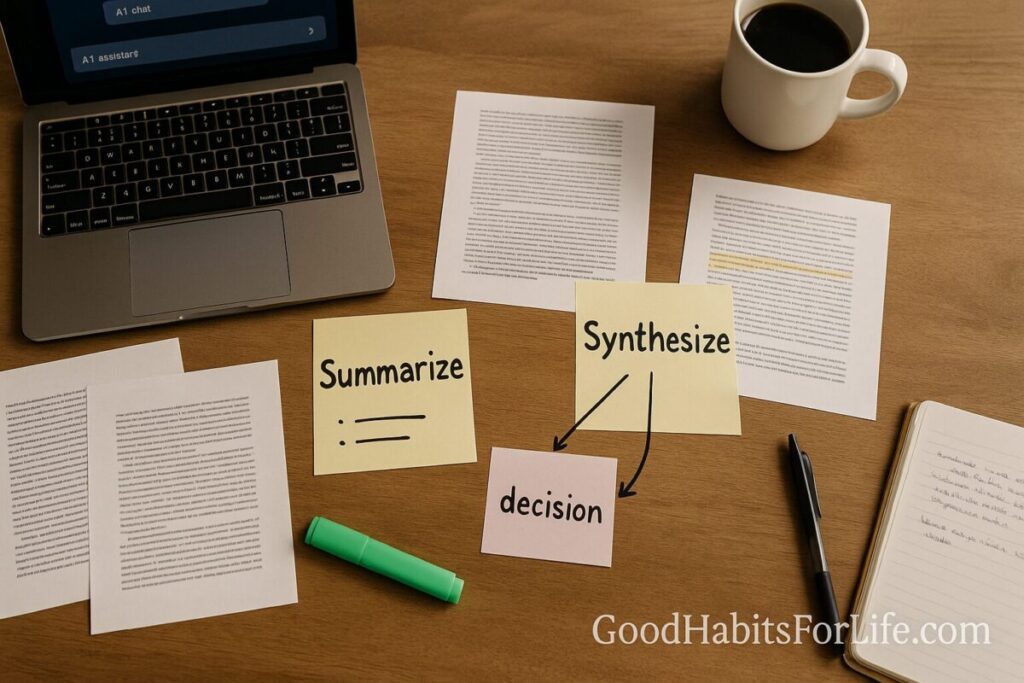
Summarize vs Synthesize: Get Better AI Notes
Summarize vs Synthesize: Get Better AI Notes
Table of Contents
🧭 What “Summarize” vs “Synthesize” Means (and Why It Matters)
Summarize = restate the main points of one source in fewer words.
Synthesize = combine ideas from multiple sources, spot agreements/tensions, and add your insight to answer a purpose-driven question (e.g., Which study method should I adopt and why?).
Why this matters for AI-assisted learning:
-
Summaries are fast but shallow. They compress content so you recognize ideas later.
-
Synthesis builds understanding and transfer. It forces comparison, explanation, and decision—behaviors tied to higher levels of Bloom’s Revised Taxonomy (analyze → evaluate → create) and to the ICAP engagement hierarchy (Interactive/Constructive > Active > Passive).
-
Research-backed learning tactics—self-explanation, Cornell Notes, and retrieval practice—all emphasize generation over passive restudy, which is exactly what synthesis requires.
Bottom line: Use AI to summarize, but you must orchestrate the synthesis to learn faster and make better decisions.
✅ Quick Start: Do-This-Today Workflow
-
Set your synthesis question (1 sentence).
“What is the most efficient note-taking method for my weekly lectures and why?” -
Collect 2–4 credible sources. Prefer university pages, peer-reviewed articles, and respected organizations.
-
Get quick AI summaries (one per source). Keep them short (150–250 words). Paste each into your notes under its source title.
-
Run 5 synthesis prompts:
-
Compare & contrast: “How do these sources agree/disagree?”
-
Because/so what: “Why do differences matter for my use case?”
-
Constraints: “What context makes each recommendation strong/weak?”
-
Decision: “Given my goal/time/tools, which approach fits best and why?”
-
Counter-example: “When would this fail? What’s my fallback?”
-
-
Convert to a Cornell layout (left: cues/questions, right: notes, bottom: 3-line summary).
-
Retrieval check (3–5 items). Write mini quiz questions from your cues. Answer them cold after a few hours.
-
Commit one behavior change you can try within 24 hours (e.g., “Use Cornell Notes + 3 self-explanations per lecture”).
🛠️ 7-Day Synthesis Habit (Starter Plan)
Goal: Turn fast AI summaries into durable understanding and a decision you trust.
-
Day 1 – Gather & Frame (30 min): Pick one topic. Write your synthesis question. Collect 3 quality sources.
-
Day 2 – Single-source briefs (40 min): Generate AI summaries (≤200 words each). Highlight claims, evidence, and context.
-
Day 3 – Map Agreements/Conflicts (30 min): Create a two-column table: Converge vs Diverge. Note reasons/evidence.
-
Day 4 – Self-Explain (25 min): For 3 key concepts, write “Because…” explanations in your own words (3–5 lines each).
-
Day 5 – Retrieval & Decision Draft (20 min): Make 5 quiz questions; answer from memory. Draft your decision with rationale.
-
Day 6 – Apply & Log (20 min): Try the decision in a real task. Log outcome + one tweak.
-
Day 7 – Synthesize & Share (30 min): Write a 150-word “executive synthesis” (What/Why/Proof/Next). Share or store as a template.
Checkpoint: If you can answer your quiz after 48 hours and explain why you chose your approach, you’ve synthesized— not merely summarized.
🧠 Techniques & Frameworks that Supercharge Synthesis
1) ICAP & Self-Explanation (high-yield)
-
ICAP predicts better learning when you move from passive reading → active note-taking → constructive activities (self-explanations) → interactive dialogues.
-
Self-explanation: After each section, write “This works because…” or “In my context, this implies…”. Even brief prompts substantially improve understanding.
Micro-prompts to paste:
-
“This concept connects to ___ I already know because ___.”
-
“If ___ is true, then I should ___; unless ___.”
-
“The evidence is strongest where ___; weakest where ___.”
2) Bloom’s Revised Taxonomy (aim higher)
Design your AI prompts to climb Bloom’s ladder:
-
Understand: “Explain in plain language + example.”
-
Analyze: “List 3 differences and why they matter.”
-
Evaluate: “Rank methods by evidence strength for [my constraint].”
-
Create: “Draft a customized workflow from the top 2 ideas.”
3) Cornell Notes (structure your synthesis)
-
Right column: distilled points + citations.
-
Left column: cue questions you’ll quiz later.
-
Bottom: your 3-line synthesis (“So what?” + next action).
4) Retrieval Practice (make it stick)
-
Replace re-reading with 3–5 recall questions.
-
Schedule quick quizzes at 24h and 72h.
-
Convert any “I forgot” into a new cue question.
5) Cognitive Load Rules (keep it light)
-
Chunk: 3–5 ideas max per session.
-
Offload: use headings, bullets, and short paragraphs.
-
Split tasks: gather → summarize → separate synthesize.
👥 Audience Variations
Students
-
Use Cornell for lectures; generate 3 self-explanations per major concept.
-
Weekly: one synthesis memo (150–200 words) answering a focus question.
Professionals
-
For a decision brief, limit to 2–3 high-quality sources; emphasize constraints (budget/time/compliance).
-
End with a “Recommendation + Risk + Mitigation” trio.
Seniors/Parents
-
Keep sources practical (university/health org guides).
-
Synthesis output = checklist (“Do / Don’t / Ask Your Doctor”).
⚠️ Mistakes & Myths to Avoid
-
Myth: “AI can do synthesis for me.”
Reality: AI can simulate synthesis, but you must set the question, choose sources, and judge trade-offs. -
Mistake: Blending summaries and calling it synthesis.
Fix: Always add a decision or principle that wasn’t in any single source. -
Mistake: Infinite highlighting.
Fix: Convert highlights into cue questions and retrieval items the same day. -
Myth: “Longer notes = better learning.”
Reality: Verbatim notes often hurt conceptual learning; rephrase in your words.
📚 Real-Life Examples & Copy-Paste Scripts
A. Synthesis Table (fill this)
| Prompt | Your Answer |
|---|---|
| Synthesis question | What’s the most effective note method for my weekly lectures and why? |
| Converge (agreements) | e.g., Generation beats restudy; structured notes help retrieval |
| Diverge (disagreements) | e.g., Longhand vs laptop; number of prompts to use |
| Decision | I’ll use Cornell with 3 self-explanations + 5 retrieval Qs per lecture |
| Evidence tags | ICAP (constructive), self-explanation, retrieval practice |
B. Five Prompts that Force Synthesis
-
“Compare and contrast Source A vs B; list 3 practical differences and when each is best.”
-
“Given constraints [time/skills/tools], recommend a plan; justify with evidence strength.”
-
“Find conflicts across sources; explain why they differ (method, context, sample).”
-
“Draft a hybrid method that keeps the strengths and mitigates the weaknesses.”
-
“Generate 5 cue questions I can quiz myself on in 24h.”
C. Cornell Cue Examples (left column)
-
“Why does retrieval outperform re-reading?”
-
“When would laptop notes beat longhand?”
-
“What’s one risk if I skip self-explanations?”
🧰 Tools, Apps & Resources
-
Note apps: Obsidian, Notion, OneNote, Apple Notes — support headers, backlinks, and templates.
Pros: flexible, searchable. Cons: can encourage hoarding—use cue questions to counter. -
Spaced-repetition: Anki, RemNote — schedule retrieval automatically.
Pros: proven memory gains. Cons: upfront card time; keep cards minimal. -
Citation/source managers: Zotero, Mendeley — clip sources, keep metadata clean.
-
Read & capture: Readwise or browser highlights — route snippets → Cornell template.
-
Timer: Any Pomodoro app — 25–30 min focused synth bursts reduce cognitive load.
(Tip: Whatever stack you choose, lock a single Cornell-style template and reuse it. Consistency beats novelty.)
📌 Key Takeaways
-
Summary = compress; synthesis = connect + conclude.
-
Learning research (ICAP, self-explanation, retrieval) favors generation—which synthesis demands.
-
Use AI for first-pass summaries, then drive human synthesis with compare/contrast, constraints, and decisions.
-
A simple weekly ritual (Cornell + self-explanations + retrieval) compounds into true expertise.
❓ FAQs
1) What’s the shortest path from summary to synthesis?
Run a 3-step loop: Compare (A vs B) → Explain (why differences) → Decide (what I’ll do + why).
2) Can AI do reliable synthesis by itself?
Treat AI outputs as drafts. You must curate sources, set the question, and judge trade-offs using your context and risk tolerance.
3) Are handwritten notes always better?
Not always. Longhand can reduce verbatim transcription and boost conceptual understanding, but if you type in your own words and quiz yourself, typed notes can work well.
4) How many sources do I need?
Two quality sources can be enough for a focused decision; three to four is safer for complex topics.
5) How do I keep notes from getting bloated?
Limit to 3–5 key ideas, convert highlights into cue questions, and perform a 24-hour retrieval check.
6) How do I avoid AI hallucinations influencing my notes?
Prefer primary/authoritative sources, paste citations, and cross-check claims against reputable organizations; use a short checklist (source, method, sample, limitations).
7) What if sources conflict?
Explain why (methods, populations, settings), then decide based on your constraints. Synthesis is about making informed trade-offs.
8) How do I measure if synthesis worked?
After 48–72 hours, answer your cue questions cold and explain your decision to a peer in 60–90 seconds.
📚 References
-
UNC Writing Center. Literature Reviews — difference between summary and synthesis. https://writingcenter.unc.edu/tips-and-tools/literature-reviews/
-
Utah Valley University Writing Center. Summary, Analysis & Synthesis (2025). https://www.uvu.edu/writingcenter/docs/summary-analysis-and-synthesis.pdf
-
Chi, M. T. H., & Wylie, R. (2014). The ICAP Framework: Linking Cognitive Engagement to Active Learning Outcomes. Educational Psychologist. PDF (ASU): https://education.asu.edu/sites/g/files/litvpz656/files/lcl/chiwylie2014icap_2.pdf
-
Iowa State University CELT. Bloom’s Revised Taxonomy overview. https://celt.iastate.edu/prepare-and-teach/design-your-course/blooms-taxonomy/
-
Roediger, H. L., & Karpicke, J. D. (2006). The Power of Testing Memory. Psychological Science. PDF (WUSTL): https://psychnet.wustl.edu/memory/wp-content/uploads/2018/04/Roediger-Karpicke-2006_PPS.pdf
-
Chi, M. T. H., et al. (1994). Eliciting Self-Explanations Improves Understanding. Cognitive Science. PDF: https://andymatuschak.org/files/papers/Chi%20et%20al%20-%201994%20-%20Eliciting%20self-explanations%20improves%20understanding.pdf
-
Cornell University, Learning Strategies Center. The Cornell Note Taking System. https://lsc.cornell.edu/how-to-study/taking-notes/cornell-note-taking-system/
-
Mueller, P. A., & Oppenheimer, D. M. (2014). The Pen Is Mightier Than the Keyboard. Psychological Science. PDF (U. Delaware host): https://cpb-us-w2.wpmucdn.com/sites.udel.edu/dist/6/132/files/2010/11/Psychological-Science-2014-Mueller-0956797614524581-1u0h0yu.pdf
-
UNESCO (2023, updated 2025). Guidance for Generative AI in Education and Research. https://www.unesco.org/en/articles/guidance-generative-ai-education-and-research
-
NIST (2023). AI Risk Management Framework (AI RMF 1.0). https://nvlpubs.nist.gov/nistpubs/ai/nist.ai.100-1.pdf
-
NSW Dept. of Education (2017). Cognitive Load Theory: Research that teachers really need to understand. https://education.nsw.gov.au/content/dam/main-education/about-us/educational-data/cese/2017-cognitive-load-theory.pdf