
Stress 101: Identify, Name, Normalize: Zone 2 + NEAT (2025)
Stress 101: Identify, Name, Normalize: Zone 2 + NEAT (2025)
Table of Contents
🧭 What & Why
What is stress?
Stress is your body’s built-in alarm and mobilization system. Short bursts help you act; long, unrelieved stress can drain energy, sleep, and focus.
Why “Identify, Name, Normalize”?
-
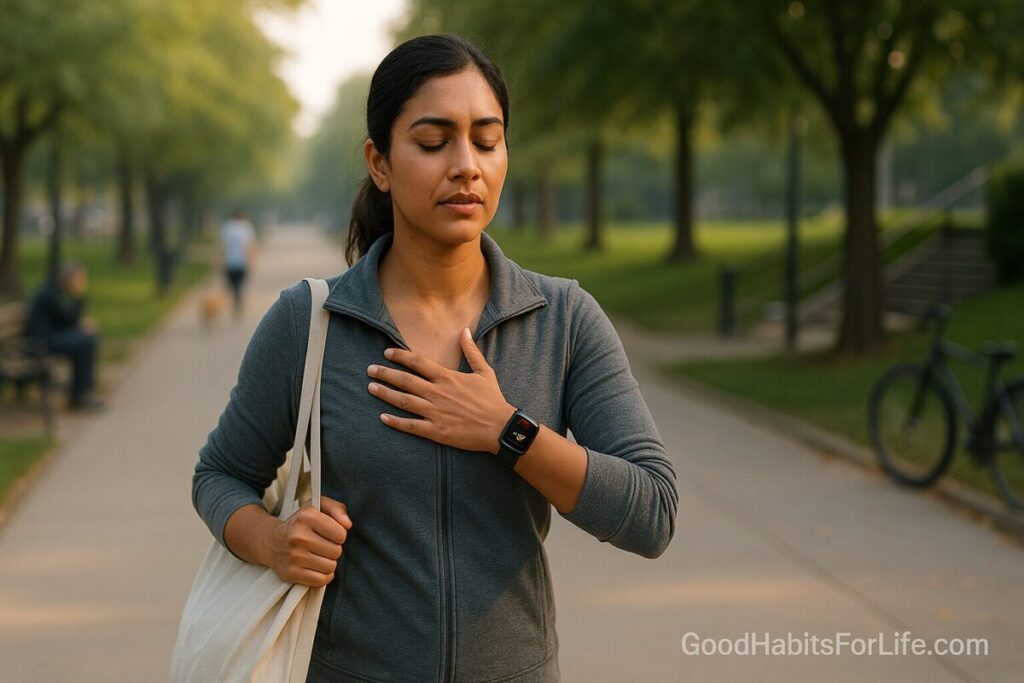
Identify: Notice the signal (heart rate, worry loop, tight jaw).
-
Name: Putting feelings into words (e.g., “I feel overwhelmed”) dampens limbic reactivity and increases prefrontal control.
-
Normalize: Remind yourself “This is stress doing its job”—which reduces shame and helps you choose helpful actions.
Why add Zone 2 + NEAT?
-
Zone 2 = easy-to-moderate aerobic work (~60–70% HRmax; you can talk in full sentences). It improves mood regulation, sleep quality, and metabolic flexibility.
-
NEAT (Non-Exercise Activity Thermogenesis) = all movement outside formal workouts (standing, walking, fidgeting, chores). It significantly contributes to daily energy expenditure and helps “bleed off” stress hormones.
Payoffs you can expect (4–8 weeks):
-
Lower perceived stress (0–10 scale down by 1–3 points)
-
Better sleep onset/quality
-
More stable energy and focus windows
-
Fewer stress-triggered snack/caffeine spikes
✅ Quick Start (Do This Today)
1) Identify (2 minutes)
-
Set a timer at lunch: scan head-to-toe for tension; rate stress 0–10.
-
Note where you feel it (chest, jaw, stomach).
2) Name (1 minute)
-
Say or write: “I feel [emotion] about [situation] because [reason]. What I need is [need].”
3) Normalize (20 seconds)
-
Script: “My body’s alarm is on. This is a normal response. I can steer what I do next.”
4) Zone 2 “Starter 15” (15 minutes)
-
Walk or cycle at a pace where you can talk—warm up 3 min → 10 min steady → 2 min easy.
-
If you already train, add this to recovery days.
5) NEAT “3×3 Rule” (9 minutes total)
-
Three times today, do 3 minutes of: brisk hallway walks, stair laps, or gentle mobility.
6) Evening wind-down (5–10 minutes)
-
Dim lights, 4-7-8 breathing (4 inhale, 7 hold, 8 exhale) × 4–8 cycles; no screens last 15 minutes.
🧠 30-60-90 Habit Plan
Goal: Reach 90–150 min/week of Zone 2 + 7,000–10,000 steps/day (or your personal sustainable NEAT baseline) while practicing identify-name-normalize daily.
Days 1–30: Foundation
-
Zone 2: 3×20 min/week (Mon-Wed-Sat).
-
NEAT: Baseline steps (e.g., 6,000/day). Use timers: 3–5 min movement each hour for 6 hours.
-
Stress label: 1+ time/day. Log in notes app.
-
Sleep anchor: Fixed wake-time daily.
Checkpoint (Day 30):
-
Perceived stress ↓ ≥1 point; Zone 2 total ≥60 min/week; steps at baseline 6/7 days.
Days 31–60: Expansion
-
Zone 2: 4×25 min/week (100 min).
-
NEAT: Add a 10-minute walk after meals (1–2/day).
-
Skills: Add 5-minute PM wind-down + weekly worry dump (journaling).
Checkpoint (Day 60):
-
Stress ↓ another 0.5–1 point; Zone 2 ≥100 min/week; steps trending +1,000/day vs. Day 1.
Days 61–90: Consolidation
-
Zone 2: 3×30–40 min or 2×45 + 1×20 (120–150 min/week).
-
NEAT: 7,000–10,000 steps/day average; stand/move breaks most hours.
-
Skills: Use scripts before tough meetings; one digital-boundary block/night.
Checkpoint (Day 90):
-
Consistent sleep, calmer baseline, better focus windows (90–120 minutes).
🛠️ Techniques & Frameworks
Affect Labeling (Name It to Tame It)
-
Use a 2-step label: “I feel anxious + rushed.” Pairing emotion + context is stronger than vague labels.
The 3 Ps Reframe
-
Ask of any stressor: Personal? Permanent? Pervasive?
-
Replace with: “It’s not personal, temporary, and specific.”
-
Zone 2 Finder (Pick One)
-
Talk Test: You can talk in complete sentences but not sing.
-
HR Guide: ~60–70% HRmax (roughly 220 – age).
-
RPE: 2–4/10 effort.
NEAT Stacks
-
Transit: Get off one stop early (5–10 min walk).
-
Work: Standing calls + pacing; stairs instead of lift.
-
Home: Put the kettle on → 3 min tidy or mobility.
-
Meals: 10-minute post-meal walk (aids glucose control and mood).
Breathing & Downshift
-
4-7-8 breathing (2–4 minutes).
-
Physiological sigh: 2 short inhales through nose + long exhale through mouth × 3–5.
Stress Dashboard (Weekly Review)
-
PSS-4 mini: rate your stress (0–16) or a simple 0–10 self-rating.
-
Sleep: time-in-bed, latency, 2 a.m. wake-ups.
-
Movement: Zone 2 minutes + steps/NEAT streak days.
📚 Audience Variations
Students
-
Zone 2 between classes; 10-min post-meal walks to avoid afternoon slump.
-
Label emotions before exams; 2-minute box breathing at the desk.
Professionals
-
Calendar-block a “walking 1:1.”
-
Use meeting buffers (5 minutes) for NEAT—hallway loops, stairs.
Parents & Caregivers
-
Stroller walks at Zone 2 pace; living-room mobility during kids’ play.
-
Label aloud: “I’m feeling frazzled; I need two quiet minutes.”
Seniors
-
Prioritize low-impact Zone 2: flat walks, cycle, water aerobics.
-
Short, frequent NEAT bursts beat one long session if joints are sensitive.
Teens
-
Music-paced Zone 2 (easy jog/cycle).
-
“Name + normalize” to handle social stress (“Nervous before tryouts—totally normal.”)
⚠️ Mistakes & Myths to Avoid
-
Myth: “If I’m not sweating hard, it won’t help.”
Truth: Zone 2’s easy–moderate work is ideal for stress and recovery. -
Mistake: Skipping movement on “busy” days.
Fix: Lean on NEAT—3×3 minutes can reset your stress curve. -
Myth: “Naming feelings makes them worse.”
Truth: Brief labeling reduces reactivity and helps self-control. -
Mistake: All-or-nothing goals.
Fix: Use the 30-60-90 ramp; protect consistency over intensity. -
Myth: “10k steps or nothing.”
Truth: Benefits start well below that; steady increases matter most.
🗣️ Real-Life Examples & Scripts
When your calendar is packed
-
“I’m at a 7/10 right now—normal for back-to-backs. I’m taking a 3-minute stair loop before the next call.”
Before a tough conversation
-
“Feeling tense and defensive about feedback—makes sense. I’ll walk 10 minutes and lead with one clarifying question.”
End-of-day shutdown
-
“I’m wired and scrolling. I’ll do 4-7-8 breathing × 6 cycles, then lights-down and a warm shower.”
Morning cue
-
“Coffee brewing = 5 minutes of Zone 2 march-in-place + mobility.”
🧰 Tools, Apps & Resources
-
Timers/Alarms: Any phone timer; set hourly 3-minute movement breaks.
-
HR/Tracking: Apple Health, Google Fit, Garmin, Polar (for HR zones).
-
Breathing Apps: Calm, Headspace, Breathwrk (short, guided options).
-
Habit Apps: Streaks, Habitify, Loop—support daily labeling/NEAT streaks.
-
Desk Helpers: Under-desk cycle, standing desk, posture reminders.
Pros/Cons snapshot
-
Apps boost consistency (pro), but can become noise (con)—keep notifications minimal.
-
HR sensors guide Zone 2 (pro), but perceived effort + talk test are usually enough (pro).
🔑 Key Takeaways
-
Stress is a signal—identify, name, normalize to regain control.
-
Zone 2 (90–150 min/week) + NEAT micro-moves lower stress load.
-
Build steadily with a 30-60-90 ramp; protect sleep and daily movement.
-
Track three signals: perceived stress, steps/NEAT, and sleep quality.
-
Short, repeatable actions beat heroic bursts—consistency compounds.
❓ FAQs
1) How many Zone 2 minutes calm stress best?
Aim for 90–150 min/week (e.g., 3–5 sessions). Many feel improvements after ~4 weeks.
2) Is walking enough for Zone 2?
Yes—if you can talk in full sentences and feel lightly challenged. Hills help.
3) What if my knees hurt?
Choose low-impact options: cycling, elliptical, pool walking. Keep NEAT gentle and frequent.
4) Do short NEAT breaks really matter?
Yes. Frequent light movement breaks reduce fatigue and help mood; they also improve post-meal glucose, which steadies energy.
5) Will naming emotions make me ruminate?
Brief, clear labels paired with action reduce reactivity. Keep it short (under 60 seconds) and follow with a small step (walk, breathe, draft a plan).
6) I’m already training hard—do I still need Zone 2?
Yes. Even for athletes, easy–moderate work supports recovery, sleep, and stress regulation.
7) What step count should I aim for?
Start from your 7-day average and add +1,000 steps/day. Many benefits appear in the 6,000–8,000 range, with more gains up to ~10,000.
8) Best time of day to do this?
Any time you’ll do it consistently. Late evening Zone 2 can be fine if it doesn’t delay sleep.
9) How fast will I feel different?
Some relief in 1–2 weeks, clearer gains by 4–8 weeks with consistent practice.
10) Can coffee/alcohol sabotage progress?
Late caffeine can worsen sleep; alcohol fragments sleep. Keep caffeine before early afternoon; keep alcohol low and early—or skip on training nights.
📚 References
-
World Health Organization. Guidelines on Physical Activity and Sedentary Behaviour (2020). https://www.who.int/publications/i/item/9789240015128
-
National Institute of Mental Health. Caring for Your Mental Health: Coping with Stress. https://www.nimh.nih.gov/health/topics/caring-for-your-mental-health
-
American Psychological Association. Stress effects and management (resource hub). https://www.apa.org/topics/stress
-
Lieberman, M. D., et al. “Putting Feelings Into Words: Affect Labeling Disrupts Amygdala Activity.” Psychological Science (2007). https://doi.org/10.1111/j.1467-9280.2007.01916.x
-
Torre, J. B., & Lieberman, M. D. “Putting Feelings Into Words—Affective Labeling as Implicit Emotion Regulation.” Current Directions in Psychological Science (2018). https://doi.org/10.1177/0963721417746796
-
Levine, J. A. “Non-exercise activity thermogenesis (NEAT).” Best Practice & Research Clinical Endocrinology & Metabolism (2002 & 2005). https://doi.org/10.1053/ybeem.2002.0197 ; https://doi.org/10.1016/j.beem.2005.04.003
-
Dunstan, D. W., et al. “Breaking Up Prolonged Sitting Reduces Postprandial Glucose and Insulin Responses.” Diabetes Care (2012). https://doi.org/10.2337/dc11-1931
-
Singh, B., et al. “Effectiveness of physical activity interventions for depression and anxiety.” British Journal of Sports Medicine (2023). https://bjsm.bmj.com/content/57/19/1209
-
Lee, I-M., et al. “Steps per Day and All-Cause Mortality.” JAMA Internal Medicine (2019). https://jamanetwork.com/journals/jamainternalmedicine/fullarticle/2734709
-
American College of Sports Medicine. ACSM Guidelines & Position Stands (aerobic intensity & prescription). https://www.acsm.org/education-resources/position-stands
-
U.S. Department of Health & Human Services. Physical Activity Guidelines for Americans (2nd ed., 2018). https://health.gov/paguidelines/second-edition/
⚕️ Disclaimer
This guide is educational and not a substitute for personalized medical or mental-health advice; consult a qualified professional for your situation.