
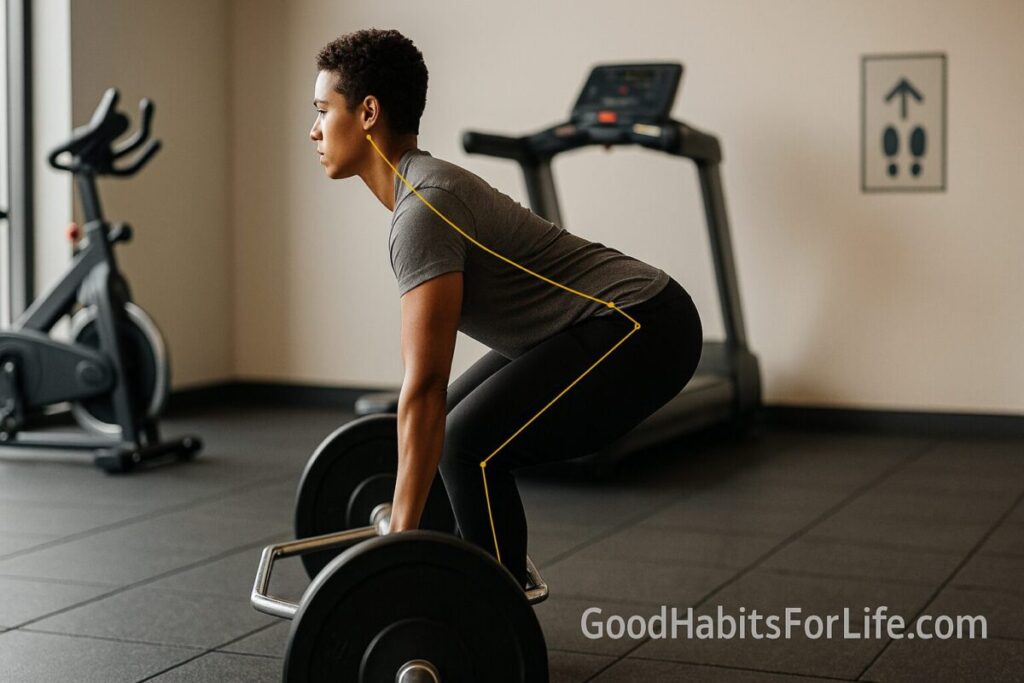
Spine Hygiene for Lifters: Flexion, Extension, Rotation: Zone 2 + NEAT (2025)
Spine Hygiene for Lifters + Zone 2 & NEAT (2025)
Table of Contents
🧭 What Is “Spine Hygiene” for Lifters—and Why It Matters
Spine hygiene means the set of habits that keep your back resilient while you lift and live: organizing load with a neutral-ish spine for heavy work, building stiffness on demand, and regularly exposing the spine and hips to flexion, extension, and rotation through safe ranges. Pair those strength habits with aerobic capacity (via Zone 2) and daily movement (NEAT, non-exercise activity thermogenesis). The combo:
-
Improves force transfer and bar path control
-
Reduces “energy leaks” and low-back irritability
-
Speeds recovery via better blood flow and metabolic health
-
Helps manage body composition and all-day stiffness
Key idea: You don’t avoid spinal motion forever—you earn it, dose it, and load it smartly.
✅ Quick Start: Do-This-Today Checklist
Warm-up (10 minutes)
-
McGill Big Three (low-load stiffness builders):
-
Curl-up 3×10–15 (5–10 s holds)
-
Side-plank 3×10–20 s/side
-
Bird-dog 3×6–8/side (5 s pauses)
-
-
Hip-hinge patterning: dowel or cable pull-throughs 2×10
-
Spine ROM snacks (controlled): cat-camel 1×6, segmental bridges 2×8
Technique cues (during heavy sets)
-
“Ribs down, 360° brace, hinge from hips.”
-
“Bar close, vertical shins off the floor, push the floor away.”
Zone 2 & NEAT (today)
-
Zone 2: 25–35 min at conversational pace (you can talk in full sentences).
-
NEAT: Hit 8,000–10,000 steps (or +2,000 above your current baseline) with micro-walks every 30–60 min.
Recovery guardrails
-
Avoid deep, end-range spine flexion in the first hour after waking.
-
Post-lift: 5–8 min easy spin or walk + gentle hips/T-spine mobility.
🗺️ 30-60-90 Roadmap (12 Weeks)
Days 1–30 (Stiffness & Patterns)
-
Big Three: 5–6 days/week, progress holds to 10–15 s.
-
Main lifts: 3–4 days/week. Keep RPE 6–7, focus on bracing and hinge.
-
Spine ROM: Cat-camel, segmental bridges, controlled quadruped rotations (2–3 days/week).
-
Zone 2: 2×/week, 25–35 min.
-
NEAT: Track steps; add +2,000/day above baseline.
Checkpoint: Less post-session tightness, easier bracing, steady steps.
Days 31–60 (Capacity & Exposure)
-
Big Three: 4–5 days/week (maintenance).
-
Main lifts: Gradually push RPE 7–8.
-
Loaded mobility (exposure to motion):
-
Flexion: Jefferson curl light dumbbell 2×6–8 (slow, controlled, pain-free).
-
Extension: Back extensions 2–3×8–12 (neutral to slight extension).
-
Rotation: Tall-kneeling cable chops/lifts 3×8–10/side.
-
-
Zone 2: 3×/week, 30–40 min.
-
NEAT: +3,000/day above original baseline.
Checkpoint: Better tolerance to accessory work; fewer “twinges.”
Days 61–90 (Resilience & Specificity)
-
Main lifts: Periodize volume/intensity for your goal (strength/hypertrophy).
-
Dynamic spinal motion under control: landmine rotations, paloff press ISO holds, controlled good-mornings.
-
Zone 2: 3–4×/week, 35–45 min; occasional lactate-guided tempo or hills just below your talk-test breakpoint.
-
NEAT: 9k–12k steps most days; include standing tasks and micro-walks.
Checkpoint: You can lift hard, recover well, and live without guarding every move.
🛠️ Techniques & Frameworks
The 3-S Framework
-
Spine-neutral (for heavy): Neutral-ish mid-ranges maximize load tolerance and force transfer.
-
Stiffness on demand: 360° brace + hip hinge before pull/squat.
-
Smoothness: Controlled tempo; avoid jerky end-range flexion under load.
Flexion, Extension, Rotation—How to Train Them
-
Flexion (dose smartly): Cat-camel, Jefferson curls (light), controlled sit-backs; keep pain-free, slow tempo.
-
Extension: Prone press-ups (gentle), back extensions (neutral to slight extension).
-
Rotation: Open-books, thread-the-needle, chops/lifts, landmine rotations (moderate load, crisp control).
Bracing & Breath (Heavy Sets)
-
Cue: “Breathe in, expand 360°, lock the canister.”
-
With or without belt: A belt can give feedback and allow harder bracing on very heavy attempts; it’s a tool—not a crutch.
-
Intra-rep breathing: For submax sets, exhale slowly past sticking points; for max attempts, brief Valsalva as coached.
Finding Zone 2 (Practical)
-
Talk test: You can speak full sentences, not sing.
-
Heart rate: Often ~60–70% HRmax (individuals vary).
-
Feels like: Warm but sustainable; nasal breathing mostly possible.
NEAT: Make Movement Automatic
-
5-minute walks after meals
-
Phone-call pacing
-
Stairs over lifts
-
Timer nudge every 30–60 min to stand, swing legs, hip circles
👥 Audience Variations
-
Students/Desk-bound pros: Prioritize NEAT timers + lunchtime 20-min Zone 2 walk; hamstring/hip-flexor openers twice daily.
-
Parents: “Stroller Zone 2,” park play (carry/lunge/swing), floor-time mobility.
-
Seniors (50+): Same framework; emphasize gradual exposure, handles/rails for hinge practice, and longer Zone 2 warm-ups.
-
New lifters: Keep accessories light while you master hinge + brace; add motion work in weeks 3–4.
⚠️ Mistakes & Myths to Avoid
-
Myth: “Never flex your spine.” → Reality: Avoiding all flexion de-conditions you; controlled motion is part of resilience.
-
Mistake: Maxing intensity before you can brace/hinge.
-
Mistake: Zero cardio. Aerobic capacity supports recovery between sets and between days.
-
Myth: “Belts are cheating.” → Belts are feedback and support for top sets; you should still learn to brace without one.
-
Mistake: Deep end-range toe-touching right after waking—discs are more hydrated and vulnerable.
💬 Real-Life Examples & Scripts
Warm-up Script (10 min)
“2 minutes easy bike → Big Three (as prescribed) → 2×10 hinge pull-throughs → 1×6 cat-camel → 1×8 segmental bridge. Now to the bar.”
Deadlift Setup Cues
“Feet under hips, bar over mid-foot. Hinge back, set lats. Big belly breath, 360° brace. Drive the floor. Hips and bar rise together.”
Squat Setup Cues
“Tripod feet. Big breath. Ribs down. Hips back a touch, knees out. Own the mid-range. Up with intent.”
Post-Lift Recovery
“6 minutes easy walk + 2 sets open-books + 1 minute diaphragmatic breathing.”
NEAT Triggers
“Every meeting = stand for first 5 minutes. Every phone call = pace. Every meal = 5-minute walk.”
Zone 2 Reality Check
“Can I talk in full sentences? If not, back off 5–10 bpm.”
🧰 Tools, Apps & Resources
-
Heart-rate monitor (wrist or chest) for Zone 2 pacing; optional lactate strips for nerds and athletes.
-
Step counter (phone/watch) + stand reminders.
-
Weightlifting belt (only for heavy sets or testing)—use to cue 360° expansion.
-
Glute-ham bench / back-extension, landmine, cable stack for rotation work.
-
Apps: Interval timers (repeat reminders), simple HR dashboards, habit trackers.
📌 Key Takeaways
-
Train positions for heavy work and motions in accessories.
-
Brace and hinge before you pull or squat.
-
Do the Big Three most days; add graded flexion/extension/rotation as tolerance improves.
-
Build an aerobic base with Zone 2; keep your day active with NEAT.
-
Follow the 12-week 30-60-90 plan; progress slowly, consistently, pain-free.
❓ FAQs
1) Should I avoid spinal flexion completely?
No. Avoid poorly controlled flexion under heavy load. Controlled flexion (and extension/rotation) in accessories helps build tolerance over time.
2) How much Zone 2 do lifters need?
Start with 2–3×/week, 25–40 min. If you’re in a heavy strength phase, keep Zone 2 easy and away from max-effort days.
3) Is walking enough for NEAT?
Walking is king for NEAT. Add stairs, standing tasks, and short mobility breaks for hips and T-spine.
4) Belt or no belt?
Belts can enhance bracing and performance on very heavy sets; you should still train bracing belt-less on most work sets.
5) Morning training—any special rules?
Warm up longer and avoid deep end-range spine flexion in the first hour after waking.
6) What if I get back “tightness” after pulling?
Back off load slightly, re-check bracing/hinge, increase Big Three frequency, and add easy Zone 2 the same day. If pain persists or radiates, consult a clinician.
7) How do I know I’m in Zone 2 without gadgets?
Use the talk test: you can speak in full sentences comfortably; breathing is steady, not gasping.
8) Can I rotate under load?
Yes—when earned. Start with anti-rotation (Pallof holds), then progress to chops/lifts and landmine rotations with crisp control.
📚 References
-
World Health Organization. WHO Guidelines on Physical Activity and Sedentary Behaviour (2020). https://www.who.int/publications/i/item/9789240015128
-
Bull FC, et al. World Health Organization 2020 guidelines on physical activity and sedentary behaviour. Br J Sports Med. 2020. https://pubmed.ncbi.nlm.nih.gov/33239350/
-
American College of Sports Medicine. ACSM’s Guidelines for Exercise Testing and Prescription. (Resource page). https://acsm.org/education-resources/books/guidelines-exercise-testing-prescription/
-
Levine JA. Non-exercise activity thermogenesis (NEAT). Proc Nutr Soc. 2003. https://www.cambridge.org/core/services/aop-cambridge-core/content/view/30B928A57E8A92BB87A89FA006DB5ACD/S0029665103000909a.pdf
-
Levine JA. Non-Exercise Activity Thermogenesis. Arterioscler Thromb Vasc Biol. 2006. https://www.ahajournals.org/doi/pdf/10.1161/01.atv.0000205848.83210.73
-
Anselmi F, et al. The importance of ventilatory thresholds to define aerobic training in health and disease. Front Physiol. 2021. https://pmc.ncbi.nlm.nih.gov/articles/PMC8456830/
-
Cerezuela-Espejo V, et al. Validity and Reliability of Exercise Test Performance Parameters. Front Physiol. 2018. https://www.frontiersin.org/journals/physiology/articles/10.3389/fphys.2018.01320/pdf
-
Adams MA, et al. Diurnal variations in stresses on the lumbar spine. Spine. 1987. https://pubmed.ncbi.nlm.nih.gov/3589804/
-
Adams MA, et al. Time-dependent changes in the lumbar spine’s resistance to bending. Clin Biomech. 1996. https://pubmed.ncbi.nlm.nih.gov/11415620/
-
Grenier SG, McGill SM. Quantification of lumbar stability using different abdominal activation strategies. Arch Phys Med Rehabil. 2007. https://www.sciencedirect.com/science/article/abs/pii/S0003999306014225
-
Ghorbanpour A, et al. Effects of McGill stabilization vs conventional therapy in chronic non-specific low back pain. J Phys Ther Sci. 2018. https://pmc.ncbi.nlm.nih.gov/articles/PMC5908986/
-
NSCA Position Statement (Weightlifting for Sports Performance). J Strength Cond Res. 2023. https://pubmed.ncbi.nlm.nih.gov/36952649/
⚖️ Disclaimer
This guide provides general fitness information and is not a substitute for personalized medical advice; consult a qualified professional if you have pain, injury, or health concerns.