
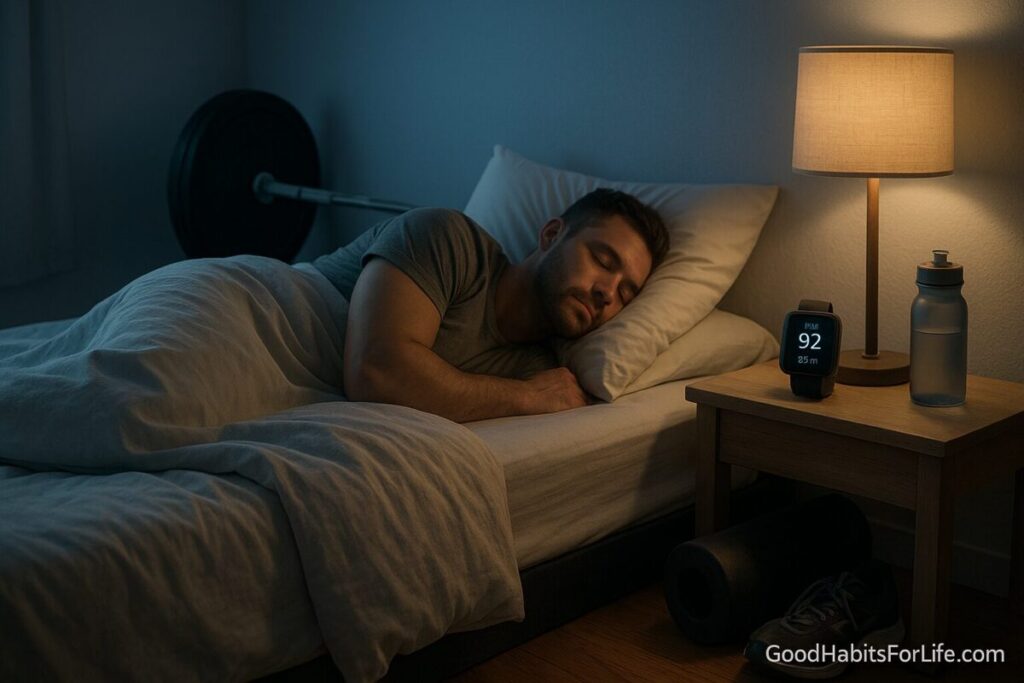
Sleep for Lifters: 4 Levers that Matter: Zone 2 + NEAT (2025)
Sleep for Lifters: 4 Levers—Zone 2 & NEAT (2025)
Table of Contents
🧭 What This Guide Covers
You want stronger lifts and faster recovery. Sleep is the multiplier. This guide shows lifters exactly which four levers move sleep quality the most—Consistency, NEAT, Zone 2, and Recovery Hygiene—and how to stack them into a simple plan that fits heavy training blocks.
Why lifters should care: Better sleep improves reaction time, strength output, mood, glycogen restoration, and decision-making. Chronic sleep restriction does the opposite—higher perceived exertion, slower recovery, and greater injury risk.
✅ The 4 Levers for Better Sleep (and Bigger Lifts)
1) Consistency: the master lever
-
Target: 7–9 hours in a fixed nightly window (e.g., 23:00–07:00) with the same wake time daily.
-
Why it works: Stable circadian timing deepens slow-wave sleep (recovery sleep), aligns hormones, and improves training readiness.
-
Micro-habits: “Phone on charge outside bedroom,” “Alarm across room,” “10-minute dim-light wind-down.”
2) NEAT: daily movement that keeps your clock honest
-
What it is: Non-Exercise Activity Thermogenesis—steps, chores, walking meetings, light mobility.
-
Target: 7,000–10,000 steps/day (or break up sitting every 30–60 min).
-
Why lifters: NEAT improves insulin sensitivity and helps regulate circadian rhythm, which shortens sleep onset latency and reduces nighttime restlessness.
3) Zone 2: cardio that boosts sleep without stealing gains
-
What it is: Low-intensity aerobic work at roughly 60–70% HRmax (you can talk in full sentences; breathing is easy-moderate).
-
Target: 2–4 sessions/week, 20–40 min each (work up to 60 min).
-
Why lifters: Zone 2 raises mitochondrial efficiency, improves HRV, and can enhance sleep efficiency—without the cortisol spike and CNS arousal of late-night high intensity.
4) Recovery Hygiene: finish the day in “sleep mode”
-
Caffeine: last dose ≥8 h before bed; total daily ≤3–4 mg/kg for most adults.
-
Light: dim lights 1–2 h pre-bed; reduce blue-light exposure; use night mode.
-
Temperature: keep the room cool (~18–19°C / 64–66°F).
-
Timing lifts: avoid very heavy/near-max sets within 3 hours of bedtime.
-
Pre-sleep protein: 20–40 g slow-digesting protein (e.g., casein) can aid overnight recovery without harming sleep for most.
-
Alcohol: avoid; it fragments sleep.
🛠️ Quick Start: Do This Today
-
Pick a sleep window (7–9 h) and lock your wake time for the next 7 days.
-
Hit 7,000+ steps: add a 10-minute walk after each meal (3×/day ≈ 3,000 steps).
-
Add one Zone 2 session (20–30 min, conversational pace) on a non-max lower-body day.
-
Caffeine cutoff: set an alarm 8 hours before your target bedtime.
-
Wind-down (10–15 min): lights low, journal tomorrow’s top 3 tasks, breathe 4-6 breaths/min, in bed on time.
🧭 30-60-90 Day Habit Plan
Days 1–30 — “Foundation”
-
Sleep: fixed window (7–9 h). Track bed & wake time only.
-
NEAT: baseline steps → +2,000 steps/day from your current average.
-
Zone 2: 2×/week, 20–30 min.
-
Hygiene: caffeine cutoff + dim lights nightly.
-
Checkpoint (Day 30): Subjective sleep quality ≥7/10, average steps ≥7k, 2 Zone 2 sessions/week.
Days 31–60 — “Build”
-
Sleep: keep the same wake time on weekends (±30 min).
-
NEAT: 8–10k steps/day; add standing/walking blocks at work.
-
Zone 2: 3×/week, 30–40 min; optional 60-min weekend ride or brisk walk.
-
Hygiene: add cool room + 5-min breathwork.
-
Checkpoint (Day 60): Faster sleep onset (<20 min), fewer night wakings, RPE lower on usual loads.
Days 61–90 — “Refine”
-
Sleep: test a 15-min earlier lights-out if you still wake unrefreshed.
-
NEAT: keep 8–10k; break up sitting every 45 min.
-
Zone 2: 2–3×/week, 40–60 min around heavy days.
-
Hygiene: experiment with 20–40 g casein 30–60 min before bed; keep alcohol at zero.
-
Checkpoint (Day 90): PRs trending up, HRV/subjective readiness improved, mornings feel “lighter.”
🧠 Techniques & Frameworks That Work
The “S.A.L.T.” Sleep Framework for Lifters
-
Schedule: fixed wake time; 7–9 h opportunity.
-
Aerobic base: Zone 2 2–4×/week.
-
Light & latency: dim lights; screens down; breathwork to fall asleep within ~20 min.
-
Total movement: NEAT 7–10k steps/day; break up long sits.
Pairing Zone 2 with Strength Blocks
-
Upper-body days: 30–40 min Zone 2 after lifting or later that day.
-
Lower-body days: keep Zone 2 short/easy (20–25 min) or schedule on the next day.
-
Peak/meet weeks: maintain only 1–2 short Zone 2 sessions to keep sleep steady.
Pre-Sleep Protein (without sleep sabotage)
-
Choose casein or Greek yogurt/quark; 20–40 g.
-
Keep fiber/fat modest to avoid GI discomfort.
-
If reflux is an issue, finish ≥60 min before bed.
👥 Variations by Audience
-
Students / shift-irregular schedules: Anchor wake time first; use 20-min afternoon naps (before 16:00) on heavy study + lifting days.
-
Professionals: Walking calls + “stairs not lifts” to hit NEAT; put Zone 2 on commute (bike) 2–3 days/week.
-
Parents: Split Zone 2 into 2×15-min stroller walks; maintain lights-down ritual even if bedtime shifts.
-
Seniors (50+): Favor low-impact Zone 2 (bike/elliptical); emphasize morning sunlight and balance work.
-
Teens: Prioritize earlier bedtime and screens-off by 22:00; Zone 2 as team warm-ups or brisk walks.
⚠️ Mistakes & Myths to Avoid
-
Myth: “Cardio kills gains.” → Appropriate Zone 2 supports recovery and sleep; keep it easy and away from max lower-body days.
-
Mistake: Training heavy at 21:30. → Finish intense work ≥3 h before bed.
-
Myth: “I can catch up on weekends.” → Irregular sleep damages rhythm; keep wake time within ±30 min.
-
Mistake: “I’m fine with 5 hours.” → Performance and reaction time drop even if you feel okay.
-
Myth: “Blue-light filters are enough.” → Still dim lights and reduce screens; brightness and content arousal matter.
💬 Real-Life Examples & Scripts
Post-Dinner Walk Script (NEAT + wind-down):
“Shoes on, timer 10 minutes. Walk the block at an easy pace. Breathe in 4, out 6. No podcasts—let your brain idle.”
Evening Lift Day (Lower Body) Schedule:
-
17:30–18:45: Squat + accessories (finish 3+ h before bed)
-
19:00: Dinner
-
20:30: 10-min walk
-
22:00: Lights dim, phone on charger outside bedroom
-
22:15: 5-min stretch + 4-6 breathing
-
22:30: In bed; optional 30 g casein
Travel Day Mini-Plan:
-
Bright light early; 3×8-min brisk walks spread across the day; short Zone 2 the next morning; keep wake time.
🧰 Tools, Apps & Resources
-
Heart-rate strap or watch: more reliable Zone 2 targeting than wrist-only optical. Pros: precision; Cons: battery/comfort.
-
Step tracker (any phone/watch): drives NEAT nudges. Pros: frictionless; Cons: accuracy varies by wrist gait.
-
Sleep tracking apps (e.g., Sleep as Android, Apple Health, Oura/WHOOP): trend awareness only. Pros: patterns; Cons: don’t obsess—use trends, not single nights.
-
Blue-light reduction: device night modes, amber lamps. Pros: simple; Cons: still reduce overall brightness.
-
Timer habit apps: set caffeine cutoff, 10-min walk alarms, and wind-down reminders.
📌 Key Takeaways
-
Consistency is king: same wake time, 7–9 h in bed.
-
Move more all day: NEAT (7–10k steps) steadies circadian rhythm.
-
Keep cardio easy: Zone 2 2–4×/week boosts sleep and HRV, not fatigue.
-
Protect the evening: caffeine cutoff, lights low, finish heavy work early.
-
Build it in 90 days: foundation → build → refine, then maintain.
❓ FAQs
1) Will Zone 2 hurt my squat and deadlift?
No—kept easy and away from maximal lower-body days, Zone 2 supports recovery, capillarization, and sleep quality, which can improve performance over cycles.
2) I lift late—can I still sleep well?
Finish heavy sets ≥3 h before bed, keep a longer wind-down, and use dim light. If that’s impossible, shift some intensity to earlier days and keep late work technique-focused.
3) How many steps should lifters aim for?
A practical range is 7–10k/day. If you’re at 3–4k, add +2k for two weeks, then step up again—focus on breaking up long sits.
4) Does pre-sleep protein disrupt sleep?
For most, 20–40 g casein 30–60 min before bed aids overnight recovery without harming sleep; adjust if reflux or GI issues occur.
5) What if I can only sleep 6 hours?
Anchor the wake time, add a 20-min early-afternoon nap on hard days (before 16:00), and protect the pre-bed routine. Work toward 7–9 h over weeks.
6) Evening cardio okay?
Yes—low-intensity finished ≥1 h before bed is generally fine. Avoid vigorous intervals late at night.
7) Best time for Zone 2?
Place it after upper-body lifting, on rest days, or mornings. Keep the hardest lower-body days separate or keep Zone 2 very easy/short.
8) How long until sleep improves?
Many notice better sleep onset within 1–2 weeks of consistent wake time + NEAT; deeper improvements accrue over 4–8 weeks.
📚 References
-
American Academy of Sleep Medicine. Sleep duration recommendations for adults. https://aasm.org/resources/pdf/sleepdurationrecs.pdf
-
CDC. How Much Sleep Do I Need? https://www.cdc.gov/sleep/about_sleep/how_much_sleep.html
-
Fullagar HHK, et al. Sleep and athletic performance: a review. Sports Med. 2015. https://pubmed.ncbi.nlm.nih.gov/26179270/
-
Mah CD, et al. Effects of sleep extension on athletic performance. Sleep. 2011. https://pubmed.ncbi.nlm.nih.gov/21804664/
-
Kredlow MA, et al. The effects of physical activity on sleep: a meta-analytic review. J Behav Med. 2015. https://pubmed.ncbi.nlm.nih.gov/26139839/
-
Banno M, et al. Exercise as a treatment for adults with insomnia: systematic review & meta-analysis. Sleep Med Rev. 2018. https://pubmed.ncbi.nlm.nih.gov/29852283/
-
Stutz J, Eiholzer R, Spengler CM. Effects of evening exercise on sleep. Sleep Med Rev. 2019. https://pubmed.ncbi.nlm.nih.gov/30731195/
-
Trommelen J, Van Loon LJC. Pre-sleep protein ingestion for overnight recovery. Sports Med. 2016. https://pubmed.ncbi.nlm.nih.gov/27500952/
-
WHO. Guidelines on physical activity and sedentary behaviour (2020). https://www.who.int/publications/i/item/9789240015128
-
EFSA. Scientific opinion on caffeine safety. 2015. https://efsa.onlinelibrary.wiley.com/doi/10.2903/j.efsa.2015.4102
-
Harvard Health. Blue light has a dark side. https://www.health.harvard.edu/staying-healthy/blue-light-has-a-dark-side
⚖️ Disclaimer
This guide is educational and not a substitute for personalized medical advice; consult a qualified professional before changing training, sleep, or nutrition.