
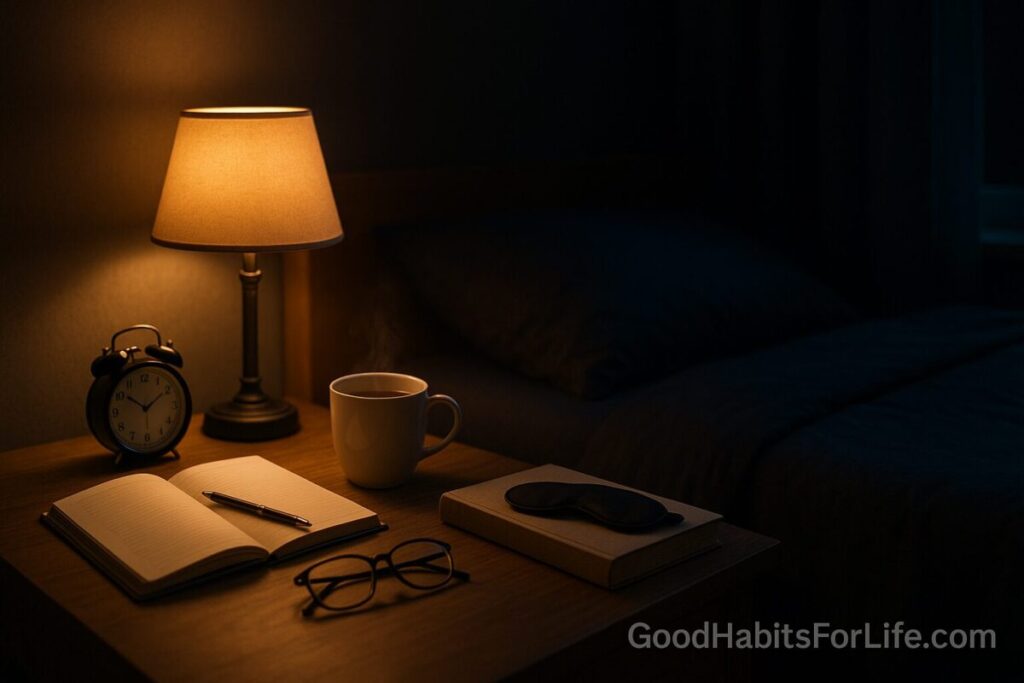
Sleep for Learning: WindDowns that Work
Sleep for Learning: WindDowns that Work
Table of Contents
🧭 What & Why
Sleep is the study partner you can’t see. During the night, the brain replays and stabilizes what you learned, linking new information to existing knowledge and protecting it from interference. High-quality sleep improves attention, working memory, problem-solving, creativity, and test performance the next day. Adults generally need 7–9 hours, with children and teens needing more. A deliberate wind-down—a short, repeatable pre-sleep routine—tells your nervous system to shift from “go” to “rest,” reducing time to fall asleep and smoothing the transition into deeper, memory-friendly sleep.
What counts as a wind-down? Any predictable, low-stimulus sequence that lowers arousal and light exposure and avoids stimulants or heavy digestion—e.g., dimming lights, light stretching, breathing/relaxation, warm shower/bath 1–2 hours before bed, paper reading, or journaling.
✅ Quick Start: Tonight’s 20-Minute Wind-Down
Goal: Ease your brain from study mode to sleep mode.
Set your anchor:
-
Lights-out target: Choose a fixed time you can keep 5–6 nights/week.
-
Device curfew: 30–60 minutes before lights-out (night mode + dim if you must use).
20 minutes, step by step
-
Dim & cool (3 min): Turn off bright overheads; use warm, low-level lamps. Set room around 18–20 °C (64–68 °F) if comfortable.
-
Unwind body (5 min): Gentle mobility (neck/shoulders/hips) or progressive muscle relaxation (tense–release major muscle groups).
-
Unwind breath (4–6 min): Slow nasal breathing; e.g., 4-6 breaths/min (inhale ~4 s, exhale ~6 s).
-
Mind sweep (3–5 min): On paper, dump tomorrow’s tasks → circle top 1–3. Close notebook; promise your brain you have a plan.
-
Low-stim wind-down (5–7 min): Paper book, calm music, or a short gratitude/three-wins journal.
Hard stops (every night):
-
No caffeine inside 6+ hours of bedtime.
-
Avoid heavy meals/alcohol close to bed.
-
Keep screens out of bed; bed is for sleep (and intimacy) only.
🗺️ 30-60-90 Habit Plan
Days 0–30: Foundation
-
Pick your anchor: Fixed wake-time (weekends vary ≤1 hour).
-
Build your “WIND-DOWN-20”: the 5-step sequence above.
-
Morning light: 10–20 min outdoor light soon after waking (or bright indoor light if needed).
-
Warm shower/bath: Optional 1–2 h before bed to speed sleep onset.
-
Caffeine rule: Last dose ≥6 h pre-bed.
-
Track: 1-line sleep log (bedtime, wake time, how long to fall asleep, 1–5 sleep quality).
Checkpoint (Day 30): Falling asleep ≤20–30 min most nights? Night awakenings rare/brief? If not, reduce pre-bed stimulation and tighten the wind-down timing.
Days 31–60: Optimization
-
Naps: If needed, keep 10–25 min before mid-afternoon; avoid late long naps.
-
Stimulus control: Can’t sleep in 20–30 min? Get out of bed; do calm, dim activity; return when sleepy.
-
Breathing/PMR mastery: Aim 6–10 min nightly.
-
Environment: Blackout shade or sleep mask; earplugs/white noise if noise sensitive.
-
Content swap: Replace scrolling with paper reading or soothing audio (fiction > news).
Checkpoint (Day 60): Better sleep continuity? Easier recall/learning next day? If still delayed sleep onset, consider earlier dimming and stronger morning light; if your body clock feels “late,” explore gradual bedtime advance (15 min every 3–4 nights).
Days 61–90: Personalization
-
Study–sleep pairing: Finish last intense study ≥60 min pre-bed; save light review only.
-
Evening routine cards: Make a 3–5-card checklist (text + tiny icons).
-
Circadian fine-tuning: If naturally delayed, consistent wake + morning light; optionally discuss light therapy with a clinician if needed.
-
Monthly review: Keep what works; retire what you don’t use.
🛠️ Techniques & Frameworks (Evidence-Aligned)
1) Light management
-
Morning bright light advances the clock → earlier sleepiness; evening bright light delays it.
-
Practical: Open curtains on waking; if dark, use a bright lamp near breakfast. After sunset, dim and warm lights; reduce overhead glare.
2) Temperature cues
-
A warm shower/bath 1–2 h pre-bed (≈40–42.5 °C / 104–108 °F) helps you fall asleep faster via heat-loss after you step out.
-
Keep bedroom cool, dark, quiet; use breathable bedding.
3) Breathing & relaxation
-
Slow breathing (4–6 breaths/min) and progressive muscle relaxation lower physiological arousal and can improve subjective sleep quality.
-
Protocol: 6–10 minutes; finish with a longer exhale (e.g., 4-in / 6-out).
4) Caffeine & alcohol timing
-
Caffeine can disrupt sleep even 6 hours before bed.
-
Alcohol fragments sleep and suppresses REM later in the night; stop several hours before bed.
5) Behavior change scaffolding
-
Implementation intentions: “If it’s 10:00 pm, then I dim lights and start WIND-DOWN-20.”
-
Habit stacking: After brushing teeth → 6 minutes breathing → 5 minutes reading.
-
Stimulus control: Keep bed for sleep; if awake >20–30 minutes, leave bed briefly.
6) Naps for learning (use wisely)
-
Short, early naps (10–25 min) can boost alertness and learning without harming night sleep. Avoid late-day long naps to prevent sleep inertia or delayed bedtime.
7) Screens & blue light
-
Reduce overall evening light and arousal. Blue-light-filter glasses have inconclusive benefits for sleep; prioritise dimming, night mode, and content choices over gadgets.
🧠 Audience Variations
Students
-
Study cadence: Spaced retrieval and light evening review → sleep → quick AM recap in morning light.
-
Dorm hacks: Eye mask, earplugs/white noise, desk lamp instead of overheads after 9 pm.
-
Exam week: Protect wake-time; trade late-night cramming for earlier sleep + dawn review.
Parents & Caregivers
-
Family routine: Shared “house dim” time; kids’ device curfew ≥60 min pre-bed.
-
Wind-down for kids: Bath → story → lights out (consistent cueing). Consider pediatric guidance before any supplements.
Professionals
-
Shift-friendly: If off late, do abbreviated WIND-DOWN-10: dim → 4-min breathing → 5-min read → bed.
-
Travel: Anchor to destination wake-time fast; seek morning light on arrival.
Seniors
-
Activity: Daytime walking/light exercise supports sleep.
-
Light: Extra morning light helps counter age-related circadian drift.
-
Naps: Keep very short and early if needed.
Teens (and late chronotypes)
-
Later body clock: Push morning light and consistent wake-time; dim evenings.
-
Homework split: High-intensity earlier; low-stim reading near bed.
Neurodiversity & Sensory-Friendly Tweaks (ADHD, Autism, SPD)
-
Predictability: Visual schedule cards for wind-down steps.
-
Sensory comfort: Preferred textures, weighted blanket if tolerated, white noise.
-
Clock shifting: Strong AM light, very dim PM; consider clinician-guided light therapy for delayed sleep-wake phase.
-
Medication timing: If on stimulants, discuss dose timing with your clinician to reduce evening alertness.
⚠️ Mistakes & Myths to Avoid
-
“I’ll catch up on sleep at the weekend.” Big swings in schedule confuse your clock.
-
“Alcohol helps me sleep.” It shortens sleep onset but wrecks later-night quality and REM.
-
“Blue-light glasses fix sleep.” Evidence is mixed; light intensity/timing and content matter more.
-
Late, long naps. Keep it short/early or skip.
-
Doing more in bed. Reading on your phone in bed trains wakefulness there.
💬 Real-Life Examples & Scripts
Study-to-Sleep Script (15 minutes)
-
“It’s 10:15 pm; lights to 30% and switch to warm.”
-
“Set tomorrow’s top 3 tasks; close notebook.”
-
“4 minutes slow breathing (4-in/6-out).”
-
“7 minutes paper reading (fiction/low-stakes). Lights out at 10:30.”
Can’t Sleep?
-
“If I’m not sleepy in 20–30 minutes, I leave bed → dim chair, breathe/read quietly → return only when sleepy.”
Family Wind-Down
-
“9:00 pm: House ‘sunset’ → warm lamps only. Kids: brush-bath-book-bed. Adults: breathing + paper book.”
Delayed Body Clock (teens/ADHD)
-
“Fixed 7 am wake, outside light by 7:20 am. Evening: dim at 9 pm, screen curfew at 9:30 pm, bed 10:30 pm.”
🧰 Tools, Apps & Resources (Pros/Cons)
-
Phone Bedtime / Wind-Down (iOS/Android) — Pros: built-in reminders, auto-Do-Not-Disturb; Cons: device temptation if notifications aren’t blocked.
-
White-noise / Brown-noise apps — Pros: masks unpredictable noise; Cons: may bother partners; keep volume low.
-
Sunlight lamp (AM) — Pros: helpful on dark mornings; Cons: quality varies; avoid late-evening use.
-
Sleep mask & earplugs — Pros: cheap, effective for light/noise; Cons: comfort varies.
-
Paper journal/notebook — Pros: quick brain dump reduces rumination; Cons: needs 2–3 min discipline.
-
Simple sleep log (paper or Notes app) — Pros: trends, not perfection; Cons: avoid obsessive tracking.
📌 Key Takeaways
-
A short, repeatable wind-down aligns brain and body for sleep—your best learning amplifier.
-
Light and timing rule: bright morning light, dim evenings; consistent wake-time anchors the system.
-
Breathing/relaxation for 6–10 minutes reduces arousal; warm shower/bath 1–2 h pre-bed helps you fall asleep faster.
-
Caffeine ≥6 h pre-bed, no heavy meals/alcohol late, and screens out of bed.
-
Personalize for neurodiversity with predictable steps and sensory comfort; seek clinician input for circadian disorders or persistent insomnia.
❓ FAQs
1) How long should my wind-down be?
10–30 minutes is enough. Consistency beats complexity.
2) Is a short nap OK if I’m studying at night?
Yes—10–25 minutes and before mid-afternoon. Late or long naps can delay bedtime.
3) Do blue-light glasses improve sleep?
Evidence is inconclusive. Reducing overall evening light and choosing low-arousal activities matter more.
4) What’s the ideal bedroom temperature?
There’s no single perfect number, but many sleep well around 18–20 °C (64–68 °F) with good airflow and darkness.
5) Can I use melatonin?
For adults, occasional low-dose may help circadian timing, but habits and light timing come first. For children/teens, use only under pediatric guidance.
6) I fall asleep fine but wake up at 3 am.
Keep the same wake-time, avoid alcohol, and use stimulus control (leave bed briefly if awake >20–30 min). Strengthen morning light and review stress management.
7) How close to bed can I exercise?
Finish vigorous sessions 2–3 hours before lights-out; gentle stretching or yoga can be part of wind-down.
8) Does a warm shower really help?
A warm shower/bath 1–2 h before bed can shorten time to fall asleep by promoting heat loss afterward.
9) What’s the minimum device curfew?
Aim for 30–60 minutes. If you must use a device, dim + night mode, and choose calm, non-interactive content.
10) How fast should I change my bedtime?
Shift ~15 minutes every 3–4 nights to avoid jet-lagging yourself.
📚 References
-
American Academy of Sleep Medicine (AASM). Recommended Amount of Sleep for a Healthy Adult. Journal of Clinical Sleep Medicine, 2015. https://jcsm.aasm.org/doi/10.5664/jcsm.4758
-
Centers for Disease Control and Prevention (CDC). About Sleep. Updated May 2024. https://www.cdc.gov/sleep/about/index.html
-
National Heart, Lung, and Blood Institute (NHLBI). How Much Sleep Is Enough? 2022. https://www.nhlbi.nih.gov/health/sleep/how-much-sleep
-
Drake C et al. Caffeine Effects on Sleep Taken 0, 3, or 6 Hours before Going to Bed. J Clin Sleep Med, 2013. https://jcsm.aasm.org/doi/10.5664/jcsm.3170
-
Haghayegh S et al. Before-bedtime passive body heating by warm shower or bath to improve sleep: a systematic review and meta-analysis. Sleep Med Rev, 2019. https://pubmed.ncbi.nlm.nih.gov/31102877/
-
NIOSH/CDC. Effects of Light on Circadian Rhythms (Work Hours, Sleep, and Fatigue). https://www.cdc.gov/niosh/work-hour-training-for-nurses/longhours/mod2/19.html
-
Rasch B, Born J. About Sleep’s Role in Memory. Physiol Rev, 2013. https://journals.physiology.org/doi/abs/10.1152/physrev.00032.2012
-
NASA (Ames). Napping in the Workplace: Benefits. 2019 briefing slide deck citing planned cockpit napping research. https://ntrs.nasa.gov/api/citations/20190033981/downloads/20190033981.pdf
-
Cochrane Review 2023. Blue-light filtering spectacle lenses for visual performance, sleep, and macular health in adults. https://www.cochranelibrary.com/cdsr/doi/10.1002/14651858.CD013244.pub2/full
-
American College of Physicians / AASM. Behavioral & psychological treatments for chronic insomnia (CBT-I core methods). AASM Clinical Practice Guideline page. https://aasm.org/resources/clinicalguidelines/clinical-guidelines/chronic-insomnia/
-
Healthy People 2030 (ODPHP/HHS). Sleep Objectives. https://odphp.health.gov/healthypeople/objectives-and-data/browse-objectives/sleep
-
Black DS et al. Mindfulness Meditation and Improvement in Sleep Quality and Daytime Impairment Among Older Adults. JAMA Intern Med, 2015. https://jamanetwork.com/journals/jamainternalmedicine/fullarticle/2110998
-
AAP / HealthyChildren.org. Melatonin for Kids: What Parents Should Know. Updated 2023. https://www.healthychildren.org/English/healthy-living/sleep/Pages/melatonin-and-childrens-sleep.aspx
-
CDC MMWR. Pediatric Melatonin Ingestions — United States, 2012–2021. 2022. https://www.cdc.gov/mmwr/volumes/71/wr/mm7122a1.htm
Disclaimer
This guide is educational and not a substitute for personalized medical advice. If sleep problems persist, consult a qualified healthcare professional.