
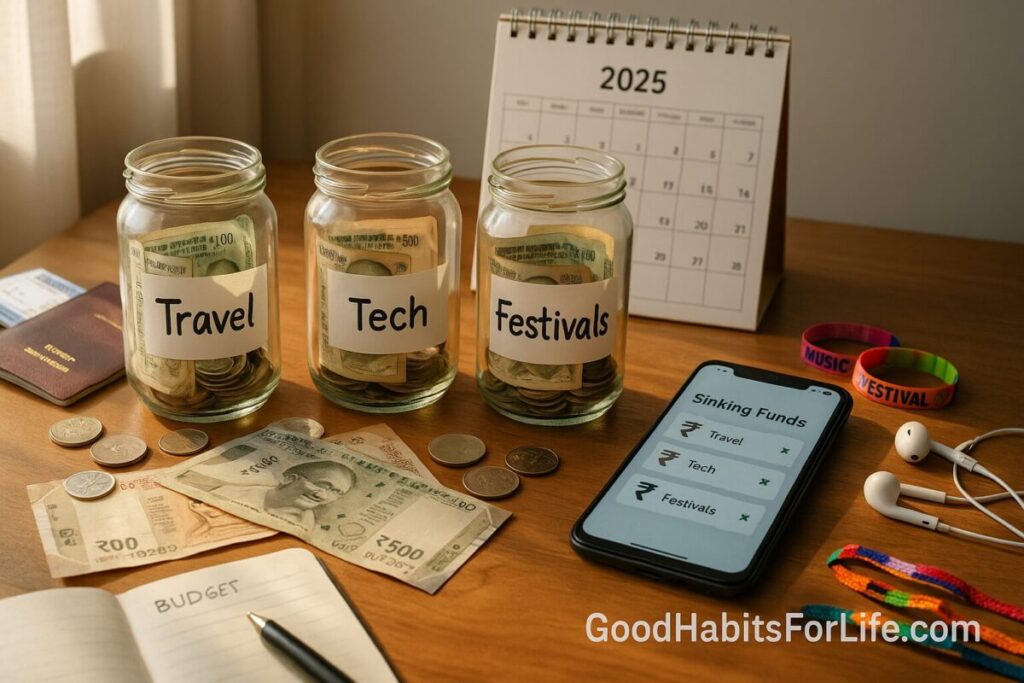
Sinking Funds for 2025: Travel, Tech, and Festivals
Sinking Funds 2025: Travel, Tech & Festival Budgets
Table of Contents
🧭 What Is a Sinking Fund (and Why It Works)
A sinking fund is a dedicated pot of money you build over time for a specific, expected cost—like a summer trip, a phone upgrade, or festival season. It’s different from an emergency fund (that’s for surprises). The psychology behind sinking funds is solid: mental accounting—separating money into distinct “buckets”—helps people follow through on goals and spend more deliberately. INFORMS Publications
Use sinking funds to flatten big costs into small monthly transfers, so your main budget (rent, groceries, utilities) stays stable. Pairing sinking funds with a simple rule like 50/30/20—needs/wants/saving—keeps the whole plan sustainable. Consumer Financial Protection Bureau
Why 2025: Travel deals are dynamic, tech releases keep tempting upgrades, and festivals/events cluster in the calendar. Planning now means fewer impulse purchases and no debt hangovers later. Also, national financial-education strategies (e.g., India’s NSFE 2020–25) emphasize budgeting and planned saving as core habits. ncfe.org.inReserve Bank of India
✅ Quick Start: Your 60-Minute Setup for 2025
Time needed: ~60 minutes
-
List the big 2025 goals
-
Travel: e.g., ₹90,000 for a June trip.
-
Tech: ₹60,000 for a Q4 laptop/phone refresh.
-
Festivals: ₹35,000 for gifts, outfits, travel to family (Diwali/Christmas/Onam/Durga Puja, etc.).
-
-
Set target dates & monthly amounts
-
Formula: Monthly transfer = Target ÷ Months left
-
Example (start in Sept 2025 → June trip in 9 months): ₹90,000 ÷ 9 = ₹10,000/month.
-
-
Create three labeled “pots”
-
Bank sub-accounts, “goal” features, or a sheet with three tabs: Travel 2025, Tech 2025, Festivals 2025.
-
-
Automate transfers
-
Set standing orders/UPI AutoPay on salary day into each pot.
-
-
Decide where to park the cash
-
High-liquidity savings or Recurring Deposit (RD) for <12 months.
-
Keep emergency fund separate (3–6 months’ expenses). Consumer Financial Protection Bureau
-
-
Add guardrails
-
Spending rules (e.g., “use Travel fund only for transport/lodging; food stays in monthly budget”).
-
Cap wants using 50/30/20 so you don’t starve your needs. Consumer Financial Protection Bureau
-
-
Review in 30 days
-
Check progress; adjust amounts if prices changed.
-
🛠️ 30-60-90 Roadmap for Travel, Tech & Festivals
Day 0–30 (Build & Automate)
-
Open/label pots; set auto-transfers.
-
Price your goals (quotes, wish-lists, festival list).
-
Cut or defer one non-essential category to free cash (e.g., subscriptions).
-
Checkpoint: All three pots funded once; totals on track.
Day 31–60 (Lock Prices & Optimize)
-
Travel: Hold fares with price alerts; pre-book high-volatility items (visas, peak-season trains).
-
Tech: Snapshot current prices and set trackers; verify trade-in/resale value of old device.
-
Festivals: Start a gifts list; buy durable items during off-season sales.
-
Checkpoint: 2× monthly contributions done; at least one cost locked at a good price.
Day 61–90 (Stress-test & Adjust)
-
Run a +10% price shock and increase monthly transfers if needed.
-
If a goal completes early (e.g., tech discount achieved), stop funding that pot and redirect to Travel/Festivals.
-
Checkpoint: Buffers added; plan resilient to price drift.
🧳 Category Playbooks: Travel ✈️ • Tech 💻 • Festivals 🎉
✈️ Travel 2025 (example target: ₹90,000–₹150,000)
Line items: flights/trains, hotels, visas, insurance, local transport, activities, buffer (10%).
Move today: Create a fare alert; block calendar days; check visa timelines; price travel insurance.
Saving hack: Put refunds (credit-card rewards, tax refunds) straight into the Travel pot.
Rule of thumb (domestic 5–7 days):
-
Flights/Trains: ₹18–45k • Hotels: ₹20–50k • Local & food: ₹12–25k • Activities: ₹5–15k • Buffer: ₹5–10k.
💻 Tech 2025 (₹40,000–₹90,000)
Line items: device price, accessories, warranty/AppleCare, software, trade-in minus value.
Move today: Decide “must-have” specs; set price-drop alerts; plan trade-in timing (launch cycles often Sep–Nov; laptops vary).
Policy: Only buy when Tech pot ≥ net price (after trade-in).
🎉 Festivals 2025 (₹25,000–₹60,000)
Line items: travel to hometown, gifts, puja/celebrations, clothing, décor, charity, sweets/food.
Move today: List recipients, set gift caps, pre-book tickets. Buy non-perishables early.
🧠 Techniques & Frameworks That Keep You On-Track
-
Envelope/“Buckets” Method: Separate pots for each goal; the mental partitioning reduces overspending. INFORMS Publications
-
50/30/20 Compatibility: If 20% for saving, allocate X% to emergency, Y% to sinking funds, Z% to long-term investing. Adjust Y as goals finish. Consumer Financial Protection Bureau
-
Quarterly Re-Baseline: Every 90 days, re-price trips, check tech announcements, and shift contributions.
-
Price Anchors & Alerts: Lock in “buy” thresholds (e.g., “Laptop ≤ ₹65k or wait”).
-
Calendar Hooks: Tie transfers to payday; tie reviews to your monthly money date.
-
Policy Pack:
-
No credit if pot < price.
-
Keep emergency fund separate and untouched. Consumer Financial Protection Bureau
-
If income changes ±10%, re-split the 50/30/20 envelope within 7 days. Consumer Financial Protection Bureau
-
👥 Audience Variations
Students: Smaller, shorter goals (weekend trips, entry-level phone). Use campus discounts and shared stays.
Parents: Add school events, uniforms, exam fees to the Seasonal pot. Lock festival travel early.
Professionals: Use payroll auto-split to fund pots on payday; claim travel/work-gear benefits where applicable.
Seniors: Favor higher liquidity; avoid locking funds you may need for healthcare.
Teens (with guardians): Start with one pot (Festivals/Birthdays). Keep amounts symbolic but consistent.
⚠️ Mistakes & Myths to Avoid
-
“I’ll just use my emergency fund.” Different purpose; emergencies ≠ planned purchases. Keep them separate. Consumer Financial Protection Bureau
-
Over-fragmenting pots. Three to five is plenty; too many buckets create friction.
-
Ignoring national pay cycles & price spikes. Use local calendars (festivals, school breaks) to time purchases.
-
Investing short-term sinking funds in volatile assets. Prioritize liquidity; market dips can derail time-bound goals.
-
No buffer. Add +10% to each target for price drift and fees.
💬 Real-Life Examples & Scripts
1) Travel math (June trip, target ₹90,000)
-
Starting Sept 2025 → 9 months → ₹10,000/month.
-
Lock flights at ₹38,000 in February; re-allocate the savings to hotels.
2) Tech upgrade (November, net ₹58,000 after trade-in)
-
Start Sept → 3 months → ₹19,500/month.
-
If a Diwali deal hits ₹55,000, buy early and stop funding the pot.
3) Festival season (October–November, ₹40,000)
-
Start Sept → 2 months → ₹20,000/month.
-
Pre-buy gifts; book train tickets ASAP.
Script with partner/roommate:
“From this month I’m auto-saving ₹X for Travel, ₹Y for Tech, and ₹Z for Festivals. These are planned costs, so we won’t touch the emergency fund. If prices change, we’ll adjust at our month-end money check-in.”
Script at the store:
“Looks great, but I’ll buy when my Tech pot covers the net price or if it drops to ₹___. Please hold, I’ll set a price alert.”
📚 Tools, Apps & Resources (quick pros/cons)
-
Any bank with sub-accounts/goal features: Native, automated; fewer bells/whistles.
-
Budget apps (YNAB/Monarch/Goodbudget): Great for envelopes and reports; subscription cost.
-
Tiller/Sheets/Notion templates: Flexible and cheap; manual setup.
-
Price trackers (CamelCamelCamel, Keepa, Flipkart/Amazon wish-lists): Alert-based; watch for dynamic pricing.
-
Travel tools (Google Flights alerts, Skyscanner): Good for trend lines; book direct for change policies.
🧾 Key Takeaways
-
Define Travel/Tech/Festivals with dates and totals.
-
Automate transfers; review monthly and quarterly.
-
Separate from emergencies; keep short-term funds liquid. Consumer Financial Protection Bureau
-
Use mental accounting to reduce impulse buys. INFORMS Publications
-
Anchor to 50/30/20 so saving stays sustainable. Consumer Financial Protection Bureau
❓ FAQs
1) Sinking fund vs emergency fund—what’s the difference?
Sinking = planned expense (known timing/amount). Emergency = unforeseen, like a job loss or medical bill; keep them separate. Consumer Financial Protection Bureau
2) How many sinking funds should I keep?
Three to five. For this guide: Travel, Tech, Festivals. Merge small goals into Seasonal if needed.
3) Where should I keep the money?
Short-term goals (≤12 months) in savings/RD for liquidity. Avoid market risk for near-dated goals.
4) How do I combine sinking funds with 50/30/20?
Use the 20% saving bucket: split across emergency savings, sinking funds, and long-term investing based on your timeline. Consumer Financial Protection Bureau
5) What if prices change?
Re-baseline every 90 days. Add a +10% buffer and raise monthly transfers if quotes increase.
6) Can I pause contributions?
Yes—after you complete a goal or if income drops. Redirect to the most urgent pot.
7) Should I invest a tech fund if the goal is 12–18 months away?
Generally keep it liquid. If you invest, accept volatility and ensure you can delay the purchase if markets fall.
8) Is there any official guidance supporting budgeting and planned saving?
Yes—consumer-finance bodies (CFPB), national strategies (e.g., NSFE 2020–25), and statistical guidance (OECD) emphasize budgeting, saving, and household financial resilience. Consumer Financial Protection Bureauncfe.org.inOECD
📚 References
-
Consumer Financial Protection Bureau (CFPB). An essential guide to building an emergency fund (2024). https://www.consumerfinance.gov/an-essential-guide-to-building-an-emergency-fund/
-
CFPB. My spending rule to live by (50/20/30 rule) (2016). https://files.consumerfinance.gov/f/201603_cfpb_rules-to-live-by_my-spending-rule-to-live-by.pdf
-
Thaler, R. (1985). Mental Accounting and Consumer Choice. Marketing Science. https://pubsonline.informs.org/doi/10.1287/mksc.4.3.199
-
OECD (2024). Handbook on the Compilation of Household Distributional Results on Income, Consumption and Saving. https://www.oecd.org/en/publications/oecd-handbook-on-the-compilation-of-household-distributional-results-on-income-consumption-and-saving-in-line-with-national-accounts-totals_5a3b9119-en.html
-
Reserve Bank of India (RBI). Financial Awareness Messages (FAME) 2024–26 — Budgeting, Saving & Responsible Borrowing. https://www.rbi.org.in/commonman/images/FAME202426022024.pdf
-
National Centre for Financial Education (NCFE). National Strategy for Financial Education (NSFE) 2020–25 (official PDF). https://ncfe.org.in/wp-content/uploads/2023/12/NSFE_20-25_ENG.pdf
-
Securities and Exchange Board of India (SEBI). Money Matters: Financial Goals and Budgeting. https://investor.sebi.gov.in/moneymatters-budandfinangoal.html
-
MoneyHelper (UK). Budgeting — tools and guidance (2025). https://www.moneyhelper.org.uk/en/everyday-money/budgeting
⚖️ Disclaimer
This guide is for general education only and is not financial advice; consider your circumstances or consult a qualified advisor before making decisions.