
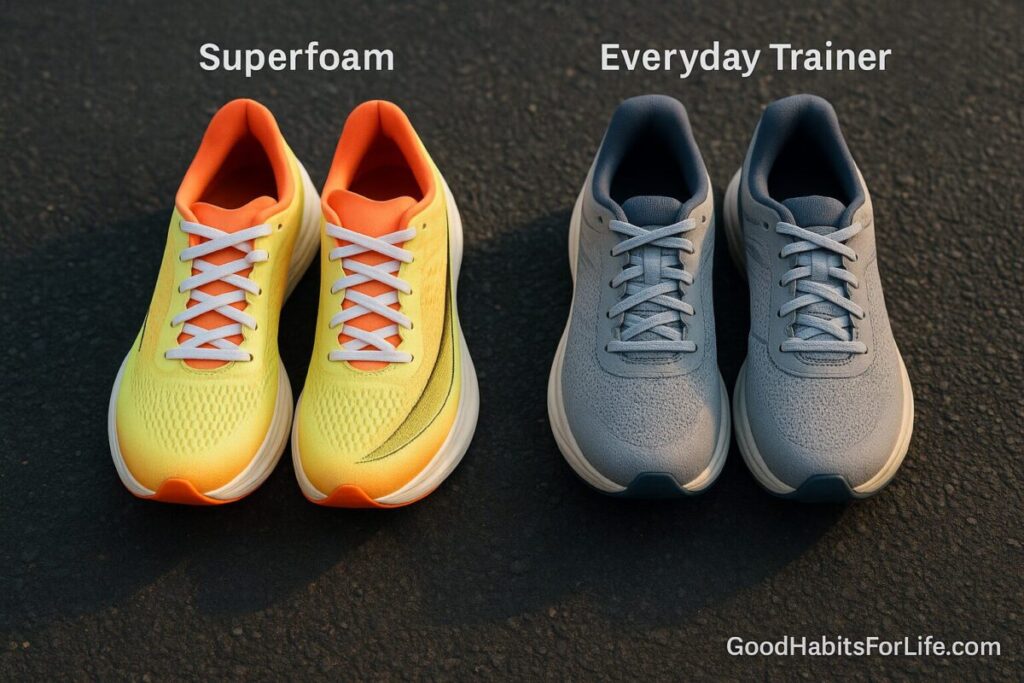
Shoes 2025: Superfoams vs Everyday Trainers
Superfoams vs Everyday Trainers (2025 Guide)
Table of Contents
🧭 What Counts as a “Superfoam” vs an Everyday Trainer?
Superfoams / “super shoes” pair (1) very soft, resilient midsoles (often PEBA/TPU blends) with (2) curved carbon- or composite-fiber plates and (3) tall stack heights (often 36–40 mm). The package stores and returns more energy while guiding your foot through a rocker. In short: fast, springy, efficient—but pricier and less durable.
Everyday trainers are your do-everything shoes for easy miles, recovery runs, treadmill, walk-commute, and gym cardio. They prioritize stability, durability, and comfort over raw speed, with more moderate foam formulations and geometry.
Why the split matters in 2025: regulations for competition shoes and rapid material innovation created a clear use-case divide—superfoams for performance, trainers for consistency and load tolerance. World AthleticsRunner’s Tribe
📚 The Evidence: Speed, Economy & Injury
Performance gains. Multiple lab studies show that the combination of compliant-resilient foam + curved plate + rocker geometry can reduce metabolic cost of running by ~2–4% for many (not all) runners. Systematic work also suggests curved plates outperform flat plates for economy. PMC+1
It’s not “the plate alone.” When researchers reduced plate stiffness in a super shoe, most of the energy-saving remained—implicating foam and geometry as key drivers, not just the plate. PubMedScienceDirect
Injury & cushioning. In a large randomized trial (>800 runners), softer-cushion shoes were associated with lower injury risk vs. harder models; follow-up analyses tied differences to impact loading characteristics. Translation: for many everyday miles, comfort + adequate cushioning can help. PubMed+1
Comfort filter & preferred movement path. Decades of “pronation control” thinking is giving way to comfort-led selection, where the shoe that lets you run naturally (your “preferred path”) may lower injury risk. Use comfort as a key decision signal. PubMedBritish Journal of Sports Medicine
Regulations. Most sanctioned road events cap stack height at ≤40 mm for non-spike racing shoes; track spikes have lower limits by event. Ultra-tall models may be banned in official competitions. World AthleticsAthletics CoachRunner’s Tribe
✅ Quick Start: Pick the Right Pair Today
-
Define purpose.
-
Races / key workouts → consider superfoams.
-
Daily easy / recovery / mixed gym → everyday trainer.
-
-
Apply the Comfort Test (5–10 min jog).
-
Zero hotspots, smooth transition, natural stride at easy pace. If you’re “managing” the shoe, it’s not right. PubMed
-
-
Check geometry.
-
Rocker + tall stack feels “bouncy”? Great for workouts—but verify cornering stability and treadmill feel.
-
-
Weight & durability.
-
Superfoams: light but often 300–600 km lifespan; trainers: 500–800 km typical. (Track your mileage.)
-
-
Rotation rule.
-
Maintain 2–3 pairs: a daily trainer, a workout/racer, and optionally a sturdy easy-day shoe.
-
-
Race legality.
-
If you plan to race, confirm stack height/model on organizers’ list. World Athletics
-
🗓️ 30-60-90 Habit Plan (Safe Superfoam On-Ramp)
Goal: Add superfoams for performance without sacrificing form or overloading tissues.
Days 1–30 (Once-weekly dose).
-
1 session/week in superfoams: strides + short intervals (e.g., 6×400 m).
-
All other runs in everyday trainers.
-
Log: stability rating (1–5), calf/Achilles soreness (0–10), pace vs effort.
Days 31–60 (Twice-weekly).
-
Add a tempo or progression run in superfoams.
-
Keep long run and recovery in trainers.
-
If any tendon/forefoot niggle >3/10 persists 48 h, drop back to once-weekly.
Days 61–90 (Race-specific).
-
Use superfoams for race-pace workouts and tune-up race; cap at ≤40–50% of weekly mileage in supers.
-
Taper into race in the same model you’ll wear on the day.
Checkpoint each month: comfort, niggles, outsole wear, midsole feel, and shoe mileage log. Adjust exposure accordingly. PubMed
🛠️ Techniques & Frameworks
CPR Method: Comfort + Purpose + Rotation
-
Comfort: If it feels awkward at easy pace, save it for workouts or skip it. PubMed
-
Purpose: Match geometry to session (rockered superfoam for speed, stable trainer for volume).
-
Rotation: Two or more different models distribute load across tissues; note how legs feel next day.
The 3-Run Trial (before committing)
-
Easy 20–30 min: check comfort and footstrike.
-
Steady 30–40 min: check stability as fatigue rises.
-
Faster 10–20 min: check responsiveness and control.
Durability & Care
-
Air-dry; avoid high heat.
-
Alternate days to allow foam rebound.
-
Retire when midsole feels “dead,” rocker feels flat, or you see asymmetrical wear.
👥 Who Should Wear What? (By Runner Type)
-
New runners / return-to-run: Start with a reliable trainer; add superfoams only after 6–8 weeks of consistent mileage.
-
Time-crunched professionals: Daily trainer for commute/treadmill; superfoams for the weekly “quality” session.
-
Students on a budget: Prioritize a versatile trainer; rent or borrow race shoes for key events.
-
Masters & seniors: Cushioned, stable trainers for most runs; small, progressive doses of superfoams if chasing PRs.
-
Walkers & general fitness: Trainers (or walking-specific shoes) usually beat superfoams for balance and lifespan.
⚠️ Mistakes & Myths to Avoid
-
Myth: “The carbon plate is the secret sauce.”
Reality: Foam + geometry + mass + plate all interact; plate alone doesn’t explain the savings. PubMed -
Mistake: Racing and daily training in the same super shoe.
Use trainers to protect form and wallet; reserve supers for when it matters. -
Myth: “More cushioning always prevents injuries.”
Softer cushioning can help some runners, but comfort and overall training load matter more than any single spec. PubMed+1 -
Mistake: Ignoring legality.
Some ultra-tall models are banned in sanctioned races—know your event rules. World AthleticsRunner’s Tribe -
Mistake: Buying by pronation labels alone.
Let comfort and control guide you; the comfort filter paradigm has stronger support. British Journal of Sports Medicine
💬 Real-Life Scripts (Store & Online)
In-store:
“I’m training for a half marathon. I want a durable daily trainer and a legal super shoe for race-pace days. Could I test these on the treadmill for 5–10 minutes each and try half-size up/down?”
Online fit check (email/chat):
“I wear EU 43 in XYZ Trainer. In your super shoe, should I choose the same or go up half a size given the narrow toe box? Is the stack height ≤40 mm for road races?”
Return policy nudge:
“If the fit is off after a short indoor run, can I exchange? I’m testing for comfort and stability per my coach’s advice.”
🔧 Tools, Apps & Resources
-
Mileage tracking: Strava Gear, Garmin Connect, Runalyze—log km and flag when shoes hit 400–500 km.
-
Race-legal check: Event tech sheets and the governing body’s shoe rules. World Athletics
-
Gait notes: Simple smartphone slow-mo from behind; check ankle wobble and knee tracking at easy pace.
-
Budget saver: Previous-year colorways of trainers often drop 20–40% with identical midsole.
🧠 Key Takeaways
-
Use superfoams as a performance tool—great for races and select workouts.
-
Use everyday trainers for most weekly volume—better durability, stability, and value.
-
Let comfort steer your choice; it aligns with lower injury risk for many runners. British Journal of Sports Medicine
-
Build a rotation and introduce supers gradually with the 30-60-90 plan.
-
Know the rules: many events cap road-shoe stack at ≤40 mm. World Athletics
❓ FAQs
1) Are super shoes worth it for beginners?
Only after a base is built. Start with a comfortable trainer; add superfoams for a race block once you’re running 3–4×/week.
2) How long do superfoams last?
Commonly 300–600 km, depending on body mass, surfaces, and model. Trainers often last 500–800 km.
3) Are carbon-plated shoes legal in races?
Yes—if they meet the stack/plate rules for your event. Many road races allow ≤40 mm stack; check before race day. World Athletics
4) Do superfoams help at slower paces?
Benefits vary; some studies show economy gains across paces, but individual response differs. Test during workouts. PMC
5) Will superfoams cause injuries?
No shoe guarantees injury-free running. Large trials suggest softer cushioning can reduce risk for some, but training load and comfort matter most. PubMed
6) I mostly walk and do light gym—should I buy superfoams?
Usually no. Trainers offer better balance, durability, and value for mixed use.
7) How do I know if a shoe is too tall or unstable for me?
On corners or uneven pavement, if you feel ankle wobble or have to “fight” the shoe, choose a lower, more stable trainer.
8) Are non-legal “mega-stack” shoes okay for training?
They can feel great for recovery days, but don’t rely on them exclusively—and remember they’re banned in many sanctioned races. Wall Street Journal
9) What size should I pick in superfoams?
Often true-to-size or half-size up if the toe box runs narrow. Always test with your race socks.
10) Do I need gait analysis?
Not required. Prioritize the comfort filter and 3-Run Trial; consider professional input if you’ve had recurring injuries. British Journal of Sports Medicine
📚 References
-
World Athletics. Athletic Shoe Regulations (effective 1 Jan 2022). (Stack-height rules and event specifics.) https://worldathletics.org (PDF). World Athletics
-
Hunter I. Energetics and Biomechanics of Uphill, Downhill and Level Running. Sports Med. 2022. (Super-shoe energetics overview.) https://pmc.ncbi.nlm.nih.gov/articles/PMC8851112/ PMC
-
Healey LA, Hoogkamer W. Longitudinal bending stiffness does not affect running economy in Nike Vaporfly 4%. 2022. (Plate alone ≠ main driver.) https://pubmed.ncbi.nlm.nih.gov/34280602/ PubMed
-
Xu Y et al. Effects of different carbon-fiber plate shapes in shoes on running mechanics and economy. 2025. https://pmc.ncbi.nlm.nih.gov/articles/PMC11850346/ PMC
-
Malisoux L et al. Shoe cushioning influences running injury risk in recreational runners. Med Sci Sports Exerc. 2020. https://pubmed.ncbi.nlm.nih.gov/31877062/ PubMed
-
Malisoux L et al. Effect of shoe cushioning on impact forces and spatiotemporal parameters. 2021. https://pubmed.ncbi.nlm.nih.gov/32781913/ PubMed
-
Nigg BM. Running shoes and running injuries: mythbusting & a new paradigm. Br J Sports Med. 2015. https://bjsm.bmj.com/content/49/20/1290 British Journal of Sports Medicine
-
Nigg BM et al. Preferred movement path & comfort filter (review). 2017. https://biomechanigg.squarespace.com (PDF). Biomechanigg Sport & Health Research
-
Coach Athletics (summary of WA update). World Athletics rule update: permitted sole thickness. 2024. https://coachathletics.com.au/ Athletics Coach
-
Runner’s Tribe. World Athletics approved shoes—2024/2025 list overview. 2025. https://runnerstribe.com/ (context on 40 mm cap & events). Runner’s Tribe
⚑ Disclaimer
This guide provides general fitness information and is not a substitute for personalized medical advice; consult a qualified professional if you have injuries or medical conditions.