
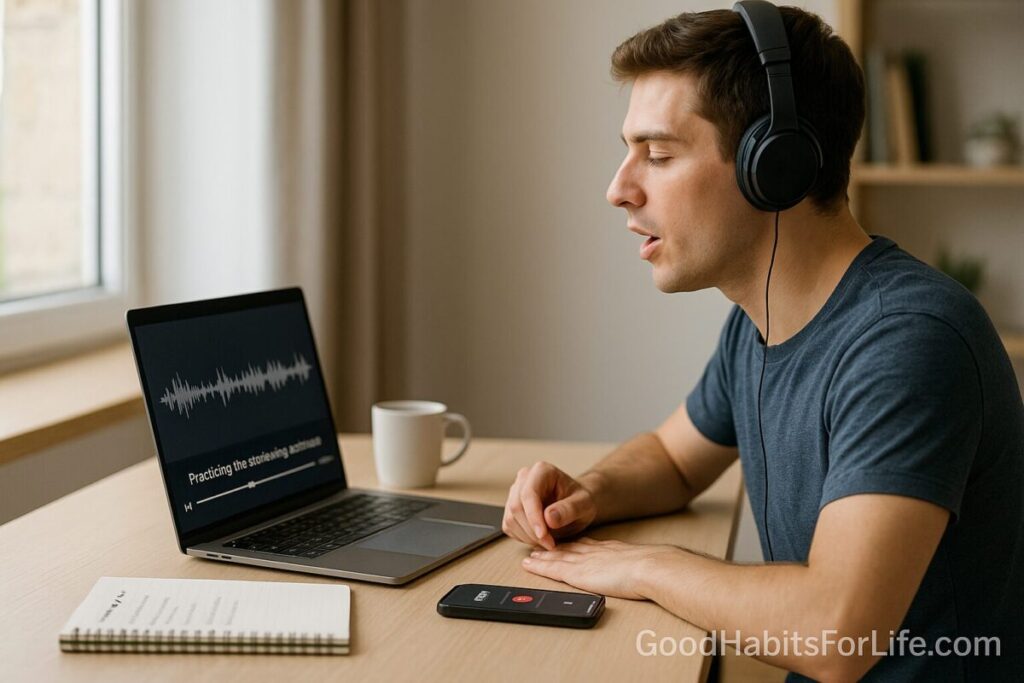
Shadowing Technique: 15 Minutes a Day
Shadowing Technique: 15 Minutes a Day
Table of Contents
🧭 What Is Shadowing & Why It Works
Shadowing is a focused speaking-while-listening exercise where you listen to a native model and repeat what you hear with minimal delay—like an audio “echo.” It began as a core drill in interpreter training and has since moved into mainstream language learning. Properly done, it targets pronunciation, rhythm, and processing speed at the same time. openstarts.units.it
Across classroom and lab studies, shadowing improves listening comprehension and bottom-up decoding (hearing sounds, syllables, and word boundaries), which then supports speaking and overall fluency. jalt-publications.org
Pronunciation and prosody (stress, rhythm, intonation) also improve with structured shadowing programs—especially when paired with short, level-appropriate audio and light feedback. jbe-platform.com+1
One mechanism behind shadowing is phonetic convergence: speakers subtly adapt their sounds to the model they’re hearing. This effect appears even when learners aren’t told to “imitate,” suggesting shadowing taps into natural mimicry pathways. Frontiers+1
Bottom line: Shadowing compresses listening + speaking + pronunciation into a single, high-yield routine—ideal for a daily 15-minute habit.
✅ Quick Start: Your 15-Minute Daily Session
Materials: 30–60 seconds of audio at your level (podcast clip, newscast snippet, story dialog), transcript or subtitles, headphones, voice recorder.
Structure (15 minutes):
-
00:00–02:00 | Warm-up
-
Mouth/jaw: exaggerate vowels and consonants; read 2–3 easy lines aloud.
-
-
02:00–05:00 | Whisper Shadow (No Transcript)
-
Play the clip 2–3×. Whisper or murmur along to align timing and melody.
-
-
05:00–09:00 | Full-Voice Shadow (With Transcript)
-
Shadow again, now reading along. Aim for matching syllable timing and stress.
-
-
09:00–12:00 | No-Transcript Shadow
-
Hide the text. Focus on linking, reductions, and intonation.
-
-
12:00–14:00 | Targeted Repair
-
Pause on trouble spots; loop 2–3 words; slow 10–15%; rebuild to full speed.
-
-
14:00–15:00 | Record & Review
-
Record one clean take; compare to the model; note 1 win + 1 focus for tomorrow.
-
Coach’s tip: Keep clips short so you can finish a full cycle daily. Short + consistent beats long + sporadic.
🗓️ 7-Day Starter Plan
Goal: Build the habit and feel the rhythm.
-
Day 1–2: Choose two short clips (≤40 s) at “easy-ish” level. Learn the routine.
-
Day 3–4: Add a second voice (e.g., interview Q&A). Practice turn-taking and intonation for questions.
-
Day 5: Try a faster clip; slow playback 10–20% for the repair step.
-
Day 6: Record a before/after comparison; note improvements in timing and stress.
-
Day 7: Light day: repeat your best clip and enjoy the “flow” feeling.
🛤️ 30-60-90 Day Roadmap (Checkpoints)
Outcomes use ACTFL-style descriptors to keep goals realistic and measurable. ACTFL
-
Days 1–30 (Novice → Novice-High):
-
Match basic stress and common intonation patterns on familiar topics.
-
Reduce syllable-by-syllable speaking; begin chunking phrases.
-
Listening: catch 70–80% of key words in your chosen clips.
-
-
Days 31–60 (Novice-High → Intermediate-Low):
-
Linking & reductions (gonna, wanna; liaison) appear in your speech.
-
Shadow 60-second clips comfortably; timing aligns without transcript.
-
Listening: follow short, unscripted segments at natural speed.
-
-
Days 61–90 (Intermediate-Low → Intermediate-Mid):
-
Prosody feels automatic; your speech rate and pause placement improve.
-
Can “echo” neutral news or story narration with few breakdowns.
-
Listening: handle new accents by adjusting lag and focusing on content words.
-
Weekly check: Keep a 30-second “benchmark” clip. Record every Sunday; compare.
🧠 Techniques & Frameworks (Prosody, Chunking, Lag)
Prosody First (Stress–Rhythm–Intonation)
-
Stress: Bold the syllable you hear as strongest; hit it slightly louder/longer.
-
Rhythm: English tends toward stress-timed rhythm; aim for even beats between stressed syllables by slightly compressing unstressed ones.
-
Intonation: Track pitch movement on questions, lists, contrasts.
Research shows shadowing programs can boost prosody and perceived fluency—especially when audio is short, level-matched, and repeated across weeks. CiNii Research+1
The “Lag” (Delay) You Should Use
-
Start with 0.25–1.0 s lag (just a word or two behind).
-
For fast speech, extend to the end of a meaningful chunk (phrase shadowing), then release the whole chunk in one breath. De Gruyter Brill
Chunking & Linking
-
Mark thought groups (/, //) on the transcript.
-
Practice reductions and linking: want to → wanna; next_day → nex(t)day.
-
Re-shadow a single sentence until breath + intonation + timing match.
Whisper → Full-Voice → Performance
-
Whisper to find timing without tension.
-
Full-voice with transcript to lock in sounds.
-
Performance without text to test memory and automaticity.
Frequency Beats Duration
-
Small daily doses create convergence and automatization; a 42-day “shadowing marathon” found steady perception gains even without explicit teaching. isca-archive.org
👥 Variations for Different Learners
Students (exam focus):
-
Use graded readers with audio; pick topics from your syllabus.
-
Create a 10-item pronunciation checklist (vowel pairs, -ed endings).
Professionals (meetings/presentations):
-
Shadow industry podcasts; extract 5 reusable sentence stems weekly.
-
Record yourself shadowing your own slides to polish delivery.
Seniors (comfort + clarity):
-
Choose slower narration; increase font size; do longer warm-ups for the jaw.
-
Prioritize intelligibility over speed.
Teens (motivation):
-
Use show clips, vlogs, or sports commentary; keep clips fun and ≤30 s.
-
Gamify: “three clean takes in a row” unlocks a new clip.
⚠️ Mistakes & Myths to Avoid
-
Myth: “Shadowing is mindless parroting.”
Done right, it’s high-attention mimicry that coordinates listening, memory, and articulation; studies show measurable phonetic convergence. Frontiers -
Mistake: Choosing audio that’s too hard/long.
If you can’t keep pace by the 3rd repeat, shorten or slow 10–20%. -
Myth: “Only beginners need it.”
Interpreting programs use shadowing to build precision and delivery skills at advanced levels. openstarts.units.it -
Mistake: Ignoring meaning.
After timing/intonation clicks, do one comprehension check: summarize in 1–2 sentences. -
Caution from interpreting literature: Some trainers warn that pure, thoughtless repeating doesn’t practice analysis; include paraphrase/summary steps to keep it meaningful. De Gruyter Brill
🧪 Real-Life Scripts You Can Copy
Warm-up mini-drills (30–60 s):
-
Vowels: beat–bit–bet–bat–bought–boat–boot–book
-
Linking: “I want_to_go” → “I wanna go”; “next_day” → “nex(t)day”
-
Stress swap: “I didn’t SAY he stole the money.” (move stress word by word)
Shadowing with transcript (news style):
-
Play 20 s of neutral news narration.
-
Whisper shadow once → full-voice with text twice → no-text once.
-
Record 1 clean take; mark 1 syllable and 1 linking fix.
Shadowing + Meaning Step (to avoid “parrot mode”):
-
After your final pass, answer: What happened? Who/what changed? (10 seconds)
-
Optional: re-tell the clip in your words with the same rhythm.
🛠️ Tools, Apps & Resources
-
Audio sources: Graded readers with audio, VOA Learning English, BBC Learning English, News in Levels, short TED/TED-Ed segments, audiobooks with text.
-
Playback control: Any podcast app with A–B looping & speed control; Audacity (desktop) or Voice Recorders (mobile).
-
Pronunciation helpers: YouGlish (real-world clips by word), Forvo (community pronunciations), dictionaries with audio (Cambridge, Oxford).
-
Tracking: Simple spreadsheet or habit app; weekly “benchmark” recording.
(Resources are suggestions; pick equivalents in your language.)
📚 Key Takeaways
-
Shadowing = listen + speak with a tiny delay.
-
15 minutes daily is enough to improve timing, prosody, and listening.
-
Keep clips short and level-appropriate; loop, slow, and repair trouble spots.
-
Use the Whisper → Full-Voice → Performance progression.
-
Track progress with weekly recordings and ACTFL-style goals. ACTFL
❓FAQs
1) Is shadowing only for pronunciation?
No. It trains prosody, timing, and processing speed, which also support listening and spontaneous speaking. jalt-publications.org
2) How long until I notice results?
Many learners feel rhythm improvements within 2–3 weeks of daily practice; research with multi-week programs reports gains in prosody, comprehensibility, and listening. jbe-platform.com+1
3) What if I can’t keep up with fast audio?
Shorten the clip or slow 10–20%. Use transcript for one pass, then remove it.
4) Should I shadow with or without a transcript?
Both. Start with text to stabilize sounds, then without to build real-time processing.
5) How does shadowing differ from simple repetition?
Repetition usually happens after the audio stops; shadowing overlaps in time, forcing alignment with natural rhythm and reductions—closer to real conversation. De Gruyter Brill
6) Can advanced learners benefit?
Yes—interpreting programs use it for delivery, clarity, and control at high levels. openstarts.units.it
7) Will shadowing change my accent?
It can increase intelligibility and comprehensibility (how easy you are to understand), even if your accent remains. Gains come from stress, rhythm, and clearer sounds. jbe-platform.com
8) Is 15 minutes really enough?
If done daily with focused clips, yes. Consistency beats marathon sessions; a 42-day routine showed steady perception benefits. isca-archive.org
📚 References
-
ACTFL. ACTFL Proficiency Guidelines 2024 (Speaking & Listening). ACTFL
-
Hamada, Y. (2012). An effective way to improve listening skills through shadowing. The Language Teacher (JALT). jalt-publications.org
-
Hamada, Y. (2016). Shadowing: Who benefits and how? Language Teaching Research (SAGE). SAGE Journals
-
Foote, J. A., & McDonough, K. (2017). Using shadowing with mobile technology to improve L2 pronunciation. Journal of Second Language Pronunciation. jbe-platform.com
-
Mori, Y. (2011). Shadowing with oral reading: Effects on prosody. Language Education & Technology. CiNii Research
-
Dufour, S., et al. (2013). How much imitation is there in a shadowing task? Frontiers in Psychology. Frontiers
-
Walker, A., & Campbell-Kibler, K. (2015). Variable selectivity in a shadowing task. Frontiers in Psychology. Frontiers
-
Kunihara, S., et al. (2022). Gradual improvements in perception/production during a 42-day Shadowing Marathon. INTERSPEECH Proceedings. isca-archive.org
-
Mu, Y. (2025). Effects of the Shadowing Technique on English Listening. ERIC (peer-reviewed PDF). ERIC
-
Schweda Nicholson, N. (2005/2008). The role of shadowing in interpreter training. University of Trieste working paper. openstarts.units.it
-
Kurz, I. (2011). ‘Shadowing’ exercises in interpreter training. De Gruyter/Brill. De Gruyter Brill