
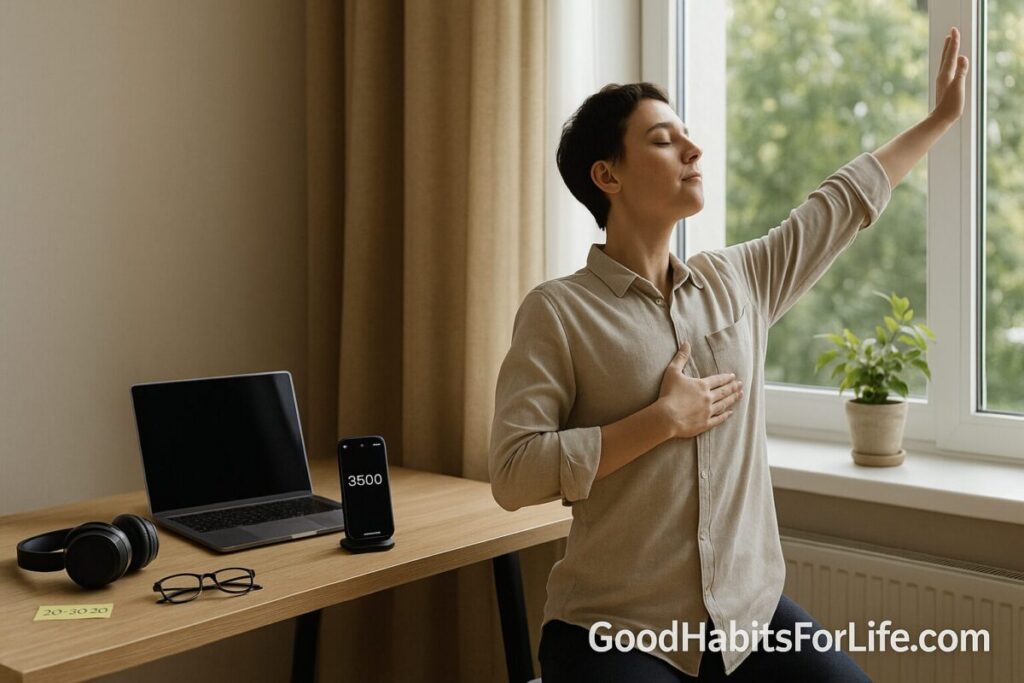
Sensory Breaks that Reset: 35 Minutes
Sensory Breaks that Reset in 35 Minutes
🧭 What & Why
What is a sensory break?
A sensory break is a brief, intentional pause that gives your brain different kinds of input—movement (proprioception/vestibular), visual rest, sound management, breath—so your arousal and attention return to a productive zone. It’s widely used in occupational therapy and is increasingly applied in schools and workplaces for self-regulation. Evidence is mixed for some sensory “diets,” but several components—active movement breaks, diaphragmatic breathing, targeted visual breaks, and nature exposure—have supportive research for attention, stress reduction, or on-task behavior. SpringerLink+4PMC+4PMC+4
Why it helps
-
Movement breaks can improve on-task behavior and classroom engagement in children; similar principles carry to adult attention. PMC+1
-
Diaphragmatic breathing improves heart-rate variability and reduces blood pressure and perceived stress. PMC+2ScienceDirect+2
-
Visual hygiene via the 20-20-20 rule eases digital eyestrain. AOA+2AAO+2
-
Nature exposure for even a short walk can restore executive attention and mood. Nature+1
-
Noise management (reducing unnecessary dB) lowers stress load; follow NIOSH/WHO guidance for safer levels. CDC+1
✅ Quick Start: Today’s 10-Minute Reset
Use this when you’re overloaded but short on time.
-
60 sec — Posture + shoulder rolls; inhale through nose, long exhale.
-
2 min — 20-20-20 (three cycles): every 20 s, look 6 m (20 ft) away. Blink deliberately. AOA
-
3 min — Box breathing (4-4-4-4). Evidence-backed breathwork boosts HRV and calm. PMC
-
3 min — Movement burst: brisk hallway walk or stair set; shake out hands. Active breaks improve on-task behavior. PMC
-
1 min — Sound reset: lower device/system volume, put on earmuffs/earbuds or pink noise; aim for quiet ≤~50–60 dBA for focused tasks if possible. (NIOSH REL for workers is 85 dBA/8h.) CDC
🛠️ The 35-Minute Sensory Reset (Modular Plan)
Pick one block from each line (visual, breath, movement, nature/surroundings, sound). The full stack fits inside 35 minutes.
A. Visual (3–5 min)
-
20-20-20 cycles (3–5 minutes total), plus gentle eye palming. AOA
B. Breath & Downshift (5–7 min)
-
2 minutes diaphragmatic breathing + 3–5 minutes paced (inhale 4 s, exhale 6 s). PMC
C. Movement/Proprioception (8–10 min)
-
Choose one: brisk walk, slow stair loops, wall push-ups (2×12), loaded carry with a tote/water bottle, gentle yoga flow. Active breaks support on-task behavior and arousal regulation. PMC
D. Nature or Green View (10–12 min)
-
Outside walk on a tree-lined path or sit by a window with greenery; even brief nature exposure can restore executive attention. Nature+1
E. Sound & Light Hygiene (3–5 min)
-
Use a decibel app to check your space (aim for quieter settings for cognitively demanding tasks). Reduce HVAC/keyboard clatter, close doors, or add soft furnishings. CDC+1
Time math example: 4 (visual) + 6 (breath) + 9 (movement) + 11 (nature) + 5 (sound) = 35 minutes.
🧠 Techniques & Frameworks (How Each Piece Works)
Table of Contents
👀 Visual Relief: The 20-20-20 Rule
Look at something ~6 m (20 ft) away for 20 s every 20 min. This relaxes the ciliary muscles, reduces accommodative strain, and eases symptoms of digital eye strain. Consider larger font, higher contrast, and proper monitor distance (≈ an arm’s length). AOA+2AAO+2
🌬️ Diaphragmatic/Paced Breathing
Breathe into the belly (abdomen rises), slow exhale longer than inhale (e.g., 4-in/6-out). Meta-analyses and trials show improvements in stress, HRV, and modest BP reductions. Start with 3–5 minutes; increase to 10 as needed. PMC+2Nature+2
🏃 Active Movement Micro-Doses
Short, structured movement breaks (2–10 minutes) can improve on-task behavior and readiness to learn. In offices, similar “movement snacks” counter static postures and help alertness. PMC+1
🌿 Nature Exposure
A 30–40-minute nature walk shows neural and behavioral markers of restored executive control; indoor views or brief outdoor time can still help. Build green routes into your day. Nature+1
🔊 Noise: Set Safe, Focus-Friendly Levels
Use the free NIOSH Sound Level Meter (iOS) to check dB. NIOSH’s recommended exposure limit is 85 dBA over 8 hours for workers; for deep-focus tasks, aim well below that when you can. CDC+1
🧸 Deep Pressure (When Appropriate)
Weighted items/blankets may help some people reduce anxiety or improve sleep; evidence is emerging and mixed—use safely and avoid for young children or anyone with breathing/mobility risk. PMC
🗺️ Habit Plan
7-Day Starter
-
Day 1–2: Two 10-minute resets (visual + breath + movement). Log how you feel before/after (1–10 scale).
-
Day 3–4: Add nature (window greenery or 8–10 min outside).
-
Day 5: Add sound check with the NIOSH app; reduce peaks. CDC
-
Day 6: Try the full 35-minute stack.
-
Day 7: Review logs; keep what worked; schedule two daily 5–10 min micro-breaks for next week.
30-60-90 Roadmap
-
30 days: Automate 2×/day micro-breaks; run 35-minute reset after cognitively heavy blocks.
-
60 days: Personalize: choose your top 3 techniques; refine durations.
-
90 days: Build contexts: commute walk via a park, desk layout for visual comfort, noise buffers in your work/study area.
🧰 Audience Variations
Students/Teens: Do 3–5 minute movement plus 20-20-20 between classes; try a 30-minute green-space walk 3×/week to support executive attention. PMC+1
Professionals/Remote workers: Schedule calendar holds (2×10 min) and one 35-minute reset after deep work.
Parents/Caregivers: Make it family-friendly—window-view eye breaks, hallway walks, “quiet minute” breathing.
Seniors: Favor slower walks and gentler breathing; research shows deep breathing modulates HRV even in older adults. ScienceDirect
⚠️ Mistakes & Myths to Avoid
-
Myth: “Only long workouts help focus.”
Reality: 2–10 minute active breaks can help on-task behavior and alertness. PMC -
Mistake: Treating weighted tools as a cure-all. Use selectively, prioritize safety, and monitor response. PMC
-
Mistake: Ignoring noise. High dB adds stress load; measure and modify. CDC
-
Myth: “Eye strain means my vision is getting worse.”
Reality: Digital eyestrain is usually temporary; habits and breaks matter. AAO
💬 Real-Life Examples & Scripts
At school (student to teacher):
“Could I do a 3-minute movement/eye break between subjects? I’ll set a timer and be back on task.”
At work (to manager):
“I’m testing a 10-minute reset twice a day—eye breaks, breathing, and a short walk—to improve deep-work quality. I’ll log results and share what helps.”
At home (parent/teen):
“Let’s try a 5-minute break: 20-20-20 eyes + two calm breaths + one hallway lap—then back to homework.”
🧱 Tools, Apps & Resources
-
NIOSH Sound Level Meter (iOS) — Accurate, free dB checks. CDC
-
Timer/Pomodoro apps — To schedule micro-breaks and the 35-minute reset.
-
Breathing apps (or simply your phone’s timer) — For 4-in/6-out or box breathing; evidence supports diaphragmatic breathwork. PMC
-
Eye-care guidance — American Optometric/Academy Ophthalmology on 20-20-20. AOA+1
-
Green-route maps — Pick a tree-lined 10-minute loop near work/school to bake in nature exposure. Nature
📌 Key Takeaways
-
A modular 35-minute reset combines visual relief, breathwork, movement, nature, and noise tuning.
-
Micro-breaks (1–5 min) between tasks maintain regulation and reduce overload.
-
Evidence backs active breaks, diaphragmatic breathing, 20-20-20, nature exposure, and sensible noise management. CDC+4PMC+4PMC+4
-
Start with a 7-day test, then scale to a 30-60-90 plan you’ll actually keep.
❓ FAQs
1) What is a sensory break, in simple terms?
A short, planned pause that changes your sensory input (eyes, breath, movement, sound) to bring your arousal/attention back to a productive level. PMC
2) How long should a sensory break be?
From 1–5 minutes (micro) up to 35 minutes (full reset). Use micro-breaks often; run the full reset after heavy cognitive blocks.
3) Does the 20-20-20 rule really help?
Yes—professional eye organizations recommend it to reduce digital eyestrain symptoms. AOA+1
4) I don’t have nature nearby—what then?
A window view of trees or plants, indoor greenery, or even brief outdoor time helps; aim for 10–15 minutes when possible. PMC
5) Are weighted blankets safe for everyone?
Not for infants/young children or anyone with breathing/mobility risks. Adults who try them should use appropriate weight and be able to remove them independently. Evidence is emerging, not universal. PMC
6) What noise level should I aim for when studying?
Lower is better for focus; for context, NIOSH’s occupational REL is 85 dBA over 8 hours—use this as an upper-exposure reference, then reduce further for cognitive work. CDC
7) Do short movement breaks really matter for learning?
Yes—classroom studies show improved on-task behavior after brief active breaks. PMC
8) How often should I do visual breaks?
Every 20 minutes if you’re on screens; pair with blinking and posture resets. AOA
📚 References
-
American Optometric Association — Computer Vision Syndrome & 20-20-20. https://www.aoa.org AOA
-
American Academy of Ophthalmology — Computers, Digital Devices, and Eye Strain (2024). https://www.aao.org AAO
-
Peiris D, et al. In-Classroom Physical Activity Breaks (Systematic Review, 2022). Int J Environ Res Public Health. https://pmc.ncbi.nlm.nih.gov/articles/PMC9368257/ PMC
-
Liu Y, et al. Diaphragmatic Breathing Relaxation (Systematic Review, 2020). Front Psychol. https://pmc.ncbi.nlm.nih.gov/articles/PMC7724962/ PMC
-
Yau KKY, et al. Effects of Diaphragmatic Breathing (2021). Int J Nurs Stud. https://www.sciencedirect.com/science/article/abs/pii/S1744388121000141 ScienceDirect
-
McDonnell AS, et al. 40-min Nature Walk Enhances Executive Control (2024). Sci Rep. https://www.nature.com/articles/s41598-024-52205-1 Nature
-
Jimenez MP, et al. Nature Exposure & Health (Review, 2021). Int J Environ Res Public Health. https://pmc.ncbi.nlm.nih.gov/articles/PMC8125471/ PMC
-
CDC/NIOSH — Noise: Recommended Exposure Limit (REL). https://www.cdc.gov/niosh/noise/prevent/understand.html CDC
-
WHO — Environmental Noise Guidelines for the European Region (2018). https://pmc.ncbi.nlm.nih.gov/articles/PMC6266190/ PMC
-
CDC/NIOSH — Sound Level Meter App (iOS). https://www.cdc.gov/niosh/noise/about/app.html CDC
-
Yu J, et al. Weighted Blankets: Sleep & Related Outcomes (Systematic Review, 2024). Front Psychiatry. https://pmc.ncbi.nlm.nih.gov/articles/PMC11056563/ PMC
-
Datta S, et al. The 20-20-20 Rule: Practice & Associations (2023). Indian J Ophthalmol. https://pmc.ncbi.nlm.nih.gov/articles/PMC10391416/ PMC
Disclaimer: This guide is educational and not a substitute for personalized medical, mental-health, or occupational-therapy advice.