
Seniors Strength: SittoStand to Deadlift: Zone 2 + NEAT (2025)
Strength Training for Seniors: Sit-to-Stand to Deadlift
Table of Contents
🧭 What & Why
The goal: a practical routine that helps you get out of chairs easily, lift groceries safely, protect joints, and keep stamina for daily life. We combine three pillars:
-
Progressive strength (sit-to-stand → deadlift) to restore hip-hinge power, grip, and posture—crucial for independence. Robust evidence shows progressive resistance training in older adults improves strength, function, and quality of life.
-
Zone 2 cardio (steady, talk-friendly pace) to support heart health and metabolic fitness.
-
NEAT (non-exercise activity thermogenesis): all your light, incidental movement that quietly raises daily energy expenditure.
Why it works (evidence):
-
Health authorities recommend at least 150–300 min/week of moderate aerobic activity plus muscle-strengthening 2+ days/week for older adults, with balance work.
-
Meta-analyses confirm progressive resistance improves strength and function in older adults.
-
Zone 2-type training (below the first ventilatory threshold; “conversational”) builds endurance and mitochondrial efficiency.
-
NEAT meaningfully contributes to daily energy burn and metabolic health.
✅ Quick Start (Do This Today)
1) Safety prep (5 min)
-
If you have unstable health conditions (e.g., uncontrolled BP, chest pain), consult a clinician first.
-
Pain rule: no sharp pain; stop if dizziness, chest discomfort, or radiating pain.
-
Gear: flat shoes, sturdy chair, optional light dumbbell/kettlebell, timer.
2) Warm up (5–7 min)
-
March in place 1 min → heel-to-toe rocks 1 min → hip hinges with a broomstick 10 reps → shoulder rolls 10 reps.
3) Strength micro-session (10–15 min)
-
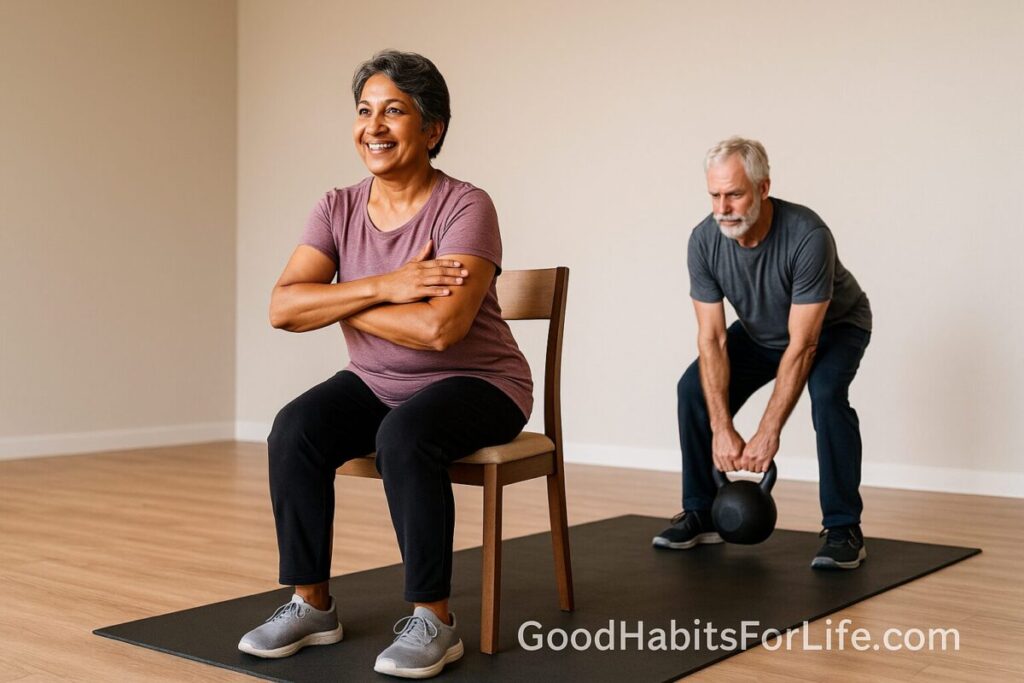
Sit-to-Stand from a chair: 3×6–10 reps (hands across chest; control down).
-
Hip-Hinge Drill (tap butt to wall): 2×8 reps.
-
Suitcase Carry (one light weight at side): 3×20–30 m each hand (or 30–45 s).
-
Balance finisher: 30–45 s single-leg stand each side (hold a countertop if needed).
4) Zone 2 sampler (10–20 min)
-
Brisk walk or easy cycle where you can talk in full sentences. If using a heart-rate device, aim roughly 60–70% of heart-rate reserve; otherwise use the talk test (comfortably conversational).
5) NEAT bumpers (all day)
-
Set a movement timer every 45–60 min. Stand, stroll for 2–3 min, or do 10 calf raises and 10 shoulder pulls.
🛠️ Techniques & Frameworks
Hip-Hinge → Deadlift Progression
-
Chair Sit-to-Stand (STS)
-
Cues: “Nose over toes,” “Drive feet through the floor,” “Stand tall.”
-
Progress: lower seat height or hold a light weight at the chest (goblet).
-
-
Box/Block Deadlift (weight starts at knee height)
-
Cues: “Push hips back,” “Shins stay near vertical,” “Long spine—proud chest.”
-
Stand up by pushing the floor away; return the weight to the box with control.
-
-
Kettlebell or Trap-Bar Deadlift (mid-shin start)
-
Start light; 2–3 sets of 5–8 reps at RPE 6–7/10 (2–4 reps “in reserve”).
-
Breathing & brace: inhale to prepare, gentle abdominal brace (as if zipping tight pants), exhale near the top.
-
-
Optional Barbell Deadlift
-
Use only if technique is solid and you enjoy it. Consider coaching for setup and loading.
-
Loading guide: Increase load when your last set feels ≤RPE 6 (very comfortable) and form stays crisp. Add 2–5% load or 1–2 reps next time.
What is Zone 2 (and how to find it)
-
The conversational zone: you can talk in full sentences, breathing deeper but not gasping.
-
Heart-rate method (approx.):
-
Estimate Max HR (MHR) ≈ 220 – age.
-
Heart-rate reserve (HRR) = MHR – resting HR.
-
Zone 2 ≈ 60–70% HRR + resting HR.
-
-
If you don’t track HR, stick with the talk test or RPE 3–4/10 (“easy-moderate, could continue for an hour”).
Examples: brisk walking, easy cycling, gentle swim, elliptical at conversational effort.
NEAT (Non-Exercise Activity Thermogenesis)
-
All the light movement outside of workouts: steps, housework, gardening, standing prep, puttering.
-
Targets:
-
6,000–8,000+ steps/day (4–6 km+) for most; start where you are and add 500–1,000 steps every 2 weeks.
-
Build movement snacks: 2–3 min every hour you’re awake.
-
📅 30-60-90 Habit Plan
Training week template (adjust days as needed):
-
Strength (Mon/Thu or Tue/Fri): 25–40 min, hinge-focused.
-
Zone 2 (3–5 days): 20–45 min/session.
-
NEAT: daily movement snacks; step goal.
Days 1–30: Foundation
-
Strength 2×/week:
-
STS 3×8–10 → Box Deadlift 3×6–8 → Suitcase Carry 3×30–45 s/side → Balance 2×30–45 s.
-
-
Zone 2: 150 min/week total (e.g., 5×30 min).
-
NEAT: baseline steps + +500/day.
-
Checks: 30-s Chair-Stand Test (count reps); RPE log after each session.
Days 31–60: Build
-
Strength 2–3×/week:
-
Progress to Kettlebell/Trap-Bar Deadlift from mid-shin, 3×5–8 (RPE 6–7).
-
Add Row or Pull-Down 3×8–10 and Split-Squat to Box 2×6–8/side.
-
-
Zone 2: 180–210 min/week total (mix in one 45–60-min walk).
-
NEAT: +1,000 steps/day above baseline; add 10-min after-meal walks.
-
Checks: repeat Chair-Stand Test; note easier breathing on familiar routes.
Days 61–90: Strengthen & Consolidate
-
Strength 3×/week (two main + one short):
-
Deadlift 3×5 (slightly heavier), STS or Goblet Squat 3×6–8, Carry 3×45–60 s, Hip-Hinge accessories (RDL with light dumbbells) 2×8.
-
-
Zone 2: 210–300 min/week (some longer easy outings).
-
NEAT: aim 7,000–9,000+ steps/day; keep hourly breaks.
-
Checks: Chair-Stand Test, comfortable grocery lifting, easier stair climbing.
👥 Audience Variations & Safety
-
Osteoporosis/low bone density: Emphasize hinge mechanics, neutral spine, slow progress; prioritize trap-bar/kettlebell over barbell at first.
-
Knee arthritis: STS to higher box, lean torso slightly forward to load hips more; avoid deep knee angles.
-
Back history: Start with hinge drills, box height above knee, and RPE 5–6; consider a physio consult for individualized cues.
-
Balance concerns: Keep a countertop support nearby; include tandem stance and heel-toe walks 2–3×/week.
-
Diabetes/BP meds: Carry glucose if needed; monitor for dizziness; longer cool-downs.
⚠️ Mistakes & Myths to Avoid
-
“Deadlifts are dangerous for seniors.” Poor technique is risky; properly taught, loaded, and progressed, hip-hinge lifts improve function and confidence.
-
Only walking is enough. Walking is great, but strength + balance reduce fall risk and maintain independence.
-
No pain, no gain. Use RPE 6–7; stop at sharp pain or form breakdown.
-
Skipping NEAT. Long sitting blunts cardio benefits—move each hour.
🧪 Real-Life Examples & Scripts
20-Minute Minimalist Session (at home)
-
Warm-up (5 min)
-
STS 3×8, Rest 60 s
-
Suitcase Carry 3×40 s/side
-
Balance 2×40 s/side
-
10-min Zone 2 walk
Simple Week
-
Mon: Strength + 20-min Zone 2
-
Tue: 30-min Zone 2 walk
-
Thu: Strength + 20-min Zone 2
-
Sat: 45-min easy bike/walk
Coach cue script (copy-paste):
“Please watch my hinge: do my hips move back before my knees, is my spine long, and do I finish tall without leaning back?”
Doctor note script (copy-paste):
“I’m starting a 2–3×/week strength plan with Zone 2 walking. Any restrictions given my meds/history?”
🧰 Tools, Apps & Resources
-
Heart-rate monitor or watch: Helps find Zone 2; con: not essential, can distract.
-
Step counter/pedometer (or phone): Tracks NEAT; con: numbers can fluctuate day-to-day.
-
Kettlebell or trap bar: User-friendly deadlifts; con: needs space and gradual instruction.
-
Resistance bands: Warm-ups, rows, hip work; con: resistance is variable.
-
Interval/Timer app: Prompts sets and hourly movement breaks; con: notifications fatigue.
-
NIA Go4Life videos / local senior classes: Guidance and variety; con: quality varies—choose reputable instructors.
🧾 Key Takeaways
-
Combine progressive strength, Zone 2 cardio, and NEAT for the biggest payoff.
-
Progress from sit-to-stand → box deadlift → kettlebell/trap-bar deadlift.
-
Aim for 2–3 strength days, 150–300 min Zone 2/week, and hourly movement snacks.
-
Keep intensity comfortable-to-moderate; increase load when form is rock-solid.
-
Use simple tests (e.g., 30-s Chair-Stand) to see tangible progress.
❓ FAQs
1) How heavy should seniors deadlift?
Start with the lightest weight that preserves perfect form (often 8–12 kg kettlebell or a light trap-bar setup). Progress when sets feel RPE ≤6 and technique is consistent.
2) Is a kettlebell deadlift safe for beginners?
Yes—handles are centered, encouraging a good hinge. Begin from an elevated start height and keep sets short (5–8 reps).
3) What heart rate is Zone 2 for a 70-year-old?
Use the talk test first (full sentences). With HR: MHR≈220−70=150 bpm. Zone 2 ≈ 60–70% HRR + resting HR; calculators can help personalize this.
4) How often should I strength train?
2–3×/week on non-consecutive days works well. Keep one session short if you’re busy.
5) I have back pain—can I deadlift?
Possibly, with medical clearance, careful hinge patterning, elevated start, and light loads. If pain persists, stop and consult a clinician.
6) What if I can’t get to the floor or lift from the ground?
Start with chair STS and box deadlifts. Lower the box gradually over weeks.
7) How do I progress from sit-to-stand to deadlift?
When STS 3×12 feels easy, introduce box deadlifts 3×8 light. After two weeks, move to kettlebell deadlifts from a slightly lower height.
8) How many steps count as good NEAT?
Whatever you do now +500–1,000/day is progress; many older adults thrive around 6,000–9,000+ steps/day, adjusted to joints and terrain.
9) Is Zone 2 better than intervals for seniors?
Both help. Zone 2 is the steady base most people can recover from; add short intervals later if desired and cleared.
10) Do I need protein shakes?
Not required, but meeting daily protein (roughly 1.0–1.2 g/kg/day unless advised otherwise) supports training; discuss with your clinician/dietitian.
📚 References
-
World Health Organization. Guidelines on physical activity and sedentary behaviour (older adults). https://www.who.int
-
U.S. CDC. Physical Activity Guidelines for Older Adults. https://www.cdc.gov/physicalactivity
-
American College of Sports Medicine. ACSM Guidelines for Exercise Testing and Prescription (10th ed.). https://www.acsm.org
-
Liu & Latham (Cochrane). Progressive resistance strength training for older adults. https://www.cochranelibrary.com
-
Seiler S. What is best practice for training intensity distribution? Scand J Med Sci Sports. https://onlinelibrary.wiley.com
-
Jones CJ, Rikli RE, et al. 30-Second Chair Stand Test (Senior Fitness Test). https://link.springer.com & https://www.cdc.gov/steadi
-
Levine JA. Non-exercise activity thermogenesis (NEAT). Mayo Clin Proc. https://www.mayoclinicproceedings.org
-
National Institute on Aging. Exercise & Physical Activity: Go4Life. https://www.nia.nih.gov
-
Galloza J, et al. Resistance training in older adults: benefits and considerations. Clin Geriatr Med. https://www.sciencedirect.com
-
ACSM Position Stand. Quantity and quality of exercise for developing and maintaining fitness. Med Sci Sports Exerc. https://journals.lww.com
Disclaimer: This article is general fitness education, not medical advice; consult your healthcare professional before starting or changing exercise routines.