
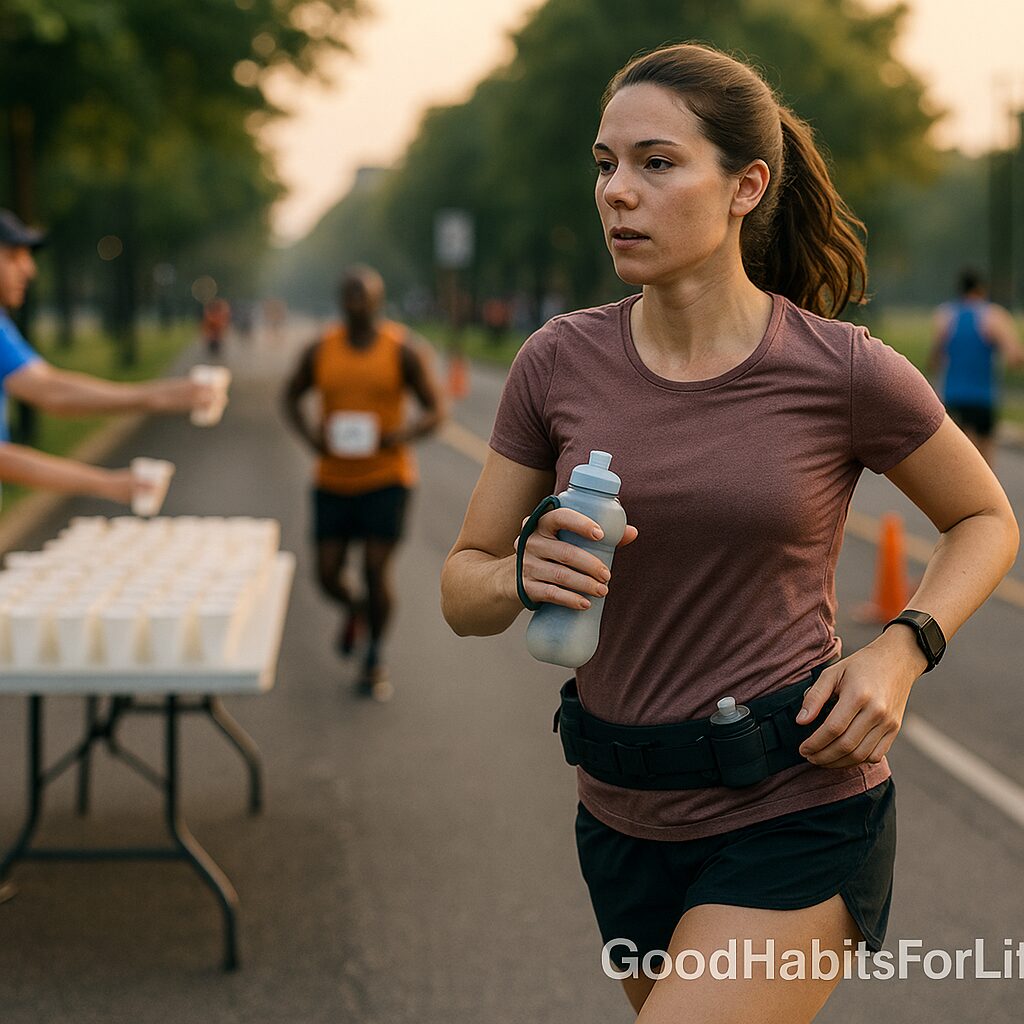
Running with Water: Handhelds, Belts & Aid Stations
Running with Water: Handhelds, Belts & Aid Stations
Table of Contents
🧭 What “running with water” really means—and why it matters
“Running with water” is more than carrying a bottle. It’s a plan to (1) start runs well-hydrated, (2) drink enough to prevent excessive (>2%) body-mass loss from sweat, and (3) avoid overdrinking that can dilute blood sodium (exercise-associated hyponatremia). The American College of Sports Medicine (ACSM) recommends individualized hydration based on your sweat rate, with the performance goal of keeping body-mass loss under ~2%. PubMed
Overdrinking is also risky. Consensus guidance on exercise-associated hyponatremia (EAH) shows that “drink to thirst” is a safe, effective way to balance under- and over-hydration for most runners, especially in mass-participation races. British Journal of Sports MedicinePMC
Pre-run hydration (races): Begin euhydrated. Practical guidance from World Athletics/IAAF suggests ~500–600 mL of fluid 2–3 hours pre-race (plus a small top-up ~10–15 minutes before start if desired). World Athletics
✅ Quick-start checklist (today)
-
Pick a carry style for today’s distance and weather (see next section).
-
Do a quick weigh-in before/after your run (no shoes): if you lose >2% body mass, add more fluid next time; if you gain, you drank too much. PubMed
-
Running >60 minutes? Pack carbs (gels/chews/drink) to reach ~30–60 g/hour. PMCPubMed
-
Use sodium: Choose a sports drink with ~400–1100 mg sodium per liter if you’re a salty sweater, running long, or it’s hot. germanjournalsportsmedicine.com
-
Race rehearsal: Practice grabbing, sipping, and moving through a mock aid station so race day feels automatic.
-
Post-run: Replace any remaining deficit via normal food/drink; if dehydrated, rehydrate progressively with fluids and electrolytes. PubMedPMC
🧰 Choose your carry method: handhelds vs belts vs vests
Handheld bottles (300–500 mL)
-
Best for: Short runs/tempo days, cool weather, runners who like minimal gear.
-
Pros: Light, fast access, easy to refill at fountains/aid stations.
-
Cons: One-handed arm swing; can feel imbalanced if full; limited volume.
Hydration belts (1–2 soft flasks or a 500–750 mL bottle)
-
Best for: 5–21 km (3–13 mi), warm days, runners who want hands-free.
-
Pros: Weight sits low/central; quick draw; add gels in pockets.
-
Cons: Fit matters—too loose = bounce; too tight = chafing. Place bottles symmetrically.
Hydration vests/packs (1–2 L)
-
Best for: Long runs, marathons in heat, trail/ultra, when carrying fuel/layers/phone.
-
Pros: Highest capacity, stable with good fit, multiple pockets.
-
Cons: Warmer on torso; needs proper adjustment; practice refills.
Fit tips:
-
Prioritize stability (no bounce) and breathability.
-
Use soft flasks up front for quick sipping; stash a backup bottle at the back or belt.
-
Distribute weight evenly; keep fluids close to your center of mass.
-
Always test gear on long training runs before race day.
🧪 How much to drink? Carbs & electrolytes 101
Fluids: The goal is to replace enough sweat to limit body-mass loss to <~2% for performance, not to finish at exactly 0% change (impractical and risky). Customize by conditions and your sweat rate. PubMed
Carbohydrates: For runs >60 minutes, plan ~30–60 g/hour (up to ~90 g/h in very long/ultra events with mixed carbohydrate sources). This improves endurance and maintains intensity. Drink mixes at ~6–8% carbohydrate are commonly used. PMCPubMed
Electrolytes (sodium): Many sports drinks fall around ~400–1100 mg sodium per liter—a practical range for replacing sweat sodium and supporting fluid absorption during prolonged exercise, especially in the heat. Adjust based on your sweat saltiness and GI tolerance. germanjournalsportsmedicine.com
Avoid overdrinking: EAH prevention statements advise drinking to thirst rather than forcing fixed, high volumes. If you’re gaining weight during a race, slow your intake. British Journal of Sports MedicinePMC
🧪 Do a 20-minute sweat-rate test (at home)
A simple test gives you a starting point for long-run and race plans.
-
Weigh yourself nude or in dry kit, pre-run (kg).
-
Run 20 minutes at your typical long-run pace in similar weather, tracking how much you drink (mL) and whether you urinate.
-
Weigh again, post-run (kg).
-
Calculate:
-
Sweat loss (L) = pre-mass − post-mass + fluid intake (L) − urine (L)
-
Sweat rate (L/h) = sweat loss ÷ duration (h)
-
Extrapolate to your race duration, then plan to replace enough to keep body-mass loss <~2% while avoiding weight gain. PMC
Rule of thumb often used in field studies: ~1 kg mass change ≈ 1 L of sweat loss (before adjusting for any fluid you consumed). PMC
🗺️ Aid-station strategy for 5K–marathon–ultra
How often are stations? World Athletics guidance for road races: water at least every 5 km, and every 2.5 km in warm climates; refreshments beyond water are provided in longer events. Expect a station at the finish as well. Always check your race’s course map for specifics. media.aws.iaaf.org
Drink plan (principles):
-
Start euhydrated (see pre-race tip above). World Athletics
-
Drink to thirst at stations; small sips are fine. Don’t force big cups at every table. British Journal of Sports MedicinePMC
-
Carb timing: For races >60–75 minutes, target ~30–60 g carbs/hour via gels/chews or sports drink; practice your combo in training. PMCPubMed
-
Electrolyte access: If you’re a salty sweater or in heat, choose the sports-drink table or carry a small sodium source to pair with water. germanjournalsportsmedicine.com
Station drill:
-
Call your choice (“Water!” or “Drink!”).
-
Pinch the cup to form a spout; take 2–4 quick sips while jogging.
-
If crowded, walk 5–10 seconds to sip cleanly, then resume pace.
-
For belts/vests, top up a soft flask every other station to spread intake.
🎯 30-60-90 Day Habit Plan
Days 1–30 (Foundation)
-
Test 2 carry methods (e.g., handheld vs belt).
-
Complete two sweat-rate tests (cool day, warm day). Log results. PMC
-
On long runs (>60 min), practice 30–45 g carbs/h and note GI comfort. PMC
-
Build a simple aid-station routine: call drink, pinch cup, sip, move.
Days 31–60 (Personalize)
-
Lock your preferred system (belt or vest).
-
Calibrate sodium: try one drink at ~500–700 mg/L on warm runs and compare perceived thirst/finish weight. germanjournalsportsmedicine.com
-
Rehearse race map: decide which stations you’ll use and what you’ll take.
Days 61–90 (Race-ready)
-
Practice on goal terrain & temperature.
-
Run a long workout with full race protocol: pre-hydration, gels, station timing. World Athletics
-
Fine-tune volumes to keep finish mass change <~2% without weight gain. PubMed
🧠 Variations (heat, terrain, youth & masters)
-
Heat/humidity: Expect higher sweat loss; prioritize shade, early starts, cooling, and slightly higher sodium. More frequent stations (2.5 km) may be provided in hot races. media.aws.iaaf.org
-
Hills/trails: Carry capacity matters (vests shine). Aid stations may be far apart; plan to leave each station with enough to reach the next safely.
-
Youth runners: Emphasize “drink to thirst,” small sips, and supervised access at meets; avoid aggressive “must finish the bottle” rules. British Journal of Sports Medicine
-
Masters/smaller runners: Lower absolute sweat rates—beware of overdrinking at frequent stations; use body-mass checks in training. PMC
⚠️ Mistakes & myths to avoid
-
Myth: “Clear pee = perfectly hydrated.” Overdrinking can still cause EAH; use thirst and performance cues. British Journal of Sports Medicine
-
Mistake: Big gulps at every station. Small sips often suffice; stop if sloshing. PMC
-
Myth: “Water only is always best.” For >60–90 min, carbs + sodium support performance and fluid balance. PMCPubMed
-
Mistake: New gear on race day. Always test belts/vests/flavors in training.
-
Myth: “You must replace 100% of sweat.” The goal is <~2% loss, not 0%—and never weight gain. PubMed
💬 Real-life scripts (training & race day)
-
At a crowded table: “Water—thank you!” (pinch, sip twice, keep moving)
-
When you need sodium: “Sports drink please.” (two sips; chase with water if strong)
-
Refill on the go (belt/vest): “Could you top this to halfway? Thanks!” (hand soft flask with cap off)
-
With your pacer/partner: “Gel in 5 minutes; remind me to grab drink at the next station.”
-
Self-talk in heat: “Sip to thirst. Shade if possible. Cool head, steady steps.”
🧭 Tools, Apps & Resources
-
Sweat-rate calculator (NATA method): Use the weigh-in formula above to build your own sheet. PMC
-
Mapping race stations: Download the race course map and mark exact station kilometers; practice the pattern on long runs. media.aws.iaaf.org
-
Wearables/logs: Use your watch or app to set fuel/hydration alerts every 15–20 minutes on long runs.
Pros/cons quick view
-
Handhelds: +fast access; −arm asymmetry.
-
Belts: +hands-free/balanced; −fit-dependent.
-
Vests: +capacity/organization; −warmer, needs adjustment.
📌 Key Takeaways
-
Keep performance loss at bay by avoiding >~2% body-mass loss—and avoid overdrinking. Personalize using sweat-rate tests. PubMed
-
For efforts >60 minutes, plan 30–60 g carbs/hour and consider sodium 400–1100 mg/L, especially in heat. PMCPubMedgermanjournalsportsmedicine.com
-
Choose carry gear by distance, heat, and refill options; train with what you’ll race.
-
Aid stations in road races appear at least every 5 km (often 2.5 km in heat). Drink to thirst at each. media.aws.iaaf.org
❓ FAQs
1) How much should I drink per hour when running?
Enough to keep body-mass loss under ~2% without gaining weight. Volumes vary widely (environment, body size, pace). Use sweat-rate testing and thirst. PubMed
2) Is water alone okay?
Yes for runs under ~60 minutes. For longer or harder runs, add carbs (~30–60 g/h) and sodium to support performance and fluid balance. PMCPubMed
3) What sodium level should my drink have?
A practical range for many runners is ~400–1100 mg/L; individual needs vary by sweat saltiness and duration. germanjournalsportsmedicine.com
4) What’s the risk of drinking “as much as possible”?
Overdrinking can cause hyponatremia (dangerously low sodium). Use a drink-to-thirst strategy, especially at frequent aid stations. British Journal of Sports MedicinePMC
5) How often are marathon aid stations?
World Athletics guidance: at least every 5 km; in heat, every 2.5 km is advisable. Check your race map. media.aws.iaaf.org
6) What pre-race hydration works?
Arrive euhydrated; practical guidance suggests ~500–600 mL 2–3 hours pre-start with a small top-up 10–15 minutes before if desired. World Athletics
7) Do handhelds hurt running form?
They can slightly alter arm swing when full; many runners prefer belts/vests for balance on longer runs. Test both and pick what feels smoothest.
8) I’m a light/small runner—should I still drink at every station?
Not necessarily. Smaller athletes often sweat less; drink to thirst and avoid weight gain over the race. PMC
📚 References
-
American College of Sports Medicine Position Stand: Exercise and Fluid Replacement. Med Sci Sports Exerc. 2007. PubMed
-
Thomas DT, Erdman KA, Burke LM. Nutrition and Athletic Performance (Joint Position of AND/DC/ACSM). 2016. PubMedDietitians of Canada
-
Jeukendrup AE. Carbohydrate Intake During Exercise. Sports Med. 2014. PMC
-
Oberritter H, et al. Fluid Replacement in Sports (position). Dtsch Z Sportmed. 2020. germanjournalsportsmedicine.com
-
McDermott BP, et al. National Athletic Trainers’ Association Position Statement: Fluid Replacement for the Physically Active. 2017. PMC
-
O’Neal EK, et al. Post-Exercise Sweat Loss Estimation Accuracy of Athletes. 2020. PMC
-
Hew-Butler T, et al. 2015 Consensus Statement on Exercise-Associated Hyponatremia. Br J Sports Med. British Journal of Sports Medicine
-
Rosner MH, et al. Exercise-Associated Hyponatremia (review). 2019. PMC
-
World Athletics (IAAF). Road Running Manual: drinking/refreshment station guidance (water ≥ every 5 km; 2.5 km in heat). 2011. media.aws.iaaf.org
-
World Athletics (IAAF). Policy/Guidance on Fluid Replacement (pre-race intake). World Athletics
-
Armstrong LE. Rehydration during Endurance Exercise: Challenges and Solutions. 2021. PMC
Disclaimer: This article provides general fitness guidance and is not a substitute for personalized medical or sports-dietitian advice—adjust for your health status, climate, and event rules.