
Rucking 101: Load, Distance, and Safety: Zone 2 + NEAT (2025)
Rucking 101: Load, Distance & Safety (Zone 2 + NEAT)
Table of Contents
🧭 What Is Rucking & Why It Works
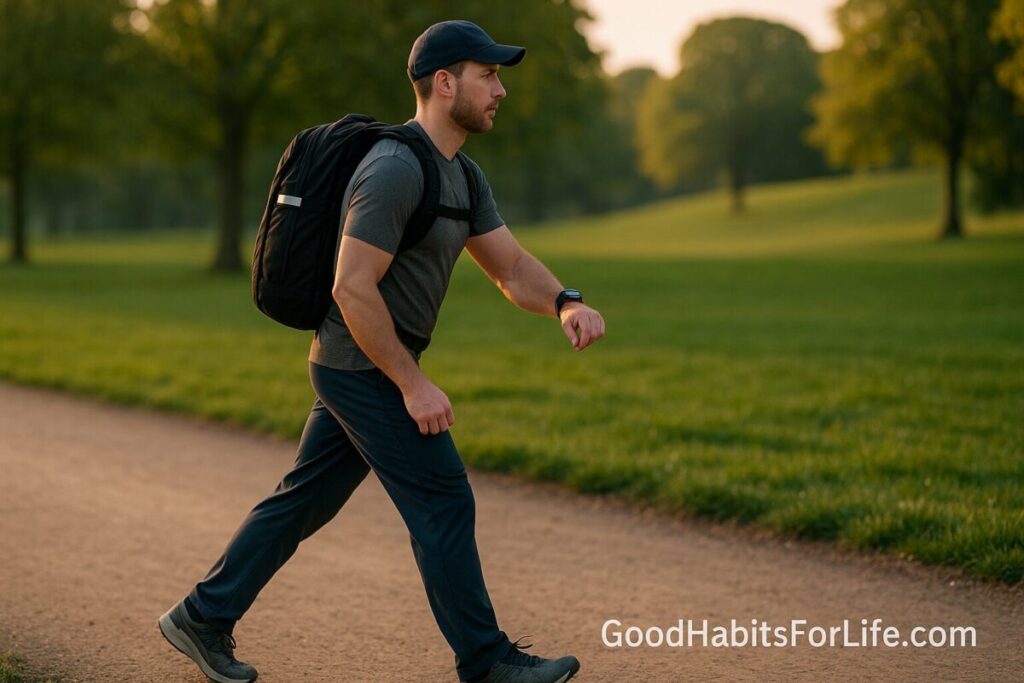
Rucking is brisk walking with a weighted backpack (a “ruck”). It blends low-impact endurance (Zone 2 cardio) with light resistance from the load. That makes it efficient for:
-
Aerobic fitness & heart health (steady, sub-threshold effort).
-
Calorie burn & weight management by elevating energy expenditure without pounding the joints.
-
Leg, hip, trunk strength-endurance via carrying load over distance.
-
NEAT (non-exercise activity thermogenesis): everyday, non-gym movement that meaningfully adds to total daily energy use.
Research on loaded carriage (often from military populations) shows that higher loads, faster paces, poor conditioning, and abrupt progressions increase injury risk, while gradual progression, good footwear, and proper load placement reduce it. Public-health guidelines also endorse moderate-intensity activities like brisk walking for cardiovascular benefits. (See References.)
✅ Quick Start: Your First 7 Days
Goal: Learn form, find your Zone 2 pace, and finish sessions feeling you could do more.
Equipment
-
A sturdy daypack with a hip belt (if available).
-
5–7 kg load (books, water bottles, sandbag/plate)—or 5–10% of body weight, whichever is lower.
-
Moisture-wicking socks + comfortable walking shoes (or light hikers).
-
Water bottle; small blister kit (tape, band-aids).
7-Day Plan
-
Day 1: 2 km easy ruck. Adjust straps: weight high/close to back, chest/hip belts snug.
-
Day 2: Rest or 20-min unweighted walk.
-
Day 3: 2.5 km at conversational pace. Note HR and RPE (Rate of Perceived Exertion 4–5/10).
-
Day 4: Mobility (hips/ankles/calf), 15-min gentle walk.
-
Day 5: 3 km. Practice cadence (short, quick steps), heel-lock lacing to prevent heel slip.
-
Day 6: Rest or cross-train (easy cycling/yoga).
-
Day 7: 3–3.5 km with one mild hill; finish able to speak full sentences.
Success checklist
-
No hot spots or unusual joint pain.
-
End each session with steady breathing, not panting.
-
Pack feels stable; no shoulder digging or lower-back ache.
🧠 30-60-90 Day Habit Plan (with Checkpoints)
Principle: Progress one variable at a time—distance or load or terrain—by 5–10% weekly.
Days 1–30 (Base)
-
Frequency: 3 rucks/week + 1 unweighted walk.
-
Distance: Build from 2–3 km to 5–6 km.
-
Load: Hold steady at 5–7 kg (or 5–10% BW).
-
Pace: Conversational; HR ~60–70% HRmax.
-
Checkpoint (Day 30): 5 km at steady pace, no hot spots; RPE ≤5/10.
Days 31–60 (Build)
-
Frequency: 3–4 rucks/week.
-
Distance: 5–8 km; add mild hills.
-
Load: Increase to 7–10 kg (or up to ~12–15% BW if comfortable).
-
Strength add-ons (2x/week post-ruck): 2–3 sets each: step-ups, split squats, hip hinges, calf raises, suitcase carry (light).
-
Checkpoint (Day 60): 7–8 km steady; next-day legs feel “used,” not trashed.
Days 61–90 (Capacity)
-
Frequency: 4 rucks/week (1 long, 2 moderate, 1 short technique day).
-
Distance: Long ruck 8–12 km; weekly total 20–30 km.
-
Load: 10–15 kg (or up to ~20% BW for experienced, injury-free adults).
-
Terrain: Add stairs/trails. Keep Zone 2; avoid jogging with a ruck.
-
Checkpoint (Day 90): Confident with 10 km+ at Zone 2, blisters under control, no lingering pains.
Note: Many healthy adults thrive long-term at 10–15% BW. Heavier loads (20–30% BW) are advanced and raise injury risk; only consider if you have months of base, great foot care, and a clear reason.
🛠️ Load, Distance & Pace: Evidence-Aligned Guidelines
Choose your load
-
Beginner: 5–7 kg or 5–10% body weight, whichever is lower.
-
Intermediate (after 6–8 weeks): 7–12 kg or 10–15% BW.
-
Advanced (specific goals only): 12–20 kg or 15–20% BW; progress conservatively.
Set your distance
-
Start 2–4 km; add 5–10% weekly.
-
Split long distances into A/B blocks (e.g., 6 km AM + 4 km PM) if feet are adapting.
Find Zone 2 pace
-
Talk test: full sentences = Zone 2.
-
HR estimate: ~60–70% of HRmax (roughly 180–age ±5–10 beats as a field heuristic).
-
Uphills? Shorten stride; keep cadence; prioritize breathing over speed.
Hydration & fueling
-
Hydrate: ~400–800 ml/hour temperate; more in heat/humidity.
-
Electrolytes: consider if >60–90 min, hot, or you’re a salty sweater.
-
Fuel: for sessions >90 min, 20–40 g carbs/hour can help.
🧍 Technique, Posture & Pack Setup
Pack fit
-
Weight high and close to the spine.
-
Tighten shoulder straps to keep the load from swinging.
-
Use sternum strap to stabilize; hip belt to transfer part of the load to hips.
Footwear & socks
-
Broken-in walking shoes or light hikers with room in the toe box.
-
Moisture-wicking socks (avoid cotton); consider a thin liner sock + outer sock.
Walking form
-
Tall posture, ribs down, slight forward lean from ankles (not waist).
-
Short, quick steps; quiet footfalls; avoid overstriding.
-
Keep hands relaxed; periodically shrug/roll shoulders to reduce tension.
Foot care
-
Trim nails; file calluses weekly.
-
At first sign of hot spots, stop, dry, tape (zinc-oxide or hydrocolloid).
-
After long rucks: wash/dry feet, air out shoes, rotate socks.
⚠️ Safety: Foot Care, Heat, Traffic & Night Rucks
-
Build gradually—jumps in load/speed/distance spike injury risk.
-
Surface/route: Begin on flat, even paths; add hills later.
-
Weather: In heat, go earlier or later; wear breathable layers; consider electrolyte mix.
-
Traffic: Face oncoming traffic on roads without sidewalks; wear high-visibility/reflective gear; obey local pedestrian rules.
-
Night rucks: Headlamp + rear blinkie; bright/reflective vest; stay alert, no loud music.
-
Pain rules: Sharp/joint pain → stop. Next-day pain >48 hr or worsening → rest and evaluate; see a professional if needed.
🧩 Variations by Audience
Beginners / detrained
-
Stay <10% BW for 4–6 weeks; emphasize foot care and consistent frequency (3x/week).
-
Keep most sessions ≤60 min; sprinkle 5–10-min unweighted walks after meals for NEAT.
Plus-size
-
Start with time-based sessions (20–30 min) rather than distance; choose flat surfaces.
-
Prioritize comfort: hip-belted pack, dual-sock system, anti-chafe balm on thighs/underarms.
-
Supplement with chair-based or water-based cross-training on off days.
Seniors
-
Clearance recommended if you have cardiovascular, balance, or orthopedic conditions.
-
Use walking poles for stability; keep loads modest (5–7 kg).
-
Focus on fall-prevention strength: sit-to-stands, step-ups, calf raises, single-leg balance.
Students/Parents
-
Convert commutes/school runs to short rucks (15–25 min).
-
Park 1–2 km away; carry pack while walking kids or to class.
-
Treat rucks as screen-break blocks between study/work sessions.
Busy professionals
-
Two 30-min weekday rucks + one 60–90-min weekend ruck = solid base.
-
Take calls on quiet paths; keep one day fully easy for recovery.
🧯 Mistakes & Myths to Avoid
-
“Heavier is better.” Not for general fitness. Excess load boosts injury risk without extra cardio benefit.
-
Running with a ruck. Increases joint and soft-tissue stress; jog only when highly conditioned and goal-specific.
-
Cotton socks are fine. They trap moisture → blisters. Choose synthetics or wool blends.
-
Big weekly jumps. Keep progression to 5–10%; change only one stressor at a time.
-
Ignoring hot spots. A 60-second tape job can save a week of downtime.
🗣️ Real-Life Scripts & Checklists
Pre-ruck 60-second checklist
-
Laces heel-locked, toe box comfy ✅
-
Load high/close; straps snug; no sway ✅
-
Water + tape + phone/ID ✅
-
Route + return ETA shared ✅
Micro-scripts
-
“Lunch-hour NEAT”: 20-min, 5–7 kg around the block; 5-min cooldown.
-
“Commute swap”: Park 1.5 km away; ruck in/out (adds ~3 km/day).
-
“Weekend long”: 8–10 km greenway; snack at halfway; focus on posture.
Post-ruck
-
5-min calf/hamstring/hip-flexor mobility.
-
Air out feet; log distance, time, load, RPE, any hot spots.
📚 Tools, Apps & Resources
-
Tracking: Strava, Garmin Connect, Google Fit, Apple Health—log distance, HR, and pace.
-
Navigation: AllTrails, Komoot—route planning and surfaces.
-
Timers/Intervals: Seconds, Strong—for cadence drills or technique intervals.
-
Foot care kit: zinc-oxide tape, hydrocolloid pads, blister patches, small scissors.
-
Packs/plates: Any stable daypack works; ruck plates/sandbags add compact load later.
Pros/cons: General fitness apps are flexible and free; dedicated ruck gear is durable but not essential to start.
🔑 Key Takeaways
-
Keep rucking easy and consistent—Zone 2 is the sweet spot.
-
Progress patiently: 5–10% increases; one variable at a time.
-
Prioritize feet: socks, lacing, early taping, and shoe rotation.
-
Integrate NEAT: short, frequent rucks beat rare marathons.
-
Loads 10–15% BW are plenty for fitness; heavier is goal-specific.
❓ FAQs
1) How many days per week should I ruck?
Start with 3 days/week, add a 4th after 3–4 weeks if recovery is good.
2) What’s better to increase first—distance or weight?
Increase distance first. Keep weight steady for several weeks, then add 1–2 kg.
3) Can I ruck to lose weight?
Yes—rucking adds caloric burn and supports adherence. Pair with adequate protein, fiber, and sleep for best results.
4) Do I need special boots?
No. Many do well with cushioned walking shoes or light hikers. Ensure fit and blister prevention.
5) What HR should I aim for?
Zone 2: ~60–70% HRmax. Use the talk test—full sentences without gasping.
6) Is rucking safe for my knees/back?
For most healthy adults, yes—if load and progression are conservative and form is good. Pre-existing issues? Get medical clearance.
7) How do I stop blisters?
Moisture-wicking socks, heel-lock lacing, keep feet dry, tape hot spots early, and break in shoes gradually.
8) What about hills or stairs?
Great for strength-endurance. Add after 3–4 weeks; keep Zone 2 breathing by shortening your stride.
9) Should I use trekking poles?
Optional for stability and to unload knees on descents—especially helpful for seniors or trails.
10) What’s a good “long ruck”?
After 6–8 weeks, many enjoy 8–12 km long rucks at an easy, steady pace.
📚 References
-
World Health Organization. Guidelines on Physical Activity and Sedentary Behaviour (2020). https://www.who.int
-
American College of Sports Medicine. ACSM’s Guidelines for Exercise Testing and Prescription (latest ed.). https://www.acsm.org
-
Knapik JJ, Reynolds KL, et al. Load carriage and injury risk in military training—selected reviews. Mil Med / J Strength Cond Res (various). https://pubmed.ncbi.nlm.nih.gov
-
U.S. Army. ATP 3-21.18 Foot Marches (Field Manual). https://armypubs.army.mil
-
Centers for Disease Control and Prevention. Physical Activity Basics; Pedestrian Safety. https://www.cdc.gov
-
National Academies of Sciences, Engineering, and Medicine. Dietary Reference Intakes for Water, Potassium, Sodium, Chloride, and Sulfate. https://www.nationalacademies.org
-
American Podiatric Medical Association. Foot Health & Blister Prevention resources. https://www.apma.org
-
National Institute for Occupational Safety and Health (NIOSH). Load handling & ergonomics guidance. https://www.cdc.gov/niosh
⚖️ Disclaimer
This guide provides general fitness information and is not a substitute for personalized medical advice. Consult a qualified professional if you have health conditions or pain.