
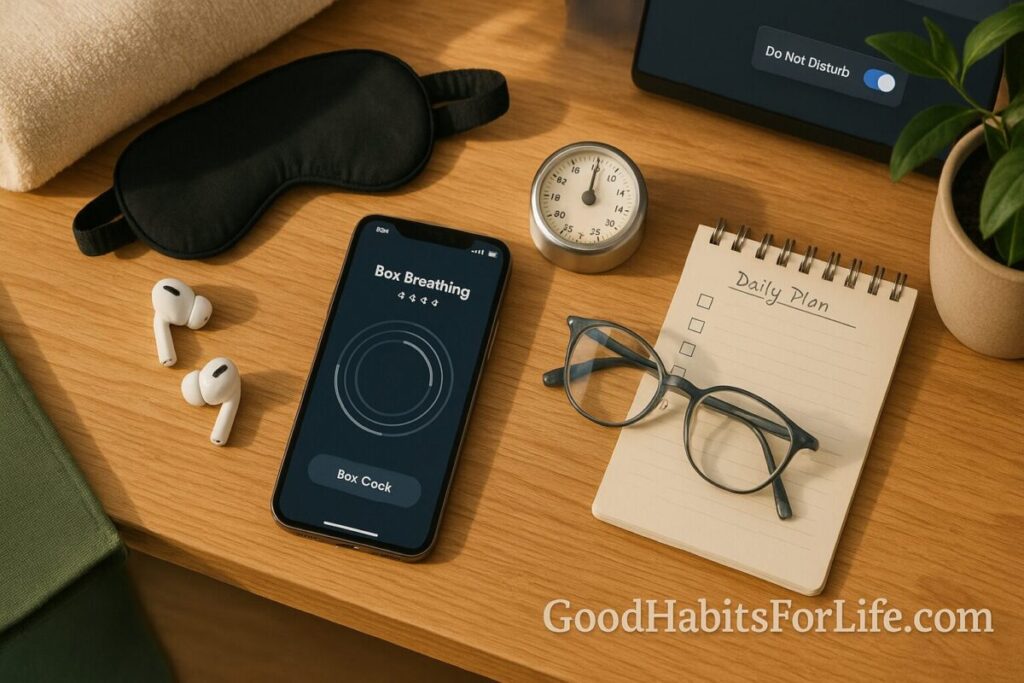
Recovery Apps: Breath, NSDR & Timers: Dopamine Detox (2025)
Recovery Apps: Breath, NSDR, Timers & Dopamine Detox (2025)
Table of Contents
🧭 What this guide covers & why it works
Scope. The term recovery apps here means three tool types you can run daily to down-shift your nervous system and regain focus:
-
Breathing apps (paced or box breathing),
-
NSDR/yoga nidra audios (non-sleep deep rest), and
-
Timers/blockers (Pomodoro, time-boxing, website/app blockers).
About “dopamine detox.” You can’t “detox” dopamine—your brain needs it. The popular phrase really means taking structured breaks from high-reward cues (e.g., endless feeds, autoplay, notifications) so those loops lose power. Think stimulus control + recovery rather than chemistry. Trusted sources below explain dopamine’s role in reward and why behavior and environment—not “flushing dopamine”—drive change.
Why it helps.
-
Paced breathing can increase heart-rate variability and reduce stress.
-
NSDR/yoga nidra supports relaxation and better sleep—both essential for workout recovery and cognitive performance.
-
Timers/time-boxing reduce decision fatigue and help you start (and stop) on time.
-
Blockers remove friction so your plan beats your impulses.
✅ Quick start (do this today)
-
Choose your trio (5 minutes).
-
Breath: pick a pacer you like.
-
NSDR: save one 10–20-min audio.
-
Timer: install a Pomodoro or time-box tool + one blocker.
-
-
Decide your daily slots (2 × 10 minutes).
-
AM: 6–10 min nasal breathing before messages.
-
PM: 10–20 min NSDR/yoga nidra before bed or post-work.
-
-
Create two automations.
-
Phone Focus/Do-Not-Disturb at chosen times.
-
Timer auto-starts with your first work block.
-
-
Put recovery before reward.
-
Breath → then check messages.
-
NSDR → then entertainment.
-
-
Track one simple metric.
-
“Recovery minutes/day” or “NSDR days/week.” Aim for 10–30 min/day total.
-
🛠️ 30-60-90 Recovery Roadmap
Days 1–30 (Stabilize — 10 min/day)
-
6 min paced breathing on wake.
-
10 min NSDR after lunch or before bed (pick one).
-
3–4 × 25-min timer blocks during work/study with 5-min micro-breaks.
-
One app/site blocker schedule (e.g., 22:30–08:00).
Days 31–60 (Build — 20 min/day)
-
8–10 min paced breathing + brief journal (“What matters today?”).
-
15–20 min NSDR 4–5 days/week.
-
Scale to 5–6 work blocks/day; add 20-20-20 eye breaks.
-
Add “urge surfing”: when craving a scroll, breathe 1 minute first.
Days 61–90 (Lock-in — 30 min/day)
-
10 min breathing and 20 min NSDR daily.
-
Time-box your evenings: 90-min “no-screen” wind-down (reading, stretch).
-
Review blocker logs weekly; tighten rules where most leaks occur.
-
Set a personal record target (e.g., 21-day NSDR streak).
🧠 Techniques & frameworks
-
Paced/Nasal Breathing. Try 4-1-6 (inhale 4s, hold 1s, exhale 6s) or box 4-4-4-4. Aim for 4–6 breaths/min during the practice.
-
NSDR / Yoga Nidra. Lie down; headphones optional. Follow a body scan + breath cue track for 10–30 minutes.
-
Pomodoro & Time-boxing. Classic 25/5, or 52/17, or three 90-min deep-work blocks. Pair with a blocker during focus.
-
Stimulus control. Remove cues that trigger high-dopamine loops: mute push alerts; move apps to a hidden page; use grayscale in evenings.
-
Implementation intentions. “If it’s 22:00, then I start NSDR.” “If I feel the pull to scroll, I first do 1 minute of 4-1-6 breathing.”
-
Ultradian rhythm. Many people focus best in ~90-min cycles; schedule a 5–10-min recovery between.
🧑🎓 Audience variations
-
Students: Shorter blocks (20/5), bedtime NSDR to improve sleep and memory consolidation; blockers on social apps during class hours.
-
Professionals: 52/17 schedule; NSDR after lunch to beat the afternoon dip; Focus mode auto-on in meetings.
-
Parents/Caregivers: 3×3-minute “micro-recoveries” (breath while the kettle boils, stroller walk, bedtime nidra); app timers synced with kids’ routines.
-
Seniors: Slower breathing pace; chair or side-lying NSDR; prioritize sleep-regularity and daylight walks.
-
Athletes/Lifters: NSDR on rest days; breath sessions post-workout to switch from sympathetic to parasympathetic; timer blocks for mobility work.
⚠️ Mistakes & myths to avoid
-
Myth: “Dopamine detox clears chemicals from your brain.”
Reality: You’re changing behaviors and cues, not your neurotransmitter levels. -
Overbreathing. Faster isn’t better; aim for slow, comfortable nasal breaths.
-
App hopping. One tool per category is enough—consistency beats novelty.
-
All-or-nothing blocks. Start with 10 minutes; scale after two stable weeks.
-
Ignoring sleep. Recovery apps support—but never replace—sleep, daylight, movement, and nutrition.
💬 Real-life scripts you can copy
-
Slack/Teams status: “🧠 Deep work 10:00–12:00—DM for urgent items.”
-
Family message: “I’m testing a 22:00 NSDR routine for 2 weeks—phone goes on Focus at 21:45.”
-
Calendar note: “Blocker On: 20:00–08:00 (Freedom/Focus).”
-
IFTTT/Shortcuts names: “Breathe First,” “Night Wind-Down,” “AM Deep Work.”
-
Self-cue card: “Craving scroll? 1 minute of 4-1-6, then decide.”
📚 Tools, apps & resources (quick pros/cons)
| Category | Examples (iOS/Android/Desktop) | Best for | Watch-outs |
|---|---|---|---|
| Breathing pacers | Breathwrk, Othership, Calm, Headspace, Healthy Minds | Guided sessions; visual pacers; habit streaks | Some require subscriptions; keep sessions short at first |
| NSDR / Yoga Nidra | Insight Timer (yoga nidra tracks), Waking Up (nidra), Balance, free university nidra recordings | Deep relaxation; pre-sleep | Try different narrator lengths; avoid if you fall asleep too early |
| Timers | Forest, Focus To-Do, TickTick, Toggl Track, Session, Rize | Pomodoro/time-boxing, analytics | Don’t over-optimize; keep a default block |
| Site/App blockers | Freedom, Focus (Mac), Opal, OneSec, StayFocusd/LeechBlock | Removing triggers during focus/sleep | Allow emergency bypass; review logs weekly |
| Eye & posture helpers | Stretchly, Workrave | Reminders for movement/20-20-20 | Over-frequent alerts can annoy—tune intervals |
(No affiliation; pick what fits your platform and budget.)
🔑 Key takeaways
-
Pair low-arousal practices (breath, NSDR) with structure (timers, blockers).
-
Treat “dopamine detox” as cue management, not chemistry.
-
Start with 10 minutes a day and one tool per category.
-
Automate start times; track one metric; review weekly.
-
Protect sleep; daylight + movement amplify everything.
❓ FAQs
1) What’s the difference between NSDR and meditation?
NSDR/yoga nidra is typically guided, body-scan oriented, and done lying down for deep relaxation; meditation is broader and often seated. Both can reduce stress.
2) How many minutes of breathing or NSDR do I need?
Start with 6–10 min breathing and 10–20 min NSDR most days. Consistency matters more than duration.
3) Which breathing pattern is best?
Any comfortable slow, nasal pattern works. Many people like 4-1-6 or box 4-4-4-4. If dizzy, slow down and breathe normally.
4) Is “dopamine detox” safe?
Taking breaks from high-stimulation apps is generally safe and helpful. It’s not a medical detox; it’s behavior change and stimulus control.
5) Are Pomodoro timers scientifically proven?
Timers help by reducing decision friction and encouraging breaks. Evidence supports time-management and break-taking for performance and well-being, though the exact ratio is personal.
6) Can I stack NSDR after workouts?
Yes—10–20 minutes post-workout can enhance recovery by shifting you into a parasympathetic state and improving sleep later.
7) Do I need paid apps?
No. Many excellent breathing pacers, nidra tracks, timers, and blockers have free tiers. Pay for convenience, not necessity.
8) What if I fall asleep during NSDR?
It’s common—especially at night. If you need alert relaxation, try earlier in the day or shorter tracks (10–12 min).
9) Will blockers hurt my creativity?
Blockers protect focus windows. Keep unblocked “wander time” elsewhere in your day for exploration.
10) How soon will I notice benefits?
Many people feel calmer after the first session and see better focus/sleep within 1–2 weeks of daily practice.
References
-
National Institute on Drug Abuse (NIDA). The Role of Dopamine in Reward. https://nida.nih.gov
-
MedlinePlus (NIH/NLM). Diaphragmatic Breathing. https://medlineplus.gov/ency/article/002496.htm
-
NCCIH (NIH). Meditation: What You Need To Know. https://www.nccih.nih.gov/health/meditation-what-you-need-to-know
-
American Academy of Sleep Medicine. Relaxation Techniques for Insomnia. https://sleepeducation.org
-
Harvard Health Publishing. The Benefits of Controlled Breathing. https://www.health.harvard.edu
-
PubMed. Yoga Nidra and Sleep/Stress Outcomes (systematic and clinical evidence). https://pubmed.ncbi.nlm.nih.gov/?term=yoga+nidra+sleep
-
WHO. Guidelines on Physical Activity and Sedentary Behaviour. https://www.who.int
-
American Psychological Association. Time Management / Procrastination (evidence & techniques). https://www.apa.org
-
University learning centers (e.g., UT Austin Sanger). Pomodoro & Time-Boxing Study Strategies. https://ugs.utexas.edu/learningcenter
-
American Optometric Association. 20-20-20 Rule for Digital Eye Strain. https://www.aoa.org
Disclaimer: This guide is for educational purposes and is not medical advice; consult a qualified professional if you have health, sleep, or mental-health concerns.