
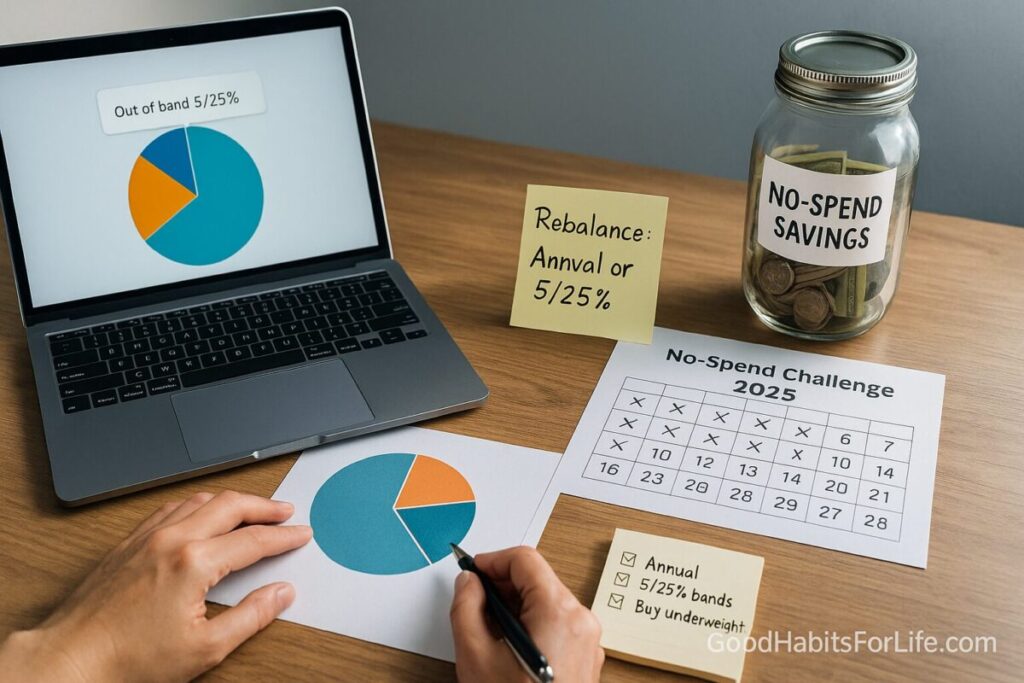
Rebalancing Rule: Once a Year or 5/25% Bands: No-Spend Challenge (2025)
Rebalancing Rule: Annual or 5/25% Bands + No-Spend (2025)
Table of Contents
🧭 Overview
This guide shows you exactly when to rebalance—either on a once-a-year calendar or using 5/25% tolerance bands—and how to pair it with a 30-day No-Spend Challenge to generate fresh cash for rebalancing buys. You’ll get a practical plan, scripts, and tools to lock this in as a sustainable good habit.
✅ What & Why
What is rebalancing?
Rebalancing is restoring your portfolio to its target asset mix after markets shift. It maintains your intended risk level so you’re not accidentally taking on more risk just because one asset rallied. Vanguard
Why it matters (evidence):
-
Risk control: Keeping allocations near target helps you stick to your plan through cycles. Schwab Brokerage
-
Cost/risk trade-off: Wider bands reduce trading costs but allow more drift; tighter bands track targets closely but may lower returns after costs. CFA Institute
-
What “usually works”: Research finds annual rebalancing works well for many investors because it limits turnover and costs. Vanguard
-
When thresholds help: Studies on threshold-based approaches (like 5/25) show potential advantages over strict calendars by trading only when misweights are meaningful. Vanguard
⚡ Quick Start (Do This Today)
-
Write your target mix (e.g., 60% global stocks / 40% bonds).
-
Choose a rule you’ll stick to
-
Annual: Rebalance on the same date each year (e.g., 15 January). Vanguard
-
5/25% bands:
-
If a target slice is ≥20%, rebalance if it drifts ±5 percentage points.
-
If a target slice is <20%, rebalance if it drifts ±25% of its target (relative). Bogleheads
-
-
-
Turn on a 30-day No-Spend Challenge in your life budget to build cash for rebalancing buys (use a government worksheet to track). consumer.gov
-
Use new contributions/dividends first to fix drifts; sell only if needed (mind taxes/fees). Vanguard
-
Schedule a reminder (calendar + IPS). Stick to the rule—no guesswork.
🛠️ 30-60-90 Day Habit Plan
Days 0–30 (Foundation + No-Spend Month):
-
Draft a one-page Investment Policy Statement (IPS) with: targets, bands, review date, tax priorities.
-
Run a 30-day No-Spend Challenge (freeze chosen discretionary categories; route savings to a “Rebalance Cash” sub-account). Use a simple, accessible budget worksheet to measure your savings. consumer.gov
-
Implement auto-contributions aligned to your targets (e.g., 60/40 split).
-
If using annual, note your exact review date. If using 5/25, set alerts in your tracker.
Days 31–60 (Execution):
-
Deploy your “Rebalance Cash” to buy underweight assets—prefer buys over sells to reduce taxes. Vanguard
-
In taxable accounts, harvest losses (where appropriate) and avoid unnecessary short-term gains.
-
Document each trade in your IPS log.
Days 61–90 (Refine & Automate):
-
Add alerts (portfolio app/spreadsheet) that flag bands breaches.
-
If you chose annual, add a semi-annual check (no trades unless bands breached) to stay aware without over-trading. Vanguard
-
Run a shorter 7-day mini no-spend tune-up if you need extra cash to finish rebalancing.
🧠 Techniques & Frameworks
1) Calendar vs. Threshold (5/25%)
-
Annual: Simple, low-maintenance; historically efficient for many investors after costs. Vanguard
-
5/25% bands: Act only when drift is meaningful; reduce “noise” trades. Bogleheads
-
Evidence edge: Threshold strategies can outperform rigid calendar rules by trading when it matters. Vanguard
2) Opportunistic Rebalancing
Check often but trade only when bands trip; classic research shows this can control risk and potentially enhance returns by capturing volatility. Financial Planning Association
3) Cost-aware sequencing
-
Use new contributions, dividends, and cash first.
-
Then exchange within tax-advantaged accounts.
-
Sell in taxable only as a last step. (This ordering manages taxes/turnover.) Vanguard
4) Practical 5/25% Examples
| Target slice | Band type | Rebalance if… | Example trigger |
|---|---|---|---|
| 60% Stocks | 5% absolute | <55% or >65% | Sell/buy to return near 60% |
| 40% Bonds | 5% absolute | <35% or >45% | Offset stock moves |
| 10% REITs | 25% of target | <7.5% or >12.5% | 25% × 10% = 2.5% band |
| 30% Intl Stocks | 5% absolute | <25% or >35% | 5 pts around target |
(Definition and logic of 5/25% bands per Bogleheads community canon.) Bogleheads
5) Behavior design: the No-Spend tie-in
A time-boxed spending freeze boosts available cash to buy underweights, so you can often rebalance without selling (reducing taxes/fees). Use simple public worksheets or toolkits to plan and track this month. consumer.govConsumer Financial Protection Bureau
6) Institutional context (FYI)
Large managers use formal rebalancing policies; recent research explores optimal thresholds for multi-asset portfolios and target-date funds, supporting threshold-based approaches. Vanguard+1Vanguard
👥 Audience Variations
-
Students/early-career: Start with annual + wide bands; prioritize automation and low costs. Use No-Spend month to seed buys.
-
Parents (busy schedules): One annual date anchored to tax/financial calendar; auto-contributions do most of the work.
-
Professionals with equity comp: Consider threshold approach; set a rule to direct vesting cash to underweights quarterly.
-
Seniors/retirees: Coordinate rebalancing with withdrawal strategy (e.g., sell overweights to fund withdrawals), while monitoring risk targets.
⚠️ Mistakes & Myths to Avoid
-
Myth: “More frequent = better.”
Over-trading can raise costs/taxes without better risk-adjusted results; annual often suffices. Vanguard -
Mistake: No written rule. Without an IPS, emotions creep in.
-
Mistake: Selling first in taxable. Try contributions/dividends/cash before realizing gains. Vanguard
-
Myth: “Never rebalance in volatile markets.”
Thresholds are designed for volatility—trade only when drift is material. Vanguard
🗣️ Real-Life Examples & Scripts
Example A — Annual 60/40:
-
15 Jan each year: Compare to target. If 65/35, sell 5 pts of stocks to bonds (prefer inside retirement account). Log in IPS.
Example B — 5/25% Bands, 70/20/10 (US/Intl/REITs):
-
Trigger if: US >75% or <65%; Intl >25% or <15%; REITs >12.5% or <7.5%. Buy/sell only the slice that breached.
Email script to adviser/broker:
“Per my IPS, please rebalance to 60/40 using new cash and dividends first. If sales are required, prioritize tax-advantaged accounts; in taxable, use highest-basis lots. Only trade the asset(s) that breached bands. Confirm execution notes for my records.”
No-Spend Challenge checklist (30 days):
-
Freeze 3–5 categories (e.g., eating out, apparel, gadgets).
-
Track daily with a one-page worksheet; move savings weekly to “Rebalance Cash.” consumer.gov
-
End of month: deploy cash to underweights.
📚 Tools, Apps & Resources
-
Budgeting & cash-build:
-
Consumer.gov Budget Worksheet (simple, printable). consumer.gov
-
CFPB “Your Money, Your Goals” Toolkit (practical worksheets, guides). Consumer Financial Protection Bureau
-
MoneyHelper (UK, gov-backed) guides & calculators. MaPS
-
-
Broker/portfolio:
-
Most brokers and retirement platforms offer allocation views and sometimes auto-rebalancing; check their help centers.
-
For DIY tracking, use a spreadsheet with conditional formatting that flags ±5 pts or ±25% of target breaches.
-
-
Reading & policy design:
-
Vanguard’s guides on rebalancing policies and TDF thresholds. VanguardVanguard
-
CFA Institute primers on asset allocation and tolerance bands. CFA Institute
-
🔑 Key Takeaways
-
Pick one rule you can follow: Annual for simplicity, 5/25% for precision.
-
Use No-Spend months to build cash that powers buy-side rebalancing. consumer.gov
-
Sequence trades: cash → tax-advantaged → taxable. Vanguard
-
Document everything in your IPS; consistency beats tinkering.
-
The goal isn’t to chase returns—it’s to keep risk on target.
❓ FAQs
1) Which is “better”: annual or 5/25%?
Neither is universally best. Annual is easy and effective; 5/25% trades only when drift is meaningful and may improve results after costs in some settings. Pick one you’ll follow. VanguardVanguard
2) How exactly do 5/25% bands work?
If a slice’s target ≥20%, rebalance if it drifts ±5 percentage points. If <20%, rebalance if it drifts ±25% of its target (e.g., 10% target → 7.5–12.5%). Bogleheads
3) How do I minimize taxes?
Favor buys using new cash, then adjust in tax-advantaged accounts; sell in taxable only if necessary. Vanguard
4) Should I rebalance during a crash?
If your bands trigger, yes—rules exist for volatile times too. Threshold-based policies are built to act on material drifts. Vanguard
5) How often should I check if I use bands?
You can check monthly/quarterly, but trade only when bands are breached (opportunistic approach). Financial Planning Association
6) Can I automate rebalancing?
Some platforms offer auto-rebalancing (calendar/threshold). If not, automate alerts and contributions and follow your IPS.
7) Where do I get a simple budget tool for the No-Spend month?
Use public worksheets from Consumer.gov or the CFPB toolkit to set targets and track savings. consumer.govConsumer Financial Protection Bureau
8) Do institutions actually use thresholds?
Yes. Research on target-date funds and multi-asset portfolios supports threshold-based rebalancing frameworks. Vanguard+1
📚 References
-
Vanguard Investor Education — “Rebalancing your portfolio.” Vanguard
-
Vanguard Research — Rational rebalancing: An analytical approach to multiasset portfolio rebalancing. Vanguard
-
Vanguard Research — Optimizing target-date fund rebalancing through threshold-based strategies. Vanguard
-
CFA Institute — Principles of Asset Allocation (tolerance bands and cost/risk trade-offs). CFA Institute
-
Charles Schwab — “Rebalancing in Action.” Schwab Brokerage
-
Bogleheads Wiki — “Rebalancing” (5/25% tolerance bands definition & examples). Bogleheads
-
Daryanani, G. (2008). Opportunistic Rebalancing: A New Paradigm for Wealth Managers. Journal of Financial Planning. Financial Planning Association
-
Consumer.gov — “Budget Worksheet” (build No-Spend cash). consumer.gov
-
CFPB — “Your Money, Your Goals” Toolkit. Consumer Financial Protection Bureau
-
Vanguard (Global) — Getting back on track: A guide to smart rebalancing. vanguardsouthamerica.com
⚖️ Disclaimer
This guide is educational and not financial advice; consider your circumstances or consult a licensed adviser before acting.