
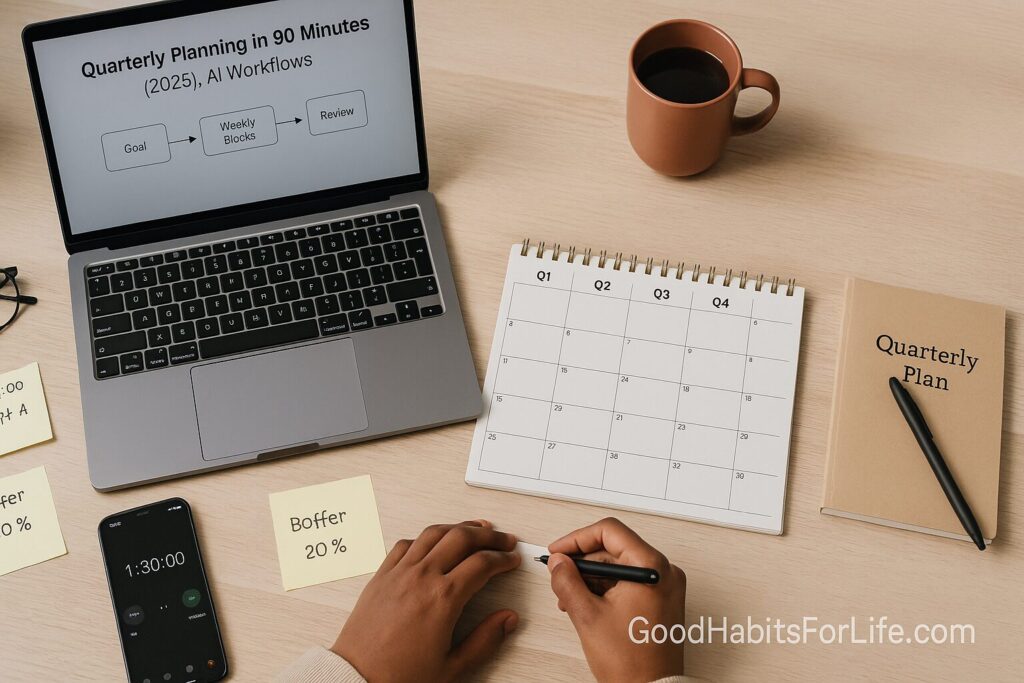
Quarterly Planning in 90 Minutes: AI workflows (2025)
Quarterly Planning in 90 Minutes (2025): AI Workflows
Table of Contents
🧭 What “Quarterly Planning in 90 Minutes” Means (and Why It Works)
Quarterly planning condenses annual ambitions into a focused 13-week sprint. You define a small set of outcomes (not tasks), choose leading metrics, and block weekly time to execute. The approach taps classic goal-setting research: specific, challenging goals improve performance—especially when paired with feedback and commitment. Stanford Medicine
Turning outcomes into “implementation intentions” (if-then plans) boosts follow-through by pre-deciding when/where you’ll act (e.g., “If it’s Tue 9:00, then I start Draft A”). Meta-analysis shows this reliably increases goal attainment. ScienceDirectResearchGate
Protecting time with calendar blocks matters because multi-tasking is largely task-switching, which adds switch costs and lowers performance; focusing on one task at a time is more effective. apa.org+1
Finally, you’ll plan with buffers. Humans chronically underestimate timelines (the “planning fallacy”), so good quarterly plans explicitly add contingency time. Massachusetts Institute of Technologyspsp.org
✅ The 90-Minute Agenda (minute-by-minute)
Prep (before you start): Export last quarter’s metrics (traffic, revenue, health, learning hours, etc.), project boards, and notes into one document.
0–10 min — Clarify the theme.
-
Pick a quarter theme (e.g., “Finish & Ship,” “Move More,” “Pipeline First”).
-
Write a one-sentence intent.
10–25 min — AI Recap & Insights.
-
Paste raw notes/metrics into your AI. Prompt:
“Summarize wins, misses, bottlenecks, and 3–5 themes. Suggest leading metrics and risks for next quarter.” -
Skim the summary; highlight what resonates.
25–45 min — Draft OKRs (3 max).
-
Objective = qualitative outcome; Key Results = 2–3 measurable indicators that move weekly. Use leading indicators when possible. The OKR method is widely used because it aligns measurable results to objectives and cadence. Atlassian
45–60 min — Pre-mortem & constraints.
-
Ask AI: “Run a pre-mortem. It’s Q-end and we failed. List top 10 reasons, early warning signals, and mitigations.”
-
Add buffers (10–30%) to critical paths to counter optimism bias. Massachusetts Institute of Technology
60–80 min — Timebox the work.
-
Convert key results into recurring Deep Work blocks (e.g., Tue & Thu 90-minute sessions) and a 30-minute Weekly Review. Timeboxing beats to-do lists for most people. Harvard Business Review
80–90 min — Lock Week 1–2.
-
Put the next two weeks on your calendar (tasks + reviews) and send yourself a one-page plan.
🗺️ A 30-60-90 Roadmap for the Quarter
Days 1–7 (Orientation)
-
Ship quick wins (≤2 hours each) to build momentum.
-
Validate KPIs and dashboards.
-
Write your implementation intentions for the top three habits:
“If it’s Mon 07:30, then 30-min walk; If it’s Tue/Thu 09:00, then Deep Work block 1; If it’s Fri 16:00, then Weekly Review.” Implementation intentions help automate initiation. ScienceDirect
Days 8–45 (Build)
-
Two Deep Work blocks/week dedicated to your main objective.
-
Weekly Review: check metrics, clear blockers, re-timebox next week.
Days 46–75 (Optimize)
-
Reduce scope creep; prune non-essentials.
-
Add a mid-quarter pre-mortem; recalibrate buffers.
Days 76–90 (Finish & Hand-off)
-
Freeze new scope. Close loops, document, and schedule Q+1 kickoff.
🧠 Techniques & Frameworks that Multiply Results
OKRs done simply. Keep 3 Objectives max; 2–3 Key Results each; review weekly. Prefer leading indicators (e.g., “publish 2 articles/week”) to lagging (“+10k pageviews”). Atlassian
Timeboxing & Deep Work. Move key tasks from lists to your calendar. It reduces context switching and stress; HBR reports timeboxing as the most useful of 100 hacks surveyed. Pair with 60–90-minute blocks (breaks between). Harvard Business Review
Counter the Planning Fallacy. Use outside-view estimates, pre-mortems, and add 10–30% buffer to critical tasks. Massachusetts Institute of Technology
Habit science. Repeat the same behavior in the same context; let cues and environment carry you. Habits run as efficient defaults alongside deliberate goals. Design stable triggers (same time/place) for review and deep-work blocks. annualreviews.orgUSC Dornsife
Monotasking beats multitasking. Protect blocks; close apps; one tab per block. APA overviews why task switching undermines efficiency. apa.org
🤖 AI Workflows: Prompts & Automations You Can Copy-Paste
1) Data recap & insights
“You are my Quarter Review Analyst. Using the data below, produce:
• 5-bullet Wins • 5-bullet Misses • Bottlenecks • 3–5 Themes • Suggested leading metrics • Risks + mitigations. Data: [paste]”
2) OKR drafts (you will edit)
“Draft 3 Objectives with 2–3 measurable Key Results each. Make KRs weekly-trackable and mostly leading indicators. Include baseline and 13-week targets.”
3) Pre-mortem
“It’s the end of the quarter and we failed. List 10 likely causes, early warning signs by week, and specific counter-measures I can schedule now.”
4) Timeboxing plan
“Turn these Key Results into a two-block/week calendar plan (60–90 minutes each) for 13 weeks, plus a 30-minute Weekly Review. Output as a table with dates for the next two weeks.”
5) Weekly Review checklist (auto-generated)
“Create a 10-minute Weekly Review checklist tied to my KRs; include metrics to check, a ‘stop doing’ list, and a small celebration ritual.”
6) Content/project decomposition
“Decompose Objective X into milestones, deliverables, and realistic buffers (assume 10–30% contingency to avoid planning fallacy).”
👥 Variations for Students, Professionals, Solopreneurs & Teams
-
Students: Objectives = courses/skills; KRs = study hours, practice sets, drafts. Timebox by course; weekly review Sun evening.
-
Busy professionals: Objectives map to OKRs or KPIs; protect two calendar blocks/week. Batch email and meetings on non-deep-work days.
-
Solopreneurs: One revenue Objective, one brand Objective. Automate reporting; review cash and pipeline weekly.
-
Teams: Run a 2-hour team session to align OKRs, owners, and cross-dependencies; publish a one-page plan to the workspace.
⚠️ Mistakes & Myths to Avoid
-
Too many goals. More than 3 Objectives dilutes focus.
-
Task lists without calendar blocks. If it isn’t timeboxed, it’s wishful.
-
Lagging metrics only. Use weekly controllable inputs.
-
No buffers. Optimism bias is real—plan margin. Massachusetts Institute of Technology
-
Skipping reviews. Weekly feedback loops are non-negotiable.
-
Letting AI decide everything. AI drafts; you judge.
💬 Real-Life Examples & Scripts
Example 1 — Personal health & energy
-
Objective: Feel energetic and focused daily.
-
KRs:
-
8,000+ steps/day average;
-
3× strength sessions/week;
-
Lights out by 23:00, 5 nights/week.
-
-
Implementation intention: “If it’s Mon/Wed/Fri 07:00, then 40-min strength.” (Paste into calendar as recurring.)
Example 2 — Content & growth (solo creator)
-
Objective: Publish consistently and grow organic traffic.
-
KRs:
-
Publish 2 articles/week;
-
Ship 1 email newsletter/week;
-
Reach 100 internal links to pillar pages.
-
-
Timeboxing: Tue/Thu 09:00–10:30 Deep Work; Fri 16:00 Review.
Weekly Review Script (10 minutes)
-
Update KR metrics (2 min)
-
What worked/blocked me? (2 min)
-
Stop/Start/Continue—1 each (3 min)
-
Timebox next week (2 min)
-
Celebrate one micro-win (1 min)
🧰 Tools, Apps & Resources
-
Planning/OKRs: Notion, ClickUp, Asana, Jira (teams). Pros: shared visibility; templates. Cons: setup time.
-
Calendars & timeboxing: Google Calendar/Outlook; add focus statuses. Pros: friction-free; cross-device. Cons: easy to overbook.
-
Habit trackers: Streaks, Loop, Apple Shortcuts. Pros: cue consistency. Cons: can become busywork.
-
AI co-pilots: ChatGPT, Notion AI. Pros: summarization, decomposition. Cons: you must verify.
-
Dashboards: Google Looker Studio, Airtable. Pros: live metrics. Cons: data hygiene required.
🔑 Key Takeaways
-
Narrow to 3 Objectives, 2–3 KRs each; prefer weekly, leading indicators.
-
Timebox two Deep Work blocks and a Weekly Review—in your calendar.
-
Use implementation intentions and stable cues to turn actions into habits. ScienceDirectannualreviews.org
-
Run a pre-mortem and add buffers to beat the planning fallacy. Massachusetts Institute of Technology
-
Let AI draft recaps, KRs, and schedules—you edit and decide.
❓ FAQs
1) How many goals should I set for a quarter?
Three Objectives is a practical upper bound for individuals; more fragments focus and increases switch costs. apa.org
2) Should Key Results be outputs or outcomes?
Use a mix, but bias to leading indicators you can control weekly (e.g., “publish 2 posts/week”) over lagging outcomes (“+10k visits”). Atlassian
3) What block length works best for Deep Work?
Aim for 60–90 minutes. Pair with short breaks. Timeboxing outperforms loose to-do lists for most people. Harvard Business Review
4) How do I avoid underestimating timelines?
Use outside-view estimates, add 10–30% buffers, and schedule a mid-quarter recalibration. Massachusetts Institute of Technology
5) Do I really need a weekly review?
Yes—feedback increases goal effectiveness; it keeps KRs visible and lets you re-timebox proactively. Stanford Medicine
6) Is multitasking ever OK?
For routine tasks, maybe—but for important work, task switching reduces efficiency; monotasking inside timeboxes wins. apa.org
7) What if I miss a week?
Resume at the next review; don’t “make up” everything—re-prioritize the next two weeks and continue.
8) Can teams do this in 90 minutes?
Use a 2-hour version: 30-min recap, 40-min OKRs, 20-min pre-mortem, 20-min timeboxing, 10-min next-steps. Reference an OKR cadence and publish a one-pager. Atlassian
📚 References
-
Locke & Latham. Building a Practically Useful Theory of Goal Setting and Task Motivation. (review). https://med.stanford.edu/content/dam/sm/s-spire/documents/PD.locke-and-latham-retrospective_Paper.pdf Stanford Medicine
-
Gollwitzer & Sheeran. Implementation Intentions and Goal Achievement (Meta-analysis). https://www.sciencedirect.com/science/article/pii/S0065260106380021 ScienceDirect
-
American Psychological Association. Multitasking: Switching costs. https://www.apa.org/topics/research/multitasking apa.org
-
Buehler, Griffin, & Ross (1994). Exploring the “planning fallacy.” https://web.mit.edu/curhan/www/docs/Articles/biases/67_J_Personality_and_Social_Psychology_366%2C_1994.pdf Massachusetts Institute of Technology
-
Atlassian. OKRs: The ultimate guide. https://www.atlassian.com/agile/agile-at-scale/okr Atlassian
-
Zao-Sanders, HBR. How Timeboxing Works and Why It Will Make You More Productive. https://hbr.org/2018/12/how-timeboxing-works-and-why-it-will-make-you-more-productive Harvard Business Review
-
Wood & Rünger (2016). Psychology of Habit (Annual Review of Psychology). https://www.annualreviews.org/docserver/fulltext/psych/67/1/annurev-psych-122414-033417.pdf annualreviews.org
-
Wood, Mazar & Neal (2021). Habits and Goals in Human Behavior. https://dornsife.usc.edu/wendy-wood/wp-content/uploads/sites/183/2023/10/Wood.Mazar_.Neal_.2021.pdf USC Dornsife