
PullUp Without a Bar (2025 Hacks)
Pull-Ups Without a Bar: 2025 Hacks
Table of Contents
🧭 What “Pull-Ups Without a Bar” Really Means
“Pull-up pattern” = pulling the body (or load) toward the torso with shoulder extension/adduction and elbow flexion. You can train that pattern without a fixed bar by mixing:
-
Isometrics (max or near-max holds against an immovable object or using straps/doors)
-
Horizontal pulls/rows (under tables, with straps, or TRX-style)
-
Vertical pulls with bands/anchors (kneeling “lat-pulldown” using a door strap)
-
Scapular control & grip (band pull-aparts, Y-T-W raises, hangs or towel grips)
Why it works:
-
Isometric training increases strength at and around the joint angle trained and can deliver solid neuromuscular gains—especially at longer muscle lengths. PubMed
-
Eccentrics (slow lowering) are highly effective for strength and hypertrophy; you can mimic them with rows or banded pulldowns at home. PubMed
-
Rows & suspension work produce meaningful activation of back and scapular stabilizers, closely supporting pull-up strength. PMC+1
-
Grip/upper-back accessories (band pull-aparts, scapular depressions) reinforce the key “shoulders-down, chest-up” pattern seen in successful pull-ups. EMG studies of pull-up variations also show robust lat/upper-back involvement. PubMed
Public health guidance also reminds us to include muscle-strengthening work at least 2 days/week—so your “no-bar pull-up” plan fits broader health goals. PMC
✅ Quick Start: Do-This-Today Mini Plan (15–20 minutes)
Warm-up (3–4 min)
-
Shoulder circles, band pull-aparts × 20, scapular wall slides × 10, cat-camel × 6.
A) Vertical-Pull Isometric (3 sets)
Choose one:
-
Door-strap kneeling pulldown hold: Loop a long towel/sheet over the hinge-side of a sturdy door (close it firmly). Kneel, grab both ends, lean back until arms are long, then pull “down and back” to a strong position. Hold 20–30 s, rest 45–60 s.
-
Towel “row-lean” against a post/beam: Wrap towel around a solid column, lean back to create tension, then hold with shoulders depressed and elbows slightly bent.
B) Inverted Row Variation (3 sets)
Pick one based on what you have:
-
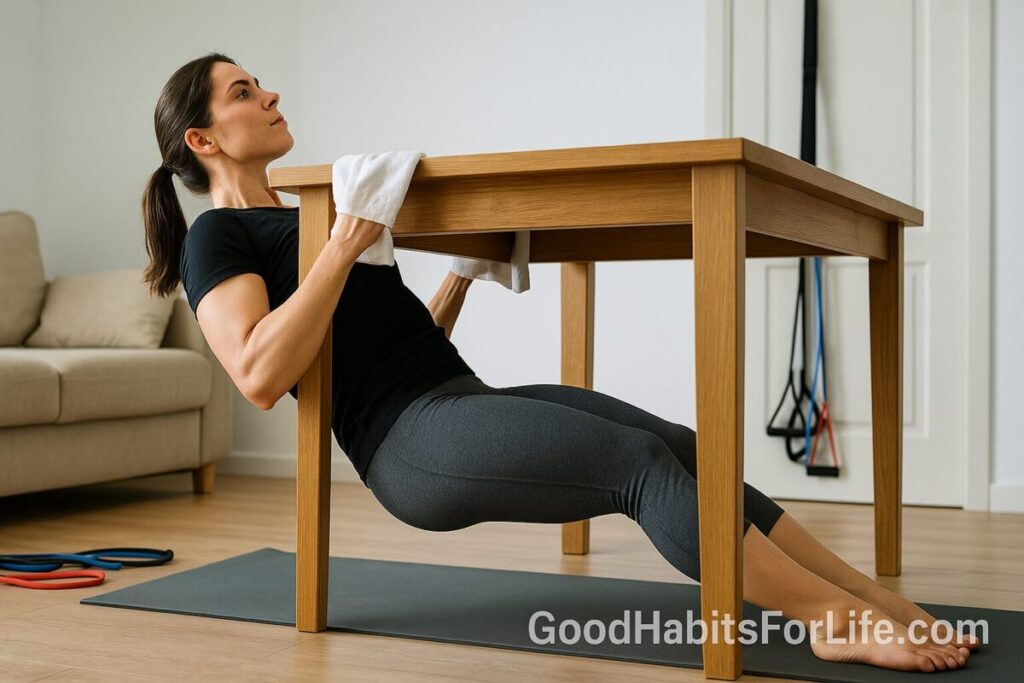
Under-table row: Lie under a solid table, grasp its edge, keep body rigid, pull chest to edge. 6–10 reps (3–5 s lowering).
-
Suspension/strap row: If you have TRX-style straps, set mid-length, heels on floor, body straight. 8–12 reps.
C) Accessories (1–2 sets each)
-
Band pull-aparts × 20
-
Prone Y-T-W (on floor) × 6 each
-
Farmer’s carry (two heavy bags/backpacks) × 30–60 m (100–200 ft)
Cues:
“Shoulders down (depress), ribcage tall, elbows to ribs, drive with the back, and slow lowering.”
🗺️ 30-60-90 Day Habit Roadmap
Training frequency: 2–3 sessions/week (non-consecutive days). Each takes 20–30 minutes.
Progression dial: When you hit the top of a rep/time range with control, progress the lever (harder angle), add seconds, or choose the next level.
Days 0–30: Foundations & Time-Under-Tension
-
A) Isometric vertical pulls: 4×20–30 s holds
-
B) Inverted rows (knees bent): 4×6–10 (3–5 s eccentric)
-
C) Accessories: band pull-aparts 2×20; Y-T-W 2×6
-
Checkpoint: 30-s strong hold + 10 clean inverted rows
Days 31–60: Harder Angles & Slow Eccentrics
-
A) Isometric holds at slightly longer muscle length (lean further) 4×25–35 s
-
B) Inverted rows (legs straight or feet elevated 15–30 cm / 6–12 in): 4×6–10
-
C) Eccentric-only rows: pull up with both hands, lower 5–6 s; 3×4–6
-
Checkpoint: 10–12 feet-elevated rows + 35-s isometric
Days 61–90: Specificity & Assisted Pulls (Still No Fixed Bar)
-
A) Kneeling “lat-pulldown” with band + door anchor: 4×6–10 (pause 1 s at chest; lower 3–4 s)
-
B) Single-arm strap/towel rows: 3×5–8/side (light assistance from legs)
-
C) Isometric top-position holds: shorten strap so your elbows are ~90°, hold 20–30 s × 3–4
-
Optional field test (if you find a playground/rings): Try strict pull-ups—no kipping. Use a band for assistance if needed.
-
Checkpoint: 8–10 strong pulldown reps @ controlled tempo + 30-s top-hold
Why this works: isometrics plus slow eccentrics build force production and control; rows and suspension pulls teach scapular depression/retraction under bodyweight—transferable to pull-ups. PubMed+1PMC
🛠️ Techniques & Frameworks that Work
1) Isometric Framework (20–40 s)
-
Positions to hold:
-
Top (elbows ~90°, shoulders down),
-
Mid (elbows ~120–140°),
-
Long (arms nearly straight, maintain shoulder “packed”).
-
-
Protocol: 3–4 sets/position, 45–75 s rest.
-
Progress: Add 5 s per week or lean further to lengthen the muscle.
-
Why it matters: Longer muscle-length isometrics can produce robust hypertrophy/strength adaptations. PubMed
2) Eccentric Emphasis (3–6 s lowering)
-
Apply to rows and band pulldowns.
-
Start with 3 s down, build to 6 s down.
-
Limit total reps (4–8) to manage soreness.
-
Why: Eccentrics are powerful for strength and muscle gain. PubMed
3) Row Angle Ladder (from easy → hard)
-
Knees bent → Legs straight → Feet elevated 15–45 cm (6–18 in) → One-arm assisted.
-
Keep ribs down, neck long, and finish with shoulders back + chest high. Suspension and inverted rows show strong back/scapular activation supportive of pull-up strength. PMC
4) Scapular Control & Grip
-
Scapular depressions on straps (mini-shrug down), band pull-aparts, prone Y-T-W, farmer’s carries, towel holds.
-
Closed-chain upper-body work recruits trunk/shoulder musculature in functional patterns. PMC
5) Session Template (20–30 min)
-
Warm-up (3–4 min)
-
Main A: Isometric vertical pull (4×20–40 s)
-
Main B: Row ladder (4×6–12, tempo 3–1–3)
-
Accessory: Pull-apart + Y-T-W (superset, 2–3 rounds)
-
Grip finisher: 1–2 carries or 20–30 s towel squeeze
🧑🤝🧑 Variations for Different People & Settings
-
Beginners / detrained: Use higher table rows or very upright strap rows; isometric holds at shorter levers (less lean).
-
Plus-size: Prioritize strap rows with adjustable foot position to match strength today; longer isometrics (15–25 s) before chasing reps.
-
Seniors: Focus on scapular control, band pulldowns, and farmer’s carries. Keep tempos slow; avoid maximal straining.
-
Students/travelers: Pack a light long loop band + door anchor; you can train anywhere.
-
Athletes: Add feet-elevated rows, one-arm strap rows, and heavier carries; use 2–3 min rests for strength focus.
-
Shoulder-sensitive: Emphasize neutral-grip rows, shorter ranges that are pain-free, and more scapular work (depressions/pull-aparts). Consider consulting a professional if symptoms persist.
⚠️ Mistakes & Myths to Avoid
-
“No bar = no progress.” False—strength is angle- and pattern-specific; isometrics/eccentrics and rows transfer well. PubMed+1
-
Shrugging up / neck jammed. Instead, think “shoulders down, pockets back.”
-
Rushing reps. Time-under-tension is your friend; use 3–5 s eccentrics.
-
Sketchy setups. Don’t balance a broom across chairs. Use solid tables, door hinge side anchors, or reputable straps.
-
Pure biceps pulling. Aim elbows to ribs, chest proud, feel lats/low traps engage.
-
Overdoing frequency. 2–3 focused sessions/week beat daily junk volume. WHO/CDC suggest muscle-strengthening ≥2 days/week. PMCCDC
💬 Real-Life 10-Minute Circuits (Copy/Paste)
Hotel Room / Dorm (10 min EMOM)
-
Min 1: Door-strap kneeling pulldown hold 30 s → rest 30 s
-
Min 2: Strap/table rows 8 slow reps (3 s down)
-
Alternate for 10 minutes; finish with pull-aparts × 25
Living Room Ladder (x2 rounds, ~10–12 min)
-
Isometric vertical pull 25–35 s
-
Inverted rows 6–10
-
Y-T-W 6 each
-
Farmer’s carry (two bags) 40–60 m (130–200 ft)
Outdoor Park
-
Strap rows on a sturdy railing, single-arm assisted rows, band face-pulls, carry a backpack for distance. (If you find safe rings/monkey bars, test a strict attempt.)
🧰 Tools & Minimal Gear (Pros/Cons)
| Tool | Why it helps | Pros | Cons |
|---|---|---|---|
| Long loop band + door anchor | Vertical pulling (kneeling pulldown), face-pulls | Cheap, portable | Needs solid door; anchor placement matters |
| Suspension straps (TRX or budget) | Adjustable angle rows, isometrics | Super versatile; scales to any level | Cost > band; needs anchor point |
| Towel/sheet | Door or post anchors for holds/rows | Free, available anywhere | Friction & slip risk—test thoroughly |
| Heavy backpack/bags | Carries, row loading | No special gear | Limited for vertical pulling |
🔑 Key Takeaways
-
You can build pull-up strength at home using isometrics + rows + bands, no bar required.
-
Emphasize scapular depression, slow eccentrics, and progressive angles.
-
Train 2–3×/week, 20–30 minutes, and follow the 30-60-90 roadmap.
-
Prioritize safe anchors and time-under-tension; test lever changes conservatively.
-
When you do find a bar, your first strict pull-ups will come faster.
❓ FAQs
1) Can rows really help my pull-ups?
Yes. Rows (especially suspension/closed-chain) hit lats, mid/low traps, rhomboids, and posterior delts—key for scapular control and pulling strength. PMC+1
2) How long should I hold isometrics?
Start with 20–30 s holds, build to 30–40 s. Longer-length holds and intentful bracing drive strength adaptations. PubMed
3) Are slow negatives worth it without a bar?
Yes. Apply eccentrics to rows/band pulldowns (3–6 s down) to build strength efficiently. PubMed
4) What if my only option is a door?
Use the hinge side, close firmly, test with partial bodyweight first, and protect the edge with a folded towel. Avoid dynamic kipping—stick to steady holds/pulls.
5) How often should I train?
2–3 days/week for strength, aligned with public health guidance to do muscle-strengthening work at least twice weekly. PMCCDC
6) My elbows/shoulders feel cranky—what now?
Reduce range, use neutral grips, slow down, and increase scapular prep (pull-aparts/Y-T-W). If pain persists, consult a qualified clinician.
7) How do I know I’m ready to try a strict pull-up on a bar?
Benchmarks: 30–40 s strong top-position hold + 10–12 feet-elevated rows with control + 8–10 clean band pulldowns.
8) Can bands replace a bar forever?
Bands are great for early phases and assistance. For peak specificity, eventually practice on a bar when available; your “no-bar” base will transfer.
📚 References
-
Oranchuk DJ, Storey AG, Nelson AR, Cronin JB. Isometric training and long-term adaptations. Sports Medicine (2019). https://pubmed.ncbi.nlm.nih.gov/30580468/ PubMed
-
Roig M, et al. The effects of eccentric vs concentric resistance training on muscle strength and mass: a systematic review with meta-analysis. Br J Sports Med (2009). https://pubmed.ncbi.nlm.nih.gov/18981046/ PubMed
-
Vural F, et al. Suspension vs conventional exercises (EMG & %BW) in push-up/inverted row. Biology of Sport (2023). https://pmc.ncbi.nlm.nih.gov/articles/PMC10516423/ PMC
-
Pozzi F, et al. EMG of shoulder/trunk muscles during closed-chain exercises. Int J Sports Phys Ther (2019). https://pmc.ncbi.nlm.nih.gov/articles/PMC8240816/ PMC
-
Youdas JW, et al. Surface EMG patterns during pull-up variations. J Strength Cond Res (2010). https://pubmed.ncbi.nlm.nih.gov/21068680/ PubMed
-
Dickie JA, et al. EMG analysis during grip variations of the pull-up. J Electromyogr Kinesiol (2017). https://pubmed.ncbi.nlm.nih.gov/28011412/ PubMed
-
American College of Sports Medicine. Progression models in resistance training for healthy adults (Position Stand). Med Sci Sports Exerc (2009). https://pubmed.ncbi.nlm.nih.gov/19204579/ PubMed
-
WHO Guidelines on Physical Activity and Sedentary Behaviour (2020). https://pmc.ncbi.nlm.nih.gov/articles/PMC7719906/ PMC
-
CDC. Adult Physical Activity Basics (2023). https://www.cdc.gov/physical-activity-basics/guidelines/adults.html CDC
-
ExRx.net. Inverted Row library pages (accessed 2025). https://exrx.net/WeightExercises/BackGeneral/BWSupineRow and related entries. exrx.net+2exrx.net+2
Disclaimer: This guide provides general fitness information and is not a substitute for personalized medical advice. If you have pain, injury, or medical conditions, consult a qualified professional before starting.