
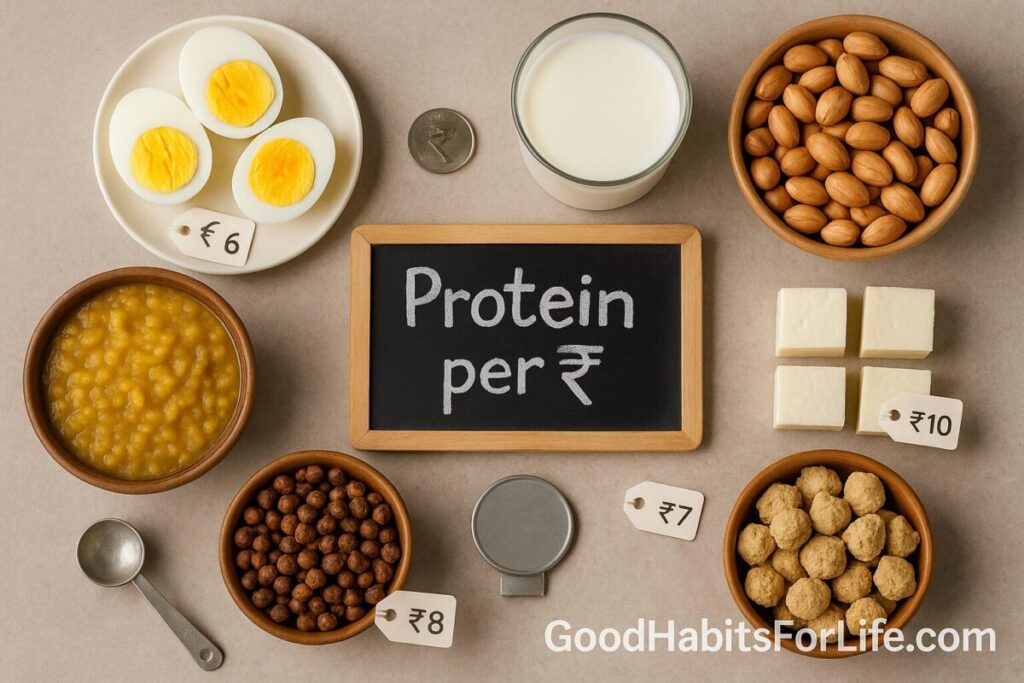
Protein per : Compare Eggs, Dal, Milk & More: Protein-Forward Plan (2025)
Protein per ₹: Eggs vs Dal, Milk & More (2025)
Table of Contents
🧭 What is “Protein per ₹” & Why it Works
Protein per ₹ is a simple value metric: how many grams of protein you get for each rupee you spend. It helps you compare very different foods on one fair scale (e.g., eggs vs dal vs milk vs paneer). You’ll still weigh taste, convenience, and dietary preferences, but this lens keeps your basket high-protein and affordable.
Benefits
-
Budget clarity: Cut guesswork; see which items deliver the most protein for your money.
-
Consistent intake: Hitting daily protein targets supports muscle repair, immunity, and satiety.
-
Quality matters: Combine plant proteins (pulses + cereals) or include dairy/eggs/meat to cover essential amino acids.
✅ Quick Start: Your 20-Minute Shopping & Cooking Plan
-
Pick 4 budget MVPs for this week (e.g., eggs, chana dal, milk, soy chunks).
-
Buy for 7 days: enough for ~80–120 g protein/day for a family of two, ~50–80 g/day for one adult (adjust by body size and goals).
-
Batch cook (60–90 min):
-
Pressure-cook 500 g dal (portion into 6–8 servings).
-
Boil 10–14 eggs.
-
Rehydrate 250 g soy chunks (season + sauté).
-
Set 1–2 L curd (optional) or buy dahi/Greek yogurt.
-
-
Assemble “protein anchors” per meal (20–30 g):
-
Breakfast: 2 eggs + 250 ml milk; or 200 g Greek-style dahi + peanuts.
-
Lunch: 1–1.5 cups cooked dal + 2 rotis + salad.
-
Dinner: 100–150 g soy chunks OR 120–150 g paneer/chicken with veggies.
-
-
Track prices once: Note current local ₹/kg or ₹/pack. Revisit monthly.
🛠️ 30-60-90 Day Protein-Forward Budget Roadmap
Days 1–30 (Starter)
-
Build your Price Sheet (eggs, milk, 3 dals, soy chunks, peanuts, paneer, chicken).
-
Hit ≥1 g/kg/day of protein as a general target (adjust per age/health).
-
Batch-cook weekly; pack 2 protein-forward snacks (e.g., roasted chana, dahi).
Days 31–60 (Upgrade)
-
Add two new proteins (e.g., fish, chickpeas/rajma, tofu).
-
Start “protein per ₹” challenges: replace 1 expensive item with a higher-value swap.
-
Try Greek-style dahi (hung curd) or paneer-lite if watching fat.
Days 61–90 (Mastery)
-
Maintain a running 3-month price trend; shop best-week deals.
-
Consistently hit 20–30 g per main meal.
-
Experiment with high-satiety combos: dal + roti + veg + dahi; egg bhurji wraps; soy-veg stir-fries.
🧠 Techniques & Frameworks (Formulas, Tables, Planning)
Formula 1 — Protein per ₹ (g/₹)
Protein per ₹=Protein per serving (g)Price per serving (₹)\text{Protein per ₹} = \frac{\text{Protein per serving (g)}}{\text{Price per serving (₹)}}
Use your local prices and serving sizes.
Formula 2 — Protein per 100 kcal (g/100 kcal)
Helpful if you’re watching calories. Higher is more protein-dense.
Typical Protein Content (reference values; round numbers)
-
Egg (1 large ~50 g): ~6–7 g
-
Milk (250 ml): ~8 g
-
Dahi/Curd (200 g): ~7–10 g (Greek-style closer to 18–20 g/200 g)
-
Paneer (100 g): ~18 g
-
Cooked dal (1 cup ~180–200 g): ~12–16 g (varies by pulse)
-
Soy chunks (25 g dry, cooked): ~12–15 g
-
Peanuts (30 g): ~7–8 g
-
Chicken breast (100 g, cooked): ~30–32 g
Use labels/IFCT values where available; cooked vs raw will change numbers. For price math, it’s simplest to use protein per serving you actually eat.
Illustrative “Protein per ₹” (example prices — update with your market)
| Food (serving) | Example price | Protein/serving | g per ₹ |
|---|---|---|---|
| Egg, 1 pc | ₹6 | 6.3 g | 1.05 |
| Milk, 250 ml | ₹15 | 8 g | 0.53 |
| Chana dal, 100 g dry (makes ~2–3 servings) | ₹9 | 21 g | 2.33 |
| Moong dal, 100 g dry | ₹13 | 24 g | 1.85 |
| Soy chunks, 100 g dry | ₹12 | 50 g | 4.17 |
| Peanuts, 100 g | ₹14 | 26 g | 1.86 |
| Paneer, 100 g | ₹40 | 18 g | 0.45 |
| Chicken breast, 100 g raw | ₹26 | 31 g | 1.19 |
These are not citywide averages—just a worked example. Replace with your local ₹ to get your true rankings.
How to Build Your Price Sheet (10 minutes)
-
List your top 10 proteins.
-
Note ₹/kg or ₹/pack, and serving size you use.
-
Compute protein/serving (from label/IFCT) and g per ₹.
-
Sort descending by g per ₹.
-
Highlight 4–5 weekly staples and 2 occasional treats.
Weekly Planning Template (copy/paste)
-
Breakfast anchors (pick 2): eggs, Greek dahi, milk, peanut butter toast.
-
Lunch anchors (pick 2): dal + roti; chole/rajma bowls; egg curry; curd rice + peanut podi.
-
Dinner anchors (pick 2): soy-veg stir-fry; paneer bhurji; chicken curry; fish when on sale.
-
Snacks (2/day): roasted chana/peanuts; dahi + fruit; boiled egg.
🎯 Audience Variations
Students:
-
Prioritize dal, eggs, soy chunks, dahi. Use electric cooker + tawa. Keep roasted chana/peanuts for class breaks.
Parents & Families:
-
Batch-cook 3 dals on Sunday; freeze portions. Do egg-paratha or egg rice for quick wins. Pack dahi + fruit for kids.
Busy Professionals:
-
Use Greek-style dahi cups, boiled eggs, paneer cubes, pre-cooked dals mid-week. Calendar a 90-minute cook block.
Seniors:
-
Focus on easy-chew options (dahi, paneer bhurji, soft dals, omelettes). Consider vitamin D & calcium with dairy; stay hydrated.
Teens & Athletes:
-
Aim ≥1.2–1.6 g/kg/day during training cycles. Keep milk + egg or dahi + peanut butter smoothies.
⚠️ Mistakes & Myths to Avoid
-
Only chasing g/₹. Value matters, but so do micronutrients, fiber, and fat quality.
-
Ignoring protein quality. Pair pulses + cereals (dal + roti) to improve amino acid profile; include some dairy/eggs if you eat them.
-
Confusing raw vs cooked weights. Be consistent—compare like with like.
-
Skipping satiety. Ultra-cheap but low-satiety picks can backfire; include veggies and fiber.
-
Thinking “more is always better.” Targets vary by age, health, and activity.
📚 Real-Life Examples & Scripts
Example Day (~110 g protein, budget-friendly)
-
Breakfast: 2 eggs (12 g) + 250 ml milk (8 g)
-
Snack: Roasted chana 40 g (7–8 g)
-
Lunch: Chana dal 1.5 cups (20–24 g) + roti + salad
-
Snack: Dahi 200 g (7–10 g) + fruit
-
Dinner: Soy chunks 120 g cooked (25–30 g) + veg
-
Before bed (optional): 200 ml milk (6–7 g)
Vendor Script (street/mandi):
“Bhaiya, last week chana dal kitne ka diya tha? Agar 2 kg loon to kya rate hoga? Fresh stock kab aata hai?”
Hostel/Roommate Script:
“I’ll do a Sunday batch: 2 dals + boiled eggs + soy. You handle rotis and salad? Let’s split costs 50-50.”
🔧 Tools, Apps & Resources
-
Price sheet in Google Sheets/Notion (track ₹, protein/serving, g/₹).
-
Nutrition databases: IFCT/ICMR tables; FoodData Central for cross-checks.
-
Apps: HealthifyMe, Cronometer, MyFitnessPal (verify Indian entries).
-
Grocery tactics: Co-op buys (5–10 kg dals), loyalty days, festival sales, buy milk in family packs if storage allows.
✅ Key Takeaways
-
Use g per ₹ to compare proteins fairly.
-
Keep 4–5 budget staples (dals, eggs, dahi/milk, soy chunks, peanuts).
-
Hit 20–30 g per meal with simple anchors.
-
Track prices monthly; swap in higher-value items as markets move.
-
Combine pulses + cereals or include dairy/eggs for better protein quality.
❓ FAQs
1) How much protein do I need daily?
General guidance for healthy adults often lands around 0.8–1.0 g/kg/day; athletes or heavy lifters may aim higher (e.g., 1.2–1.6 g/kg/day). Adjust with a professional if needed.
2) Are plant proteins “complete”?
Many plant foods lack one or more essential amino acids. Mix pulses with grains (e.g., dal + roti, rice + rajma) or include dairy/eggs to round out the profile.
3) Is paneer bad for budgets?
Paneer is tasty and convenient but lower g/₹ than dals/soy/eggs in many markets. Use strategically—e.g., once or twice a week.
4) What’s better: raw vs cooked weight for tracking?
Either is fine—be consistent. For shopping math, using servings you actually eat is practical.
5) Are soy chunks safe to eat daily?
Most people can include soy foods regularly. If you have thyroid or other medical concerns, discuss with a clinician.
6) I’m lactose-intolerant—how do I hit protein?
Use pulses, soy (tofu/chunks), eggs, chicken/fish as preferred. Lactose-free milk or hard paneer may be tolerable for some.
7) Can I do high-protein on vegetarian diets?
Yes. Combine dals, soy, dairy, peanuts and plan 20–30 g anchors per meal.
8) What about protein powders?
Useful for convenience, but whole-food proteins are usually cheaper per ₹ and bring extra nutrients. If you use powders, select tested brands.
9) Does higher protein help with weight management?
Higher-protein meals tend to improve satiety and help preserve lean mass during weight loss when calories are controlled.
10) Which dal is “best”?
Choose the dal you enjoy that scores well on your local g/₹ (chana, moong, masoor, urad). Variety = better micronutrient spread.
📚 References
-
ICMR-NIN. Dietary Guidelines for Indians (2020).
-
ICMR-NIN. Indian Food Composition Tables (2017).
-
FAO/WHO. Protein Quality Evaluation (PDCAAS) & later FAO reports on DIAAS.
-
USDA FoodData Central — standard nutrient references for cross-checking foods.
-
Harvard T.H. Chan School of Public Health — Protein: Moving toward healthy choices.
-
Cochrane & major reviews on higher-protein diets, satiety, and body composition.
-
FSSAI “Eat Right India” resources on balanced diets and safe food handling.
-
WHO guidance on healthy diets and macronutrient balance.
(Use the most recent editions/updates available for your region.)
Disclaimer
This article is for general nutrition education and budgeting only and is not medical advice. Consult a qualified professional for personal guidance.