
Progressive Summarization for Busy Learners
Progressive Summarization for Busy Learners
🧭 What & Why
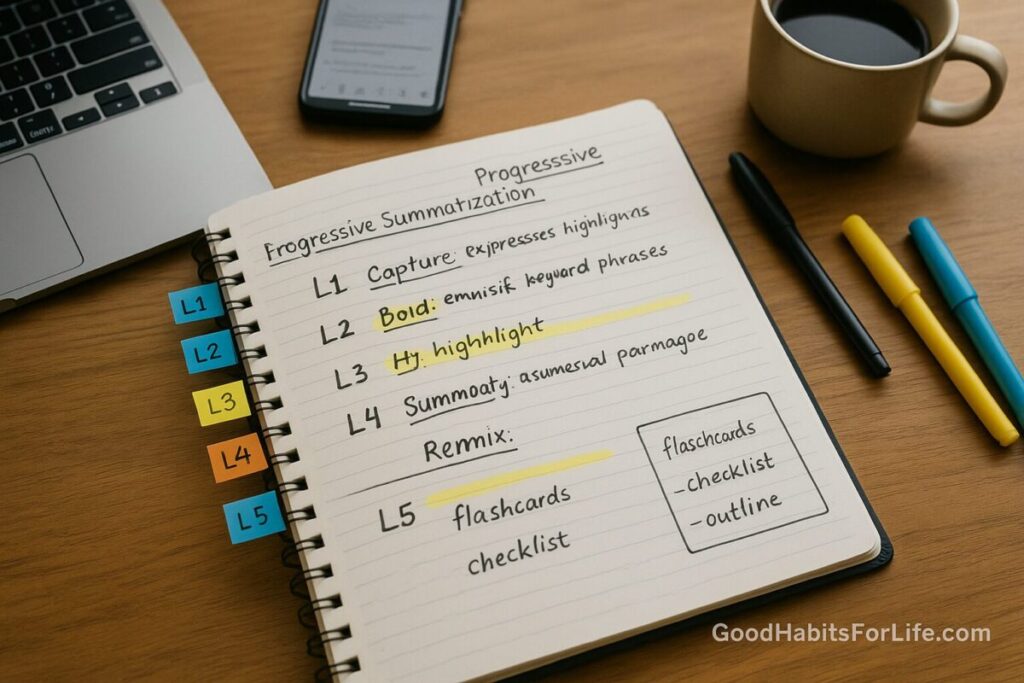
Progressive summarization (PS) is a note-layering method popularized by Tiago Forte. You capture once, then distill the same note in small, opportunistic passes so the most meaningful parts become instantly “glanceable.” The classic five layers:
-
L1 Capture: Raw highlights, clippings, meeting notes.
-
L2 Bold: Emphasize the best lines (keywords, sentences).
-
L3 Highlight: Add a second pass to spotlight only the essential few.
-
L4 Summary: A brief paragraph or bullet summary in your own words.
-
L5 Remix: Turn insights into outputs (flashcards, checklists, outlines, posts).
This approach is documented in Forte’s original essays and book Building a Second Brain. buildingasecondbrain.com+3Forte Labs+3Forte Labs+3
Why it works for learning:
-
Cognitive load: You lighten the burden on working memory by compressing and structuring information, which supports schema formation. PMC+1
-
Generative learning: L4/L5 force you to generate explanations and reorganize ideas—strategies shown to deepen understanding. Cambridge University Press & Assessment+1
-
Retrieval + spacing: L5 outputs and reviews add self-testing and spaced practice—two of the highest-utility study techniques. SAGE Journals+1
✅ Quick Start (Do This Today)
Time needed: ~30 minutes.
-
Pick a home for notes: Obsidian, Notion, OneNote, Evernote, or Google Docs all work. Create a folder “/Learn/” and a tag “#PS”.
-
Choose one source you’re studying (chapter, paper, lecture).
-
L1 Capture (10 min): Paste your notes or import highlights. Keep structure (headings, bullets).
-
L2 Bold (5–8 min): Bold only the lines that truly matter—names, definitions, results, “aha” claims. If everything looks important, nothing is.
-
L3 Highlight (3–5 min): Yellow-highlight the few bolded fragments you’d want to see on a phone screen in 30 seconds.
-
L4 Summary (3–5 min): Write 3–5 bullets in your own words: What problem? What method? What result? Why it matters?
-
L5 Plan (2 min): Decide one output (e.g., 3 recall questions or 5 Anki cards).
-
Schedule reviews:
-
If your target test/usage is 1 month away, schedule the next review 3–6 days from now (≈10–20% of the interval). PubMed
-
🛠️ 7-Day Starter Plan (+30-60-90 Growth)
Day 1 — Set Up & First Pass
-
Install/prepare your note app, create /Learn/ and #PS.
-
Process one source through L1→L4; create 3–5 L5 recall questions.
Day 2 — Retrieval Boost
-
Answer your recall questions without looking, then check answers (testing effect).
-
Add/adjust L4 bullets based on mistakes. SAGE Journals
Day 3 — Second Source
-
Repeat L1→L4 on a new reading. Keep L3 fragments ultra-short.
-
Create interleaved recall: mix questions from Source A & B. PubMed
Day 4 — Spaced Review #1
-
Revisit Day-1 notes (3–6 days later) and refine L4.
-
Promote any recurring ideas to a Concepts page.
Day 5 — Build a Mini-Output
-
Use L5 to draft a 150-word explainer (or 5 slides, or 5 flashcards).
Day 6 — Spaced Review #2
-
Revisit Day-2 notes (spaced) and self-test again.
Day 7 — Weekly Retro (20 min)
-
Tag 3 notes #ready (highly distilled) and archive 1 low-value note.
-
Plan the next week’s sources and review dates.
30-60-90 Roadmap (scale up without overwhelm)
-
30 days: Standardize templates (L1→L5), add keyboard shortcuts for bold/highlight, and automate date-stamped review tags.
-
60 days: Build a Topic Map (index page) linking your most-used L4 summaries. Start small group study using your L5 prompts.
-
90 days: Publish a personal “Field Guide” (your best L4/L5) and run a capstone project (presentation, article, prototype) drawn from PS notes.
🧠 Techniques & Frameworks (Backed by Research)
1) Retrieval Practice (Testing Effect)
Convert L4 bullets into questions and answer from memory before peeking. Retrieval improves long-term retention more than re-reading. Practical rule: 3–5 questions per note page. SAGE Journals+1
2) Spaced Reviews
Schedule short reviews that grow further apart. When planning, use the 10–20% rule: if you want to remember something in T days, schedule the first review around 0.1–0.2 × T. (E.g., T = 30 → 3–6 days). PubMed
3) Interleaving
Mix problem types or topics (A–B–C–A–B–C) during practice to improve discrimination and transfer, even if practice feels harder. Use your PS index to shuffle prompts. PubMed
4) Generative Learning
At L4/L5, summarize, map, teach, or draw. Generative strategies (summarizing, mapping, self-testing, self-explaining, teaching) deepen understanding. Cambridge University Press & Assessment+1
5) Manage Cognitive Load
Keep L3 fragments ultra-short to fit working memory limits and reduce extraneous detail. Design notes to be processed at a glance. PMC
6) Calibrate Highlighting
Unstructured highlighting and unguided summarization are low-utility alone; PS fixes this by layering structure, self-testing, and spacing. cmapspublic2.ihmc.us
👥 Audience Variations
Students:
-
Use PS to turn chapters/lectures into L4 cheat-sheets + L5 practice questions.
-
Interleave topics across weeks (e.g., calculus + physics problem types). PubMed
Professionals:
-
Apply PS to research memos, client briefs, and meeting minutes.
-
L5 outputs: decision trees, checklists, or one-page briefs.
Seniors / Returning Learners:
-
Keep L3 fragments extra short; add larger fonts and ample spacing (reduce cognitive load). PMC
Teens:
-
Limit L1 capture sessions to 20–25 minutes; end each session with 3 L5 questions.
⚠️ Mistakes & Myths to Avoid
-
“I’ll highlight everything.” If >20–25% is bolded, you haven’t decided what’s essential (and you defeat working-memory limits). cmapspublic2.ihmc.us+1
-
“Summarization alone is enough.” Not by itself—combine with retrieval and spacing. cmapspublic2.ihmc.us
-
Skipping L5. Without outputs (questions, flashcards, checklists), you miss retrieval practice. SAGE Journals
-
Processing every note. Don’t apply every layer to every note. Focus on the ones that “resonate” or you’ll burn out. Forte Labs
-
No review schedule. Add review dates when you create L4; use the 10–20% rule as a default. PubMed
💬 Real-Life Examples & Scripts
Example A — From L1 to L4 (research paper)
-
L1: Paste abstract + 3 key results.
-
L2: Bold the result statements.
-
L3: Highlight the one line that explains effect size or main claim.
-
L4 (bullets):
-
Problem: prior studies used short intervals; this one tests months-long spacing.
-
Method: 1,350 participants; varied gaps; test up to 1 year.
-
Result: optimal first review ≈10–20% of the target interval.
-
Why it matters: sets sane defaults for review schedules. PubMed
-
Example B — L5 Output (3 recall Qs)
-
What’s the testing effect and why does it beat re-reading on delayed tests? SAGE Journals
-
Define interleaving and give one benefit on transfer. PubMed
-
What’s a starting rule for spacing the first review? PubMed
Weekly Review Script (10–15 min, calendar reminder):
-
Open the #ready tag.
-
Answer your L5 questions cold; then peek.
-
Promote one note (tighten L3/L4).
-
Archive one note.
-
Plan next review dates.
🧰 Tools, Apps & Resources (brief pros/cons)
-
Obsidian (Markdown, local files): fast linking, plugins; setup learning curve.
-
Notion: great databases/templates; offline and heavy pages can slow you down.
-
OneNote/Evernote: easy clipping; less flexible for plain-text workflows.
-
Google Docs: universal; linking and atomic notes are clunkier.
-
Readwise / Reader: capture highlights; ensure you still do L2–L5 yourself.
-
Anki / RemNote: ideal for L5 cards and spaced repetition.
Tip: Bind shortcuts for Bold and Highlight; create a PS template:
📚 Key Takeaways
-
Layer notes from capture → compression → creation.
-
Pair PS with retrieval practice, spaced reviews, and interleaving for lasting learning.
-
Keep L3 ultra-brief to respect working-memory limits and reduce noise.
-
Don’t process everything—select ruthlessly; schedule reviews as you go.
-
Convert insights to outputs (questions, flashcards, checklists) to close the loop.
❓ FAQs
1) How is PS different from Zettelkasten or Cornell Notes?
PS emphasizes layered distillation of the same note over time; Zettelkasten emphasizes atomic, densely linked notes; Cornell is a structured capture template. You can mix them.
2) How much time should a pass take?
L2/L3 passes are quick—5–10 minutes per note is typical. Save deeper L4/L5 for high-value sources.
3) What if I’m a heavy highlighter?
Channel it into L2 then L3 with strict limits; then force a retrieval step (L5) so highlighting doesn’t become passive. cmapspublic2.ihmc.us
4) How often should I review?
Use the 10–20% rule for your first review; then expand intervals (e.g., 3–6 days → 2–3 weeks → 2–3 months). PubMed
5) Can PS replace flashcards?
PS feeds flashcards: convert L4 bullets into L5 Q→A cards for key facts, while keeping richer L4 summaries for concepts.
6) Does PS work for STEM problem solving?
Yes. Interleave problem types in L5 practice, and summarize solution patterns at L4. PubMed
7) Is summarization actually effective?
Unguided summarization alone is low-utility; PS adds structure, retrieval, and spacing, which are high-utility. cmapspublic2.ihmc.us
8) I get overwhelmed by long PDFs—what should I do?
Start with headings and abstracts for L1; bold only the key claims (L2); one-line L3; then write 3-bullet L4 in your own words.
References
-
Forte, T. “Progressive Summarization: A Practical Technique for Designing Discoverable Notes.” Fortelabs (2017; updated 2022). Forte Labs
-
Forte, T. “Progressive Summarization II: Examples and Metaphors.” Fortelabs (2017; updated 2022). Forte Labs
-
Forte, T. Building a Second Brain. Atria Books (2022). Google Books
-
Dunlosky, J. et al. “Improving Students’ Learning With Effective Learning Techniques.” Psychological Science in the Public Interest (2013). cmapspublic2.ihmc.us
-
Roediger, H. L., & Karpicke, J. D. “Test-Enhanced Learning.” Psychological Science (2006). SAGE Journals
-
Cepeda, N. J. et al. “Spacing Effects in Learning: A Temporal Ridgeline of Optimal Retention.” Psychological Science (2008). PubMed
-
Cepeda, N. J. et al. “Distributed Practice in Verbal Recall Tasks: A Review and Quantitative Synthesis.” Psychological Bulletin (2006). PubMed+1
-
Rohrer, D., & Taylor, K. “The Shuffling of Mathematics Problems Improves Learning.” Instructional Science (2007). uweb.cas.usf.edu
-
Rohrer, D. et al. “The Benefit of Interleaved Mathematics Practice Is Not Limited to Superficially Similar Kinds of Problems.” Applied Cognitive Psychology (2014). PubMed
-
Fiorella, L., & Mayer, R. E. Learning as a Generative Activity: Eight Learning Strategies that Promote Understanding. Cambridge University Press (2015). Cambridge University Press & Assessment
-
Leppink, J. et al. “Cognitive Load Theory: Practical Implications and an Important Challenge.” Perspectives on Medical Education (2017). PMC