
Pomodoro Variations: 30/5/25 for Realistic Days: AI workflows (2025)
Pomodoro Variations: 30/5/25 for Realistic Days: AI workflows
Table of Contents
🧭 What & Why
Definition:
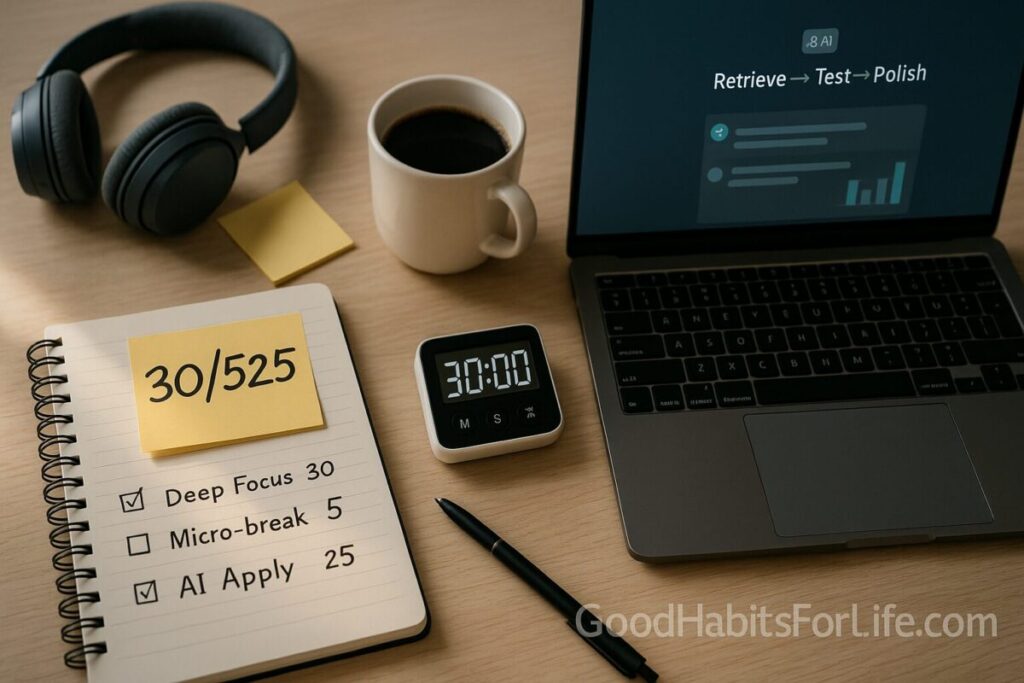
30/5/25 is a realistic Pomodoro variation designed for modern study/work blocks:
-
30 min Deep Focus on a single, high-value objective
-
5 min Micro-break to reset attention and reduce mental fatigue
-
25 min Applied Focus using AI to retrieve, test, produce, or polish outputs (notes, code, drafts, flashcards)
Why it works:
-
The testing (retrieval) effect improves long-term retention when you end a cycle by recalling/checking rather than re-reading. PubMed+2SAGE Journals+2
-
Spacing and distribution across multiple short sessions outperform massed practice for durable learning. PubMed+2laplab.ucsd.edu+2
-
Micro-breaks (≤10 min) can bolster well-being and help performance, especially after demanding bouts. PLOS+1
-
Wakeful rest right after learning consolidates memory—perfect for the 5-minute reset. SAGE Journals+1
-
Early evidence suggests self-regulated or flexible break-taking can match or beat rigid timers for motivation; 30/5/25 is structured yet adaptable. PubMed+1
✅ Quick Start (Do This Today)
-
Pick one priority (one page of notes, 10 practice items, 1 problem set, 1 section of a report).
-
Set a 90-minute window and run three 30/5/25 cycles (or start with just one).
-
Cycle A (30): Deep Focus—no notifications, one tab, one task.
-
Reset (5): stand, breathe, sip water, look away 20 seconds, no phone.
-
Cycle A (25): AI-assisted output/retrieval (quiz yourself, summarise, draft, or polish).
-
Log one metric: # pages solved, # flashcards answered, words drafted, accuracy %.
-
Review in 2–24 hours with another 30/5/25 to leverage spacing.
🧠 The 30/5/25 Cycle (Anatomy)
30—Deep Focus
-
Goal: input + understanding (read/learn/solve).
-
Rules: narrow scope, time-box, visible checklist, distraction blockers.
-
Tip: batch hard examples first while energy is high.
5—Micro-break / Wakeful Rest
-
Goal: reset attention, protect working memory, avoid cognitive drift.
-
Do: walk/stretch, gaze 20 m away, breathe 4-4-6, hydrate.
-
Avoid: doomscrolling, inbox, noisy chats.
25—Applied Focus (AI workflows)
-
Goal: output + retrieval (teach, test, produce).
-
Options:
-
Quiz yourself (short-answer > multiple choice).
-
Create output (outline → draft → refine).
-
Explain back (teach a rubber duck/AI in your own words).
-
Error-driven review (fix what you missed, tag weak spots).
-
🛠️ Habit Plan: 30-60-90 Roadmap
Days 1–30: Install the base
-
Run 1–2 sessions/day (1 session = 1–3 cycles).
-
Track only one metric (e.g., solved items).
-
Build a one-click ritual: timer + focus mode + AI prompt template.
Days 31–60: Scale & personalise
-
Move to 2–3 sessions/day on big days; stay at 1 on light days.
-
Swap 25 (Applied) between retrieval days and production days.
-
Add a spaced review loop (review today’s material tomorrow, then again after 3–7 days). PubMed
Days 61–90: Automate & optimise
-
Use templates (checklists, prompts, rubrics).
-
Add weekly retrospective: success rate, distractions, top bottleneck.
-
Adjust ratios: 35/5/20 for reading-heavy weeks; 25/5/30 for project drafting.
🧪 Techniques & Frameworks (With AI Workflows)
1) Retrieval-First Finisher (RFF)
-
In the last 25, generate 10 recall prompts from your notes and answer without peeking; then compare.
-
AI workflow: “Create 10 short-answer questions from this text; then grade my answers with a brief rationale.”
-
Why: retrieval practice cements learning better than re-reading. PubMed
2) Two-Pass Understanding (TPU)
-
30: skim → mark confusions → re-read key lines.
-
25: ask AI for socratic Q&A on the confusing bits, then write a 150-word “teach-back.”
-
Why: combining comprehension + generative recall builds durable schemas. PMC
3) Spaced Micro-Sets (SMS)
-
Break big topics into 3–5 micro-sets across the week; schedule each for a new 30/5/25.
-
AI workflow: have AI produce 3 escalating practice sets and a spaced plan for the next 7 days.
-
Why: spacing effect beats cramming; performance rises on delayed tests. PubMed
4) Example-Swap Drills (ESD)
-
30: study 2 worked examples.
-
25: ask AI to swap numbers/contexts and quiz you; explain your steps aloud.
-
Why: varied practice improves transfer.
5) Error Tag + Fix (ETF)
-
Keep a “miss log”: when you miss something in the 25, tag it (“formula slip,” “definition fog”).
-
Next session’s 30 opens with those tags; AI generates 1–2 fresh items per tag.
6) Energy-Flexible Breaks
-
Feeling drained? Make the 5 a wakeful rest (eyes closed, no input).
-
Why: even short rest periods can aid consolidation. SAGE Journals
7) Flexible vs Rigid Timers
-
Prefer consistency, not dogma. If in deep flow, let a cycle run longer; if motivation dips, switch tasks inside the 25.
-
Evidence: rigid Pomodoro vs self-regulated breaks show mixed differences in fatigue/motivation; flexibility is fine. PubMed+1
👥 Audience Variations
Students
-
Pair each lecture/topic with two cycles (learn → retrieve).
-
Use AI to convert notes into flashcards and practice questions.
Professionals
-
Make the 25 a shipping block (slide build, email drafts, code commit).
-
Weekly: one strategy session to prioritise 3 rocks; all cycles feed those.
Parents
-
Use family study blocks (everyone does quiet work for 30; 5 break together; 25 for practice/outputs).
-
Keep visual timers so kids see progress.
Seniors
-
Shorter cycles (20/5/20) with gentle movement in the 5; emphasise retrieval games, journaling.
Teens
-
Turn 25 into “teach your future self” videos; AI generates a rubric for clarity and completeness.
⚠️ Mistakes & Myths to Avoid
-
Myth: “Pomodoro must be 25/5.”
Reality: Intervals are adjustable; choose what fits the task and your energy. PubMed -
Mistake: Using the 5 for social feeds.
Fix: Make it input-free (walk, breathe, water). -
Mistake: Re-reading in the 25.
Fix: Retrieve/produce (tests, summaries, outputs). PubMed -
Mistake: Giant, vague goals per cycle.
Fix: One clear outcome (“solve 6 items,” “outline section 2,” “draft intro”). -
Mistake: Skipping spaced reviews.
Fix: Revisit after 1–3–7 days. PubMed
💬 Real-Life Examples & Scripts
For a stats chapter
-
30: read 8 pages; flag 3 sticky points.
-
25 (AI): “Quiz me with 8 short-answer items on hypothesis tests; then show worked solutions.”
For a literature review
-
30: extract 6 key findings into a table.
-
25 (AI): “Turn these notes into a 200-word synthesis paragraph with citations placeholders.”
For coding practice
-
30: follow one tutorial section; build a tiny feature.
-
25 (AI): “Generate 5 unit tests and edge cases for this function; suggest refactors.”
For languages
-
30: read an article; mark phrases.
-
25 (AI): “Create a 12-item cloze test and a 1-minute conversation drill using today’s phrases.”
For exam prep
-
30: work 6 problems.
-
25 (AI): “Find error patterns in my solutions; create 4 new problems targeting those errors.”
🧰 Tools, Apps & Resources
-
Timers: Focus To-Do, Toggl Track, Be Focused, Forest (simple timers, logs).
-
Distraction blockers: Freedom, Focus, Cold Turkey (schedule app/site blocks).
-
Study managers: Notion, Obsidian, Apple Notes (templates for cycle checklists).
-
Flashcards: Anki (spaced repetition scheduler).
-
Task orchestration: Sunsama/Akiflow/Motion (batch cycles into calendar).
-
AI helpers: ChatGPT or similar for retrieval prompts, rubrics, summaries, practice sets (keep prompts saved as templates).
-
Ergonomics: Pomodoro-friendly wrist timer; stand-up cues; blue-light management (for late sessions).
(Pros: quick setup, visibility, automation. Cons: can over-tool—keep it simple and consistent.)
📌 Key Takeaways
-
30/5/25 blends comprehension + rest + retrieval/production—a realistic recipe for busy, modern days.
-
The final 25 is where AI accelerates output, feedback, and spaced review prep.
-
Use flexible timing and tight scopes; track one metric per session.
-
Stack sessions across the week to exploit spacing; end each with retrieval.
❓ FAQs
1) Is 30/5/25 better than classic 25/5?
Not universally—both work. Choose the cadence that fits your task length and energy. Evidence supports breaks, spacing, and retrieval rather than one exact minute ratio. PLOS+2PubMed+2
2) How many cycles per day?
Start with 1–3 cycles (30–90 min). Advanced days: 2–4 sessions separated by hours for spacing. PubMed
3) What should I do in the 5-minute break?
Stand, move, breathe, hydrate, or wakeful rest—avoid screens and new inputs. SAGE Journals
4) How do I use AI without over-relying on it?
Use it for quizzes, rubrics, summaries, re-phrasing, and error analysis—but always attempt first, then compare.
5) Does rigid timing hurt motivation?
Some studies show self-regulated breaks can keep motivation steadier than rigid timers; adapt when needed. PubMed+1
6) Can I extend the 30 if I’m in flow?
Yes. Keep single-task focus; if still productive, let it run and shorten the 25, or push the applied block to the next cycle.
7) How do I fit this into a full day?
Anchor one 90-min session after your highest-energy hour. Add more only if quality stays high.
8) What if my course requires long problem sets?
Use 35/5/20 or 45/5/20; keep the 25 (or 20) for retrieval checks and solution write-ups.
9) How do I track progress?
Log completed outputs (problems solved, words drafted) and accuracy—avoid vanity time metrics.
10) Is there medical risk with intense focus blocks?
For most healthy people, no—but remember to move, hydrate, and rest your eyes; seek professional advice if you have specific health concerns.
📚 References
-
Roediger, H. L., & Karpicke, J. D. (2006). Test-Enhanced Learning (testing effect overview). Psychological Science. https://doi.org/10.1111/j.1467-9280.2006.01693.x PubMed
-
Roediger, H. L., & Karpicke, J. D. (2006). The Power of Testing Memory: Implications for Educational Practice (overview manuscript). Psychnet+1
-
Cepeda, N. J., Pashler, H., Vul, E., Wixted, J. T., & Rohrer, D. (2006). Distributed Practice in Verbal Recall Tasks: A Review and Quantitative Synthesis. Psychological Bulletin. PubMed+1
-
Cepeda, N. J., et al. (2008). Spacing effects in learning: a temporal ridgeline of optimal intervals. Psychological Science. laplab.ucsd.edu+1
-
Albulescu, P., et al. (2022). “Give me a break!” A systematic review and meta-analysis on micro-breaks. PLOS ONE. PLOS+1
-
Dewar, M., et al. (2012). Brief Wakeful Resting Boosts New Memories. Psychological Science. SAGE Journals+1
-
Biwer, F., et al. (2023). Comparing ‘Pomodoro’ breaks and self-regulated breaks (student study). PubMed
-
Smits, E. J. C., Wenzel, N., & de Bruin, A. (2025). Effectiveness of Self-Regulated, Pomodoro, and Flowtime Break-Taking Techniques. Behavioral Sciences. MDPI
-
Pastötter, B., & Bäuml, K.-H. T. (2014). Retrieval practice enhances new learning (forward effect). Frontiers in Psychology. PMC